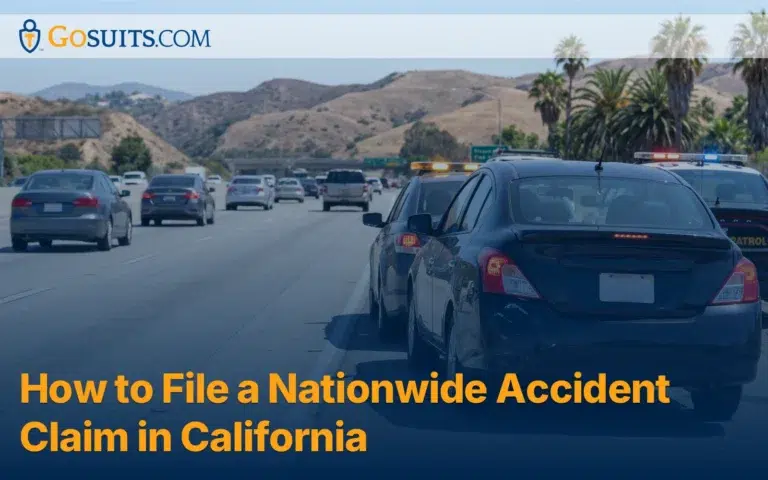
You file a Nationwide accident claim in California by notifying the Nationwide insurer involved, either through your own policy or against the policy of the driver who caused the crash, and by meeting California’s separate reporting rules and filing deadlines. Nationwide publishes a claims line at 1-800-421-3535 and accepts online reports [1]. Reporting a loss starts the insurance process, but it does not stop the clock on a lawsuit. In California, a lawsuit for injuries generally must be filed within two years of the injury under Code of Civil Procedure section 335.1 [7]. Whether you are a policyholder or an injured third party changes your rights, so identify your role first.
This article reads “Nationwide accident claim” as a claim involving Nationwide Insurance after a motor vehicle collision. It covers civil claims only, from the perspective of both injured claimants and the people and insurers who respond to them.
Legal Snapshot
-
Legal Topic: Filing and handling a motor vehicle accident insurance claim with Nationwide in California
-
Case Stage: Pre-lawsuit claim reporting and insurance negotiation
-
Primary Legal Issue: Whether the claim is first-party (your own Nationwide policy) or third-party (against a Nationwide-insured driver), and which California deadlines and claims-handling rules apply
-
Primary Authority: California Code of Civil Procedure sections 335.1 and 338; Vehicle Code section 16000; California Code of Regulations, title 10, sections 2695.5 and 2695.7; Insurance Code sections 790.03 and 11580.2
-
Date Legal Authority Last Reviewed: November 10, 2026 (statutory text should be re-confirmed against official sources before reliance; see review notes)
What Does a “Nationwide Accident Claim” Mean?
A Nationwide accident claim is a request for payment from Nationwide after a crash, and the type of claim depends on whose policy pays. A first-party claim is made under your own Nationwide policy, such as collision, medical payments, or uninsured and underinsured motorist coverage. A third-party claim is made against the liability coverage of a Nationwide policyholder who you believe caused the crash.
Nationwide’s claims page says you can start a claim by logging in to your account, calling 1-800-421-3535, or contacting your agent. It recommends having your name and address, information about any witnesses and injured people, general details of the crash, and your policy number, if available [1]. Some Nationwide policies are issued by affiliated companies, so check the insurer name on the declarations page, and ask the adjuster to confirm the insurer name and claim number in writing.
What Does California Law Say?
California is an at-fault state, so the driver who caused a crash, through their liability insurance, is generally responsible for the harm it caused. Under California’s pure comparative negligence rule, an injured person who was partly at fault can still recover, but the award is reduced by their share of fault (Li v. Yellow Cab Co. (1975) 13 Cal.3d 804). Under Civil Code section 1431.2, when more than one defendant is at fault, each generally pays only its own share of non-economic damages, such as pain and suffering [12].
California also regulates how insurers handle claims. Insurance Code section 790.03 defines unfair claims settlement practices [11], and the Fair Claims Settlement Practices Regulations in title 10 of the California Code of Regulations set response times [3]. Federal law does not govern an ordinary private auto claim of this kind.
What Legal Rules Apply?
|
Rule |
What it requires |
Authority |
|---|---|---|
|
DMV accident report (SR-1) |
The driver, or an insurance agent, broker or legal representative, files within 10 days if anyone was injured or killed, or property damage exceeds $1,000. It is in addition to police or insurer reports. |
|
|
Insurer acknowledgment |
Generally within 15 calendar days of notice of claim |
10 CCR section 2695.5(e) [3] |
|
Accept or deny |
Generally within 40 calendar days of proof of claim, or written notice that more time is needed |
10 CCR section 2695.7(b) [3] |
|
Payment after acceptance |
Undisputed amounts generally within 30 calendar days |
10 CCR section 2695.7(h) [3] |
|
Minimum liability limits |
$30,000 per person, $60,000 per accident, $15,000 property damage on policies issued or renewed on or after January 1, 2025 |
Vehicle Code section 16056 [6] |
Some parts of California’s claims regulations apply differently to first-party claims, made under your own policy, and third-party claims, made against another driver’s policy. Separately, under Vehicle Code section 20008, a driver involved in a crash that injures or kills anyone must make a written report to the California Highway Patrol, or to city police if the crash happened in a city, within 24 hours.
How Does This Apply to a Real Case?
Hypothetical Example (not a GoSuits case): A commuter is rear-ended in stop-and-go traffic on the 405 freeway in Orange County. At the scene, the other driver gives a Nationwide policy number. Over the next two days, the commuter’s neck pain gets worse.
-
Safety and medical care. Call 911 if anyone is hurt and get examined, since symptoms can appear later.
-
Police and DMV reports. Request the crash report, and calendar the 10-day SR-1 deadline if there was any injury or more than $1,000 in damage [5].
-
Identify the coverage route. Use the other driver’s Nationwide policy for a third-party claim, and review your own policy for collision, medical payments, and uninsured or underinsured motorist coverage.
-
Report the claim and get a claim number. Provide the basic facts, such as date, place, vehicles, and insurer information, and keep a dated log of every call and letter. Nationwide’s claims line is the published starting point [1], though a third-party claimant should confirm with the policyholder’s adjuster how intake is handled.
-
Be careful with statements and releases. Before giving a recorded statement, signing a medical authorization, or accepting an offer, speak with a lawyer. Individual circumstances vary, and this article is not legal advice.
-
Track the response times. Note the 15-day and 40-day marks and follow up in writing.
What Evidence Can Matter?
Evidence matters because the insurer decides liability and value from the documents it receives, and no single item proves a claim by itself. Useful categories include:
-
Police or CHP crash reports: they record the officer’s observations, citations, and witness names, though they are not conclusive on fault.
-
Photographs and video: scene, vehicle damage, injuries, and dashcam or nearby surveillance footage, which can be overwritten quickly.
-
Medical records and bills: they link treatment to the crash and support the amount of medical damages.
-
Employment and wage records: they show missed work and any reduced earning ability.
-
Vehicle data and repair estimates: they help show impact severity and property damage.
-
Insurance documents and claim correspondence: declarations pages, claim numbers, and the dated record of who said what.
-
Witness statements and, in disputed cases, accident reconstruction analysis: these can help resolve conflicting accounts.
What Damages or Remedies May Be Available?
Under California Civil Code section 3333, damages in an injury case are meant to compensate for all the harm the wrongful conduct caused [13]. Depending on the facts, an injured person may seek:
-
Past and future medical expenses
-
Lost income and loss of earning capacity
-
Physical pain, mental suffering, and loss of enjoyment of life
-
Vehicle repair or replacement and other property damage
-
Wrongful death damages for qualifying family members in a fatal crash
-
Punitive damages, only in limited cases where the injured person proves by clear and convincing evidence that the other driver acted with oppression, fraud, or malice (Civil Code section 3294)
What is recoverable depends on the applicable law, the available insurance limits, and the facts. Nothing here predicts or guarantees an outcome.
What If the Other Party Disputes Liability?
If Nationwide or its policyholder disputes fault, Nationwide may deny the claim, assign you a share of the fault, or make a low offer. Under Moradi-Shalal v. Fireman’s Fund Ins. Companies (1988) 46 Cal.3d 287, an injured person generally cannot sue the other driver’s insurer for unfair claims practices, so the usual remedy is a lawsuit against the at-fault driver. You can still report claims-handling concerns to the California Department of Insurance, which regulates insurers [14]. The Department’s auto claims mediation program, however, does not apply to claims made against another person’s insurance [14].
In a lawsuit, civil cases are filed in the superior court of the proper county, such as the Los Angeles County Superior Court at the Stanley Mosk Courthouse or the Orange County Superior Court at the Central Justice Center in Santa Ana.
What If Insurance Is Involved?
Insurance is at the center of most Nationwide claims, and the amount of available coverage can limit what you can actually collect. California’s minimum liability limits are $30,000 per person and $60,000 per crash for bodily injury, and $15,000 for property damage, so a serious injury can easily exceed a minimum-limits policy [6]. Check the policy limits listed on the at-fault driver’s declarations page, which the insurer can confirm in writing.
If the at-fault driver is uninsured or underinsured, your own policy’s uninsured and underinsured motorist coverage may respond. Insurance Code section 11580.2 governs that coverage, including its arbitration requirements for disputes between insured and insurer [10]. A person injured in a car crash may also have a personal injury claim against more than one party, and car accident lawyers can review how the policies and parties fit together. Liens from health insurers or medical providers may also affect what a claimant keeps, so settlement terms deserve careful review.
How Long Do I Have to Act?
California sets separate deadlines for reporting a crash, for insurer responses, and for filing a lawsuit. The table below shows the general rules. Negotiating with Nationwide does not extend the deadline to file a lawsuit, so a GoSuits attorney can confirm every deadline that applies to your claim.
|
Item |
General deadline |
Authority |
|---|---|---|
|
SR-1 report to DMV |
10 days after a qualifying crash |
Vehicle Code section 16000 [4] |
|
Personal injury lawsuit |
2 years from injury |
Code of Civil Procedure section 335.1 [7] |
|
Property damage lawsuit |
3 years |
Code of Civil Procedure section 338 [8] |
|
Claim against a public entity (for example a city bus or government vehicle) |
6 months for the government claim |
Government Code section 911.2 [9] |
|
Wrongful death lawsuit |
Generally 2 years |
Code of Civil Procedure section 335.1 [7] |
In limited situations, such as when the injured person is a minor, the deadline to file a lawsuit can be paused, so any exception needs a review of your specific case.
What Should I Do Next?
-
Get medical care and keep every record.
-
Confirm whether anyone was hurt or damage exceeded $1,000, then complete the SR-1 within 10 days if required.
-
Report the loss to the correct Nationwide insurer and write down the claim number and adjuster name.
-
Collect and preserve photographs, reports, bills, and correspondence.
-
Calendar the lawsuit deadlines above.
-
Speak with a California personal injury lawyer before giving a recorded statement or accepting a settlement. Self-representation against an insurer carries real risk.
Related California Personal Injury Resources
For an overview of injury claims in the state, see the California personal injury resources at GoSuits.
Talk With a GoSuits Attorney
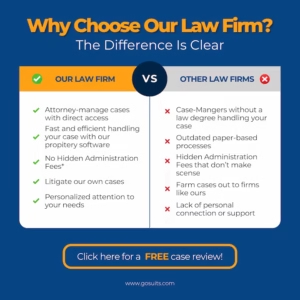
An injury claim can involve medical evidence, insurance issues, liability disputes, and legal deadlines. If you were injured in a California accident involving Nationwide coverage, a GoSuits attorney can review the circumstances of your case and explain your options. You can schedule a free consultation, and GoSuits’ California personal injury team serves clients statewide. Results depend on the facts, and no outcome is guaranteed.
This article provides general legal information, not legal advice, and does not create an attorney-client relationship.
References
-
Cal. Code Regs. Tit. 10, Section 2695.7, Standards for Prompt, Fair and Equitable Settlements – vLex
-
California Vehicle Code Section 16000 – California Legislative Information
-
Report of Traffic Accident Occurring in California (SR-1) – California DMV
-
California Vehicle Code Section 16056 – California Legislative Information
-
California Code of Civil Procedure Section 335.1 – California Legislative Information
-
California Code of Civil Procedure Section 338 – California Legislative Information
-
California Government Code Section 911.2 – California Legislative Information
-
California Insurance Code Section 11580.2 – California Legislative Information
-
California Insurance Code Section 790.03 – California Legislative Information
-
California Civil Code Section 1431.2 – California Legislative Information
-
California Civil Code Section 3333 – California Legislative Information
-
Automobile Claims Mediation Program – California Department of Insurance