































Where do Dallas rideshare crashes tend to happen?
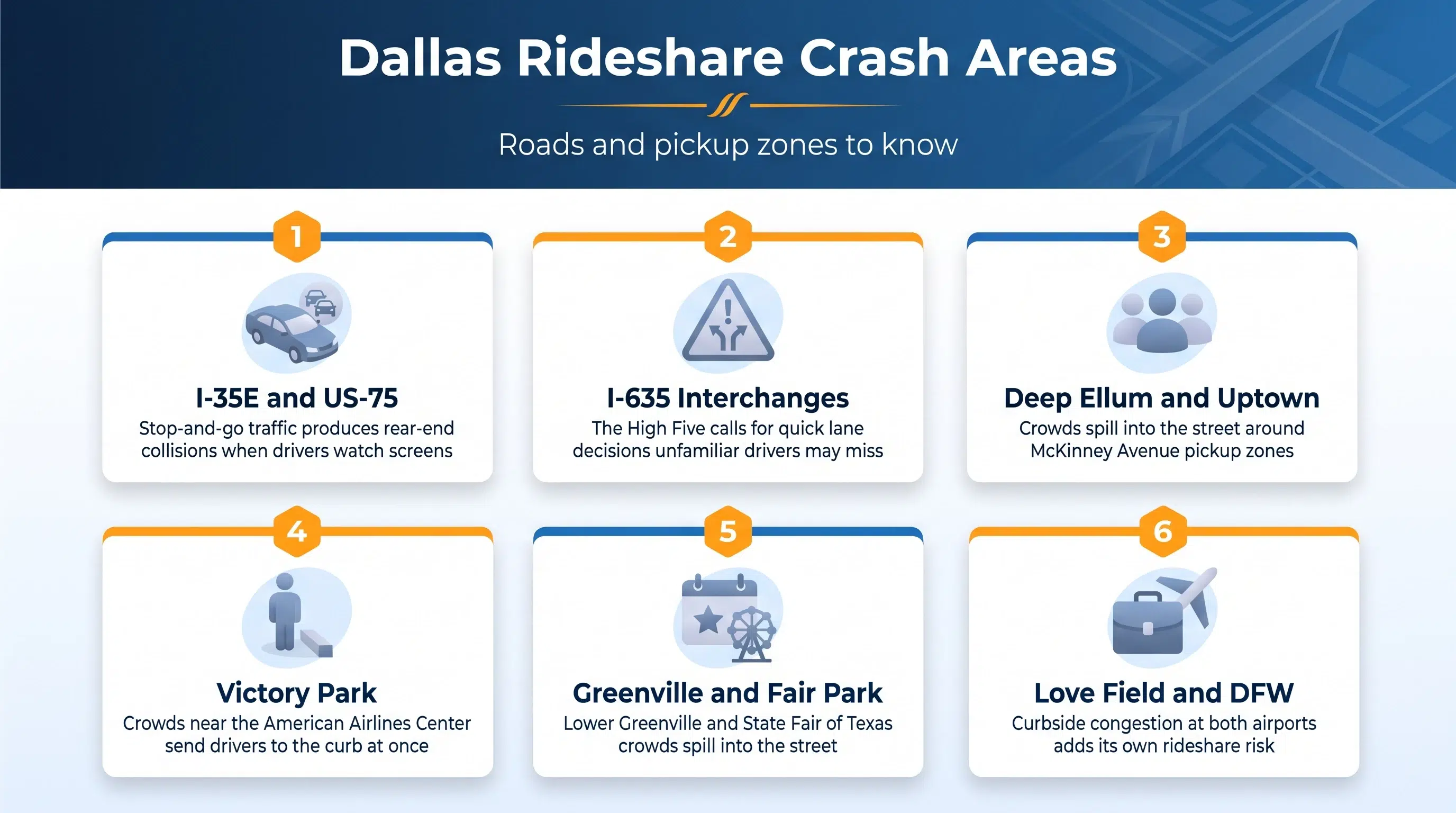
Rideshare drivers in Dallas spend most of their working hours in the same places everyone else drives, and the usual trouble spots show up. On I-35E and US-75, stop-and-go traffic produces rear-end collisions, and a driver watching a navigation screen is slower to react. The I-635 interchanges, including the High Five where I-635 meets US-75, call for quick lane decisions that unfamiliar drivers do not always make safely.
Then there are the pickup zones. Deep Ellum, Uptown’s McKinney Avenue, Victory Park near the American Airlines Center, Lower Greenville and Fair Park during the State Fair of Texas all send crowds into the street at once. Drivers stop suddenly, double park, or pull across a bike lane while a rider climbs in. Love Field and DFW International Airport add their own curbside congestion.
Dallas weather matters too. Spring storms and hail can slow traffic and cut visibility, summer heat stresses tires, and a rare ice event can shut down the freeways and send drivers sliding.
What insurance applies in a Dallas rideshare crash?
Texas Insurance Code Chapter 1954 sets the required coverage by app status. When a driver is logged on but has not accepted a ride, the minimum is $50,000 per person and $100,000 per incident for injury or death, plus $25,000 for property damage. During a prearranged ride, it is $1 million for death, bodily injury and property damage. If the driver’s own policy has lapsed or does not provide the required coverage, the company’s insurance must cover the claim from the first dollar (Insurance Code 1954.054).
Those figures are minimums. Your own uninsured and underinsured motorist coverage and personal injury protection, which apply where Chapter 1952 requires them, may add to what is available. We review all of it before we value a claim.
What about Waymo and other driverless cars in Dallas?
Local news reported in August 2026 that Waymo opened its driverless ride service to the public in Dallas, on city streets within its service area. Highway trips and Love Field rides were not yet offered at the time of that report, and service areas change, so we look at the facts of each crash.
In a collision with one of these vehicles, there may be no human driver to question. The proof lives in sensor recordings, camera feeds and software logs held by the operating company. We send a written preservation demand quickly, because those records are not kept indefinitely. The operating company is generally the party answerable for how the vehicle drove, and other drivers or road hazards may share responsibility too.
Who else might be responsible besides the driver?
A second motorist who caused the crash, the owner of a car the driver borrowed or rented, a manufacturer when a defect is involved, and a public entity when a road hazard played a role are all possibilities. If a City of Dallas or DART vehicle or property was involved, the Texas Tort Claims Act requires written notice within six months, which is far shorter than the standard period. Do not wait on that.
The rideshare company can also be answerable for its own conduct, not only through insurance. How a driver was screened, and whether the company knew of safety complaints, can become part of a case.
How does fault work for a Dallas rideshare claim?
Texas follows modified comparative fault. If a jury assigns you a share of the blame, your compensation is reduced by that share, and if you are more than 50% at fault you recover nothing. Insurers raise this argument often, saying that a passenger got out on the wrong side, that a cyclist was in the wrong spot, or that another driver was the real cause.
Texas requires drivers to carry at least $30,000 in liability coverage per person. For a serious injury, that can run out fast, which is why the rideshare tiers and your own coverage matter so much.
What is a Dallas rideshare injury claim worth?
- Medical costs: Emergency treatment at a Dallas hospital, surgery, therapy and future care.
- Lost income: Time off work and any lasting effect on your ability to earn.
- Pain and disruption: The physical pain, anxiety and activities you cannot do the way you did before.
- Coverage available: The app-status tier, personal policies and uninsured motorist coverage.
- Liens: Hospitals and health plans may ask to be repaid from a settlement. We negotiate those balances to try to leave more with you.
We do not predict a number before the evidence is in. Insurers sometimes offer a quick payment early, before the full injury picture is known, and you should not accept without advice.
How long do you have to file in Dallas County?
Generally two years from the date of the crash for a Texas injury lawsuit, and the same general period applies to a wrongful death claim. The six-month notice rule above is the exception to watch for. Rideshare terms may also include an arbitration clause for passengers. We read them in every case; they do not always apply, and they do not bind people who never agreed to them.
What should you do after a rideshare crash in Dallas?
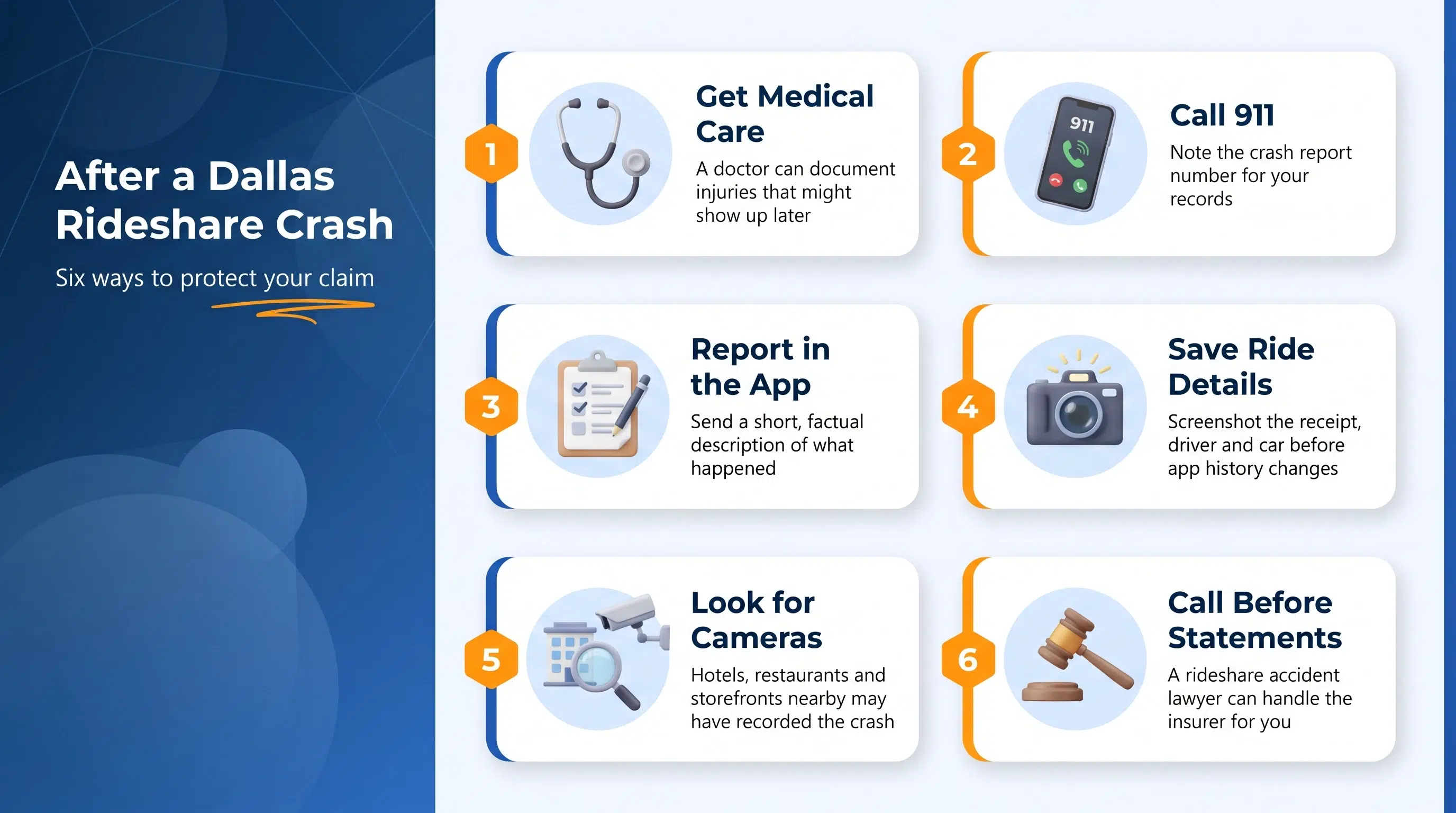
Get medical care today. Dallas has major trauma centers, and a doctor can document injuries that might show up later.
Call 911 and note the report number. Report the crash in the app, briefly.
Save the ride details. Screenshot the receipt, the driver and the car before the app history changes.
Look for cameras. Note any hotel, restaurant or storefront cameras near the crash and tell us right away.
Call before you give a statement. A rideshare accident lawyer can handle the insurer for you.
Related pages: Texas rideshare accident lawyers, our Dallas personal injury team, Uber, Lyft and Waymo accident lawyers, car accident lawyers, truck accident lawyers, pedestrian accident lawyers and wrongful death lawyers. To talk about your own case, schedule a free consultation.