The at-fault driver’s liability insurer usually pays your car accident medical bills, but in one lump sum at settlement or judgment. Until then, bills go to your own coverage: MedPay or PIP, health insurance, Medicare, or Medicaid. Several of those payers can claim repayment from your settlement, and any unpaid balance stays yours.
Medicare and Medicaid (Medi-Cal in California) have a legal right to be repaid from your settlement, and many health plans and MedPay or PIP insurers can claim repayment too. If no coverage pays a bill, you still owe the provider, though some providers agree to wait for payment from your settlement through a lien. Who pays first depends on the state where the crash happened, who was at fault, and the insurance involved.
Legal Snapshot
-
Legal Topic: Who pays medical expenses after a motor vehicle crash, and who is repaid from a recovery
-
States Covered: California, Texas and Illinois (all three are at-fault states)
-
Case Stage: From the first treatment through settlement, lawsuit and lien resolution
-
Primary Authority: Cal. Ins. Code § 11580.2; Cal. Veh. Code § 16056; Howell v. Hamilton Meats & Provisions, Inc. (2011) 52 Cal.4th 541; Cal. Civ. Code §§ 3045.1–3045.6; Tex. Ins. Code § 1952.152; Tex. Prop. Code ch. 55; Tex. Civ. Prac. & Rem. Code § 41.0105; Haygood v. De Escabedo (Tex. 2011); 770 ILCS 23 (Health Care Services Lien Act); Wills v. Foster, 229 Ill. 2d 393 (2008)
-
Date Legal Authority Last Reviewed: Pending attorney review
Does the At-Fault Driver Pay My Medical Bills as They Come In?
Usually not. The law makes the at-fault driver responsible for damages, and medical expenses are part of those damages. But the at-fault driver and their insurer generally do not have to pay your hospital or doctor as the bills arrive. Payment from their side normally comes when the claim settles or a court enters a judgment, which can be months or longer after the crash.
That gap is why the question really has two parts: who pays the provider now, and who is responsible for the cost in the end. The first is usually your own coverage. The second is usually the at-fault driver’s insurer, up to its policy limits.
What Is the Difference Between No-Fault and At-Fault States?
In a no-fault state, your own auto policy pays a set amount of your medical bills through PIP no matter who caused the crash, and lawsuits against the other driver are limited unless the injury meets a threshold. In an at-fault state, the person who caused the crash is responsible for the damages, and you can bring a claim against that driver.
California, Texas and Illinois are all at-fault states. Each one still offers some first-party coverage that can pay bills early, but it works differently in each state:
|
California |
Texas |
Illinois |
|
|---|---|---|---|
|
Fault system |
At-fault |
At-fault |
At-fault |
|
Minimum liability limits |
$30,000 / $60,000 / $15,000 (policies issued or renewed on or after Jan. 1, 2025) |
$30,000 / $60,000 / $25,000 |
$25,000 / $50,000 / $20,000 |
|
Early medical coverage on your own policy |
MedPay, optional |
PIP, included unless you reject it in writing |
MedPay, optional |
|
Uninsured motorist (UM) coverage |
Included unless waived in writing |
Offered; can be rejected in writing |
Required |
|
Billed vs. paid medical amounts |
Limited to amounts paid or owed (Howell) |
Limited to amounts actually paid or incurred (§ 41.0105) |
Reasonable value of the care, including amounts an insurer discounted (Wills v. Foster) |
|
Hospital and provider liens |
Hospital Lien Act, Civ. Code §§ 3045.1–3045.6 |
Hospital lien, Prop. Code ch. 55 |
Health Care Services Lien Act, 770 ILCS 23 |
The minimum liability limits in California, Texas, and Illinois are a floor, not a measure of what an injury is worth. Medical bills from a serious crash can pass the at-fault driver’s policy limit, and when they do, your own underinsured motorist (UIM) coverage or MedPay may help cover the gap.
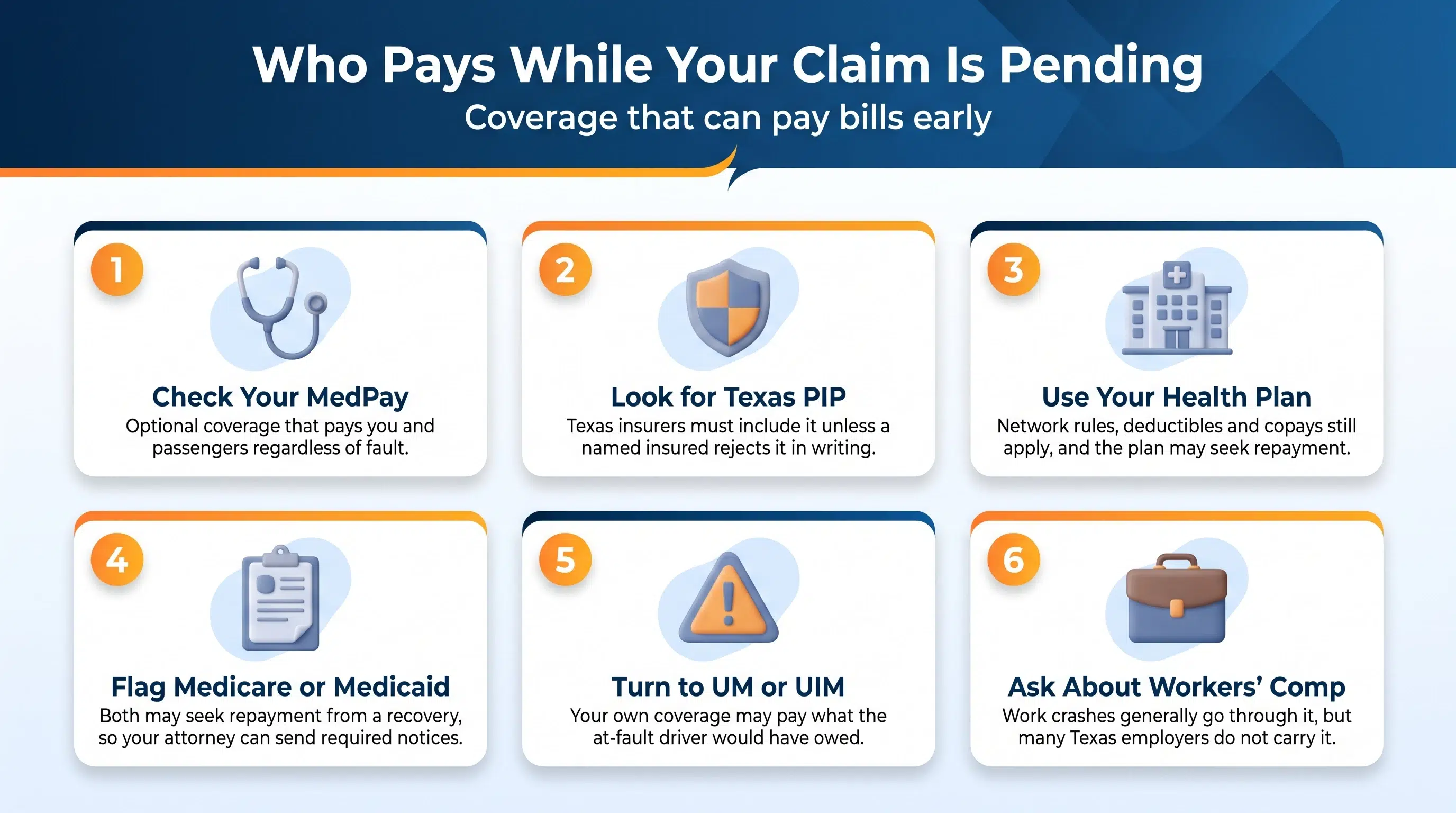
Who Pays My Medical Bills While the Claim Is Pending?
MedPay and PIP
MedPay is optional coverage on your own auto policy. It pays medical bills for you and your passengers after a crash, regardless of fault, up to its limit. In Texas, every auto liability policy must include personal injury protection (PIP) unless a named insured rejects it in writing (Tex. Ins. Code § 1952.152). Texas PIP pays medical bills and part of lost income without regard to fault (§ 1952.155), and most policies carry a $2,500 per-person limit unless you chose more. Because MedPay and PIP are your own coverages, you can use them before anyone decides who caused the crash. Your declarations page shows if you have either one.
Health Insurance
Your health plan generally pays crash-related care under its normal terms: network rules, deductibles and copays still apply. Many plans have a right to be repaid from your settlement, which is called subrogation or reimbursement. How much a plan can recover depends on the type of plan and its written terms. See What Is Subrogation in a Personal Injury Case? and, for California, Can My Health Plan Take Part of My California Injury Settlement?
Medicare and Medicaid
Medicare and state Medicaid programs (Medi-Cal in California) can pay for covered care after a crash, and both have a legal right to be repaid from a settlement, judgment, or award for the injury-related care they paid for. In California, a Medi-Cal member must notify the Department of Health Care Services (DHCS) in writing within 30 days of filing a claim or lawsuit (Cal. Welf. & Inst. Code § 14124.73). No settlement, judgment, or award is final until Medi-Cal has had a reasonable time to perfect and collect its lien (§ 14124.76). If Medicare or Medicaid has paid any of your bills, tell your attorney early so the required notices go out on time.
Uninsured and Underinsured Motorist Coverage
If the at-fault driver has no insurance, or too little, your own UM or UIM coverage may pay what that driver would have owed, up to your limits. Underinsured coverage generally applies after the at-fault driver’s liability limits are used up. UM and UIM claims have their own notice and timing rules in each state.
If You Were Hurt at Work
If the crash happened while you were working, workers’ compensation generally pays the medical care. Texas is different: many Texas employers are non-subscribers that do not carry workers’ compensation, and an injured employee may then have a direct claim against the employer. Work crashes can also involve a third party, such as another driver or a contractor on a construction site.
Will I Have to Pay Anyone Back From My Settlement?
Often, yes. Several payers can have a right to be repaid from your recovery:
-
Hospitals and providers. In California, a hospital that provides emergency and ongoing care can have a lien on your recovery if the statutory notice is given (Civ. Code §§ 3045.1–3045.6). In Texas, a hospital lien is generally limited to the lesser of the reasonable charges or 50 percent of what the injured person recovers (Tex. Prop. Code § 55.004). In Illinois, all health care liens together are capped at 40 percent of the recovery, and no single type of provider can receive more than one-third (770 ILCS 23/10).
-
Health plans with reimbursement or subrogation rights in their plan terms.
-
Medicare and Medicaid, for injury-related care they paid for.
-
MedPay or PIP carriers, if the policy allows reimbursement or an offset.
Liens can often be reviewed for accuracy and, in some cases, reduced. Do not sign a release or accept a settlement until every lien and reimbursement claim is identified, because unpaid liens can follow the money.
Can I Recover the Full Amount the Hospital Billed?
That depends on the state:
-
California: When insurance paid a negotiated rate, past medical damages are limited to the amount paid or still owed, not the higher billed figure (Howell v. Hamilton Meats & Provisions, Inc., 52 Cal. 4th 541 (2011)). Without insurance, you may recover the lesser of the amount incurred or the reasonable value of the care (Bermudez v. Ciolek, 237 Cal. App. 4th 1311 (2015)). A patient treated on a lien basis is generally treated as uninsured (Pebley v. Santa Clara Organics, LLC, 22 Cal. App. 5th 1266 (2018)).
-
Texas: Recovery of past medical expenses is limited to the amounts actually paid or incurred by or on your behalf (Tex. Civ. Prac. & Rem. Code § 41.0105). Under Haygood v. De Escabedo, 356 S.W.3d 390 (Tex. 2011), only evidence of those amounts is admissible at trial.
-
Illinois: You may seek the reasonable value of your medical care, including the full billed amount if you show it’s reasonable (Wills v. Foster, 229 Ill. 2d 393 (2008)). Under the collateral source rule, the defense can’t reduce your award by the amounts an insurer or Medicare or Medicaid discounted or wrote off.
How these rules apply to care provided on a lien basis, or to future care, is a question for an attorney. For California, see Future Medical Costs: How Are They Proven and Discounted?
What If I Was Partly at Fault?
Sharing some blame does not always end a claim, but the rules differ:
-
California uses pure comparative fault. Your recovery is reduced by your percentage of fault, even if you were mostly at fault.
-
Texas uses modified comparative fault. You can recover only if you were 50 percent or less at fault, and your recovery is reduced by your share.
-
Illinois also uses modified comparative fault. You can recover only if you were 50 percent or less at fault, and your recovery is reduced by your share.
Your own MedPay, PIP and health coverage still pay under their terms, whoever was at fault. In California, an uninsured driver generally cannot recover non-economic damages such as pain and suffering, though medical expenses may still be recoverable. See Proposition 213: Can an Uninsured Driver Recover Pain and Suffering?
What If No Insurance Is Available?
If the at-fault driver is uninsured, you have no UM coverage, and you have no health coverage, you may be responsible for the bills while you pursue the at-fault driver directly. Some providers will treat on a lien basis, meaning they wait for payment from the case. If it turns out there is no claim, because the crash was your own fault or the evidence is not there, you may be responsible for the medical bills yourself. Ask providers about payment plans or financial assistance early, before bills go to collections.
No case outcome is guaranteed. Situations like these are where reviewing every possible policy, including policies on other vehicles in your household, can matter most.
What Evidence Helps With Medical Bills?
-
Itemized bills and medical records showing the treatment, its link to the crash, and what was charged, paid and still owed.
-
Explanation of benefits statements from your health plan, MedPay, PIP, Medicare or Medicaid.
-
Declarations pages for every policy that may apply, including liability, MedPay or PIP, and UM/UIM.
-
Lien notices and letters from hospitals, health plans and government programs.
-
The police report, photos and video, which help establish who was at fault.
-
Wage records, if you are also claiming lost income.
How Long Do I Have to Act?
Most personal injury lawsuits must be filed within two years of the injury in California (Cal. Code Civ. Proc. § 335.1), Texas (Tex. Civ. Prac. & Rem. Code § 16.003), and Illinois (735 ILCS 5/13-202). Claims against a government entity move faster: a written claim or notice is generally due within six months in California and six months or less in Texas, and a lawsuit against a local public entity in Illinois generally must be filed within one year. Uninsured motorist claims have their own timing rules. Do not rely on this article to calculate a deadline in your case.
What Should I Do Next?
-
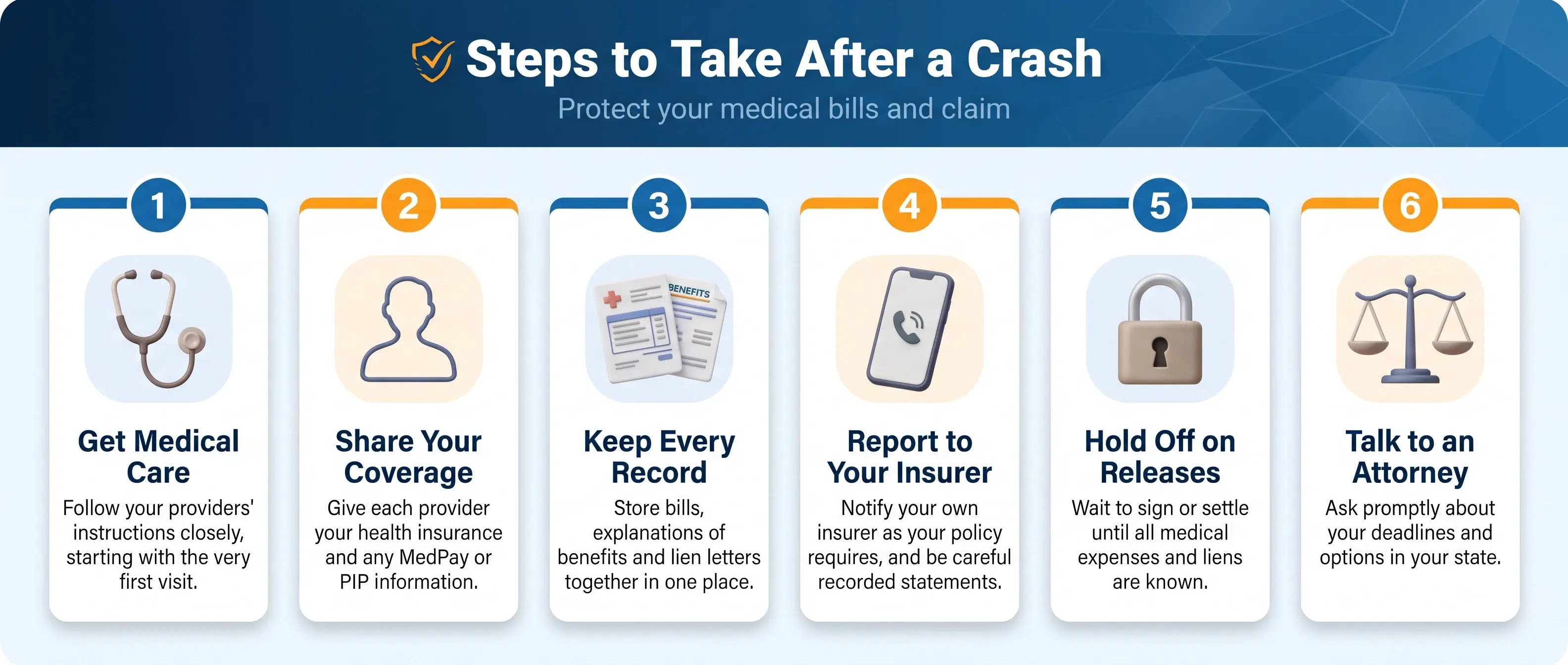
Get medical care and follow your providers’ instructions.
-
Give each provider your health insurance and, if you have it, your MedPay or PIP information.
-
Keep every bill, explanation of benefits and lien letter in one place.
-
Report the crash to your own insurer as your policy requires, and be careful about giving a recorded statement to the other driver’s insurer.
-
Do not sign a release or accept a settlement until all medical expenses and liens are known.
-
Speak with a personal injury attorney promptly about your deadlines and options.
Related Guides
-
Who Will Pay for My Personal Injury Medical Bills? (all injury types, not only car accidents)
-
Multiple People Injured After Driver Plows Through Starbucks in Coppell, Texas
Talk With a GoSuits Attorney
Medical bills after a crash can involve several insurers, liens and deadlines at once. If you were hurt in a car accident in California, Texas or Illinois, you can schedule a free consultation so a GoSuits attorney can review what happened and explain your options. No attorney fee unless we recover; case costs and medical bills may still be owed. This article provides general legal information, not legal advice, and reading it does not create an attorney-client relationship.
References
-
California Insurance Code § 11580.2 – California Legislative Information
-
California Vehicle Code § 16056 – California Legislative Information
-
The Personal Injury Lien Process – California Department of Health Care Services
-
770 ILCS 23/10, Health Care Services Lien Act – Illinois General Assembly
-
Auto Insurance Shopping Guide – Illinois Department of Insurance