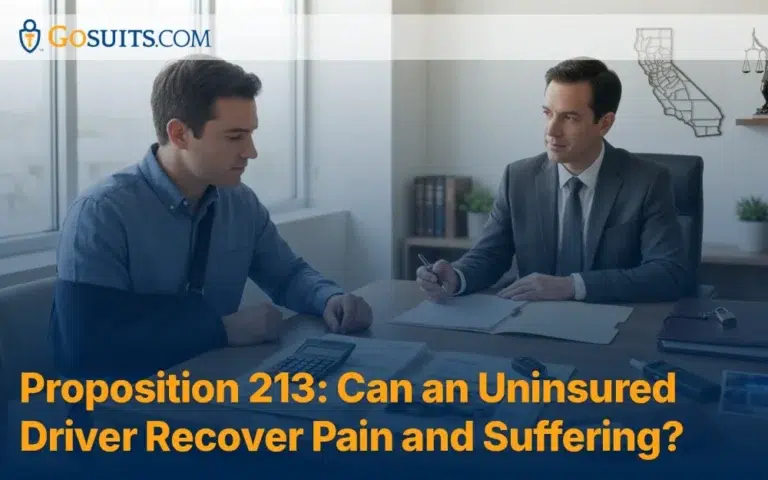
California law bars most uninsured drivers from recovering non-economic damages, pain and suffering, emotional distress, physical impairment, and similar losses after a vehicle accident. That bar comes from Civil Code section 3333.4, enacted by voters in November 1996 as part of Proposition 213, the Personal Responsibility Act of 1996. The statute reaches three categories of injured persons: owners of uninsured vehicles, operators who cannot establish financial responsibility, and drivers convicted of DUI arising from the same incident. [1]
Economic damages medical bills, lost wages, and out-of-pocket losses remain fully recoverable by everyone, including uninsured drivers and DUI offenders. And one critical exception, written into subdivision (c) of the statute, restores the right to non-economic damages for an uninsured owner when the at-fault driver is later convicted of DUI in connection with the crash. [1]
Legal Snapshot
- Legal Topic: Non-economic damages bar for uninsured motorists, DUI offenders, and convicted felons in California vehicle accident claims
- Primary Authority: California Civil Code § 3333.4 (enacted by Proposition 213, Nov. 5, 1996)
- Related Authority: California Civil Code § 3333.3; California Vehicle Code §§ 23152, 23153; California Vehicle Code § 16000 et seq. (Financial Responsibility Laws)
- Key California Supreme Court Decisions: Horwich v. Superior Court, 21 Cal.4th 272 (1999); Day v. City of Fontana, 25 Cal.4th 268 (2001); Hodges v. Superior Court, 21 Cal.4th 109 (1999)
- Jurisdiction: State of California
- Courts Where Cases Are Filed: Orange County Superior Court, Central Justice Center (Santa Ana) for most Orange County civil actions
- Case Stage: Applicable at pre-litigation, negotiation, motion in limine, and trial
- Date Legal Authority Last Reviewed: 2025
What Is Proposition 213, and Why Did Voters Pass It?
Proposition 213 was a statewide ballot initiative approved by California voters on November 5, 1996, under the title The Personal Responsibility Act of 1996. Its stated goal was to prevent uninsured motorists, convicted drunk drivers, and convicted felons from recovering “unreasonable damages from law-abiding citizens.” The voters’ declaration of purpose stated that those who fail to take essential personal responsibility should not be rewarded by the civil justice system. [1]
The measure added two statutes to the California Civil Code. Section 3333.4 addressed vehicle accident claims. Section 3333.3 addressed claims by persons whose injuries were proximately caused by their own commission of a felony. These two statutes work together as the civil liability pillars of Proposition 213. [2]
The California Supreme Court has construed section 3333.4 in several decisions and confirmed that its reach is broad. In Day v. City of Fontana, 25 Cal.4th 268 (2001), the court held that the bar applies not just in lawsuits between motorists, but also in actions against public entities for nuisance and dangerous condition of public property so long as the action arises out of the operation or use of an uninsured motor vehicle. [3]
If you were injured in a vehicle accident in Orange County and questions about insurance coverage are affecting your claim, personal injury lawyers familiar with California’s financial responsibility framework can review your specific situation.
What Are the Three Categories of Persons Who Cannot Recover Pain and Suffering Under Civil Code 3333.4?
Civil Code section 3333.4, subdivision (a), bars recovery of non-economic losses “in any action to recover damages arising out of the operation or use of a motor vehicle” when any of the following applies to the injured person. [1]
Category 1: Drivers Convicted of DUI Arising From the Accident
Subdivision (a)(1) bars non-economic recovery when the injured person “was at the time of the accident operating the vehicle in violation of Section 23152 or 23153 of the Vehicle Code, and was convicted of that offense.” Vehicle Code sections 23152 and 23153 address driving under the influence of alcohol or drugs and driving under the influence causing injury. [4]
The conviction requirement is essential. An arrest, a pending charge, or a charge resolved by a plea to a non-DUI offense does not satisfy this subdivision. The conviction must arise from the same incident in which the claimant was injured not a different DUI offense at a different time. [1]
Category 2: Owners of Uninsured Vehicles
Subdivision (a)(2) bars non-economic recovery when the injured person “was the owner of a vehicle involved in the accident and the vehicle was not insured as required by the financial responsibility laws of this state.” California’s financial responsibility laws, codified beginning at Vehicle Code section 16000, require that owners of vehicles operated on public roads carry minimum liability insurance or satisfy an approved alternative. [5]
This subdivision targets the registered owner who was driving an uninsured vehicle that the owner had title to. The analysis turns on ownership, not on whether the driver was at fault in the accident. An uninsured owner who was struck by a negligent driver still falls within this category, subject to the DUI exception discussed below.
Category 3: Operators Who Cannot Establish Financial Responsibility
Subdivision (a)(3) bars non-economic recovery when the injured person “was the operator of a vehicle involved in the accident and the operator can not establish his or her financial responsibility as required by the financial responsibility laws of this state.” [1]
This provision reaches drivers who did not own the vehicle they were operating but who nonetheless cannot demonstrate financial responsibility. Whether the vehicle’s owner carried insurance that extended to permissive drivers is a key factual question under this subdivision. If the vehicle owner’s policy covered the driver, there may be a basis to establish financial responsibility even if the driver had no personal policy.
What Non-Economic Damages Are Barred?
The statute bars “non-economic losses to compensate for pain, suffering, inconvenience, physical impairment, disfigurement, and other nonpecuniary damages.” California Civil Jury Instructions (CACI) categorize non-economic damages to include physical pain, mental suffering, loss of enjoyment of life, disfigurement, physical impairment, inconvenience, grief, anxiety, humiliation, and emotional distress. All of these categories fall within the reach of the section 3333.4 bar. [6]
If the Non-Economic Bar Applies to Me, What Damages Can I Still Recover?
The bar under Civil Code section 3333.4 is limited to non-economic losses. Economic damages which represent actual financial losses are not restricted by this statute and remain fully recoverable regardless of the claimant’s insurance or conviction status. [1]
Recoverable Economic Damages
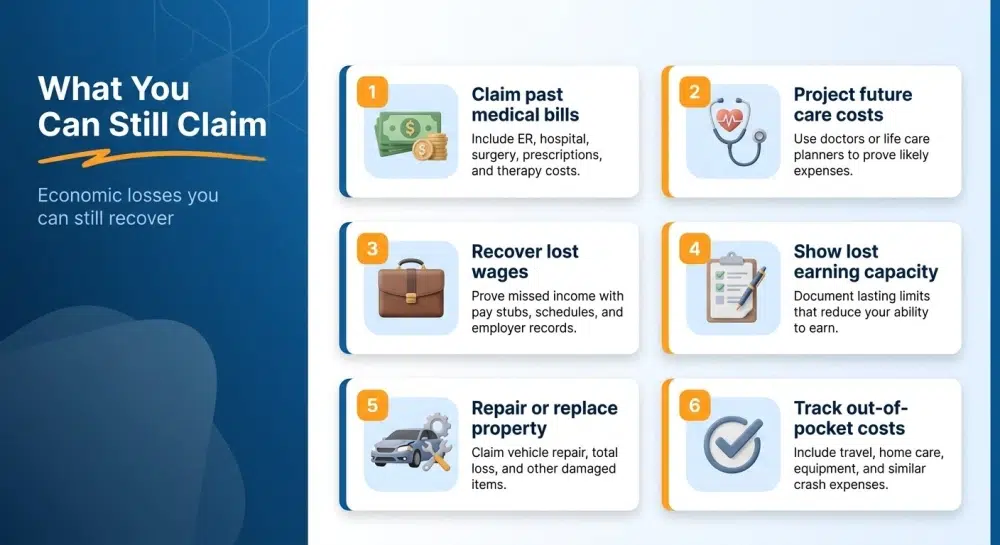
Economic damages in a California vehicle accident claim may include:
- Past medical expenses: emergency care, hospitalizations, surgeries, prescription medications, physical therapy, and follow-up treatment
- Future medical expenses: costs reasonably certain to be incurred, established through treating physician testimony or life care planning
- Lost wages and income: earnings lost because injury prevented the claimant from working
- Loss of earning capacity: where injury permanently reduces the ability to earn at prior levels
- Property damage: repair or replacement of the vehicle and other personal property damaged in the collision
- Other out-of-pocket expenses: transportation to medical appointments, home care, adaptive equipment, and similar costs
For example, a driver who owns an uninsured vehicle and suffers a serious shoulder injury in a rear-end collision on southbound I-5 in Irvine can still pursue a claim for the full cost of surgery, rehabilitation, and weeks of missed work. The Proposition 213 bar removes only the non-economic component, not the economic losses.
California law governing the measure of medical damages involves additional complexity. Under the framework established in Howell v. Hamilton Meats & Provisions, Inc., 52 Cal.4th 541 (2011), the recoverable amount for past medical expenses is generally the amount actually paid or accepted in full satisfaction rather than the higher billed amount, a rule that operates separately from Proposition 213 and applies in all vehicle accident cases. An attorney can advise on how these two separate frameworks interact in a specific claim.
Understanding the full scope of what you may be able to recover after an accident in California is an important first step. Our knowledge base article on pain and suffering damages in California explains how non-economic losses are calculated and proven in personal injury claims where the bar does not apply.
What Is the Exception That Restores Non-Economic Damages After a DUI Crash?
Civil Code section 3333.4, subdivision (c), creates an exception that restores the right to recover non-economic damages for a person who would otherwise be barred under subdivision (a)(2) as the uninsured owner of a vehicle involved in the accident. The exception applies when the at-fault driver “was convicted of driving under the influence of alcohol or drugs in violation of Section 23152 or 23153 of the Vehicle Code, arising out of the same accident.” [1]
In plain terms: an uninsured vehicle owner who was injured by a driver who is later convicted of DUI in connection with that same crash may recover both economic and non-economic damages from the at-fault driver, notwithstanding the general bar imposed by subdivision (a)(2).
What Does the Exception Require?
- The claimant must be the owner of an uninsured vehicle involved in the accident, falling under subdivision (a)(2). The statute’s text ties the exception specifically to that subdivision.
- The at-fault driver must be convicted of a DUI offense under Vehicle Code section 23152 or 23153 not merely arrested, charged, or cited.
- The conviction must arise from the same accident that caused the claimant’s injury, not from a separate incident.
The timing of a civil claim relative to the criminal proceedings matters in practice. If the at-fault driver’s DUI case is still pending when the injured person needs to proceed with settlement negotiations, the exception may not yet be established. Monitoring the criminal docket and coordinating the civil claim with the criminal timeline is a practical consideration that an attorney can address. Cases involving DUI crashes on Orange County corridors like Pacific Coast Highway through Newport Beach or the SR-73 Toll Road frequently involve overlapping criminal and civil proceedings. In those situations, how the civil claim is timed and documented can affect the ultimate recovery.
Where the DUI exception applies, drunk driving accident claims in California may also involve a claim for punitive damages under Civil Code section 3294. Punitive damages are separate from non-economic compensatory damages and are not governed by section 3333.4. Whether a court would find the defendant’s conduct sufficient to support punitive damages depends on the specific facts and requires attorney analysis under California law. [7]
Does Proposition 213 Apply Differently to Passengers and Non-Owner Drivers?
The scope of Civil Code section 3333.4 depends heavily on the injured person’s role in the accident. The California Supreme Court addressed this in Horwich v. Superior Court, 21 Cal.4th 272 (1999), holding that the statute’s bar operates against only those who are “the uninsured owner or operator of a vehicle involved in the accident.” [2]
Passengers Are Generally Not Barred
A passenger injured in a vehicle accident is neither the owner nor the operator of the vehicle in which they are riding. The California Supreme Court in Horwich reasoned that the initiative was aimed at those who “failed to take personal responsibility” under California’s financial responsibility laws. Because a passenger has no obligation under those laws to insure the vehicle, the passenger does not fall within the bar even if the vehicle was uninsured. [2]
This means that a person riding in a friend’s uninsured vehicle who is injured in a crash on I-405 through Costa Mesa can typically pursue a full personal injury claim, including non-economic damages, against an at-fault driver. The passenger’s own lack of personal auto insurance has no bearing on this right.
Non-Owner Drivers of a Covered Vehicle
A driver who does not own the vehicle they are operating, but who was driving with the owner’s permission, may or may not fall within subdivision (a)(3) depending on whether financial responsibility can be established. If the vehicle owner’s insurance policy extended coverage to permissive drivers, and that coverage meets California’s minimum financial responsibility requirements, the non-owner driver may be able to demonstrate financial responsibility and avoid the bar.
In Horwich v. Superior Court, the California Supreme Court analyzed what “injured person” means under the statute and concluded it refers to the person in the position of the plaintiff, the one who is seeking recovery and who must be either the uninsured owner or the uninsured operator. [2] In practice, this means that the insurance coverage status of the vehicle being driven and whether that coverage extends to the driver is a central factual question that must be resolved on the date of loss.
What About the Families of an Uninsured Driver Who Was Killed?
Horwich v. Superior Court also addressed a wrongful death scenario. The court held that surviving family members bringing a wrongful death claim are not barred from recovering non-economic damages (such as loss of care, comfort, and society of the decedent) solely because the decedent was an uninsured driver. The bar under section 3333.4 operates against the “injured person” the decedent but the wrongful death plaintiffs (who are the family members) are distinct plaintiffs with an independent cause of action. Because the family members themselves were not the uninsured owners or operators, the bar does not automatically apply to their wrongful death claim. [2]
This is a nuanced area of law, and the specific facts of each case including whether any family member was also an uninsured owner or operator can affect the analysis. Wrongful death claims in California also have their own procedural requirements under Code of Civil Procedure section 377.60. Cases involving fatal accidents and the Proposition 213 framework require careful legal analysis from the outset. Our Irvine team handles car accident cases throughout Orange County and can assess how California law applies to your situation.
What Should I Verify About Coverage Status Before Assuming the Bar Applies to My Claim?
The application of Civil Code section 3333.4 is not automatic. Several factual questions must be resolved before a person can know whether the bar applies to their claim. Assuming the bar applies without this analysis could lead to accepting less compensation than California law actually allows.
1. Was the Vehicle Insured on the Date of the Accident?
The relevant date is the date of the accident, not the date the claim is filed. A policy that lapsed before the collision leaves the owner-operator within the bar even if new coverage was obtained shortly after the crash. A policy that was active on the date of loss protects the claimant even if the insurer later cancelled it. Obtaining the insurance declarations page and any cancellation or lapse notices covering the specific date of the accident is the first verification step. [5]
2. What Is the Vehicle Owner of Record?
Subdivision (a)(2) applies to the “owner” of an uninsured vehicle. California Vehicle Code section 460 defines owner as a person who holds legal title to the vehicle. The registration and title records for the vehicle involved should be reviewed to establish who the owner was on the date of loss.
3. If You Were Driving Someone Else’s Vehicle, Did That Vehicle’s Policy Cover You?
Many personal automobile policies extend coverage to permissive drivers people the owner permits to use the vehicle. If the vehicle’s owner carried a compliant policy that extended to you as a permissive driver, your financial responsibility under subdivision (a)(3) may be established through that policy. The policy language governs, and it should be reviewed by an attorney.
4. Was the At-Fault Driver Convicted of DUI Arising From This Accident?
Pending charges don’t do it. If the other driver was arrested for DUI at the scene but the case hasn’t gone anywhere yet, the subdivision (c) exception technically hasn’t been met. It’s only once there’s a conviction under Vehicle Code sections 23152 or 23153 that things shift and the uninsured owner can probably recover non-economic damages again. Which is why I’d say watching how the criminal case plays out, and getting certified conviction records when they land, is honestly a big piece of handling the civil claim well.
5. What Was Your Role Owner, Operator, or Passenger?
As discussed above, the statute applies differently depending on whether you were the owner, a non-owner driver, or a passenger. Clarifying your role and confirming the applicable coverage situation as it existed on the date of the accident is the foundation for any Proposition 213 analysis.
These questions often arise quickly after a collision, when insurance adjusters are already investigating. Before providing recorded statements or signing any documents, understanding which category you fall into and whether any exception applies is important.
How Does the Proposition 213 Analysis Work in Practice?
These are hypothetical examples for illustrative purposes only. They are not GoSuits cases and do not represent any actual claims or results.
Example 1: Uninsured Owner with No DUI by At-Fault Driver
A driver owns a vehicle and the insurance lapsed six weeks before a crash. A distracted driver rear-ends them at a red light near the I-405 and Jamboree Road interchange in Irvine. The at-fault driver was not impaired and is not charged with DUI. Under Civil Code section 3333.4, subdivision (a)(2), the injured driver is barred from recovering non-economic damages. However, the injured driver can still pursue a claim for medical bills, lost wages, and vehicle repair costs from the at-fault driver those economic losses remain fully available.
Example 2: Uninsured Owner, At-Fault Driver Convicted of DUI
Same scenario, except the at-fault driver smells of alcohol at the scene, is arrested, and is later convicted of driving under the influence in violation of Vehicle Code section 23152. Under section 3333.4, subdivision (c), the exception is now satisfied. The uninsured owner can recover both economic damages and non-economic damages such as pain and suffering from the convicted DUI driver. DUI-related crashes near Newport Beach and Dana Point have produced exactly this type of overlapping civil and criminal proceeding in Orange County courts.
Example 3: Passenger in an Uninsured Vehicle
A passenger has no personal auto insurance and is riding in a friend’s uninsured car when another driver runs a red light and causes a collision. The passenger is injured. Because the passenger is neither the owner nor the operator of the uninsured vehicle, Civil Code section 3333.4 does not bar the passenger’s non-economic damages. The passenger may pursue a full personal injury claim against the at-fault driver for both economic and non-economic losses.
Example 4: Non-Owner Driver of an Insured Vehicle
An employee is driving a company vehicle with the employer’s permission when the crash occurs. The company’s commercial auto policy covers permissive drivers. Because the driver can establish financial responsibility through the employer’s policy under subdivision (a)(3), the non-economic damages bar does not apply. The driver may pursue a full claim.
What Evidence Can Matter in a Proposition 213 Claim?
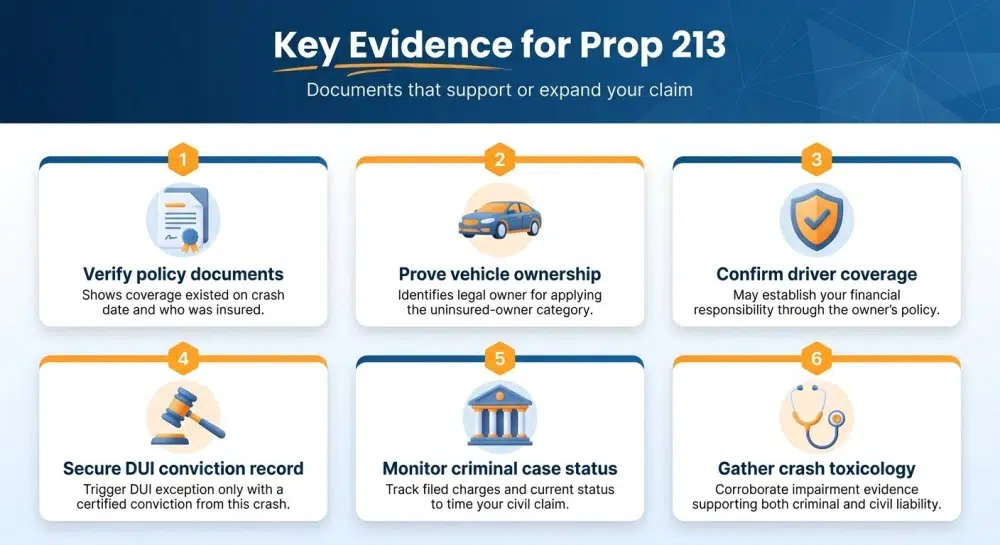
Evidence in cases where section 3333.4 may apply falls into two categories: evidence relevant to the Proposition 213 coverage analysis itself, and evidence supporting the underlying injury claim.
Evidence Relevant to the Proposition 213 Analysis
- Insurance declarations pages and cancellation records: establish whether the vehicle was covered on the date of loss and who the named insured was
- Vehicle registration and title records: confirm who owned the vehicle at the time of the accident
- Policy endorsements covering permissive drivers: may establish financial responsibility for a non-owner operator
- Criminal court records: certified conviction records from a DUI prosecution arising from the incident are necessary to trigger the subdivision (c) exception
- Criminal case docket and arrest records: confirm whether DUI charges were filed and their current status
- Blood alcohol or toxicology reports from the crash: may be relevant to both the DUI prosecution and the civil claim
Evidence Supporting the Injury Claim (Economic Damages)
- Police report and traffic collision report: documents the accident, parties, and initial investigation
- Medical records and treatment records: establish the nature and severity of injuries
- Medical bills and explanation-of-benefits forms: establish past medical expenses
- Employment records and pay stubs: support lost income and wage loss claims
- Photographs of vehicle damage and scene: corroborate the severity of the collision
- Witness statements: may support liability and may be relevant to DUI observations
- Dashcam footage or surveillance video: can establish the manner of the collision and the at-fault driver’s behavior
- Expert testimony from treating physicians or vocational experts: may be necessary to establish future medical costs and loss of earning capacity
No single piece of this stuff proves liability on its own. And it doesn’t lock in a dollar figure either. Whether a given document or photo or statement ends up carrying weight, or even gets admitted at all, comes down to the specific facts of the case, the rules of evidence, and the court’s rulings. That’s just how it works. But collecting and locking down evidence fast after a collision in Orange County where skid marks fade, surveillance footage gets wiped on a short loop, and what a witness remembers at week one is pretty different from what they’ll remember at month six is honestly one of the smartest early moves you can make.
How Long Do I Have to File a Claim in California After a Vehicle Accident?
California Code of Civil Procedure section 335.1 establishes a two-year statute of limitations for personal injury claims. [8] The clock generally begins on the date of the injury. Missing this deadline ordinarily results in the loss of the right to pursue the claim, regardless of whether the Proposition 213 bar applies or not even a claimant with only economic damages must file within this period.
Government Entity Claims: Six-Month Deadline
If the claim involves a government entity a city, county, or state agency California Government Code section 911.2 requires that a government tort claim be filed within six months of the date of the incident before a lawsuit may be initiated. [9] This deadline is substantially shorter than the standard two-year limitation. Cases involving dangerous road conditions maintained by a city or county, such as a poorly marked intersection in Anaheim or a roadway defect near the SR-55 in Santa Ana, may require this accelerated notice. Failing to meet the government claim deadline can be outcome-determinative. [DEADLINE REQUIRES LEGAL VERIFICATION FOR EACH SPECIFIC CLAIM]
Other Potential Deadline Issues
- If the injured party is a minor, the limitations period may be tolled until the minor reaches age 18, subject to specific exceptions
- Insurance policies may impose contractual deadlines for reporting and cooperating with the claim that are separate from the statute of limitations
- Uninsured motorist claims under the injured party’s own policy may be subject to policy-specific notice and arbitration deadlines
Both clocks run at the same time. That’s the thing people miss. You might be waiting on a DUI conviction so the subdivision (c) exception kicks in, but your civil statute of limitations is ticking right alongside it, and the court doesn’t really care what’s happening on the criminal side. So filing the civil claim within the statutory period, even while the criminal case is still pending, is probably the safer play in most situations. How exactly to structure that given the criminal case status? Honestly, that’s an attorney conversation.
What Should I Do After a Vehicle Accident If I Was Uninsured?
The Proposition 213 analysis does not eliminate the ability to pursue a claim after a vehicle accident it narrows certain categories of damages in certain circumstances. The following steps can help protect whatever recovery rights California law allows.
- Seek medical treatment immediately and keep all records and receipts
- Preserve evidence from the scene: photograph the vehicles, the positions after impact, and any relevant road conditions
- Obtain the other driver’s insurance information, vehicle registration, and driver’s license at the scene if possible
- Report the accident to your insurance company as required by your policy, even if the vehicle was not insured
- Obtain a copy of the police or California Highway Patrol collision report
- If the at-fault driver was arrested for DUI, note the arresting agency and ask about the assigned case number; monitor the criminal proceedings through the Orange County Superior Court docket
- Gather your vehicle’s title and any insurance documents showing the effective dates of any prior coverage
- Avoid giving recorded statements to the other driver’s insurance company before understanding how section 3333.4 applies to your claim
- Contact an attorney promptly, given the two-year statute of limitations and the six-month government claim deadline if a public entity is involved
A personal injury claim involving Proposition 213 questions touches on insurance coverage analysis, criminal court timelines, medical evidence, and civil litigation strategy. If you were injured in an accident in Irvine, Newport Beach, Santa Ana, Fullerton, or anywhere in Orange County, contact GoSuits for a free consultation to discuss what your claim may involve.
Can an uninsured driver sue the at-fault driver for anything at all in California?
Yes. Civil Code section 3333.4 bars non-economic damages only. An uninsured driver who falls within subdivision (a)(2) or (a)(3) may still pursue the at-fault driver for all economic losses: past and future medical expenses, lost income, lost earning capacity, property damage, and other out-of-pocket costs. The bar limits what the claimant can recover, not the ability to sue altogether. For background on how Orange County car accident claims are handled more broadly, see our blog post on Orange County car accident claims.
If I was driving my employer’s uninsured vehicle, am I barred from pain and suffering damages?
Short answer: it depends on the insurance. If your employer’s vehicle had a policy that extended coverage to permissive drivers, and that coverage meets California’s minimum financial responsibility rules, you can probably establish financial responsibility through that policy and avoid the subdivision (a)(3) bar. But. If the vehicle was flat-out uninsured, or if the policy excluded employee drivers in your specific setup, the analysis shifts and you might end up barred anyway. Someone really needs to read the actual policy language. That’s where the answer lives.
Does Proposition 213 apply if I was not at fault for the accident at all?
Yes. Fault in the accident is a separate question from the Proposition 213 bar. In Day v. City of Fontana, 25 Cal.4th 268 (2001), the California Supreme Court affirmed that an uninsured motorcyclist was barred from non-economic damages even though the jury found he was not at fault in the collision. The bar under section 3333.4 is triggered by the claimant’s insurance status, not by the claimant’s role in causing the accident. This is one of the most counterintuitive aspects of the statute. For an example of how DUI crash proceedings work near Orange County, see our blog post on the Dana Point Harbor DUI hit-and-run.
Does the Proposition 213 bar apply to my uninsured motorist (UM) coverage?
Civil Code section 3333.4, subdivision (b), provides that an insurer “shall not be liable, directly or indirectly, under a policy of liability or uninsured motorist insurance to indemnify for non-economic losses” for a person described in subdivision (a). This means the bar extends to UM claims as well. An uninsured vehicle owner who falls within subdivision (a)(2) cannot collect non-economic damages through a UM policy on a different vehicle they own, at least not as a general matter. The interaction between Proposition 213 and California’s uninsured motorist coverage rules is a complex area. An attorney should review the specific policies and claim circumstances. For context on how UM coverage works in California, see our blog on the Huntington Beach DUI crash.
What is Civil Code section 3333.3, and is it different from 3333.4?
Civil Code section 3333.3, also enacted as part of Proposition 213, is a separate provision. It applies in any negligence action and bars a plaintiff from recovering any damages economic and non-economic if the plaintiff’s injuries were “in any way proximately caused by the plaintiff’s commission of any felony, or immediate flight therefrom,” and the plaintiff has been duly convicted of that felony. [2] Unlike section 3333.4, which bars only non-economic damages for uninsured drivers and convicted DUI drivers, section 3333.3 bars all damages for convicted felons injured during or in flight from their felony. The two provisions can overlap if an uninsured driver was also committing a felony at the time of the accident, but they are analyzed separately.
Talk With a GoSuits Attorney
Whether Civil Code section 3333.4 bars non-economic damages in your case depends on facts that must be reviewed carefully: the insurance status of the vehicle on the date of loss, who owned the vehicle, whether you were a driver or a passenger, and whether the at-fault driver has been or may be convicted of DUI. Economic damages remain available in all cases regardless of the Proposition 213 bar, and the DUI conviction exception can restore the full scope of recovery in the right circumstances.
If you were injured in a vehicle accident in Irvine, Newport Beach, Santa Ana, Fullerton, or anywhere in Orange County and have questions about what California law allows you to recover, a GoSuits attorney can review your claim and explain your options at no charge. There is no fee unless we recover for you. Schedule your free consultation here.
References and Legal Authorities
- California Civil Code § 3333.4 – California Legislative Information (leginfo.legislature.ca.gov)
- Horwich v. Superior Court, 21 Cal.4th 272 (1999) – Supreme Court of California, via CourtListener
- Day v. City of Fontana, 25 Cal.4th 268 (2001) – Supreme Court of California, via CourtListener
- California Vehicle Code § 23152 (Driving Under the Influence) – California Legislative Information
- California Vehicle Code – Financial Responsibility Laws (§ 16000 et seq.) – California Legislative Information
- California Civil Jury Instructions (CACI) – Non-Economic Damages – Judicial Council of California
- California Civil Code § 3294 – Punitive Damages – California Legislative Information
- California Code of Civil Procedure § 335.1 – Two-Year Personal Injury Statute of Limitations – California Legislative Information
- California Government Code § 911.2 – Government Tort Claim Filing Deadline – California Legislative Information
- California Civil Code § 3333.3 – Felony Bar (Proposition 213, § 2) – California Legislative Information
- Orange County Superior Court – Civil Division – occourts.org
- California Code of Civil Procedure § 377.60 – Wrongful Death Standing – California Legislative Information