
- What are pain and suffering damages in California?
- How is pain and suffering compensation calculated in California?
- What types of harm qualify as pain and suffering in a California personal injury claim?
- Is there a cap on pain and suffering damages in California?
- What factors affect how much California accident injury compensation you may receive?
- How does a plaintiff build a strong pain and suffering claim?
- How does a defendant challenge non-economic damages in California?
- What is the deadline for filing a personal injury pain and suffering claim in California?
- How do Orange County and Los Angeles courts handle pain and suffering cases?
- How GoSuits Irvine Helps Injury Victims Pursue Non-Economic Damages
- References and Resources
What are pain and suffering damages in California?
When someone suffers a physical injury because of another person’s negligence, the financial losses are often the most visible part of what they lose. Medical bills, lost wages, and property damage can be tallied on a spreadsheet. But some of the deepest harm a person endures cannot be reduced to a dollar amount so easily: the sleepless nights, the fear of getting back in a car after a freeway crash on the I-405, the grief over activities they can no longer enjoy, the strain on a marriage caused by chronic pain. California law recognizes all of these losses as compensable, and the legal term for them is non-economic damages, commonly known as pain and suffering damages.
Start with the statute. California Civil Code Section 3333 defines tort damages as “the amount which will compensate for all the detriment proximately caused thereby, whether it could have been anticipated or not.” [1] That’s the wide-open language. The civil jury instructions, CACI No. 3905A specifically, do the work of translating that into something a juror can actually apply, listing the concrete categories that count when they’re calculating pain and suffering compensation. [2] #ref-2
If you have been injured in an accident and are navigating a personal injury claim, understanding how non-economic damages are defined, calculated, and contested in California courts is essential before you accept any settlement or appear before a jury.
How is pain and suffering compensation calculated in California?
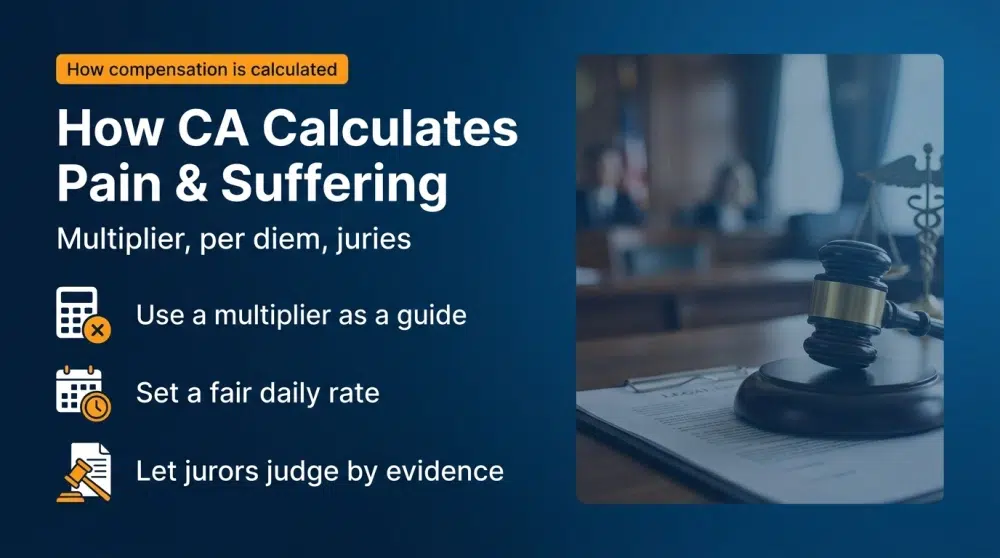
Unlike economic damages such as hospital bills or lost wages, pain and suffering damages in California do not have a fixed formula. California courts recognize two commonly used methods for presenting non-economic damages to a jury, and understanding each one can help you appreciate why the same injury may produce vastly different outcomes depending on the quality of legal advocacy.
The Multiplier Method
Under this approach, an attorney totals the plaintiff’s verifiable economic damages and multiplies that figure by a number typically ranging from 1.5 to 5. The multiplier rises with the severity of the injury, the degree of the defendant’s fault, the duration of the victim’s suffering, and whether the harm is expected to be permanent. For example, a rear-end collision on the SR-73 Toll Road that causes a soft-tissue injury may produce a lower multiplier than a catastrophic crash resulting in permanent nerve damage. Neither the California Civil Code nor the CACI jury instructions mandate the use of a multiplier, but attorneys and insurance adjusters use the method as a starting point during demand letter negotiations.
The Per Diem Method
The per diem method assigns a daily dollar value to a person’s pain and suffering and multiplies it by the number of days the victim has experienced, or is projected to experience, that suffering. Advocates argue that presenting pain and suffering as a daily rate makes it more concrete and easier for a jury to visualize. Defense counsel often challenges this method by arguing there is no principled basis for the chosen daily rate.
What California Juries Actually Do
California CACI No. 3905A instructs jurors to use “their judgment” to determine a reasonable amount, guided by evidence of the nature, extent, and duration of the plaintiff’s injury. [2] Jurors are told there is no fixed standard. The quality and consistency of evidence, including medical records, expert testimony, and the plaintiff’s own testimony about daily life limitations, drives the outcome. Our attorneys at GoSuits have observed that juries respond most powerfully to detailed, coherent narratives that connect specific injuries to specific life disruptions, rather than abstract numerical arguments alone.
If you want to understand how to maximize your California accident injury compensation, reviewing our knowledge base article on what are the different types of personal injury damages can give you a clearer picture of the full landscape of recoverable losses.
What types of harm qualify as pain and suffering in a California personal injury claim?
California law recognizes multiple categories of non-economic harm. The CACI jury instructions list the following categories under the umbrella of pain and suffering: [2]
- Physical pain and discomfort, both past and reasonably certain to be experienced in the future
- Mental suffering and emotional distress, including anxiety, fear, humiliation, and grief
- Loss of enjoyment of life, meaning the inability to engage in activities that once brought pleasure
- Disfigurement and physical impairment, including visible scarring
- Inconvenience, such as limitations on everyday activities like driving, cooking, or caring for children
- Grief and sadness arising from a catastrophic injury
The Legal Information Institute at Cornell Law School defines pain and suffering as “the physical discomfort and emotional distress that are compensable as noneconomic damages,” noting that it encompasses “pain, discomfort, anguish, inconvenience, and emotional trauma that accompanies an injury.” [3]
Personal injury lawyers who handle cases in Orange County and across the Los Angeles basin routinely encounter clients who underestimate the value of these categories, often because they feel uncomfortable placing a dollar amount on something as personal as grief or fear. California law does not require you to minimize those feelings for a jury. It requires you to document and present them clearly.
Is there a cap on pain and suffering damages in California?
For most personal injury cases in California, including car accidents, truck crashes, premises liability claims, and product liability actions, there is no statutory cap on non-economic damages. A jury may award whatever amount the evidence supports and the jurors believe is fair under the instructions they receive. [1]
This distinguishes California from states that have enacted blanket limits on pain and suffering awards. California’s approach reflects the state’s longstanding policy that injured plaintiffs should be fully compensated for all harm they suffer, not just the financial losses that are easiest to measure.
However, California does limit non-economic damages in one category of cases unrelated to the scope of this article. In the general personal injury context, including auto accidents on the I-5, slip-and-fall incidents at commercial properties in the Irvine Spectrum, and construction accidents, juries retain full discretion over the size of non-economic awards.
Punitive or exemplary damages are a separate matter. Under California Civil Code Section 3294, a plaintiff may recover punitive damages when they prove by clear and convincing evidence that the defendant acted with malice, oppression, or fraud. [4] Punitive damages are designed to punish and deter, not merely to compensate, and they go beyond pain and suffering compensation in both purpose and calculation.
What factors affect how much California accident injury compensation you may receive?
Several variables influence the eventual value of non-economic damages in a California personal injury case. These factors matter at every stage, from initial settlement negotiations to trial at the Orange County Superior Court or the Los Angeles County Superior Court.
Severity and permanence of the injury
Injuries that cause permanent disability, chronic pain, or disfigurement typically produce significantly higher non-economic damage awards than injuries that heal completely within a few months. A spinal cord injury suffered in a multi-vehicle crash near the I-405 and I-5 interchange may produce a substantially different non-economic award than a sprained wrist that resolved within six weeks.
Strength and consistency of medical evidence
Gaps in medical treatment can undermine a pain and suffering claim. Insurers and defense attorneys argue that if a plaintiff did not seek consistent medical care, their pain must not have been as significant as claimed. Documenting every visit, every prescription, and every physical limitation contemporaneously is critical.
Comparative fault
Pure comparative negligence. That’s California’s rule. The basic idea is simple enough: if a jury thinks you share some of the blame, your award shrinks by that exact percentage. [5] So picture a 405 Freeway pileup where the jury says you’re 20 percent at fault and the total damages come in at $500,000. You’d actually take home $400,000. The reduction hits everything, by the way, the medical bills side and the pain and suffering side alike.
Quality of documentation and presentation
Pain journals, photographs documenting visible injuries over time, testimony from family members about changes in the plaintiff’s daily life, and consistent statements to treating physicians all help establish the depth of non-economic harm. The more concrete and consistent the record, the harder it is for a defense attorney to argue that suffering is exaggerated.
Defendant’s conduct and resources
Reckless behavior moves the needle. If a defendant blew through a red light at speed in downtown LA, or got behind the wheel impaired on the SR-55, jurors tend to notice, and that moral weight quietly seeps into the verdict, even when the case is technically about compensatory damages and not punitive ones. And then there’s the practical side. The defendant’s insurance limits and what they actually own set the real ceiling, no matter what a jury thinks the case is worth.
Venue and jury pool
Juries in different California counties have different characteristics. Cases tried at the Central Justice Center in Santa Ana and those tried at the Stanley Mosk Courthouse in Los Angeles may produce different verdicts even for factually similar injuries, reflecting differences in the local community’s experiences with injury, economic hardship, and corporate defendants.
How does a plaintiff build a strong pain and suffering claim?
Whether you are injured in a rear-end collision on the Newport Coast or in a pedestrian accident near Anaheim, the steps you take in the days and weeks following the incident shape the value of your California pain and suffering compensation claim.
Seek immediate and consistent medical care
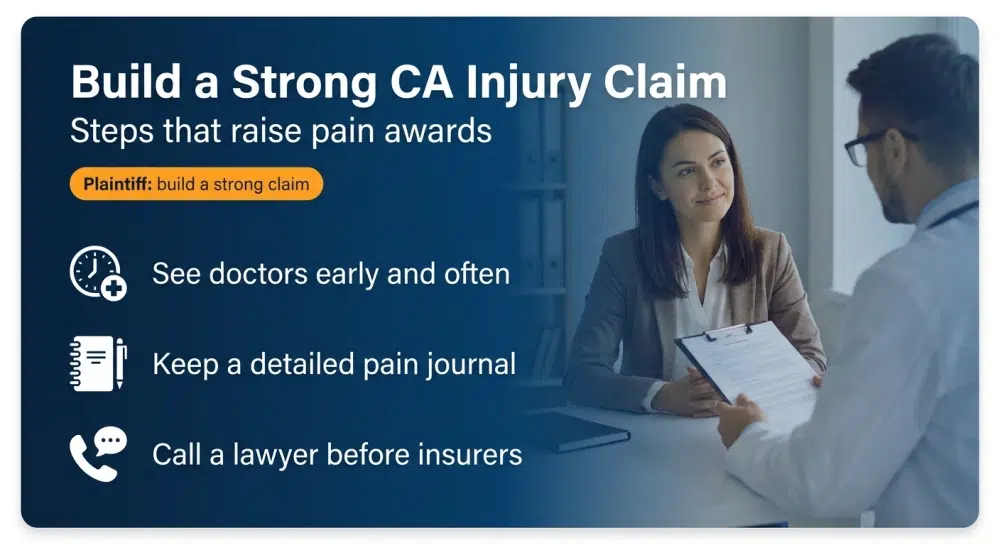
A treating physician’s notes are among the most powerful forms of evidence in a non-economic damages case. Every time you describe pain, limitation, or emotional distress to your doctor, that contemporaneous record becomes part of your legal file. Delays in seeking treatment invite skepticism from adjusters and juries alike.
Keep a detailed pain journal
Documenting day-to-day limitations, pain levels, activities you could not complete, and emotional states creates a private record that can be disclosed during litigation or used by your attorney to craft compelling deposition testimony and trial narratives.
Preserve evidence of lifestyle impact
Photographs of visible injuries, text messages expressing pain or limitations to family members, and records of canceled plans, missed events, or abandoned hobbies all support the loss-of-enjoyment-of-life component of your claim.
Work with personal injury lawyers before speaking to insurers
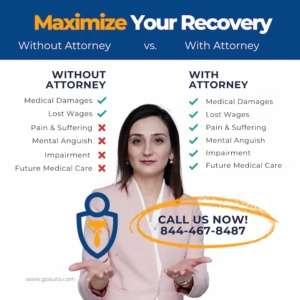
Here’s something most injury victims don’t realize. Insurance adjusters are trained, professionally trained, to get you talking in ways that make your injuries sound less serious than they are. Talking to personal injury lawyers before you give any recorded statement is basically a guardrail, it keeps you from accidentally saying something that hurts your own case. And in California specifically? It matters even more. Pure comparative fault is unforgiving, and even a tiny admission of partial blame chips away at what you can recover.
If you have been injured and want to understand how a skilled legal team evaluates and pursues your case, a consultation with Irvine personal injury lawyers is a critical first step, particularly before you sign any release or accept a settlement offer.
How does a defendant challenge non-economic damages in California?
Understanding how the opposing side approaches non-economic damages helps plaintiffs and their attorneys prepare stronger cases. Defense strategies in California pain and suffering claims commonly include the following.
Challenging the severity or causation of the injury
Defense attorneys often retain medical professionals to conduct independent medical examinations and testify that a plaintiff’s ongoing symptoms are exaggerated, pre-existing, or caused by something other than the defendant’s conduct. This makes the plaintiff’s treating physician’s documentation especially important.
Disputing consistency of treatment
If a plaintiff missed medical appointments, stopped treatment prematurely, or failed to follow physician instructions, defense counsel will argue that the plaintiff’s suffering was not as severe as claimed or that the plaintiff failed to mitigate their damages.
Arguing comparative fault
In California, any evidence that the plaintiff contributed to the accident, whether through distracted driving, jaywalking, or failure to wear a seatbelt, can reduce the defendant’s proportional liability under the pure comparative negligence rule. [5]
Challenging the per diem or multiplier presentation
Defense counsel frequently argues to jurors that no principled basis exists for the daily rate or multiplier a plaintiff’s attorney proposes, urging the jury instead to rely only on the medical evidence and their own common sense under CACI No. 3905A. [2]
Offering early low settlements
Insurance companies sometimes approach injured victims quickly with settlement offers intended to resolve claims before the full extent of injuries and suffering is known. A claimant who accepts an early settlement may waive the right to recover additional compensation even if symptoms worsen or new conditions emerge.
Victims who retain Los Angeles personal injury lawyers before engaging in settlement discussions protect themselves from these tactics and can negotiate or litigate from a position of informed strength.
What is the deadline for filing a personal injury pain and suffering claim in California?
California law imposes strict deadlines on personal injury claims. Under California Code of Civil Procedure Section 335.1, the general statute of limitations for personal injury claims is two years from the date of injury. [6] Missing this deadline typically results in permanent loss of the right to pursue compensation, regardless of how strong your underlying claim may be.
Several exceptions exist that can toll or extend this deadline:
- Discovery rule: When the plaintiff did not know, and could not reasonably have discovered, that an injury occurred or was connected to the defendant’s conduct, the two-year period may begin running from the date of discovery rather than the date of the act or omission.
- Government defendants: Claims against government entities, including cities, counties, and state agencies, typically require filing a government tort claim within six months of the incident before a lawsuit may be filed. [7]
- Minors: When the injured party is a minor, the limitations period is generally tolled until the minor turns 18, subject to specific exceptions.
- Wrongful death: Surviving family members pursuing a wrongful death claim have two years from the date of the decedent’s death to file a lawsuit, which may differ from the date of the underlying accident.
The statute of limitations in California is a hard line. Miss it and the case is over before it starts. That’s why getting personal injury lawyers involved early actually matters, because preserving evidence, finding witnesses, and hitting procedural deadlines all take real time, and the longer you wait the weaker the eventual case tends to be. A wrongful death claim layered on top makes things trickier, the legal timelines start running parallel and they need careful coordination so nothing slips through.
How do Orange County and Los Angeles courts handle pain and suffering cases?
Where the case actually gets filed depends on the county. In Orange County, personal injury cases go through the Orange County Superior Court, and the Central Justice Center in Santa Ana is basically the workhorse civil courthouse for the bigger personal injury matters. [8] Up in LA County, the filings land at the Los Angeles County Superior Court. The Stanley Mosk Courthouse handles civil cases coming out of downtown Los Angeles. [9]
Both courts apply the same substantive California law governing non-economic damages, but local rules, judicial temperaments, and jury pool demographics create meaningful differences in litigation strategy.
Orange County cases
Orange County roads are brutal at rush hour, probably some of the most congested in the state. The SR-55, the I-405, and the SR-73 Toll Road carry enormous daily commuter volumes through Irvine, Costa Mesa, Newport Beach, and Santa Ana, and the constant stop-and-go on those corridors produces rear-end crashes and merge-collision scenarios that drive a big chunk of the personal injury pain and suffering claims I see come through. Juries here are something else worth understanding. They’re drawn from a wide spread of communities, and cases tend to resonate when the medical evidence is well-organized and the testimony actually rings true.
Los Angeles cases
Driving in LA isn’t just driving. The I-405, I-5, US-101, and I-10 generate vehicle volumes that are honestly hard to picture if you haven’t been stuck in them, and they generate corresponding crash risks to match. The jury side is its own challenge. LA County’s jury pool is one of the most diverse in the country, so attorneys really have to think about how evidence lands and how witnesses come across. And the big verdicts that have come out of LA courts? Those have effectively set the benchmarks the rest of California looks at when valuing catastrophic injury claims.
In both jurisdictions, early and proactive legal representation, from evidence preservation to filing, dramatically improves the quality of a pain and suffering case.
How GoSuits Irvine Helps Injury Victims Pursue Non-Economic Damages
Pain and suffering damages aren’t a side note. They’re often the most consequential piece of a California personal injury claim, and they’re almost always the most contested too. Presenting them well takes a few things working together, detailed evidence gathering, a narrative that actually hangs together, and real advocacy whether the case lands in mediation, arbitration, or in front of a jury. That’s the combination GoSuits brings for injury victims across Irvine, Orange County, Los Angeles, and beyond.
Technology-driven case management for faster results
Most personal injury firms aren’t doing this. GoSuits runs on proprietary software built from the ground up for personal injury work, and the platform handles deadlines, evidence organization, and documentation in a way that genuinely keeps things from slipping. While a lot of firms still depend on manual processes and case managers acting as middlemen, we let the technology absorb the administrative load. That way our attorneys spend their time on the part of the job that actually matters, the case itself.
Direct attorney access for every client
Every GoSuits client is assigned a designated attorney, not a case manager or paralegal who filters communications. You have direct, unfettered access to your attorney throughout the life of your case. This structure keeps you informed, reduces the chance of miscommunication, and means that the person making decisions about your case is the same person you can call with questions.

A record of results across California
Our attorneys have 30 years of combined experience handling personal injury claims, including cases involving car accidents, truck crashes, rideshare collisions, workplace injuries, construction accidents, and wrongful death claims. We have taken cases to trial and understand what juries respond to, which makes us more effective negotiators as well. You can review our record of results for clients across our prior cases page.
Our practice areas span the range of personal injury claims. Whether you are pursuing non-economic damages after a crash on the I-405, a product failure, a slip-and-fall at a property in the Irvine Spectrum, or a workplace injury, our team evaluates every recoverable category of loss. You can learn more about the full scope of what we handle on our practice areas page.
Trial experience as a negotiating advantage
Insurance companies and defense attorneys know which law firms will actually go to trial and which ones will settle at any price to avoid the courtroom. Our attorneys’ trial experience is not merely a credential; it is a practical tool. Defendants and their insurers assess settlement offers differently when they know your legal team is prepared to take the case in front of a jury at the Central Justice Center in Santa Ana or the Stanley Mosk Courthouse in Los Angeles.
Free consultation for injury victims in Irvine and Los Angeles
If you or a family member has been injured and you want to understand the full value of your claim, including pain and suffering compensation you may not have considered, we invite you to speak with a member of our legal team. The consultation is free, there is no obligation, and you can learn more about who we are and how we work on our about us page and our our attorneys page.
To speak with a GoSuits attorney about your California personal injury claim, schedule a free consultation today.
References and Resources
- California Civil Code Section 3333 – Measure of Damages for Tort – California Legislative Information
- California Civil Jury Instructions (CACI) – Judicial Council of California
- Pain and Suffering – Legal Information Institute, Cornell Law School
- California Civil Code Section 3294 – Exemplary Damages – California Legislative Information
- California Civil Code Section 1714 – Comparative Fault – California Legislative Information
- California Code of Civil Procedure Section 335.1 – Statute of Limitations for Personal Injury – California Legislative Information
- California Government Code Section 911.2 – Government Tort Claims Deadline – California Legislative Information
- Orange County Superior Court – Civil Division – occourts.org
- Los Angeles County Superior Court – Civil Division – lacourt.org
- California Courts – The Judicial Branch of California – courts.ca.gov
- California Civil Code Section 3281 – Compensatory Relief – California Legislative Information
- Civil Cases – United States Courts – uscourts.gov