Yes, a police report can affect how an Illinois injury claim is investigated and evaluated because insurers may review it for details about the crash, the people involved, witness information, citations, and statements made at the scene. However, a police report does not automatically determine who was at fault, and an injured person may still pursue a claim even when no report was filed.
After a crash, accident victims often face questions about medical bills, insurance communications, and whether an unfavorable or incomplete report could affect their ability to recover compensation.
A police report can provide important details about the incident, including officer observations, citations, witness information, and accident conditions, but it is only one part of the overall evidence. Other factors, such as photographs, medical records, witness statements, and additional investigation, may also affect how an Illinois injury claim is evaluated.
Key Takeaways
- A police report can affect an Illinois injury claim because insurance companies often use it as part of their liability evaluation, but it does not automatically determine fault.
- Illinois law may require a driver to report certain crashes to law enforcement, but a police report is not generally required as a condition of filing an injury claim or lawsuit. Some insurance claims may nevertheless require additional corroborating evidence.
- Police reports may include accident details, driver statements, officer observations, citations, and other information that can influence settlement discussions.
- A report is only one piece of evidence. Photos, witness statements, medical records, video footage, and other documentation may also affect the outcome of a claim.
- Illinois follows modified comparative negligence under 735 ILCS 5/2-1116, meaning fault percentages can reduce compensation or prevent recovery when an injured person is more than 50% responsible.
- Reviewing a police report early can help identify errors, reveal evidence that should be preserved, and address issues that may affect an injury claim.

Is a police report legally required after an Illinois accident?
The existence of a police report is not generally a prerequisite to pursuing an Illinois injury claim, but drivers are legally required to notify law enforcement after certain qualifying crashes. The reporting requirements under Illinois law are separate from the question of whether an injured person can pursue compensation through an insurance claim or lawsuit.

When Illinois Law Requires You to Call the Police
Under 625 ILCS 5/11-407, a driver must notify the appropriate law-enforcement agency by the fastest available means when no officer is present and the crash:
- causes injury or death;
- causes more than $1,500 in property damage;
- causes more than $500 in property damage when a vehicle involved is uninsured as required by law; or
- falls within certain school-bus-related reporting provisions.
This requirement is intended to ensure that qualifying crashes are properly documented and investigated. It does not mean that a person loses the right to bring an injury claim simply because a police report was not created. However, failing to properly report an accident that requires notification may create separate legal and practical issues.
The obligation to report a crash and the ability to pursue compensation are two different issues. A police report may provide valuable documentation for an injury claim, but liability is ultimately determined by the available evidence and applicable Illinois law.
Police Crash Reports and Motorist Reporting
A responding officer may prepare an Illinois Traffic Crash Report and submit it through the investigating law-enforcement agency. Under current Illinois law, private motorists are no longer generally required to complete and send the former SR-1B Illinois Motorist Report to IDOT.
If no officer responds to a crash that must be reported under Illinois law, the driver should promptly contact the appropriate local police department, county sheriff, or Illinois State Police. Current Illinois State Police guidance states that a qualifying crash report should be filed as soon as possible and within 10 days when no officer appears. This is separate from the former SR-1B Illinois Motorist Report that motorists are no longer generally required to send to IDOT. The available reporting method depends on where the crash occurred and the type of accident. For example, ISP’s online reporting option is limited to certain single-vehicle, property-damage-only crashes on qualifying state routes, while other crashes may require an in-person report.
What Happens If You Do Not Report a Reportable Crash?
Failing to report a crash that requires notification under Illinois law may create compliance issues and make an injury claim more difficult to evaluate.
Without an official report or other timely documentation, insurance companies may question details such as how the accident occurred, when injuries developed, or who was involved.
Leaving the scene can create separate legal consequences. Section 11-401 of the Illinois Vehicle Code governs crashes involving personal injury or death, while section 11-402 applies to crashes resulting only in damage to an attended vehicle. These provisions require drivers to stop, remain at or return to the scene, and comply with the applicable information and reporting duties.
From a personal injury claim perspective, the absence of a report does not automatically eliminate the ability to seek compensation.
However, it may require additional evidence, such as photographs, witness statements, medical records, or other documentation, to establish the facts of the accident.
How a Police Report Actually Impacts Your Injury Claim
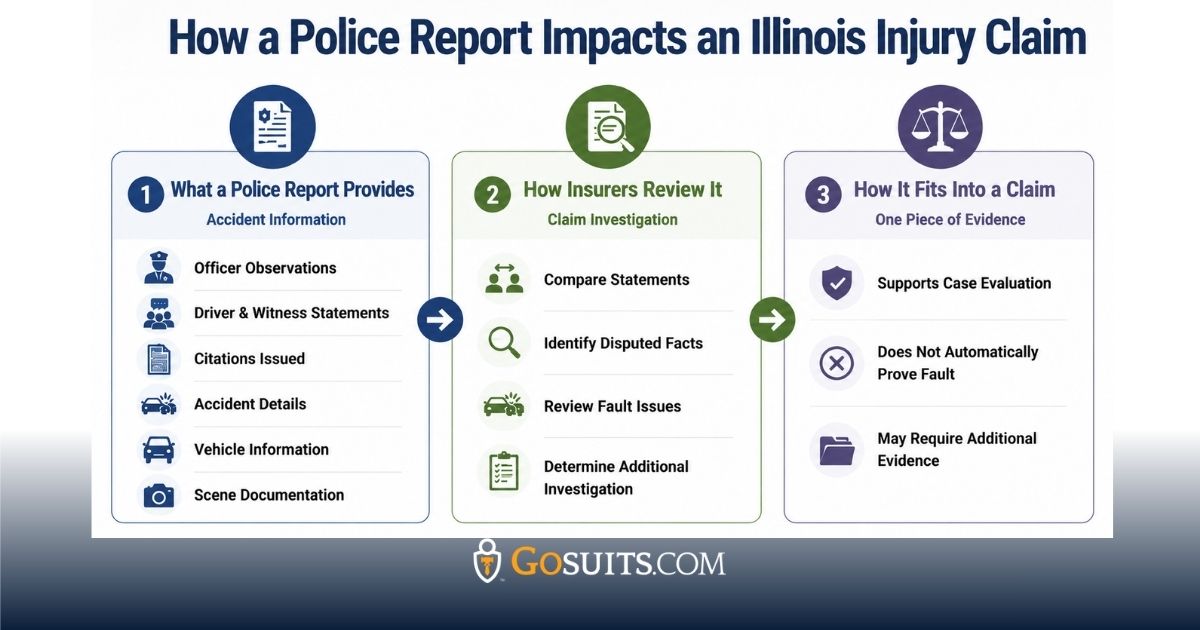
A police report can be an important piece of evidence in an Illinois injury claim, but it is only one part of the overall evaluation process. Insurance companies and attorneys may review the information contained in a police report alongside witness statements, photographs, medical records, vehicle damage, and other evidence. Whether any part of the report may be used in court depends on the Illinois Rules of Evidence and the purpose for which it is offered.
What Insurance Adjusters Look for in an Illinois Police Report
Insurance adjusters often review police reports during the early stages of an injury claim to gather information about how an accident occurred. The report may help them identify disputed facts, compare statements, and determine what additional investigation may be needed.
Common details adjusters may examine include:
- Officer’s description of the accident: Notes about the location, road conditions, vehicle positions, and the officer’s observations at the scene.
- Citations issued: Traffic violations or citations may influence how an insurer evaluates potential fault, although they do not automatically establish legal liability.
- Statements from drivers or witnesses: Initial accounts may be compared against later statements to identify inconsistencies or areas requiring further review.
- Accident diagrams or crash details: Diagrams and descriptions of the collision may help explain the sequence of events.
- Injury information documented at the scene: Notes about reported injuries or medical response may provide context regarding the timing of injuries.
- Insurance information exchange: Vehicle and insurance details may help identify the parties and available coverage.
For example, a police report involving a collision between two vehicles may become part of the evidence reviewed by a Chicago car accident attorney when evaluating liability and damages. Similarly, reports involving a CTA bus, commercial vehicle, or other transportation service may require additional review of the circumstances surrounding the incident, particularly when multiple parties or insurance policies are involved.
Is a police report admissible in an Illinois courtroom?
A police accident report is generally not admissible as direct proof of fault in an Illinois civil trial. Illinois Rule of Evidence 803(8) expressly excludes police accident reports from the public-records hearsay exception, and Illinois courts have recognized that these reports often contain secondhand statements, conclusions, or information outside the officer’s personal knowledge.
That does not mean every fact connected with the report is unusable. An officer or witness may testify from personal knowledge, and particular statements or portions of a report may sometimes be used for a limited purpose, such as impeachment or recorded recollection, if the required evidentiary foundation is established.
Outside trial, the report may still influence insurance investigations and settlement discussions. It does not, however, conclusively determine legal fault.
How a Police Report Can Help or Hurt Your Case
A police report can strengthen an injury claim when it provides accurate, timely documentation of important accident details. It may help by:
- Recording the basic circumstances of the accident shortly after it occurred
- Supporting a consistent account of what happened
- Identifying witnesses, involved parties, or evidence that may require further investigation
- Documenting citations, vehicle information, or observations from the scene
However, a report can also create challenges when it contains incomplete or inaccurate information. Potential issues may include:
- Incorrect descriptions of how the accident occurred
- Missing witness information or important details
- Statements recorded without full context
- Early fault assumptions based on limited information available at the scene
A police report can influence how an insurer views an injury claim, but it does not replace a complete investigation. Additional evidence may be necessary to establish liability, especially when the report does not accurately reflect the full circumstances of the accident.
Can you file an Illinois injury claim without a police report?
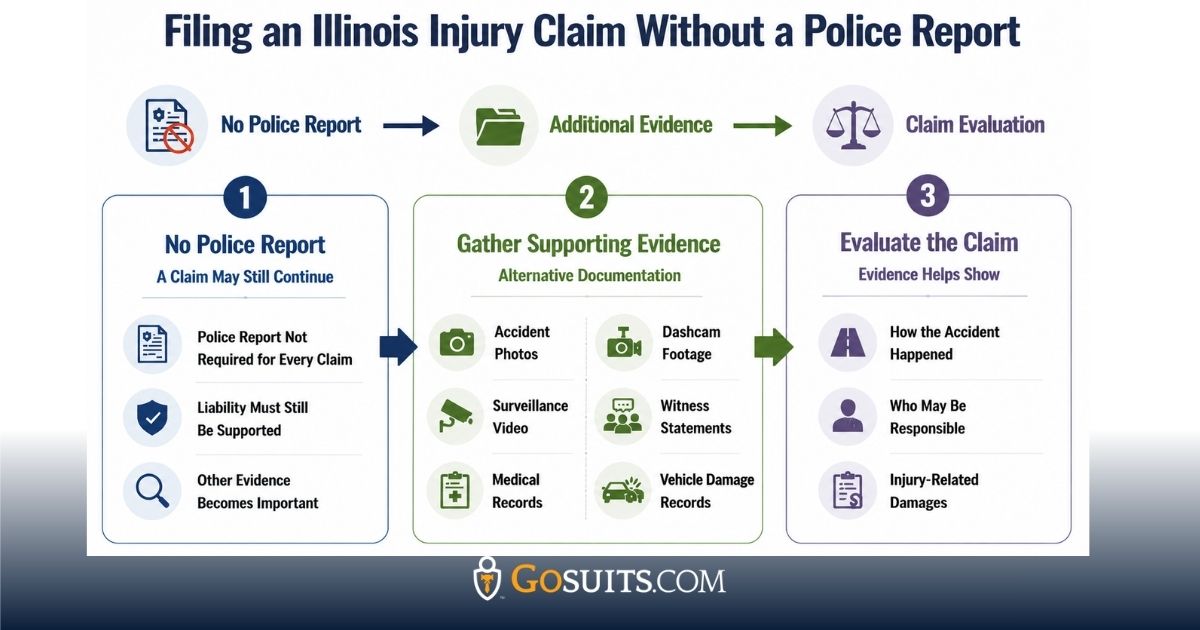
Yes. An injured person may still pursue an Illinois injury claim without a police report, but proving how the accident occurred may require additional supporting evidence. A police report can provide an early record of the incident, but it is not the only way to establish liability, damages, or the connection between the accident and resulting injuries.
Why Other Evidence Becomes More Important
An injured person generally does not need to possess a police report as a prerequisite to filing an insurance claim or personal injury lawsuit. However, a driver may still have had a separate legal duty to report the crash, and certain insurance claims may require corroborating evidence or compliance with policy notice conditions.
The absence of a report may be particularly significant in certain uninsured-motorist or hit-and-run claims, especially when there was no physical contact with the unidentified vehicle. Applicable policy terms may require corroborating evidence or impose other notice and proof requirements. Whether those requirements are satisfied depends on the facts and the language of the policy.
Without a police report, liability disputes may become more difficult to resolve because there is no official record of the accident created shortly afterward. Insurance companies may request additional documentation to evaluate the circumstances of the crash, the severity of injuries, and the actions of each person involved.
The evidence needed will depend on the type of accident, the disputed issues, and the applicable insurance coverage.
Alternative Evidence That Can Replace a Missing Report
When no police report exists, other forms of evidence may help document the accident and support an injury claim, including:
- Accident scene photographs: Images of vehicle positions, property damage, road conditions, traffic signals, and visible injuries.
- Dashcam footage: Video recordings that capture the events leading up to or during the collision.
- Surveillance footage: Security camera recordings from nearby businesses, residences, parking areas, or other locations.
- Witness statements: Accounts from individuals who observed the accident and can describe what occurred.
- Medical records: Documentation showing the timing, nature, and treatment of accident-related injuries.
- Vehicle damage documentation: Repair estimates, inspection records, and photographs that may help explain the impact.
- Insurance communications: Claim records, messages, and other correspondence exchanged during the insurance process.
- Expert analysis: Accident reconstruction or other professional evaluations may help clarify disputed facts in more complex cases.

Why Insurance Companies Question Claims Without Reports
A missing police report does not automatically prevent an injury claim from moving forward, but insurance adjusters may view the absence of a report as a reason to request more information. Without an official accident record, an insurer may have questions about the timing of the incident, the severity of the injuries, or the details surrounding how the accident occurred.
These questions can often be addressed through other evidence. A claim is evaluated based on the overall information available, rather than the presence or absence of a single document.
Illinois Comparative Negligence and Why Police Report Details Matter
A police report can influence discussions about fault after an Illinois accident, but it does not determine legal responsibility on its own. Illinois evaluates fault by considering the complete body of evidence, including the police report, witness statements, physical evidence, medical records, and other accident-related information.
The 51% Bar Rule Explained
Under 735 ILCS 5/2-1116, Illinois follows a modified comparative negligence rule. An injured person may recover damages when they are 50% or less responsible for causing their injuries, but the amount recovered is reduced by their percentage of fault. If the injured person is found more than 50% at fault, they generally cannot recover damages from another responsible party.
For example, if a person has $100,000 in proven damages and is found 20% at fault, the recoverable amount may be reduced to $80,000. If the person is determined to be more than 50% at fault, recovery is generally barred under Illinois’ comparative negligence rule.
How Police Report Details Can Affect Fault Analysis
A police report may influence how insurers and attorneys evaluate fault after an accident. Details such as citations, officer observations, driver statements, and accident diagrams can help explain the circumstances of the crash and identify issues that require further investigation.
However, a police report does not establish binding legal fault. Additional evidence may change the liability analysis, especially in complex cases.
What to Do If Your Police Report Is Wrong or Incomplete
A police report may not always include every detail of an accident or may contain information that does not accurately reflect what occurred.
A person may ask the reporting agency about correcting factual errors or adding supplemental information, but the available process and whether any change will be made depend on the agency and the nature of the requested correction.
How to Request a Correction or Supplemental Report
When a police report contains missing information or factual errors, the first step is generally to contact the law enforcement agency that prepared the report. The process may vary depending on whether the report was created by the Chicago Police Department (CPD), Illinois State Police, or another local agency.
A request for correction or supplementation may involve providing additional information, explaining the specific issue, and submitting supporting documentation when available. Depending on the agency’s procedures, officers may add supplemental information or clarify certain portions of the report, although changes to an officer’s original observations or conclusions are not always made.
Keeping records of communications with the reporting agency and preserving any supporting evidence can help document efforts to address inaccurate or incomplete information.
Why You Should Loop In an Attorney Before Disputing It Yourself
Before disputing information in a police report, it is important to consider how any additional statements or corrections may affect an injury claim. A personal injury attorney can help review the report alongside other evidence, identify potential inaccuracies, and determine the best way to address missing or incorrect information.
Additional evidence, such as witness statements, photographs, video footage, accident reconstruction, and medical records, may help provide a more complete picture of what happened.
Careful handling of the report and supporting evidence can help ensure the claim is evaluated based on the full circumstances of the accident.
Protecting Your Injury Claim After an Accident in Chicago
The steps taken immediately after an accident can affect how an Illinois injury claim is documented and evaluated. While every situation is different, preserving evidence, obtaining accurate information, and keeping communications clear can help create a stronger record of what occurred.
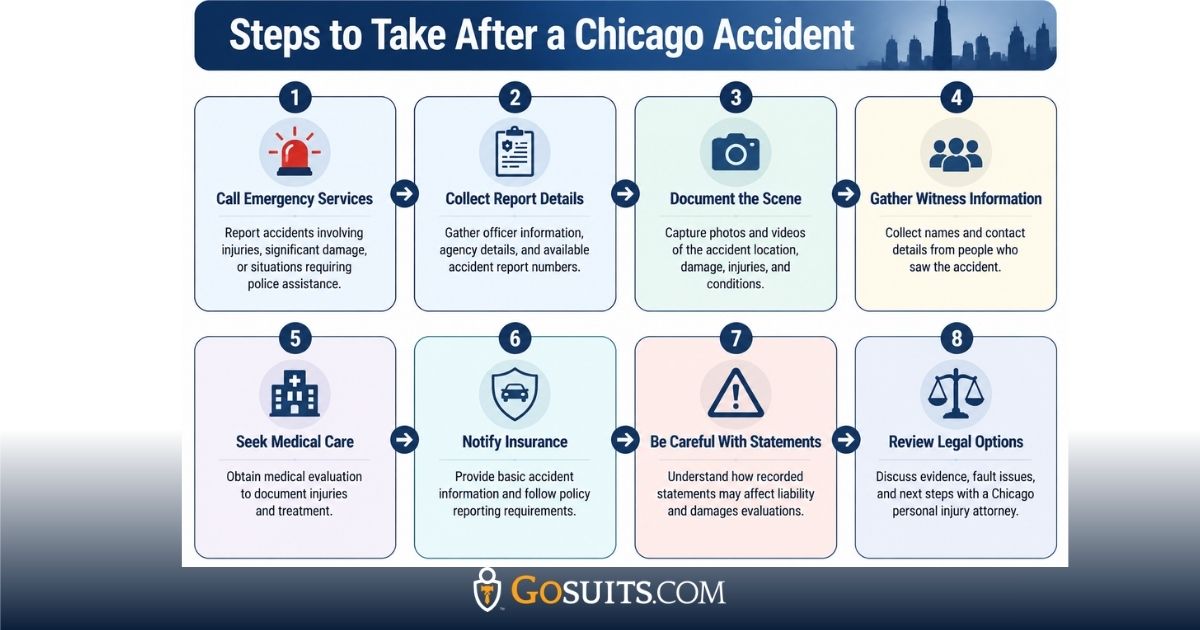
After an accident in Chicago, consider taking the following steps:
- Call emergency services when required. Report crashes involving injuries, significant damage, or other circumstances requiring law enforcement assistance.
- Collect officer information and report details. Obtain the responding officer’s name, badge number, agency, and any available accident report number.
- Document the accident scene. When it is safe to do so, take photographs or videos of the accident location, vehicle damage, visible injuries, and road conditions, traffic signals, or other relevant surroundings.
- Gather witness information. Collect names and contact details from anyone who observed the accident or the events leading up to it.
- Seek medical care. Prompt medical evaluation can help document injuries and connect treatment to the accident.
- Notify your insurance company. Provide basic facts about the incident and follow the reporting requirements in your policy, while avoiding unnecessary speculation about fault.
- Be careful with recorded statements. Insurance companies may request recorded statements during the claim process. Before providing detailed statements, consider how your responses may affect the evaluation of liability and damages.
- Discuss your options with a Chicago personal injury attorney. Legal guidance can help review the available evidence, evaluate potential fault issues, and determine the appropriate next steps for the claim.
Getting a Copy of Your Police Report in Chicago and Across Illinois
Obtaining a police report can help an injured person review the documented details of an accident, verify the information recorded by law enforcement, and provide records for an insurance claim or legal evaluation. The request process depends on the agency that investigated the accident.

Requesting Reports From the Chicago Police Department
For a crash investigated by the Chicago Police Department, a traffic crash report may be requested through CPD’s Traffic Crash Report service. Requesters generally need identifying details such as the crash date, report number, location, or information about the people or vehicles involved.
CPD currently offers online and in-person request options, and fees may apply. Because fees, service hours, and request procedures can change, confirm the current requirements on the official CPD website before submitting the request.
Requesting Reports From Illinois State Police and Other Agencies
Outside Chicago, police reports are usually requested from the agency that investigated the accident. Depending on the location, this may include the Illinois State Police (ISP), Cook County agencies, suburban police departments, or other local law enforcement offices.
Each agency may have different request procedures and information requirements. A police report can provide valuable details for an injury claim, but it should be considered alongside other evidence, including medical records, photographs, witness statements, and accident documentation.
FAQs
Do I need a police report to file an injury claim in Illinois?
Not generally as a prerequisite to filing the civil claim itself. However, Illinois law may require the driver to report a qualifying crash to law enforcement, and some insurance claims may involve separate corroboration or notice requirements.
Can I still pursue compensation if no police report was filed?
Potentially. An injury claim may still be pursued without a police report, but additional evidence may be needed to prove what happened, who was responsible, and how the accident caused the claimed injuries.
Can a police report be used against me in court?
Not automatically. Police reports may raise hearsay issues and are not always admissible as proof of fault at trial. However, they can influence settlement discussions and insurance evaluations.
What if my Illinois police report contains errors?
A person can contact the law enforcement agency that prepared the report to ask about correcting or supplementing inaccurate information. Additional evidence, such as witness statements, photographs, videos, or medical records, may also help address mistakes or missing details.
How do I get a copy of my Chicago police report?
A Chicago accident report can generally be requested through the Chicago Police Department’s records process. The request typically requires information such as the accident date, location, and details about the involved vehicles or individuals.
Does a police report decide who is at fault?
No. A police report does not determine legal fault. Liability is based on the complete evidence, including the report, witness accounts, physical evidence, and other documentation.
How long do I have to file an injury claim in Illinois?
Many Illinois personal injury claims are subject to a two-year statute of limitations under 735 ILCS 5/13-202. Different deadlines may apply depending on the type of claim and circumstances involved.