A California property owner is not automatically liable when someone falls on their premises. Liability depends on whether the owner knew or reasonably should have known, that a dangerous condition existed and failed to fix it or warn about it in time. That knowledge requirement is called notice, and in most contested slip and fall claims it is the question that controls the outcome. The California Supreme Court’s decision in Ortega v. Kmart Corp. (2001) 26 Cal.4th 1200 made the length of the inspection interval the central factual issue: if a store cannot show that its employees checked the area within a reasonable time before the fall, a jury may infer that the hazard was present long enough that a reasonable inspection program would have caught it.
Legal Snapshot
- Legal Topic: Premises Liability / Slip and Fall
- Jurisdiction: California (statewide; local venue includes Orange County Superior Court, Central Justice Center, Santa Ana)
- Primary Legal Issue: Constructive Notice of a Dangerous Condition
- Primary Authority: Ortega v. Kmart Corp., (2001) 26 Cal.4th 1200; California Civil Code § 1714(a)
- Secondary Authority: Peralta v. Vons Cos., (2018) 24 Cal.App.5th 1030; Getchell v. Rogers Jewelry, (2012) 203 Cal.App.4th 381; Castellon v. U.S. Bancorp, (2013) 220 Cal.App.4th 994
- Case Stage: Pre-litigation through trial
- Date Legal Authority Last Reviewed: July 2025
What Does Premises Liability Mean Under California Law?
Premises liability is the branch of California negligence law that governs injuries caused by unsafe property conditions. California Civil Code § 1714(a) states that everyone is responsible for injuries caused to another by their want of ordinary care in the management of their property. Applied to slip and fall cases, that duty means a property owner or occupier a store, a shopping center, a landlord must use reasonable care to inspect the property, discover dangerous conditions, and either repair them or give adequate warning.
Customers, tenants, other lawful visitors, they’re all covered by the duty. That said, an owner isn’t on the hook for guaranteeing perfect safety, and that’s kind of an important distinction. Four elements have to be there. The defendant owned or controlled the property in some way. The defendant was negligent in how they used or maintained it. The plaintiff was harmed. And the defendant’s negligence had to be a substantial factor in causing that harm. Notice is tucked into that second element. Without evidence the owner knew, or reasonably should’ve known, about the condition, negligence just doesn’t get off the ground.
Actual Notice, Constructive Notice, and Owner-Created Hazards
California courts recognize three paths to establishing that a property owner had the knowledge required to impose liability.
Actual notice exists when the owner or an employee had direct knowledge of the hazard before the fall. An example is a customer complaint logged at a service desk, a maintenance request submitted but not completed, or a manager who personally saw a spill and intended to clean it later.
Constructive notice exists when the condition existed long enough that a property owner exercising reasonable care would have discovered it. Duration is the key. A spill that sat on a grocery store floor for thirty seconds is a very different case from one that sat for forty-five minutes. Courts ask whether the interval between inspections was reasonable given the nature of the business and the foreseeability of the hazard.
Owner-created hazards are the third path. When the dangerous condition results from the owner’s own conduct a floor-waxing crew leaving a wet surface, a delivery employee stacking boxes that obstruct a walking path, the owner already has notice because the owner caused the problem. No additional proof of notice duration is required.
In practice, most contested claims in Orange County courtrooms turn on constructive notice, because actual notice is often difficult to document and owner-created hazards are comparatively straightforward. The constructive versus actual notice distinction in premises liability shapes how discovery is conducted, what evidence must be preserved, and how each side frames its argument at trial.
What Ortega v. Kmart Corp. Changed
Before Ortega, California courts split on how to handle slip and fall cases where the plaintiff could not prove exactly how long a spill had been on the floor. Some courts required direct proof of duration as a threshold matter, effectively ending many legitimate cases on summary judgment. The California Supreme Court resolved the conflict in Ortega v. Kmart Corp., (2001) 26 Cal.4th 1200. [1]
The case arose from a slip on a puddle of water on the floor of a Kmart store. The plaintiff could not show precisely when the puddle formed. Kmart argued that without evidence of how long the water had been there, the plaintiff could not prove constructive notice. The Supreme Court disagreed. The Court held that constructive notice can be inferred from the totality of the circumstances, including the absence of evidence that the store inspected the area within a reasonable time before the fall. In the Court’s analysis, when a store cannot produce a record showing that the area was checked recently, the jury may reasonably infer that the condition existed long enough to be discovered.
The effect on real cases is significant. Ortega means the plaintiff doesn’t have to find someone who watched the spill form and marked the time, which is kind of a relief because almost nobody witnesses that. The focus shifts instead to the store’s inspection program, whether it was actually followed, and how recently an employee checked that part of the floor before the incident. Two hours with no inspection in a high-traffic produce aisle at an Irvine grocery store near the Spectrum? That silence in the records becomes evidence a jury can weigh.
Ortega has been cited more than 200 times in California courts. It remains the governing standard for constructive notice in California slip and fall litigation. The personal injury lawyers who handle these cases in Orange County routinely structure their discovery requests around what the Court described as the “reasonable inspection” inquiry. [2]
Why the Inspection Interval Becomes the Central Factual Question
Once Ortega is understood, the importance of inspection records becomes clear. When a defendant store cannot prove that its employees swept or checked the specific area within a reasonable period before the fall, the plaintiff’s attorney can argue that the absence of that proof permits the inference of constructive notice.
What counts as a “reasonable” inspection interval depends on context. A self-service salad bar or produce section with abundant liquid and foot traffic creates a higher foreseeable risk than a carpeted electronics department. A store that operates in a busier part of the Irvine Spectrum-area retail corridor may face a higher standard than a low-traffic specialty shop. Courts assess reasonableness case by case, and the frequency called for in the store’s own written policies is often offered as evidence of what the store itself recognized as adequate.
The following table illustrates how different inspection intervals interact with notice:
| Time Since Last Documented Inspection | Hazard Type | Notice Argument Available? |
|---|---|---|
| Less than 5 minutes | Spill in high-traffic aisle | Weaker constructive notice argument; facts dependent |
| 30–60 minutes | Liquid on hard floor | Stronger constructive notice argument under Ortega |
| No record of inspection | Any | Jury may infer hazard existed long enough to be discovered |
| Owner’s own crew caused hazard | Any | No duration proof needed; notice established by creation |
Because the inspection interval is so central, slip and fall lawyers focus immediately on obtaining the store’s inspection and maintenance logs, employee schedules, and any written cleaning policies. These documents are among the first items requested in discovery in Orange County Superior Court proceedings.
The Mode-of-Operation Argument in Self-Service Areas
California recognizes a closely related theory sometimes called the mode-of-operation doctrine. When a business’s chosen method of operation makes it reasonably foreseeable that customers will encounter a particular type of hazard, the owner has a heightened obligation to address that hazard. Injury lawyers handling Irvine-area cases at the Orange County Superior Court cite this theory in cases involving self-service food displays, open salad bars, bulk bin sections, and produce areas where spills and dropped items are predictable consequences of how customers shop.
The theory matters because it connects the business’s systemic choices, how it chooses to display merchandise and serve customers to the likelihood of a specific type of floor hazard. A store that invites customers to handle loose produce or fill containers from open bins has created operating conditions where floor debris is foreseeable. That foreseeability, some California courts have reasoned, bears on whether the inspection interval was adequate and whether the store met its duty of care.
The mode-of-operation rule in slip and fall cases can work alongside the Ortega constructive notice theory or on its own, and determining which argument applies requires examining the specific layout and customer-service model of the business involved. This analysis is relevant to cases filed by slip and fall injury attorneys serving clients at locations throughout Orange County, including Newport Beach, Costa Mesa, Santa Ana, and Fullerton.
What Evidence Can Matter in a California Slip and Fall Claim?
The type of evidence that helps establish or defeat notice claims is relatively consistent across California slip and fall cases. Understanding each category helps injured people take action quickly after an incident.
Inspection and Sweep Logs
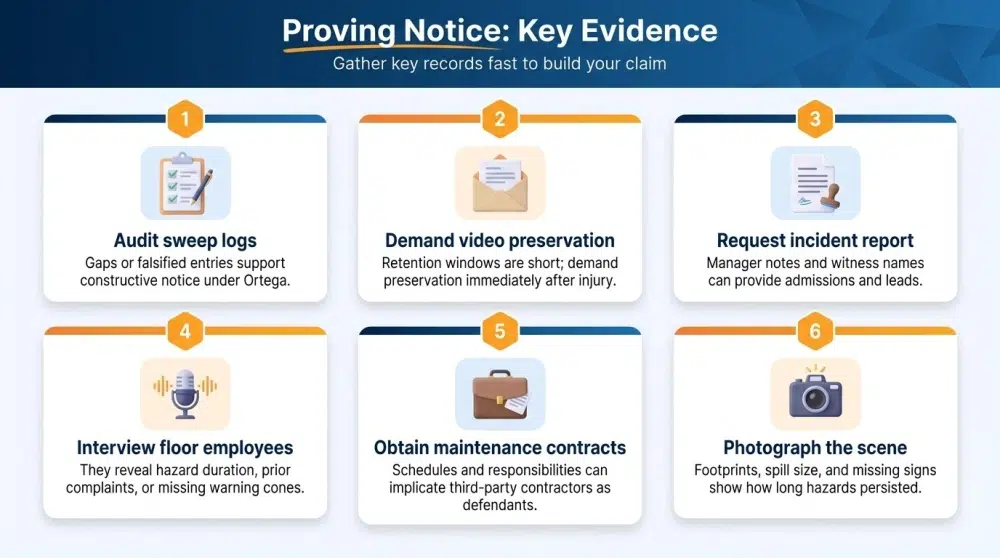
Many retailers use paper or electronic logs requiring employees to initial or scan a location at scheduled intervals. These records are central to the notice dispute. If the log shows an inspection fifteen minutes before the fall, that supports the defense. If the log is missing entries, shows an inspection two hours earlier, or contains signatures that appear falsified, those facts cut against the owner. These documents should be requested in litigation as soon as possible, because routine document-retention policies can result in deletion within weeks.
Surveillance Footage and Retention Windows
Video from a store’s security system can show precisely when a spill appeared and whether employees walked past it. The retention window for most retail surveillance systems ranges from thirty days to as few as seventy-two hours. A lawyer representing an injured person typically sends a preservation demand letter to the store immediately after being retained, instructing the business to retain all footage from the incident area. Failure to preserve footage after receiving such a demand can result in an inference instruction at trial meaning the jury may be told to assume the missing footage would have been unfavorable to the store. [3]
Incident Reports
When a fall occurs, store managers often complete an internal incident report. That document may contain admissions about the floor condition, identify which employees were working and where, note the presence or absence of wet-floor signs, or record witness names. An injured person should always request a copy of this report. If the store refuses, the report can be obtained through formal discovery at the Orange County Superior Court. Signing the report is not required; simply asking that it be completed and requesting a copy is reasonable.
Employee Statements
Employees who were on the floor at the time of the fall may know how long the condition existed, whether anyone reported it, or whether a wet-floor cone was available nearby but not placed. These statements become critical if the store argues that the hazard appeared moments before the fall. An experienced slip and fall lawyer will seek to identify and depose the employees who were working that section in the hours before the incident.
Floor Maintenance Contracts
Larger retail operations often contract with third-party janitorial or floor-maintenance companies. Those contracts define cleaning schedules, specify how often certain areas are serviced, and assign responsibility. If a third-party contractor was responsible for maintaining the floor, both the store and the contractor may be defendants. The maintenance contract, the contractor’s logs, and the contractor’s own crew schedules are all discoverable. [4]
Photographs and Physical Evidence
If the injured person is able to take photographs immediately after the incident, those images can show the size of the spill, the absence of a warning cone, footprints through the liquid suggesting multiple people walked past, and the specific floor material. Physical evidence such as torn or uneven flooring should also be documented. Courts have recognized that photographs taken promptly after a fall can provide circumstantial evidence of how long a condition had been present.
Medical Records and Bills
Connecting the fall to documented injuries requires consistent and detailed medical records beginning from the date of the incident. Gaps in treatment, or treatment that begins weeks after the fall, can complicate the causation argument at trial.
How Comparative Fault Is Argued: Footwear and Distraction
California follows a pure comparative fault system. Under this framework, a plaintiff’s recovery is reduced in proportion to their own share of fault. A jury finding that the plaintiff was thirty percent at fault would reduce a $100,000 award to $70,000. The defense in slip and fall cases commonly advances two arguments to establish or increase the plaintiff’s comparative fault percentage.
Footwear arguments. If the plaintiff was wearing flip-flops, high heels without non-slip soles, or shoes in poor condition, the defense will argue that the footwear contributed to the fall. This argument is more persuasive in some contexts than others. A customer wearing flip-flops at a beach-area store in Newport Beach faces a different analysis than one wearing the same footwear inside a dry-goods retail store. Footwear is documented early: the plaintiff’s shoes at the time of the fall should be preserved.
Distraction arguments. If the plaintiff was looking at a phone, talking to a companion, reaching for merchandise, or otherwise not watching the floor, the defense may argue that the plaintiff failed to keep a reasonable lookout. California courts allow this comparative fault argument, but it does not automatically defeat the claim. The question is always proportionate: a distracted customer who falls on a spill that has been on the floor for ninety minutes faces a different comparative analysis than one who falls on a spill that appeared sixty seconds earlier.
An injured person’s own conduct is scrutinized from the moment of the fall. Statements made to store employees or security personnel immediately after the incident can be used to construct a comparative fault argument later. This is one reason why consulting slip and fall lawyers promptly after an Orange County premises incident is important.
What If the Property Owner Disputes Liability?
Property owners and their insurers routinely deny slip and fall claims. Common defenses include: the condition was “open and obvious” such that a reasonable person would have avoided it; the plaintiff assumed the risk of the condition; the plaintiff’s own negligence was the primary cause; or no one at the store knew or should have known about the condition within any reasonable time before the fall. A store may also argue that its inspection program was adequate and was followed correctly on the day in question.
Each of these defenses can be challenged. The open-and-obvious doctrine does not automatically absolve a property owner when the owner’s own conduct made avoidance impractical: for example, when a hazardous area is the only path to a product the customer needs or to an exit. California courts have allowed claims to proceed even where a hazard had visible characteristics, when other circumstances made avoidance unreasonable.
Disputed liability is often resolved through the testimony of lay witnesses, employees, and expert witnesses. Accident reconstruction testimony and flooring safety experts both appear in Orange County Superior Court slip and fall trials. Expert evidence tends to be more common when the floor surface itself is claimed to be defective: for example, a surface that fails to meet standards for wet coefficient of friction.

What If Insurance Is Involved?
Most commercial property owners carry general liability insurance that covers slip and fall claims. After an incident, the store’s insurance carrier typically assigns an adjuster who will investigate the claim, interview witnesses, and attempt to document evidence that supports a low-value resolution or denial. The adjuster works for the insurance company, not for the injured person.
Giving a recorded statement to the store’s adjuster before consulting an attorney carries risk. Statements made to the adjuster can be used later to argue comparative fault or to challenge the severity of the injuries. An injured person is not required to provide a recorded statement to the opposing party’s insurer.
If the property owner is uninsured or underinsured relative to the damages, other avenues may exist depending on the facts. A shopping center owner and a tenant who operates a store may each have separate insurance policies. Identifying all potentially responsible parties and all applicable insurance coverage is an early step in the claim process for the personal injury lawyers handling Irvine premises cases. [5]
How Long Do I Have to File a Slip and Fall Claim in California?
For a personal injury claim against a private property owner in California, the statute of limitations is generally two years from the date of the injury under California Code of Civil Procedure § 335.1. Missing this deadline typically bars the claim entirely, regardless of how strong the underlying facts are.
There are important exceptions and shorter deadlines that can apply. If the property is owned or operated by a government entity a city-owned parking structure, a county-maintained facility, or a public transit station, the injured person must first file a government tort claim within six months of the incident under California Government Code § 911.2 before filing a lawsuit. Failure to file this claim on time can permanently forfeit the right to sue the government entity.
For minors, the statute of limitations is generally tolled until the minor reaches age 18, with some exceptions. Discovery of the injury and its connection to the incident can also affect timing in some cases.
Because these deadlines are strictly enforced and because evidence particularly surveillance footage disappears quickly, acting promptly is important. The slip and fall injury attorneys at GoSuits serving Orange County and Irvine-area clients can help evaluate applicable deadlines for a specific situation. [6]
How This Applies in Practice
Example 1: The Grocery Store Aisle (Constructive Notice)
A shopper falls on a puddle of liquid near an open refrigeration unit at a grocery store in the Irvine Spectrum area. The store cannot produce a sweep log showing any inspection of that aisle in the ninety minutes before the fall. There are no wet-floor cones near the spill. Footprints through the puddle suggest multiple people walked past before the fall occurred. Under Ortega, the absence of an inspection record, combined with the footprints and lack of any warning, allows the jury to infer that the condition existed long enough that a reasonable inspection program would have discovered it. This is a constructive notice case built around the inspection gap.
Example 2: The Self-Service Produce Section (Mode of Operation)
A shopper slips on a grape that fell from an open bin at a grocery store with a self-service produce section in Costa Mesa. The store has an inspection log showing a sweep twenty minutes before the fall. The plaintiff’s attorney argues that the store’s decision to use open bins in a high-traffic produce area a method of operation that foreseeably generates floor debris created an obligation to inspect more frequently than every twenty minutes during peak shopping hours. The factual dispute is whether twenty-minute intervals were reasonable given the store’s specific layout and customer volume. Both Ortega and the mode-of-operation theory are in play.
Example 3: The Freshly Waxed Floor (Owner-Created Hazard)
A tenant slips on a recently waxed floor in a commercial building lobby in Fullerton. The building management company’s maintenance crew applied a floor treatment that morning and did not post warning signs. There is no need to prove how long a “spill” existed or when it appeared: the management company created the hazard through its own conduct. Notice is established, and the claim analysis moves to causation and damages.
Note: These examples are hypothetical illustrations of legal concepts only. They do not represent actual GoSuits cases or any specific outcome.
What Damages or Remedies May Be Available?
California law allows an injured person to seek compensation for a range of economic and non-economic losses resulting from a slip and fall. Recoverability depends on the applicable law, the facts of the case, the severity of the injuries, and the plaintiff’s own comparative fault percentage.
- Medical expenses: Reasonable costs of past and future medical treatment, including emergency care, surgery, hospitalization, physical therapy, and ongoing rehabilitation.
- Lost income: Wages or salary lost while recovering from injuries, supported by employer records and pay stubs.
- Loss of earning capacity: In more serious cases involving permanent injury, compensation for reduced future earning ability.
- Physical pain and suffering: California allows recovery for physical pain experienced because of the injury.
- Mental anguish: Emotional distress, anxiety, depression, and related psychological harm are recognized categories of non-economic damages.
- Physical impairment and disfigurement: Long-term loss of function or visible scarring are compensable in California.
- Property damage: Damage to personal property such as clothing, eyeglasses, or electronic devices may be included.
California does not cap compensatory damages in premises liability cases for most private defendants. Note, however, that California’s Medical Injury Compensation Reform Act (MICRA) caps non-economic damages in medical malpractice cases only that cap does not apply to slip and fall cases against property owners. The actual value of a claim depends on a thorough review of the medical evidence, lost-income documentation, and the defendant’s available insurance coverage.
What Should I Do After a Slip and Fall in California?
The actions taken immediately after a fall can significantly affect a subsequent claim.
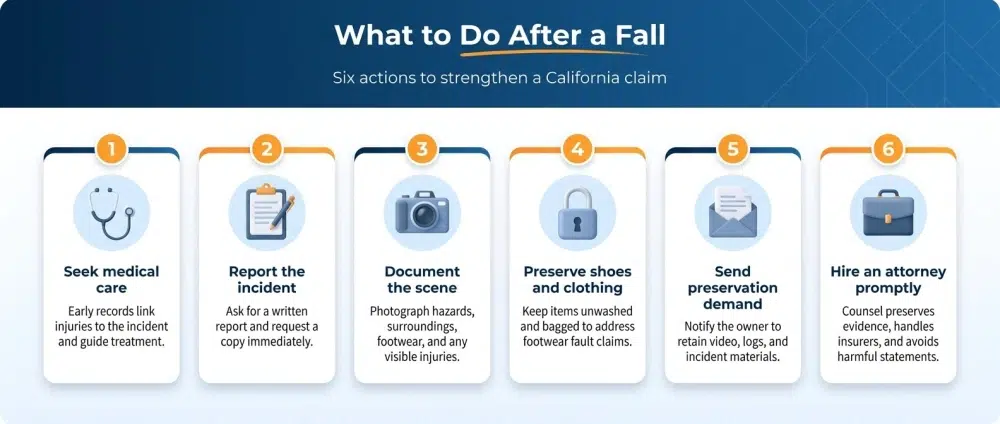
- Seek medical attention. Even if injuries seem minor, a medical evaluation creates a contemporaneous record connecting the fall to any harm. Delay in seeking treatment can be used to argue that the injuries were not serious or that they resulted from something else.
- Report the incident to the property owner or manager. Ask that an incident report be completed and request a copy. Do not sign any forms that release the owner from liability.
- Document the scene. Photograph the hazard, the surrounding area, any lack of warning signs, your footwear, and any visible injuries. If others witnessed the fall, note their names and contact information.
- Preserve your clothing and shoes. The footwear worn at the time of the fall should not be discarded, as it may be relevant to comparative fault arguments.
- Send a written preservation demand. If represented by a lawyer, the lawyer typically sends a demand to the property owner to preserve all surveillance footage, inspection logs, and incident reports immediately.
- Avoid providing a recorded statement to the opposing insurer before consulting with an attorney.
- Consult an attorney promptly. Given the short window for preserving surveillance footage and the statute of limitations, early legal consultation preserves options.
If you were injured at a retail store, shopping center, or other commercial premises in Orange County, our Irvine personal injury team can review what happened and explain whether you may have a claim. Schedule a free consultation with GoSuits.
Talk With a GoSuits Personal Injury Attorney
A slip and fall claim in California can involve detailed legal questions: whether constructive notice can be established from the inspection records, how the mode-of-operation theory applies to the specific store layout, whether multiple defendants are responsible, and what the property owner’s insurance coverage looks like. These issues benefit from careful analysis of the actual facts and documents involved in a specific case.
If you or a family member was injured at a retail property, commercial facility, or other premises in Orange County, including incidents at stores near the SR-73 Toll Road corridor, in Irvine, Newport Beach, Santa Ana, or Fullerton our Irvine premises liability team can review the circumstances. We serve clients throughout the region as personal injury lawyers focused on helping injured people understand their options.
Contact GoSuits for a free consultation. There is no fee unless we recover for you.
Related California Personal Injury Resources
Our Irvine personal injury team handles the full range of premises liability and accident claims throughout Orange County. If you were involved in a different type of accident or want to learn more about California personal injury law, these resources may help:
- Personal injury claims in Irvine and Orange County: GoSuits Irvine Personal Injury Lawyers
- Slip and fall claims in the Irvine area: Irvine Slip and Fall Injury Attorneys
- How negligence laws work in California: Negligence Laws in California: A Comprehensive Guide
- California personal injury statute of limitations: How Long Do You Have to Sue for Personal Injury in California?
- Understanding what is personal injury in California: What Is Considered Personal Injury in California?
References and Legal Authorities
- Ortega v. Kmart Corp., (2001) 26 Cal.4th 1200 – CourtListener / California Supreme Court
- California Civil Code § 1714 – California Legislative Information
- Peralta v. Vons Cos., (2018) 24 Cal.App.5th 1030 – CourtListener / California Court of Appeal
- Getchell v. Rogers Jewelry, (2012) 203 Cal.App.4th 381 – CourtListener / California Court of Appeal
- California Code of Civil Procedure § 335.1 (Two-Year Personal Injury Statute of Limitations) – California Legislative Information
- California Government Code § 911.2 (Six-Month Government Tort Claim Deadline) – California Legislative Information
- Castellon v. U.S. Bancorp, (2013) 220 Cal.App.4th 994 – CourtListener / California Court of Appeal
- California Courts – Official Judicial Branch Website
- Orange County Superior Court – California Courts Locator
- California Law – Legislative Information Portal (All Codes)