Yes. Under Texas law, a property owner or manager may be held civilly liable when inadequate security allows a foreseeable criminal attack to injure a tenant, guest, or business invitee. The governing framework comes from the Texas Supreme Court’s 1998 decision in Timberwalk Apartments, Partners, Inc. v. Cain, 972 S.W.2d 749 (Tex. 1998). That case requires a court to weigh five specific factors, proximity, recency, frequency, similarity, and publicity of prior criminal incidents before concluding that an attack was foreseeable enough to impose a duty on the property owner. Whether your claim can move forward depends on what those factors show about the particular location where you were harmed, not about Dallas crime rates in general.
Legal Snapshot
- Legal Topic: Negligent Security / Premises Liability
- Jurisdiction: Texas (state law) Dallas County, Dallas District Courts
- Case Stage: Pre-litigation through trial; also relevant at summary judgment
- Primary Legal Issue: Whether a property owner’s failure to provide adequate security caused a foreseeable criminal attack
- Primary Authority: Timberwalk Apartments, Partners, Inc. v. Cain, 972 S.W.2d 749 (Tex. 1998); Texas common law premises liability
- Supporting Authority: UDR Texas Properties, L.P. v. Petrie, 517 S.W.3d 98 (Tex. 2017); Texas Property Code § 92.052 et seq. (landlord repair obligations, distinguished from personal injury claims); Restatement (Second) of Torts § 344 (1965)
- Date Legal Authority Last Reviewed: July 2025
What Is a Negligent Security Claim?
A negligent security claim is a type of premises liability lawsuit. The injured person called the plaintiff argues that the property owner or manager created or allowed an unreasonable risk by failing to install adequate security measures, and that the resulting conditions allowed a third party’s criminal act to cause harm.
In Texas, a complaint about inadequate security is analyzed as a premises defect claim, not a “negligent activity” claim. The Texas Supreme Court confirmed this distinction in Timberwalk, explaining that the defendant’s failure to provide security measures “created an unreasonable risk of harm that defendants knew or should have known about and yet failed to correct.” That framing matters because it sets the standard of care the jury applies and determines what evidence is required to survive summary judgment. [1]
Negligent security cases arise most often in apartment complexes, parking garages, hotel parking lots, shopping center parking areas, convenience stores, and nightclubs settings common across Dallas neighborhoods such as the Design District, Oak Cliff, Deep Ellum, and areas adjacent to major corridors like I-35E or the Dallas North Tollway where late-night commercial activity and residential density create recurring security challenges.
What Does Texas Law Say About Property Owner Liability for Criminal Acts?
The starting point under Texas common law is that a person generally has no legal duty to protect another from the criminal acts of a third party. The Texas Supreme Court restated this general rule in Timberwalk, citing its earlier decisions in Walker v. Harris, 924 S.W.2d 375 (Tex. 1996) and Centeq Realty, Inc. v. Siegler, 899 S.W.2d 195 (Tex. 1995).
There is, however, an important exception. The court recognized in Lefmark Management Co. v. Old, 946 S.W.2d 52 (Tex. 1997) that a person who controls premises “does have a duty to use ordinary care to protect invitees from criminal acts of third parties if he knows or has reason to know of an unreasonable and foreseeable risk of harm to the invitee.” A landlord who retains control over the security and safety of the premises falls squarely within that exception. [2]
Foreseeability whether the general danger of criminal conduct at this specific location was predictable before the attack is the central battleground. Because nearly any location could theoretically experience crime, the Timberwalk court refused to impose a duty based on abstract crime statistics alone. Specific prior criminal activity at or near the property is required. Personal injury lawyers and defense attorneys both scrutinize this threshold question early in every negligent security case.
The Five Timberwalk Foreseeability Factors
The Texas Supreme Court identified five factors courts must weigh when deciding whether criminal conduct on a property was foreseeable. These factors apply together no single factor controls, and courts must consider the whole picture. [1]
| Factor | What It Measures | Evidence That Helps the Plaintiff |
|---|---|---|
| 1. Proximity | How close to the property prior crimes occurred | Incidents on the property itself or in the immediately adjacent block; CAD/police data for the specific address or complex |
| 2. Recency | How recently prior crimes occurred before the attack at issue | Multiple incidents in the months immediately before the assault; a pattern that was still active, not a single incident years earlier |
| 3. Frequency | How often prior crimes occurred | Several incidents within a short time window; courts have found foreseeability where significant numbers of incidents occurred within one to three years |
| 4. Similarity | How closely prior crimes resemble the crime that injured the plaintiff | Prior assaults, robberies, or sexual assaults (for a rape claim); prior property break-ins may also be relevant because an intruder who enters to steal may encounter and harm a resident |
| 5. Publicity | Whether prior crimes were reported to or known by the property owner | Police reports showing the property address, tenant complaint records, lease renewal discussions about security concerns, news coverage of incidents at the location |
The court in Timberwalk explained that when prior crimes are very similar to the incident at issue, fewer incidents may still establish foreseeability. Conversely, when prior crimes are less similar (such as vandalism versus violent assault), a larger number of prior incidents will be needed. The frequency required to show foreseeability “lessens as the similarity of the previous crimes to the incident at issue increases.” [1]
The Texas Supreme Court revisited the foreseeability question in UDR Texas Properties, L.P. v. Petrie, 517 S.W.3d 98 (Tex. 2017), a case arising out of a parking lot assault at an apartment complex. The court applied the same Timberwalk framework, reinforcing that the analysis remains the controlling standard for negligent security cases in Texas. [3]
Who Can Bring a Claim and Who Can Be Named as a Defendant?
Potential Plaintiffs
Texas courts distinguish among three categories of persons on a property: invitees, licensees, and trespassers. The duty to protect from criminal acts applies most clearly to invitees, people who are on the premises with the owner’s express or implied invitation and for a purpose connected to the owner’s business or the use of the property. Tenants in an apartment complex are invitees; so are customers in a strip mall parking lot, hotel guests, and nightclub patrons. [2] Personal injury lawyers who handle these claims carefully evaluate the plaintiff’s legal status on the property at the time of the attack, because it affects the duty owed.
Potential Defendants
Anyone who owns or controls the premises may owe a duty. In Dallas-area cases, this commonly includes:
- Apartment complex ownership entities and their management companies
- Retail property owners and commercial landlords
- Hotel and motel operators
- Parking garage owners or operators
- Restaurant and nightclub owners
- Third-party security contractors, where the contract or their conduct creates a separate basis for liability
When an assault results in death, surviving family members may also have a wrongful death claim under Texas Civil Practice and Remedies Code Chapter 71. [4] Our Dallas personal injury team handles both serious injury and fatal attack claims arising from inadequate security.
How Is Prior Crime History Evidence Obtained?
The Timberwalk factors all depend on what actually happened at or near the property before the attack. Gathering that history is one of the first tasks in a negligent security case. Several sources are used.
Dallas Police Department Records
The Dallas Police Department maintains incident and offense records. Open records requests under the Texas Public Information Act, Tex. Gov’t Code Chapter 552, can produce call-for-service data and incident reports for a specific address or geographic area over a defined period. Defense attorneys will scrutinize the same records to argue that calls do not equal crimes, or that reported incidents were of a different type. [5]
Computer-Aided Dispatch (CAD) Data
CAD data captures every call received by emergency dispatch, including the address, the nature of the call, and the time. CAD data can show a pattern of calls from an apartment complex even when no formal offense report was filed. Courts have distinguished between calls (which may not result in confirmed crimes) and confirmed incident reports, so both types of data are relevant but must be interpreted carefully. The Timberwalk court itself noted that eleven dispatch calls in the surrounding area the year before the attack included only one confirmed crime, a distinction that supported the defense. [1]
Property Management Records
Apartment complexes and commercial properties often maintain their own internal security logs, maintenance request files, lease termination records citing safety concerns, and records from contracted security companies. These records are obtainable through discovery once a lawsuit is filed. Tenant complaints about lighting, broken gates, or prior incidents can establish actual notice to the owner, which strengthens the publicity factor.
Security Company Records
When a third-party security firm was retained, its incident logs, patrol schedules, staffing levels, and training records become relevant. Gaps in patrol coverage, understaffing relative to the property’s crime profile, or inadequate guard training may all support a finding that security was deficient.
How Does This Apply to a Real Case?
Hypothetical Example (not a GoSuits case):
A resident of a 250-unit apartment complex in South Dallas is assaulted and robbed in the complex’s parking lot at 10:30 p.m. on a weeknight. She later learns that in the twelve months before her attack, police had responded to the same complex for three prior robbery reports and two aggravated assault calls, all of which involved the parking lot. The complex’s perimeter gate had been broken for several months, several parking lot light fixtures were inoperative, and the security camera nearest the parking lot entrance had not recorded for approximately 90 days. The management company had received written tenant complaints about the lighting and the camera.
Under the Timberwalk framework, the prior incidents at the same address (proximity), occurring within the preceding year (recency), with multiple events (frequency), involving robbery and assault (similarity to the attack at issue), and documented in police calls that the management company received formal tenant notice of (publicity) would present a factual basis for a jury to find that criminal activity in the parking lot was foreseeable. Whether the owner took reasonable steps in response or failed to do so, would then determine whether that failure caused the plaintiff’s injury.
This type of case is filed in Dallas County District Court, where civil cases of this kind are handled at the George L. Allen Sr. Courts Building. Preserving evidence early is critical: surveillance footage is often recorded over within days or weeks, and security logs may not be retained indefinitely.
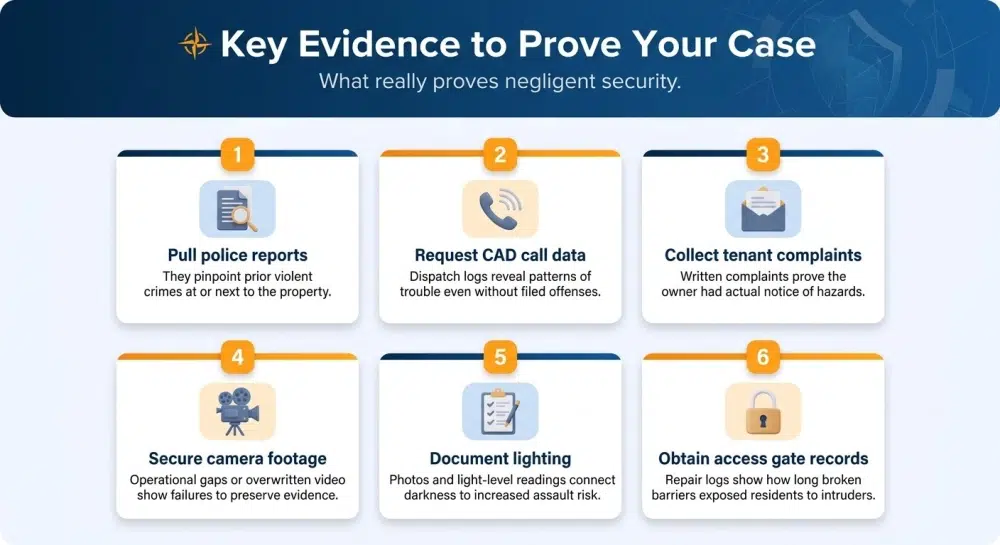
What Evidence Can Matter in a Negligent Security Case?
Evidence in these cases tends to fall into two categories: evidence about prior criminal activity (to establish foreseeability) and evidence about the property’s security conditions (to establish breach of duty and causation).
Prior Crime Evidence
- Police incident reports and CAD records for the specific property address and the surrounding area, covering at minimum the one to two years before the attack
- Tenant complaint records referencing safety issues, prior incidents, or requests for security improvements
- Prior lawsuits or insurance claims involving the property, which may reveal undisclosed incidents
- Media reports or news coverage of criminal incidents at the location, which are relevant to the publicity factor
Property Security Condition Evidence
- Lighting inspection records and photographs documenting whether exterior lights in parking areas and walkways were functioning at the time of the attack
- Surveillance camera coverage and maintenance logs, including whether cameras were operational, where they were positioned, and when recordings were last reviewed or preserved
- Gate and access control records, including repair requests, work orders, and the length of time any broken access controls went unrepaired
- Security staffing records, patrol schedules, and the ratio of security personnel to residents or visitors relative to what was contractually promised
- Security company contracts and post orders, which establish what the property owner required and whether the contractor complied
- Property maintenance records showing awareness of security system deficiencies
Injury and Causation Evidence
- Medical records and emergency room documentation from the date of the attack
- Police report from the attack itself, including the scene description, witness statements, and any information about how the attacker gained access
- Witness statements from other tenants, nearby business employees, or bystanders
- Photographs and video of the scene taken at or near the time of the attack
- Expert testimony from security consultants who can opine on the adequacy of security measures relative to the known crime history and industry standards
Evidence that a property owner was aware of security problems through tenant complaints, prior break-ins, or management meeting minutes directly strengthens the foreseeability and notice elements. Absent such notice, an owner who had no way of knowing about prior incidents may successfully argue that no duty arose. An attorney can help identify and request the specific records needed before they are lost or destroyed. For a broader discussion of how courts analyze constructive versus actual notice in premises liability cases, see our article on constructive vs. actual notice in premises liability.
Which Physical Security Conditions Are Most Commonly at Issue?

Lighting
Adequate exterior lighting in parking areas, stairwells, walkways, and building entry points is one of the most frequently cited deficiencies in negligent security cases. Inoperative or insufficient lighting makes it easier for attackers to operate undetected and harder for potential victims to see danger approaching. Evidence of lighting deficiencies typically comes from property maintenance records, photographs, and expert analysis of foot-candle levels measured against industry standards for residential or commercial properties.
Access Gates and Perimeter Control
Controlled access whether a key-coded gate, an attended entry, or a card-reader system limits who can enter a property. A broken access gate that has gone unrepaired for weeks or months removes that barrier entirely. In Timberwalk itself, an access gate on one side of the apartment complex was non-functional, and the court examined whether the owner’s failure to repair it contributed to the foreseeable risk. Evidence of how long any access control failure persisted and whether the property owner received notice of it is central to these cases.
Surveillance Camera Coverage
Operational cameras in parking lots, entrances, and common areas both deter criminal activity and create a record when crimes occur. A camera that is non-functional, incorrectly aimed, or whose footage is not retained for a sufficient period may fail both purposes. When cameras were present but not working at the time of an attack, that condition is itself evidence of inadequate security. Courts have also considered whether the camera footage that did exist was preserved; spoliation of relevant video can be a significant litigation issue.
Security Staffing Levels
When a property contracts for security personnel, the adequacy of patrol schedules, the number of officers relative to property size, and whether officers were actually present at the times and locations specified in the contract all become factual questions. Evidence that staffing was reduced in response to budget pressures, or that officers were assigned tasks unrelated to security patrol, may support a claim of inadequate staffing relative to the known crime profile of the property.
Prior Incident Reports
Internal security logs, incident reports prepared by the property’s own security personnel, and records of police calls to the address are among the most important evidence in establishing whether the owner had actual knowledge of prior criminal activity. The publicity factor in Timberwalk focuses on this question: could the owner have known of the prior incidents? If tenant complaints were submitted in writing, or if police responded to the property for prior similar crimes, those records will likely be produced in discovery.
What Damages or Remedies May Be Available?
Texas law recognizes several categories of compensable damages in personal injury cases, including negligent security claims. The specific damages available depend on the facts of the case, the nature and extent of the injuries, and applicable legal standards. Nothing here should be read as a guarantee of any particular recovery.
- Medical expenses (past and future): Treatment costs from emergency care, hospitalization, surgery, physical rehabilitation, mental health treatment, and any anticipated future care
- Lost income: Wages or salary lost while recovering from the assault
- Loss of earning capacity: Where injuries are permanent or long-lasting, reduced ability to earn income in the future
- Physical pain and suffering: Compensation for the physical pain caused by the attack and its aftermath
- Mental anguish: Texas recognizes mental anguish as a separate category of damages; victims of violent assault often experience significant trauma, anxiety, post-traumatic stress symptoms, and related conditions
- Physical impairment: Loss of physical function or permanent disability resulting from injuries
- Disfigurement: Permanent scarring or disfigurement resulting from the attack
- Wrongful death damages: Where an assault is fatal, surviving spouses, children, and parents may pursue wrongful death claims under Texas Civil Practice and Remedies Code § 71.002 for pecuniary loss, loss of companionship, and mental anguish
- Exemplary (punitive) damages: Texas Civil Practice and Remedies Code Chapter 41 permits exemplary damages when a defendant’s conduct involves fraud, malice, or gross negligence. Whether inadequate security rises to that level is a fact-specific question, but extreme indifference to known, serious criminal risks has been argued as a basis for exemplary damages in some premises liability cases.
Families who have lost a loved one to violence on a property with inadequate security should also speak with an attorney about wrongful death lawyers in Dallas and survival action claims under Texas law. Both the property owner’s liability and the available categories of recovery should be evaluated together.
What If the Property Owner Disputes Foreseeability or Liability?
Defense arguments in negligent security cases are typically built around the same five Timberwalk factors the plaintiff relies on. A property owner will argue that prior crimes on the property were too few, too old, too dissimilar, or too remote to make the specific attack foreseeable. They may argue that the attacker was a resident or authorized visitor, removing the relevance of any access control failure. They may contend that no reasonable security measures would have prevented the attack regardless of whether the lighting was adequate or the gate was functional.
And then there’s comparative fault. Texas runs a modified version, tucked into Chapter 33 of the Civil Practice and Remedies Code, and it has real teeth. If you’re found more than 50 percent at fault for your own injuries, you don’t recover anything. Zero. That’s why defense counsel spends time picking apart what the victim was doing walking through a parking lot at 2 a.m., choosing a route through a stretch that had a reputation, maybe skipping past a posted warning. Whether any of it lands is fact-specific, and I’d say that’s exactly the kind of analysis you want a lawyer doing before you draw any conclusions.
Here’s the thing about summary judgment in these cases. Whether you survive it or get tossed usually comes down to three things: how much prior crime evidence you’ve got, how specific it is, and how closely it resembles what happened to you. Well-documented incidents that look a lot like your attack? Those tend to get you in front of a jury. A thin record, or a history that’s mostly car break-ins and petty theft? Those get dismissed under Timberwalk pretty routinely. That’s why lawyers who actually handle these cases spend so much of their early time digging into the foreseeability record. It’s kind of the whole ballgame.
What If Insurance Is Involved?
Commercial property owners and landlords typically carry general liability insurance that may cover negligent security claims. When a claim is made, the insurance carrier will conduct its own investigation and may argue that the attack was not foreseeable or that the owner’s security measures were adequate. The carrier may also argue coverage exclusions or attempt to limit the amount paid.
In Texas, the Texas Prompt Payment of Claims Act, Insurance Code Chapter 542, imposes deadlines on insurance companies to acknowledge, investigate, and respond to claims. Violations of those deadlines can result in additional damages a point worth understanding if an insurer is slow to respond after an assault on a covered property.
If the property owner lacks sufficient insurance or has no applicable coverage, other avenues, such as claims against a third-party security contractor or the property’s management company may need to be explored. Understanding who all the responsible parties are and what coverage exists is one of the first steps in evaluating a negligent security claim.
How Long Do I Have to Act?
Texas imposes a two-year statute of limitations on most personal injury claims, including negligent security claims. This deadline is found in Texas Civil Practice and Remedies Code § 16.003(a). In general, the two-year period begins running from the date of the assault. Missing that deadline typically means losing the right to pursue a civil claim, regardless of how strong the case might otherwise be. [6]
Government defendants play by different rules. If the attack happened at a facility owned or operated by a city, a public housing authority, or some other governmental body, you’re not in a normal premises case anymore you’re under the Texas Tort Claims Act, Chapter 101 of the Government Code. And that means a written notice requirement kicks in fast. Six months from the incident, in most cases. That’s separate from the limitations period, and it lands a lot sooner than most people expect. Blow past it and you probably don’t have a claim left. [7]
Evidence deadlines matter independently of the legal deadline. Surveillance footage may be overwritten within 24 to 72 hours. Security logs may not be retained indefinitely. Acting promptly after an assault helps preserve the evidence needed to evaluate and support a claim.
Note: Applicable deadlines should be confirmed by an attorney based on the specific facts of each case, including whether any governmental entities are involved. [DEADLINE REQUIRES LEGAL VERIFICATION for government claims.]
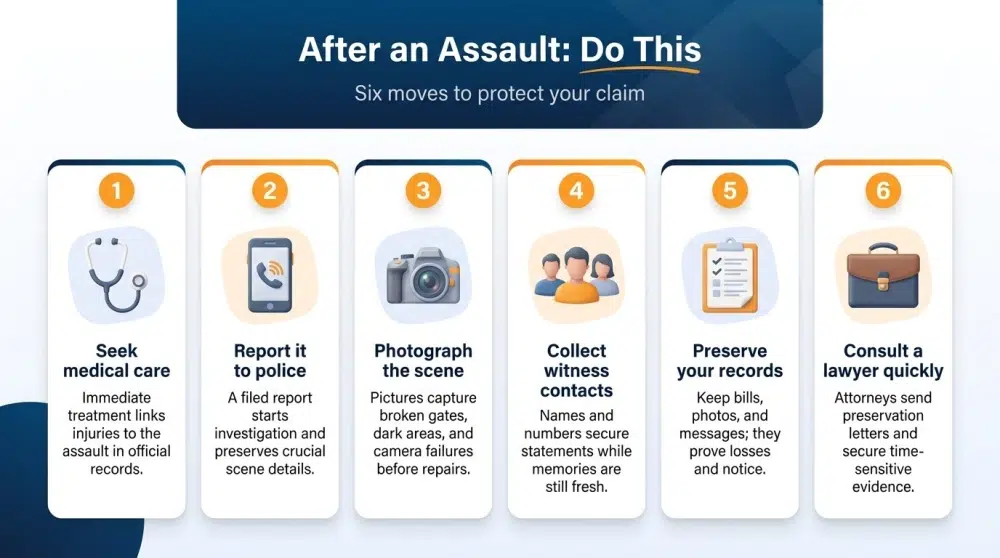
What Should I Do After an Assault Caused by Inadequate Security?
- Seek medical attention immediately, even if injuries seem minor. Adrenaline can mask pain, and documented treatment is important evidence of both injury and causation.
- Report the assault to police and obtain a copy of the incident report.
- Photograph the scene as soon as it is safe to do so the broken gate, the dark parking lot, the inoperative camera before conditions are repaired.
- Identify witnesses and collect contact information from anyone who observed the attack or the conditions of the property.
- Preserve your own records medical bills, time missed from work, communications with the property owner or management company, and any written complaints you previously made about security conditions.
- Do not sign any releases from the property owner’s insurance company without legal advice.
- Consult a personal injury attorney promptly. The foreseeability investigation gathering crime data, securing surveillance footage, preserving security records is time-sensitive, and the statutory limitations period is running from the date of the assault.
A negligent security claim involves premises liability law, foreseeability analysis, insurance coverage issues, and often complex discovery from property owners and security companies. If you were injured in a Dallas assault on a property with inadequate security, schedule a free consultation with a GoSuits personal injury attorney to review the circumstances of your case and understand your options. There is no fee unless recovery is obtained.
Can I sue if there had been only minor crimes at the property before my assault?
It depends on the type of prior crimes and how they compare to what happened to you. The Timberwalk court explained that prior property crimes like burglaries, may be relevant to a violent personal crime, because an intruder who enters to steal may encounter and harm a resident. However, vandalism to vehicles in a parking lot generally does not foreshadow sexual assault. The similarity factor requires that prior crimes be sufficiently close in type to put the owner on notice of the specific danger that materialized. An attorney can assess whether the prior crime history at your location meets this standard.
What if the attacker was a resident of the apartment complex?
The fact that an attacker lived at the property does not automatically eliminate the owner’s liability. However, it does affect the analysis. If the attacker had authorized access to the property regardless of whether security measures were in place, a broken gate or inadequate lighting may be less directly tied to causation. Courts evaluate whether the particular security failures not just security in general allowed or facilitated the specific attack.
How long does surveillance footage typically survive before being overwritten?
Retention periods vary by property. Many commercial and residential security systems overwrite footage within 24 to 72 hours; others retain video for up to 30 days. Once a legal claim is foreseeable, property owners who receive notice of a potential claim have an obligation to preserve relevant evidence, including footage. A demand letter or a formal legal hold letter from an attorney, sent as soon as possible after the incident, can help protect this evidence. Delays significantly increase the risk that critical footage will no longer exist.
Can I pursue a claim if the criminal who attacked me was never caught?
Yes. The civil claim against a property owner for negligent security is separate from any criminal case against the attacker. The property owner’s liability depends on whether they breached a duty to provide adequate security not on whether the attacker is identified, prosecuted, or convicted. Many negligent security civil cases proceed successfully without any criminal proceeding against the attacker.
What if my lease says the property owner is not responsible for crimes?
Lease provisions attempting to limit or waive a landlord’s liability for negligence are subject to legal scrutiny under Texas law and may not be enforceable in all circumstances. Contractual language that purports to eliminate liability for the owner’s own negligence in providing a safe premises is not automatically valid. Whether such a provision applies, and whether it is enforceable, requires legal analysis of the specific contract language, how it was presented, and the applicable law. An attorney can evaluate whether a lease clause affects a particular claim.

Is a negligent security claim the same as suing my landlord for failing to make repairs?
No. The Texas Supreme Court in Timberwalk addressed this directly. Texas Property Code Chapter 92, Subchapter B governs a landlord’s obligation to repair or remedy conditions of which a tenant gives notice. That statute provides its own remedies, reduced rent, repair-and-deduct rights, and certain civil penalties. But a personal injury claim arising from inadequate security is governed by Texas common law premises liability, not by the Property Code repair-and-remedy provisions. The two systems operate independently.
Related Texas Personal Injury Resources
- Texas premises liability and slip and fall injury claims in Dallas
- Personal injury claims process in Texas courts
- Types of damages available in Texas personal injury cases
- Texas modified comparative fault the 51% bar rule
- Statute of limitations for personal injury claims in Texas
- Wrongful death claims in Texas what families need to know
- Dallas survival action pain and suffering damages
Talk With a GoSuits Attorney
A negligent security claim involves multiple legal issues at once foreseeability under the Timberwalk factors, physical security standards, insurance coverage questions, and time-sensitive evidence preservation. If you were injured in a Dallas assault on a property you believe had inadequate lighting, broken access controls, non-functional cameras, or insufficient staffing, a GoSuits personal injury attorney can review the facts of your situation and explain your legal options.
GoSuits serves injury victims in Dallas and across Texas. If your injuries were fatal, our Dallas wrongful death lawyers assist surviving families in pursuing compensation for their loss. Schedule a free consultation today. No fee is charged unless a recovery is made.
References and Legal Authority
- Timberwalk Apartments, Partners, Inc. v. Cain, 972 S.W.2d 749 (Tex. 1998) – CourtListener
- Lefmark Management Co. v. Old, 946 S.W.2d 52 (Tex. 1997) – CourtListener
- UDR Texas Properties, L.P. v. Petrie, 517 S.W.3d 98 (Tex. 2017) – CourtListener
- Texas Civil Practice and Remedies Code Chapter 71 – Wrongful Death – Texas Legislature
- Texas Public Information Act, Government Code Chapter 552 – Texas Legislature
- Texas Civil Practice and Remedies Code §16.003 – Two-Year Limitation Period – Texas Legislature
- Texas Tort Claims Act, Government Code Chapter 101 – Texas Legislature
- Texas Civil Practice and Remedies Code Chapter 33 – Proportionate Responsibility – Texas Legislature
- Texas Civil Practice and Remedies Code Chapter 41 – Damages – Texas Legislature
- Centeq Realty, Inc. v. Siegler, 899 S.W.2d 195 (Tex. 1995) – CourtListener
- Walker v. Harris, 924 S.W.2d 375 (Tex. 1996) – CourtListener
- Texas Property Code Chapter 92 – Residential Tenancies – Texas Legislature