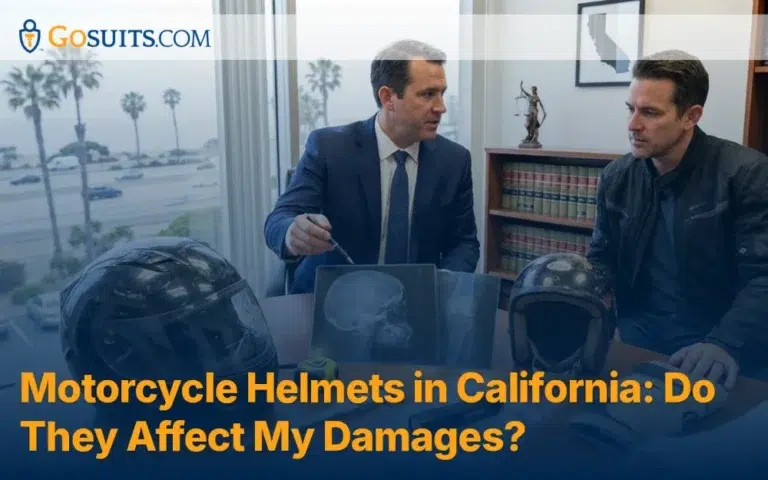
California law requires every motorcycle rider and passenger to wear a safety helmet that meets federal standards. Riding without a compliant helmet does not bar an injury claim, and it does not reduce overall damages across the board. Under California’s pure comparative fault system, a helmet defense is a targeted argument: the at-fault party can ask a jury to reduce compensation only for the specific head injuries that a proper helmet would have prevented, not for every category of harm. A rider who suffered a broken leg, road rash, or internal injuries while not wearing a helmet has no reduction to those damages simply because a helmet was absent. The argument must be supported by expert testimony tying the failure to wear a helmet to a specific, identifiable worsening of head-related injuries.
Legal Snapshot
- Legal Topic: Motorcycle Helmet Requirement and Comparative Fault in Personal Injury Claims
- Jurisdiction: California (Irvine, Orange County; statewide application)
- Case Stage: Pre-litigation through trial
- Primary Legal Issue: Whether helmet non-compliance reduces a rider’s damages, and to what extent
- Primary Authority: California Vehicle Code § 27803; 49 CFR § 571.218 (FMVSS No. 218); California Civil Code § 1714 (comparative fault framework)
- Date Legal Authority Last Reviewed: July 2025
What Does California Vehicle Code Section 27803 Require?
California Vehicle Code § 27803 establishes a universal helmet requirement for all persons operating or riding as passengers on a motorcycle, motor-driven cycle, or motorized bicycle on any public highway. The statute applies equally to the driver and every passenger, there is no age threshold above which the requirement is waived, and there is no exception for experienced riders.[1]
The law defines what it means to “wear” a helmet: the helmet must sit on the person’s head, be fastened with the chin strap, and fit securely without excessive lateral or vertical movement. A helmet carried on the handlebars or resting loosely on the head without a fastened strap does not satisfy the statute.
Section 27803 delegates the substantive safety specifications to a separate provision, Vehicle Code § 27802, which in turn incorporates the federal safety standard. That federal standard is Federal Motor Vehicle Safety Standard No. 218, codified at 49 CFR § 571.218. FMVSS 218 establishes minimum performance requirements for impact attenuation, penetration resistance, and retention system integrity. A compliant helmet must be labeled with a DOT certification mark on the rear exterior surface. Helmets that display only a decorative or sticker-applied “DOT” mark without actually meeting the underlying performance tests are not compliant with the statute.[2]
The passenger and driver obligations are identical under the statute. A passenger who rides without a compliant helmet is personally in violation of § 27803(c). In a civil case, that violation may be raised against the passenger in the same way it might be raised against a driver who rode without one.
How Does a Helmet Defense Actually Work in a California Civil Claim?
California is a pure comparative fault state. Under this system, a plaintiff’s recovery is reduced only by the percentage of fault attributable to that plaintiff. A defendant who argues that an injured rider contributed to their own harm by not wearing a compliant helmet is raising a species of comparative fault but it is a limited one.[3]
The helmet defense does not function as an all-or-nothing bar to recovery. Courts applying California comparative fault principles recognize that non-helmet use is relevant only to the injuries a helmet could have prevented, most obviously traumatic brain injuries, skull fractures, facial lacerations at the helmet coverage zone, and similar head trauma. The defense has no logical application to:
- Fractures of the limbs, pelvis, or spine
- Internal organ injuries
- Road rash or soft-tissue injuries to the torso and extremities
- Property damage to the motorcycle
- Pre-impact economic losses
A jury presented with a helmet defense is expected to evaluate each category of harm and, where the defense applies, apportion the reduction only to the specific head injuries that expert testimony establishes would have been different had the rider worn a compliant helmet. Without that expert foundation, the argument is likely to be legally insufficient.
Riders who sustained only orthopedic injuries, broken wrists, a fractured clavicle, tibial fractures common in low-side crashes face a helmet argument that carries little practical weight. If no head injury occurred, the absence of a helmet is simply irrelevant to the damages at issue.
What If a Rider Wore a Novelty Helmet or a Non-Compliant Helmet?
A novelty helmet, sometimes marketed as a “shorty,” “skullcap,” or similar style typically does not meet FMVSS 218. These helmets are often thin-shelled, lack adequate impact-absorbing liner material, and cannot pass the impact attenuation tests required by the federal standard. A helmet that carries a decorative DOT sticker but was never tested or certified to the standard’s performance requirements is treated as non-compliant, regardless of how it is labeled.
Wearing a novelty helmet raises a factual question that goes to the core of the comparative fault analysis: would a compliant helmet have prevented or reduced the specific head injuries that the rider suffered? If the novelty helmet provided near-zero impact protection, a jury could find the effect comparable to wearing no helmet at all. If the novelty helmet provided some limited protection, the analysis becomes more nuanced, and the expert testimony becomes correspondingly more important.
On the other hand, the mere existence of a non-compliant helmet does not transform a defendant’s liability into something lesser. The defendant still bears responsibility for the negligent conduct that caused the crash, whether that was an unsafe lane change on State Route 55 near Santa Ana, a failure to yield at an intersection in Anaheim, or any other negligent act. The helmet issue only reaches the damages that would otherwise flow from the collision.
A practical consideration: an insurer or defense attorney who discovers that a rider wore a novelty helmet will often raise the compliance question early. That makes it important to preserve the helmet and document its specifications and labeling before any dispute over its compliance status arises.
What Does a Damaged Helmet Tell Investigators and Attorneys?
A helmet that was worn during a crash is a physical record of the forces experienced by the rider’s head. The location, depth, and pattern of damage to the outer shell and the foam liner can help reconstruct the point of impact, the direction of the strike, and the magnitude of the forces transmitted. Crash reconstruction professionals and biomechanical engineers routinely examine helmet damage as part of a broader analysis of how an injury occurred.
Helmet evidence is relevant in several ways:
- Impact confirmation: Scuffing, cracking, or compression of the EPS foam liner at a specific location corroborates that the rider’s head struck a surface at that region, supporting or contradicting a particular sequence of events.
- Force magnitude: Deep compression of the liner, fracturing of the outer shell, or crush deformation can assist experts in estimating the energy transmitted to the skull and brain, providing a basis for opinions about whether a particular injury pattern is consistent with the documented forces.
- Causation disputes: In cases where the at-fault party argues that a head injury was pre-existing or minor, visible helmet damage may directly contradict that position.
- Compliance documentation: The DOT certification label and the manufacturer’s sizing and construction information are printed on or inside the helmet. This information establishes whether the helmet satisfied the federal standard and, if it did, supports the argument that the rider took reasonable precautions.
Because of this evidentiary value, the helmet should be preserved in the same condition it was found after the crash. It should not be cleaned, repaired, repainted, or discarded. Ideally, it should be stored in a sealed bag or box and kept away from heat and solvents, which can alter or degrade the foam liner and potentially change the physical characteristics that an expert would need to examine. Alerting an attorney to the existence of the helmet early, before well-meaning family members or insurance adjusters handle or photograph it extensively protects its integrity as evidence.
How Does This Apply in a Real Case?
The following is a hypothetical example for illustrative purposes only. It does not represent an actual GoSuits case or any specific incident.
Example: A motorcyclist is riding northbound on I-405 near Irvine during heavy stop-and-go traffic when a driver in the adjacent lane merges without signaling and strikes the motorcycle. The rider goes down and suffers a fractured right femur, severe road rash across the right arm and hip, and a concussion. The rider was wearing a novelty shorty helmet that did not carry a legitimate FMVSS 218 certification.
The at-fault driver’s insurer raises the helmet defense, arguing that a compliant helmet would have prevented or reduced the concussion. The rider’s attorney responds by retaining a biomechanical engineer who examines the helmet’s damage, the rider’s head strike trajectory as indicated by road rash and impact marks, and the published medical literature on concussion mechanics. The expert concludes that, given the impact forces involved and the low-velocity nature of the secondary head contact, a compliant helmet would have reduced but not eliminated the concussion risk.
In this scenario, the jury is asked to assess comparative fault only on the concussion-related damages, not on the femur fracture, not on the road rash, and not on the lost wages attributable to the orthopedic recovery. The femur injury had nothing to do with the helmet. The helmet’s relevance is confined to a subset of the total damage claim.
What Evidence Can Matter in a California Motorcycle Helmet Case?
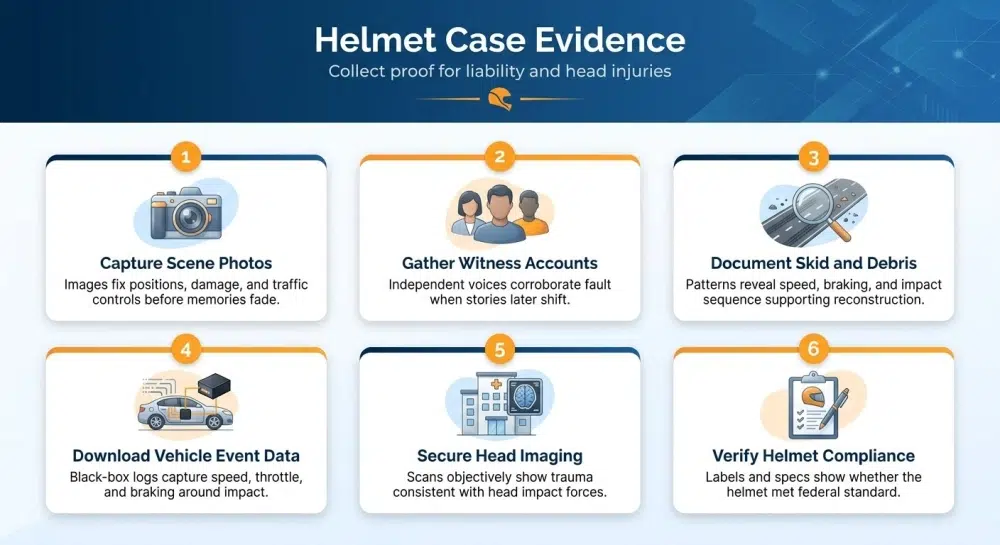
Evidence in a motorcycle injury case involving helmet questions typically spans two separate tracks: evidence going to the crash itself and liability, and evidence going to the helmet’s role in the injuries.
Evidence relating to the crash and liability:
- Police report and any traffic citation issued to the at-fault party
- Photographs and video from the scene, including dashcam and fixed surveillance footage
- Witness statements and contact information
- Skid marks, debris fields, and vehicle damage patterns
- Electronic data from vehicle systems (event data recorders)
- Cell phone records where distracted driving is alleged
Evidence relating to the helmet and head injuries:
- The physical helmet itself preserved in post-crash condition
- Photographs of the helmet taken at the scene before it was moved
- The DOT certification label and manufacturer’s specifications
- Emergency medical records documenting the initial head injury assessment
- Imaging studies (CT scans, MRI) showing intracranial or skull pathology
- Expert reports from biomechanical engineers, neurologists, or accident reconstructionists
- FMVSS 218 performance data for the specific helmet model, if available
Evidence suggesting that the other party was fully at fault for the collision, excessive speed, a red-light violation, an unsignaled lane change supports the underlying liability claim and provides context for understanding why the helmet issue should affect only a limited portion of the damages, if any.
What Damages or Remedies May Be Available?
A motorcyclist injured through another party’s negligence in California may pursue several categories of damages, subject to the facts of the case and applicable law. Recoverability depends on the specific injuries suffered, the evidence available, and any reduction attributable to comparative fault.
- Past medical expenses: Hospital costs, emergency treatment, surgery, rehabilitation, medications, and related care already incurred
- Future medical expenses: Projected costs of ongoing treatment, including physical therapy, follow-up surgeries, or long-term care needs
- Lost income: Wages, salary, or self-employment income lost during recovery
- Loss of earning capacity: Diminished ability to earn income in the future due to a permanent injury
- Physical pain and suffering: Compensation for the physical experience of the injury and recovery
- Mental anguish: Psychological suffering, anxiety, and emotional distress flowing from the injury
- Physical impairment and disfigurement: Permanent functional limitations or visible scarring
- Property damage: Repair or replacement of the motorcycle and riding gear
- Wrongful death damages: Where a crash proves fatal, the decedent’s family may have a separate claim that includes loss of financial support, loss of companionship, funeral expenses, and related losses
Where a defendant’s conduct was especially egregious, such as operating a vehicle while intoxicated punitive damages may potentially be available under California Civil Code § 3294, subject to meeting that statute’s heightened standard. That issue requires careful legal analysis of the specific facts.
The personal injury lawyers at our Irvine office serve riders throughout Orange County, including Newport Beach, Costa Mesa, Santa Ana, and Fullerton. If a crash proved fatal, our team also handles wrongful death claims under California law for families navigating the aftermath of a fatal motorcycle accident.
What If the Other Party Disputes Liability?
Defendants in motorcycle injury cases sometimes argue that the rider contributed to the crash itself, not just to the severity of injuries. Common arguments include allegations that the rider was speeding, lane splitting unsafely, or failing to maintain proper lane position. These are separate from the helmet issue and implicate different portions of the comparative fault analysis.
California’s pure comparative fault system means that even a rider found significantly at fault can still recover damages proportional to the defendant’s share of fault. A jury that finds a rider 30 percent at fault and the defendant 70 percent at fault would reduce the total damage award by 30 percent. Unlike modified comparative fault states, California imposes no cutoff that eliminates a plaintiff’s recovery at 50 or 51 percent fault.
Gathering strong liability evidence, physical evidence from the scene, surveillance footage along the SR-73 Toll Road or the I-405 interchange, and prompt witness statements is important precisely because disputes over the underlying collision can affect the entire recovery, not just the helmet-related portion of damages.
For a broader look at how other motorcycle-specific legal issues can affect your claim, the article on lane splitting legal in Irvine California motorcycle law explained addresses how lane-splitting conduct is evaluated in California civil cases.
What If Insurance Is Involved?
Most California motorcycle injury claims are resolved through negotiation with the at-fault party’s automobile liability insurer. The helmet compliance issue typically surfaces during the insurer’s investigation, because it is a recognized damages-reduction argument that trained adjusters are aware of. Insurers may use the non-compliance issue as leverage to reduce settlement offers, sometimes applying the reduction more broadly than California law supports.
An injured rider negotiating directly with a liability insurer without legal assistance may not know how narrow the helmet defense actually is or how to counter an insurer’s valuation. The insurer’s position that a non-compliant helmet justifies reducing the entire claim rather than just the head-injury component is overbroad and inconsistent with California’s comparative fault principles.
Uninsured and underinsured motorist (UM/UIM) coverage available on the rider’s own policy may also be relevant if the at-fault driver carried insufficient coverage to satisfy the claim. California law addresses how UM/UIM benefits interact with comparative fault findings, and those provisions can affect the net recovery available to an injured rider.
How Long Do I Have to Act?
California Code of Civil Procedure § 335.1 generally establishes a two-year statute of limitations for personal injury claims arising from negligence. This period typically begins running on the date of the injury. If a motorcycle crash victim dies from their injuries, the wrongful death limitations period under Code of Civil Procedure § 335.1 typically begins on the date of death, but this analysis can be affected by specific circumstances and requires legal verification.
Several exceptions and shorter deadlines may apply depending on the parties involved:
- Claims against a government entity: If the at-fault party is a government employee or if a public road defect contributed to the crash, the Government Claims Act imposes a six-month deadline to file an administrative claim with the relevant agency before any lawsuit can proceed. Missing this deadline can permanently bar the claim.
- Minor claimants: The limitations period may be tolled while an injured person is a minor, but the specific rules require confirmation in each case.
- Insurance reporting deadlines: Most auto insurance policies require prompt reporting of incidents; failure to report in a timely manner can affect coverage.
[DEADLINE REQUIRES LEGAL VERIFICATION] – The applicable deadlines in a specific case depend on the facts, the identity of all potentially liable parties, and the applicable law. Speaking with an attorney promptly after a crash preserves options that may otherwise be foreclosed by waiting.
What Should I Do Next?
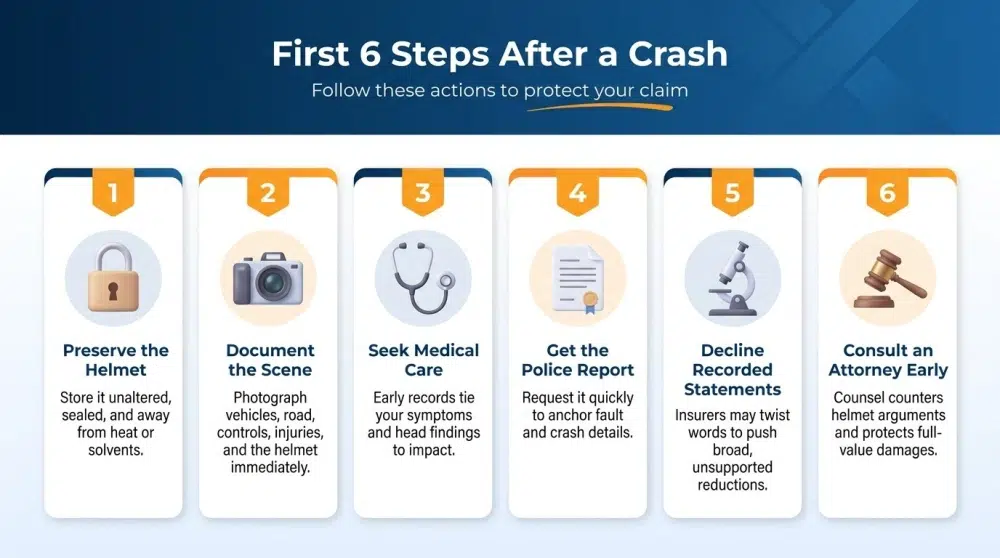
- Preserve the helmet: Secure the helmet used in the crash in an undisturbed condition. Do not clean it, repair it, or throw it away. Place it in a sealed bag or box away from heat and chemicals.
- Document everything at the scene: Photographs of both vehicles, the road, traffic control devices, skid marks, the helmet, and visible injuries are important even if police photographs also exist.
- Seek medical evaluation promptly: Delayed medical attention can complicate the link between the crash and any head injuries and may create arguments that injury symptoms predated the collision.
- Obtain the police report: Request a copy of the traffic collision report from the responding law enforcement agency as soon as it is available.
- Avoid recorded statements to opposing insurers: A liability insurer representing the other party has no obligation to protect your interests. Statements you make can be used to support a broader helmet-based reduction than the law allows.
- Consult an attorney before settling: Once a settlement release is signed, the claim is typically resolved for good, even if additional medical costs emerge later. Evaluating the full scope of damages including future expenses and any head-injury comparative fault exposure is important before agreeing to any amount.
Motorcycle accident claims in California, particularly those involving helmet compliance disputes, disputed liability on busy corridors like the SR-55 or I-5 through Orange County, and serious orthopedic or neurological injuries involve enough legal complexity that legal assistance is worth considering early. An attorney can assess the specific facts, identify all available coverage, retain the right experts, and respond to insurer arguments that overstate what the helmet defense can accomplish.
If you or a family member was injured in a motorcycle crash in Irvine or elsewhere in Orange County, a GoSuits personal injury attorney can review the circumstances of your case and explain your legal options at no charge. Schedule a free consultation to speak with our team.
What makes a helmet “compliant” under California law?
A compliant helmet must meet the requirements of 49 CFR § 571.218 (FMVSS No. 218). It must pass impact attenuation tests limiting peak acceleration and duration, a penetration test, and a retention system test. A legitimate DOT certification label placed on the rear exterior of the helmet, not an after-market sticker must identify the manufacturer, model, size, and month and year of manufacture. Helmets that display decorative “DOT” markings without meeting the underlying performance requirements are non-compliant regardless of how they are labeled.
If I only broke my leg in a motorcycle crash and did not hit my head, does the helmet issue matter?
Generally, no. The helmet defense is logically confined to head injuries. If the documented injuries are entirely orthopedic, fractures, soft-tissue tears, joint injuries and no head trauma occurred, helmet non-compliance has no causal connection to the damages claimed. A defendant raising the helmet argument in that scenario would face difficulty establishing the foundation required for the comparative fault reduction. The evidence would not support attributing any portion of a leg fracture to helmet absence.
Can the defense use a damaged helmet against me?
Helmet damage is a double-edged piece of evidence. The defense may argue that the visible damage shows the helmet absorbed forces, while also arguing that a “better” helmet would have absorbed more. Your attorney, working with a biomechanical expert, can use the same damage to demonstrate the forces the helmet actually absorbed and to corroborate your account of how the crash unfolded. This is why preserving the helmet undamaged, unwashed and unaltered is so important. Altering it, even with good intentions, can compromise an expert’s ability to analyze and explain the physical evidence. You can read about a recent Orange County motorcycle crash in this report: Orange County car accident claims.
My passenger was not wearing a helmet. Does that affect the passenger’s separate claim?
Vehicle Code § 27803 imposes the same helmet obligation on passengers as on drivers. A passenger riding without a compliant helmet is personally in violation of the statute. In a civil claim brought by that passenger, a defendant could raise the passenger’s helmet non-compliance as a comparative fault argument but again, only as it relates to head injuries the helmet would have prevented. The passenger’s claim for all non-head injuries remains intact regardless of helmet compliance. For a related story involving a passenger fatality in the region, see this report: Anaheim sidewalk crash injures pedestrians.
How long do I have to file a motorcycle injury lawsuit in California?
California Code of Civil Procedure § 335.1 generally sets a two-year period from the date of injury to file a personal injury lawsuit. If a government entity may be responsible, an administrative claim typically must be filed within six months of the incident under the Government Claims Act. These deadlines can be affected by the specific facts of a case, including the plaintiff’s age and whether additional parties are identified later. A legal consultation promptly after the crash is the most reliable way to protect against missing a controlling deadline.
Related California Personal Injury Resources
- personal injury lawyers in Irvine: GoSuits Irvine Practice Overview
- motorcycle accident lawyers in California: Practice Area Overview
- What Is the Most Common Motorcycle Accident Scenario?: GoSuits Knowledge Base
- How Much Is a Motorcycle Accident Settlement in California?: GoSuits Knowledge Base
- California Comparative Negligence in Car Accidents: GoSuits Knowledge Base
- Is Lane-Splitting Legal in Irvine, California? Motorcycle Law Explained: GoSuits Knowledge Base
- The Role of a Personal Injury Lawyer in Motorcycle Accident Cases in California: GoSuits Knowledge Base
Talk With a GoSuits Attorney
Motorcycle injury claims in California, particularly those involving helmet compliance questions, disputed liability on Orange County freeways and surface streets, and serious orthopedic or brain injuries benefit from careful legal analysis. The helmet defense is frequently misapplied by insurers, and riders who do not know how the law actually works may accept reductions they should not accept.
GoSuits personal injury lawyers represent injured motorcyclists and their families throughout California. Our Irvine office serves riders across Orange County, including those injured on State Route 73, the I-405, and the I-5 corridor through the Irvine Spectrum area and beyond. We handle motorcycle accident claims on a contingency fee basis, there are no attorney fees unless we recover for you.
If your injuries were serious enough to require medical attention, the claims process will involve insurance negotiations, potential litigation, medical liens, and legal deadlines. Speaking with an attorney early helps you understand your rights and avoid steps that could limit your recovery. Schedule a free consultation with the GoSuits team today.
Learn more about prior cases we have handled, meet our attorneys, read more about GoSuits, or explore our full range of practice areas.
References and Legal Authorities
- California Vehicle Code § 27803 – Motorcycle Helmet Requirement – California Legislative Information
- 49 CFR § 571.218 – Standard No. 218; Motorcycle Helmets – Cornell Legal Information Institute (e-CFR)
- California Civil Code § 1714 – Duty of Care and Comparative Fault Framework – California Legislative Information
- California Vehicle Code § 27802 – Safety Helmet Standards (Reference Standard for § 27803) – California Legislative Information
- California Code of Civil Procedure § 335.1 – Two-Year Statute of Limitations for Personal Injury – California Legislative Information
- California Government Code § 910 – Government Claims Act Administrative Claim Requirement – California Legislative Information
- California Civil Code § 3294 – Punitive Damages Standard – California Legislative Information
- Helmets Are Effective – National Highway Traffic Safety Administration (NHTSA)
- California comparative fault principles – California Legislative Information
- Assembly Bill 51 – Lane Splitting Authorization and CHP Guidelines Reference – California Courts (Historical Reference)