Short answer: Whether you must give a recorded statement in California depends entirely on which insurer is asking. The at-fault driver’s insurance company has no contractual authority over you; you are not their policyholder, and you are not required to give them a recorded statement. Your own insurer is different. California auto policies nearly always contain a cooperation clause that obligates you to assist in the insurer’s investigation, and that obligation typically includes a recorded statement for first-party claims such as uninsured motorist and underinsured motorist coverage. Understanding the difference before you pick up the phone can materially affect the outcome of your claim.
Legal Snapshot
- Legal Topic: Recorded statements; insurance cooperation clauses; California two-party consent
- Case Stage: Pre-litigation; claims investigation
- Primary Legal Issue: Whether a claimant is obligated to give a recorded statement to an adverse or first-party insurer
- Key Statutes: California Penal Code § 632 (two-party recording consent); California Insurance Code § 790.03 (unfair claims practices) [1] [2]
- Primary Authority: California Penal Code § 632; California Department of Insurance regulations; California Insurance Code Article 6.5
- Date Legal Authority Last Reviewed: July 2025
The Two-Insurer Distinction: Why It Changes Everything
After any car accident on the SR-73 Toll Road, along Jamboree Road, or anywhere else in Orange County, an injured person will typically hear from two separate insurers: the at-fault driver’s insurance company and their own insurance company. These are legally and contractually different relationships, and they produce different obligations.
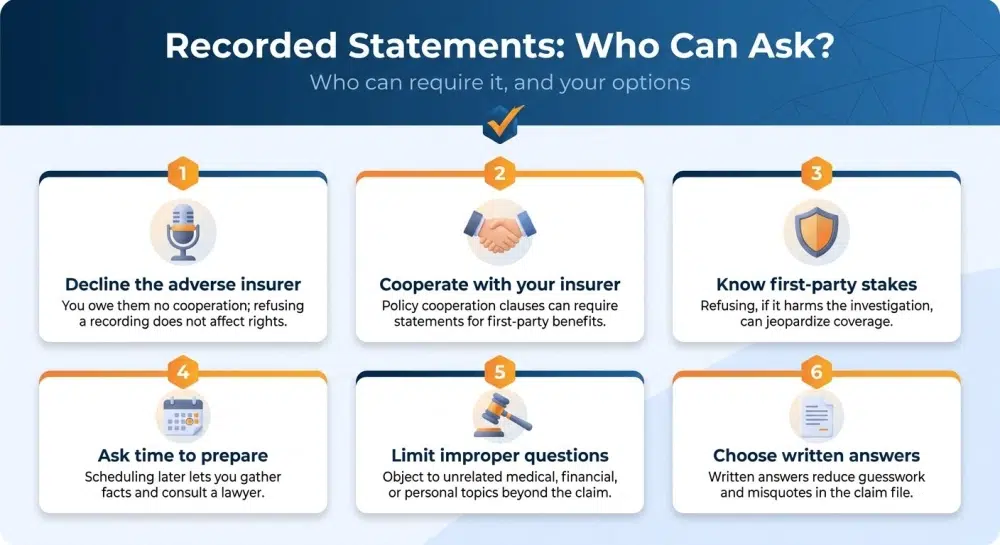
The adverse insurer is the insurance company of the driver who caused the crash. That company owes you money under its liability policy if its insured was negligent. But you have no contract with that company. You never agreed to cooperate with its investigations. California law does not require you to give the adverse insurer a recorded statement. Their adjuster may ask, and may even imply it is routine or required, but no policy provision, statute, or court rule requires you to comply. Politely declining is entirely lawful.
Your own insurer is the company you pay premiums to. You have a contract with them, and that contract almost certainly contains a cooperation clause. When you make a first-party claim under your own policy, including a claim for uninsured motorist benefits, underinsured motorist benefits, medical payments, or collision coverage, that cooperation clause generally applies. Refusing a recorded statement to your own insurer in connection with a first-party claim can give the company grounds to deny or delay that claim.
| Insurer | Your Relationship | Obligation to Give a Recorded Statement? |
|---|---|---|
| At-fault driver’s insurer (adverse insurer) | No contract; you are a claimant only | No. You may decline. No legal penalty attaches. |
| Your own insurer (first-party claim) | Policyholder; bound by cooperation clause | Generally yes, for UM/UIM and first-party claims. Refusal can jeopardize coverage. |
| Your own insurer (third-party claim only) | Policyholder reporting an accident to your carrier | Depends on policy language and whether you are seeking first-party benefits. Review your policy terms. |
California’s Two-Party Consent Rule and Recorded Calls
California is a two-party consent state for recordings. California Penal Code section 632 makes it unlawful for a person to intentionally record a confidential communication without the consent of all parties. [1] A phone conversation with an insurance adjuster generally qualifies as a confidential communication under this section.
The practical consequence: an insurance adjuster may not legally record your call without informing you and obtaining your consent. In practice, adjusters who record calls are supposed to announce the recording at the outset. If an adjuster begins asking substantive questions before disclosing that the call is being recorded, ask directly: “Is this call being recorded?” If the answer is yes, you may ask to continue the conversation in writing instead, or you may proceed with awareness of what is happening. Recording without disclosure can expose the insurer to civil liability under Penal Code section 637.2, which provides a private right of action. [1]
How Adjusters Use Recorded Statements
Insurance adjusters are trained to conduct recorded statements in ways that benefit the insurer. Understanding the mechanics helps you recognize the risks. A recorded statement is transcribed, stored in the claim file, and can be produced in discovery if the case goes to litigation. Anything you say can be used to challenge your credibility or contradict later testimony.
The following categories of questions create the most risk in a recorded statement:
1. Speed, Distance, and Reaction Time
Adjusters frequently ask questions like, “How fast were you going?” or “How far away was the other car when you first saw it?” Answering with any number locks you in. If your memory later sharpens or an accident reconstructionist demonstrates that the speeds were different from your estimate, the adjuster will use your recorded answer to argue that you are inconsistent or unreliable. People are notoriously poor at estimating speed and distance under stress.
2. Statements About Your Physical Condition
The most damaging thing a claimant can say in an early recorded statement is some version of “I feel fine” or “I wasn’t really hurt.” Serious injuries, including soft-tissue damage, traumatic brain injury, and spinal injuries, commonly have delayed symptom onset. Neck pain that appears minor on the day of a crash near the SR-55 interchange may develop into a months-long medical situation. An early statement that minimizes your condition will be used to argue that any later-diagnosed injury is unrelated to the crash.
3. Volunteering Fault Language
Phrases such as “I should have braked sooner,” “I didn’t see the light,” or even “I’m so sorry” are interpreted by adjusters as admissions. California follows a pure comparative fault system, meaning that any degree of shared fault assigned to you reduces your recovery proportionally. [3] Statements that hint at shared responsibility give adjusters grounds to push for a larger comparative fault allocation.
4. Pre-Existing Conditions
Adjusters ask about prior injuries or medical treatment. The question sounds routine, but the purpose is to build a record that can be used to attribute current symptoms to pre-existing conditions rather than the accident. California’s eggshell plaintiff doctrine means that a defendant takes the plaintiff as they are, even if the plaintiff was more vulnerable due to a prior condition. [4] A poorly framed answer about a prior injury can obscure this protection.
Uninsured and Underinsured Motorist Claims: A Special Obligation
The cooperation clause carries particular weight for uninsured motorist (UM) and underinsured motorist (UIM) claims. In these situations, your own insurer is essentially stepping into the shoes of the at-fault driver who either had no insurance or insufficient coverage. Courts have interpreted the cooperation clause broadly in the UM/UIM context, and California courts have generally held that an insured who refuses to give a recorded statement or otherwise refuses to cooperate in a UM/UIM claim may lose coverage if the refusal prejudices the insurer. [5]
Personal injury lawyers in Irvine who represent UM/UIM claimants will almost always arrange to be present during a recorded statement required by the client’s own insurer, or will negotiate the format of the statement, such as allowing written questions and answers rather than a live recorded call. That procedural flexibility is frequently available when the claimant is represented.
Understanding your UM/UIM rights in Orange County and when your own insurer can compel a statement is part of understanding how California insurance companies operate after an accident.
How Recorded Statements Move Through Discovery
If your claim moves to litigation, the recorded statement becomes a formal piece of evidence. The insurer or defense counsel will obtain a transcript, and that transcript will be available for use at deposition and at trial. Inconsistencies between the recorded statement and later deposition testimony are a standard defense tactic. Even innocent differences in phrasing can be magnified to suggest that a claimant is exaggerating or changing their story.
The statement is also a baseline for the adjuster’s assessment. An adjuster who reads a recorded transcript in which a claimant minimizes symptoms will initially value the claim lower. Reversing that first impression after the medical records come in is harder than starting with a careful, accurate statement in the first place.
What You Can Reasonably Decline or Defer
Even when a recorded statement is required by your own insurer, certain limitations protect you:
- You can request adequate time to prepare. There is no obligation to give a recorded statement within 24 hours of a crash. Asking for a few days to gather your thoughts and consult an attorney is reasonable.
- You can have an attorney present. When you are represented, the attorney can object to improper or misleading questions and can ensure the statement is accurate.
- You can object to questions outside the scope of the claim. Questions about unrelated medical history, finances, or other matters not relevant to the covered claim may exceed what cooperation clauses require.
- You can ask for the statement to be conducted in writing. Some insurers will accept written answers to written questions, which gives you time to review your responses carefully.
- Regarding the adverse insurer: You may decline entirely and direct all communications to your attorney or to the insurer by letter only.
Correcting a Statement You Already Gave
Giving a recorded statement before understanding these issues is common. Many people speak with adjusters the same day as the crash, when they are still in shock and may not yet know the extent of their injuries. A statement given under those circumstances is not necessarily fatal to a claim, but it requires attention.
A prior statement cannot be erased, but it can be supplemented. Approaches that may help include:
- Providing a written statement to the adjuster that clarifies or corrects specific points, noting that symptoms were still developing and were not yet fully apparent at the time of the recorded statement.
- Ensuring that all treating physicians document the onset and progression of symptoms accurately, so the medical record tells a complete story that is consistent with delayed onset.
- Having an attorney review the original transcript and identify any damaging statements that need to be addressed before settlement negotiations begin or litigation is filed.
California Insurance Code section 790.03 identifies certain insurer practices as unfair claims settlement practices, including the failure to promptly investigate claims and the use of unreasonable interpretations of policy language. [2] An insurer who relies on an early, ambiguous recorded statement to deny an otherwise valid claim may be engaging in conduct that raises bad faith concerns, which an attorney can evaluate.
What Evidence Supports a Claim When No Statement Is Given
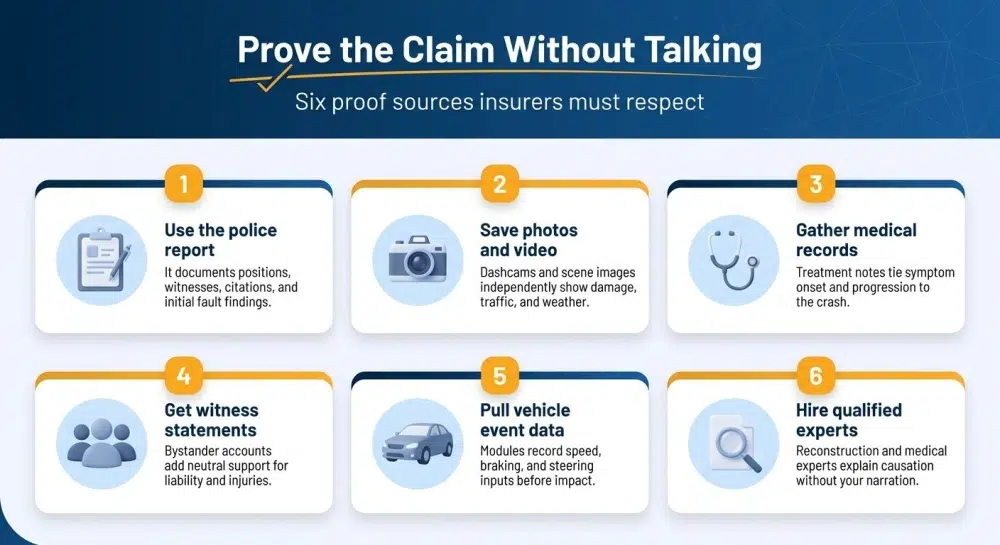
Declining to give a recorded statement to the adverse insurer does not leave a claim without evidentiary support. Other evidence categories that support a personal injury claim in California include:
- Police report: The CHP or local law enforcement report typically documents vehicle positions, witness statements, citations, and initial fault determination.
- Photographs and video: Dashcam footage, intersection cameras, and cell phone photographs of the scene and vehicle damage provide independent documentation.
- Medical records and bills: Comprehensive medical documentation from emergency rooms, urgent care, and treating physicians establishes the nature, onset, and progression of injuries.
- Witness statements: Bystanders or passengers who observed the crash can provide accounts not subject to the same credibility attacks as statements by the injured party.
- Vehicle event data: Modern vehicles store electronic data including speed, braking, and steering inputs that may be extracted with appropriate legal process.
- Expert testimony: Accident reconstructionists and medical experts can provide opinions that do not depend on a claimant’s recorded statement.
Potential Damages in a California Injury Claim
The damages available in a California personal injury claim are not reduced by the fact that a claimant declined to give a recorded statement to the adverse insurer. Recoverable categories may include:
- Past and future medical expenses, including surgery, physical therapy, imaging, and prescriptions
- Lost wages and diminished earning capacity
- Physical pain and mental anguish
- Physical impairment and disfigurement
- Property damage and loss of use of a vehicle
Recoverability and amount depend on the applicable law, the facts of the specific case, and the evidence supporting each category of loss. No outcome is guaranteed.
How Long Do You Have to File a Claim in California?
In California, the statute of limitations for most personal injury claims is two years from the date of the injury. [6] Claims against a government entity require a government tort claim to be filed with the relevant agency within six months of the incident under the California Government Claims Act. [7] These deadlines apply independently of the insurance claims process. Missing them can eliminate the right to recover compensation entirely.
Talk With a GoSuits Attorney
A recorded statement is one of the most consequential things that happens early in a California injury claim. If you have received a request for a statement from any insurer, or if you have already given one and have questions about what it means for your claim, a GoSuits personal injury attorney in Irvine can review the circumstances and explain your options at no cost.
No attorney fees unless you recover. Learn about our contingency fee structure.
GoSuits California Resources
References and Legal Sources
- California Penal Code § 632 – Invasion of Privacy / Confidential Communications Recording – California Legislative Information
- California Insurance Code § 790.03 – Unfair Methods of Competition and Deceptive Acts – California Legislative Information
- California Civil Code § 1714 – Liability for Negligence; Comparative Fault Principles – California Legislative Information
- Eggshell Skull Doctrine in California – GoSuits Knowledge Base
- Uninsured / Underinsured Motorist Coverage in California – GoSuits Knowledge Base
- California Code of Civil Procedure § 335.1 – Two-Year Limitation Period for Personal Injury – California Legislative Information
- California Government Code § 911.2 – Six-Month Government Claims Deadline – California Legislative Information
- California Department of Insurance – Consumer FAQs on Auto Insurance Claims
- California Penal Code § 637.2 – Civil Liability for Unlawful Recording – California Legislative Information
- CourtListener – Federal and State Case Law Research