- What Is the Deadline to File a Car Accident Lawsuit in California?
- When Does the Two-Year Clock Start Running?
- What Happens If You Miss the California Car Accident Lawsuit Deadline?
- Are There Exceptions That Extend the Filing Deadline?
- What If a Government Vehicle or Entity Was Involved?
- Is the Deadline Different for Property Damage Claims?
- What If a Minor Was Injured in a California Car Accident?
- What Is the Deadline for a Wrongful Death Claim After a Car Accident?
- Why Should You Act Well Before the Deadline Expires?
- How Does the Statute of Limitations Affect Both Plaintiffs and Defendants?
- Are There Local Considerations for Irvine and Los Angeles Car Accident Cases?
- How GoSuits Helps California Car Accident Victims
- References and Resources
What Is the Deadline to File a Car Accident Lawsuit in California?
If you were injured in a car accident in California, you generally have two years from the date of the accident to file a personal injury lawsuit against the at-fault driver or other responsible parties. This rule comes directly from California Code of Civil Procedure § 335.1, which states that an action for injury to, or for the death of, an individual caused by the wrongful act or neglect of another must be brought within two years. [1]
Missing this deadline almost always means losing your right to pursue compensation in court permanently. California courts strictly enforce the statute of limitations, and the at-fault party’s attorney will move to have your case dismissed if you file even one day late. If you have been injured or lost a loved one in a crash, speaking with car accident lawyers as soon as possible will help protect your rights before time runs out.
When Does the Two-Year Clock Start Running?
In most car accident cases, the two-year period begins on the date the collision occurred. This is because the injury is immediate and obvious: the harm arises at the moment of impact, and California law considers the cause of action “accrued” at that point.
However, there are situations where the starting date is not so straightforward. The discovery rule can apply when an injured person did not and reasonably could not know about the injury or its connection to a specific act of negligence. [2] In such cases, the two-year period may begin when the injury is discovered, or when it reasonably should have been discovered through ordinary diligence. This scenario is more common in cases involving latent injuries, such as a traumatic brain injury whose full extent became apparent weeks after the crash.
Key dates to track from the very first day after an accident include:
- The exact date and time of the collision this is your baseline filing deadline anchor.
- The date you first received medical treatment medical records time-stamp your injuries.
- Any written communications with insurance adjusters these can affect what facts are on record.
- Any deadline letters or coverage denial notices these may trigger separate response windows.
Do not rely on a rough estimate of your deadline. Confirming the precise start date with personal injury lawyers protects you from inadvertent waiver.
What Happens If You Miss the California Car Accident Lawsuit Deadline?
If you file your lawsuit after the California personal injury statute of limitations has expired, the defendant’s legal team will file a motion to dismiss. California courts will grant that motion in virtually every circumstance. You will lose the right to:
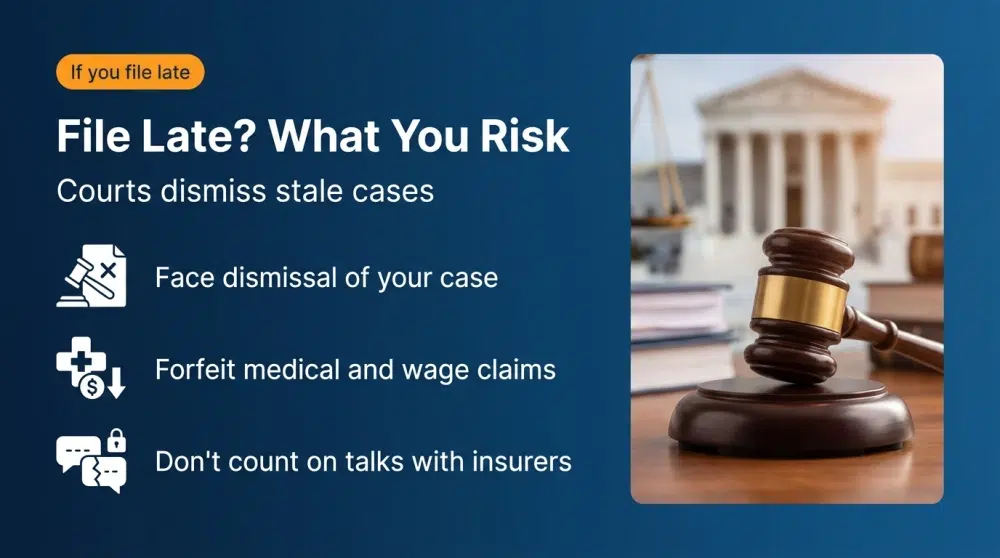
- Recover medical expenses past and future treatment costs become unrecoverable through litigation.
- Claim lost wages and future earning capacity economic losses you suffered due to the accident can no longer be pursued in court.
- Seek compensation for pain and suffering non-economic damages are forfeited along with everything else.
- Hold the negligent party accountable no court judgment means no enforceable legal responsibility.
Some people mistakenly believe that ongoing insurance negotiations “pause” the lawsuit clock. They do not. The car accident claim deadline in California runs independently of any settlement discussions. Insurance companies are well aware of this, and some use lengthy negotiations as a strategy to run out your legal time. If a fair settlement has not been reached and the deadline is approaching, a lawsuit must be filed to preserve your rights.
Are There Exceptions That Extend the Filing Deadline?
California law provides several tolling provisions legal pauses in the countdown that can extend the two-year window under specific circumstances. Understanding these is important, but you should never count on them without confirming they apply to your situation with a qualified attorney.
Is the Deadline Extended If the Plaintiff Was a Minor?
Yes. When the injured person is a minor (under 18 years of age) at the time of the accident, the two-year period does not begin until the minor turns 18. This means the minor has until their 20th birthday to file a personal injury lawsuit, regardless of when the accident occurred. [3] There is an important exception: if a lawsuit is brought on the minor’s behalf by a parent or guardian during the minor’s childhood, the child’s own tolling right does not apply to that earlier lawsuit.
Does Mental Incapacity Toll the Statute of Limitations?
Under California Code of Civil Procedure § 352, if a person is mentally incapacitated at the time the claim arises, the statute of limitations is tolled until the disability is removed. This provision requires a careful legal analysis of the degree and duration of incapacity, and it does not apply automatically. [3]
What If the Defendant Left California After the Accident?
California law generally pauses the limitations period for the time during which a defendant is absent from the state, making them difficult or impossible to serve with a lawsuit. If the at-fault driver lived in another state or relocated after the crash, this tolling provision may apply.
Can Fraud or Intentional Concealment Extend the Deadline?
If the defendant actively concealed facts that prevented you from discovering your injury or the defendant’s identity, the limitations period may be tolled until you discovered or reasonably should have discovered those facts. This exception is narrow and fact-specific.
What If a Government Vehicle or Entity Was Involved?
Car accidents involving government-owned vehicles or government employees driving in the scope of their duties follow a very different and much shorter timeline. If a city bus, county vehicle, state employee’s car, or any other government entity is involved, California’s Government Claims Act imposes strict prerequisites before you can file a lawsuit. [4]
You must first file an administrative claim with the specific government agency within six months of the date of the injury. This is not the same as filing a lawsuit it is a mandatory pre-filing notice. If the government agency rejects your claim (or fails to respond within 45 days), you then have only six months from the date of the written rejection notice to file your lawsuit in court, under California Government Code § 945.6. [5]
The consequences of missing the government claims deadline are the same as missing the civil statute of limitations: you lose your right to sue. If your accident involved:
- A Caltrans vehicle or road defect
- A city or county bus (such as MTA in Los Angeles)
- A law enforcement vehicle
- A public school district vehicle
…then the six-month government claims deadline applies and moves faster than the standard two-year window. If you are unsure whether a government entity is involved in your accident, it is critical to consult with injury compensation lawyers before any deadlines pass.
Is the Deadline Different for Property Damage Claims?
Yes. If your car or other property was damaged in a crash and you want to sue for those repair costs rather than personal injuries, California’s statute of limitations for property damage is three years from the date of the incident, under California Code of Civil Procedure § 338. [6]
In practice, most car accident victims pursue property damage through insurance negotiations rather than litigation. However, if those negotiations fail, the three-year window gives you slightly more time than the two-year personal injury deadline. Note that if you have both personal injury and property damage claims arising from the same accident, the shorter two-year period governs your personal injury claim. Missing the personal injury deadline does not preserve your right to go back and recover medical costs through a property damage theory.
What If a Minor Was Injured in a California Car Accident?
As noted above, the limitations period is tolled for injured minors in California. [3] But there are practical reasons why waiting until the minor turns 18 is rarely the right approach:
- Evidence deteriorates over time. Surveillance footage is overwritten, witnesses’ memories fade, and physical evidence from the accident scene may no longer be available years later.
- Medical documentation becomes fragmented. Keeping a clear chain of medical records is easiest immediately after the injury.
- Insurance policies may lapse or change. The at-fault party’s liability coverage information may be harder to trace years later.
In many cases, a parent or legal guardian can file a lawsuit on the minor’s behalf well before the child turns 18. The settlement or judgment proceeds are typically deposited into a court-supervised account for the minor’s benefit. Consulting with personal injury lawyers promptly after a child is injured in a car crash helps preserve the quality of the evidence and the value of the claim.
What Is the Deadline for a Wrongful Death Claim After a Car Accident?
When a car accident causes a fatality, surviving family members typically spouses, children, and sometimes parents may bring a wrongful death claim under California Code of Civil Procedure § 377.60. [7] The statute of limitations for a wrongful death lawsuit in California is also two years, but it begins on the date of the decedent’s death, not the date of the accident. If a person is critically injured in a crash and dies several weeks later, the two-year period for the wrongful death claim starts from the date of death, not the collision date.
This creates a nuanced situation: the estate may also have a separate survival action for the decedent’s own pain and suffering before death, which is governed by the same two-year period but measured from the accident date. If you have lost a family member in a traffic collision, our Los Angeles personal injury team urges you to act quickly the emotional weight of loss can cause these deadlines to pass unnoticed. fatal crash attorneys in Los Angeles are familiar with these overlapping timelines.
Who Can File a Wrongful Death Claim in California?
Under § 377.60, wrongful death claims may be brought by:
- The surviving spouse or domestic partner
- The decedent’s children
- The decedent’s parents (if there is no surviving spouse or children)
- Other heirs who were financially dependent on the decedent
Why Should You Act Well Before the Deadline Expires?
The California car accident lawsuit deadline is two years, but building a strong civil case requires time long before the courthouse steps. Here is why early action matters so much:
Evidence Is Time-Sensitive
Traffic camera footage, dashcam recordings, and cell phone data are often overwritten or deleted within days or weeks of an accident. Skid marks fade. Witnesses move. If you want this evidence preserved for use in your case, a legal team must act quickly to send evidence preservation letters, secure surveillance footage through formal requests, and retain accident reconstruction professionals when necessary.
The Opposing Party Is Already Protecting Themselves
The at-fault driver’s insurer assigns an adjuster to the claim almost immediately after the crash. That adjuster is gathering evidence and assessing liability from day one with the insurer’s interests in mind, not yours. Waiting months or years before consulting with car accident lawyers means you are without advocacy during a period when the other side is building their defense.
Medical Treatment Records Must Be Comprehensive
California courts and insurance adjusters look carefully at the consistency and continuity of medical treatment. Gaps in treatment whether caused by financial barriers, delayed symptoms, or simple oversight can be used to argue that your injuries were not as serious as claimed. Beginning treatment promptly and maintaining documentation creates the clearest possible record linking the crash to your injuries.
Settlement Negotiations Take Time
Trials are rare. Most car accident cases in California settle, but meaningful settlement talks don’t kick off until you hit something called maximum medical improvement, MMI for short. It’s basically the moment doctors can size up the full picture of your injuries. The problem? MMI can take a while. If yours doesn’t arrive until 18 months in, you’ve barely got any negotiation runway, and zero runway if talks collapse and a lawsuit has to be filed before the two-year mark. Starting early gives your legal team room to actually negotiate from a position of strength instead of panic. For a closer look at what to do right after a crash, see our guide on how much time you have to take legal action after a car accident .
How Does the Statute of Limitations Affect Both Plaintiffs and Defendants?
The California personal injury statute of limitations operates differently depending on which side of the case you are on, and understanding both perspectives is important for a complete picture.
The Plaintiff’s Perspective
Two years. That’s the window for anyone injured in a California accident. Doesn’t matter where you got hurt. LA area, anywhere in Orange County, around Irvine, the rest of the state. Same deadline. File within two years or that right is gone. The thing I see happen a lot? Someone gets hurt, decides early they don’t want to sue, then months later their situation changes and they reconsider, only to find out the window already closed. There’s nothing to do at that point. So even if you’re on the fence, even if you’re pretty sure you don’t want to file, talking to a personal injury attorney early is kind of a no-brainer. Consultations are free. Losing your legal rights isn’t.
The Defendant’s Perspective
Flip side now. Defendants and their insurance companies actually love these deadlines. The reason is simple. Certainty. After two years go by, they’re untouchable on that particular accident claim. Nobody can drag them into court anymore. And honestly, this is part of why some insurers will slow-walk a settlement on purpose. The logic isn’t complicated. If they can keep stringing you along until the filing deadline slips past, and no lawsuit has been filed, your claim is gone. Just like that. They get to raise the statute of limitations as an affirmative defense, and the courts will back them up. Every time.
Here’s something else that catches people off guard. California is a pure comparative fault state. What does that mean in practice? Even if you carry some of the blame for the accident, you can still recover damages, but they get knocked down by whatever percentage of fault is assigned to you. [8] Defendants know this and use it constantly. They’ll push to bump your share of fault as high as possible because it directly cuts what they owe. Wrapping your head around California’s comparative negligence rules before the statute of limitations runs out? That’s another reason not to put off talking to a lawyer.
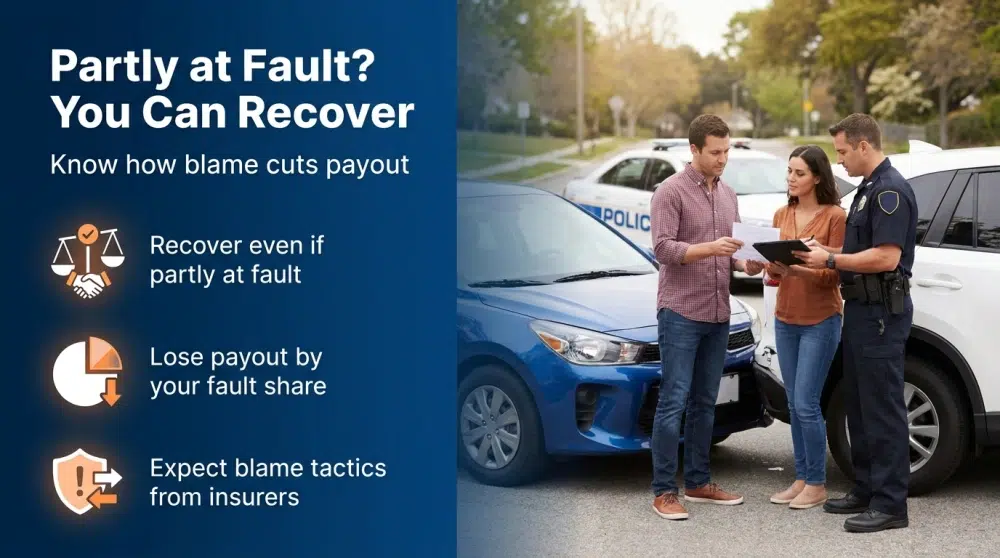
Here’s something else that catches people off guard. California is a pure comparative fault state. What does that mean in practice? Even if you carry some of the blame for the accident, you can still recover damages, but they get knocked down by whatever percentage of fault is assigned to you. [8] Defendants know this and use it constantly. They’ll push to bump your share of fault as high as possible because it directly cuts what they owe. Wrapping your head around California’s comparative negligence rules before the statute of limitations runs out? That’s another reason not to put off talking to a lawyer.
Are There Local Considerations for Irvine and Los Angeles Car Accident Cases?
California’s statewide two-year statute of limitations applies uniformly across all counties, including Orange County (where Irvine is located) and Los Angeles County. However, there are local practical realities that affect how these cases unfold.
Los Angeles County Court Considerations
LA Superior Court is slammed. Truly. The volume of civil litigation moving through that system is staggering, which means trial dates can sit further out than they would in a smaller county. So filing early isn’t just about the statute of limitations. It’s also about claiming your spot in the queue before everyone else does. And just so it’s on your radar, accidents in nearby communities like Long Beach, Torrance, Glendale, Burbank, and Pasadena all funnel into the LA County court system too. Same court. Same backlog.
Car crashes are still a huge issue down here. Anyone who’s driven the 405 on a weekday already knows that, but the numbers back it up. NHTSA data consistently puts California near the top of the list for annual traffic fatalities. [9] Which, when you really think about it, kind of makes sense. Tens of millions of drivers. Some of the busiest freeways in the entire country. Car accident injury claims aren’t exactly rare around here. Unfortunately.
Orange County and Irvine Considerations
If your accident happened in Irvine, Costa Mesa, Newport Beach, Santa Ana, Fullerton, or Huntington Beach, you’re probably looking at Orange County Superior Court. It’s a different animal from LA. Their own local rules. Their own way of doing things. And cases there sometimes move at a pace that’s noticeably different from what you’d see up in LA County. The statute of limitations stays the same, two years, that part doesn’t change. But knowing how OC courts actually handle their procedures? That’s where local experience really starts to matter.
For accidents involving rideshare vehicles (Uber or Lyft), which are common throughout Orange County and greater Los Angeles, additional insurance coverage layers and corporate liability questions arise that can complicate both the claim deadline analysis and the actual litigation process.
How GoSuits Helps California Car Accident Victims
How Gosuits Los Angeles Helps Injury Victims
A car accident can flip your life upside down in seconds. We get that. At GoSuits, we also get that trying to figure out California’s legal system while you’re still healing is, honestly, a lot to ask of anyone. So if you or someone in your family got hurt in a crash anywhere in California, the greater LA area, all over Orange County, out in Irvine, wherever, a free consultation with our personal injury team can lay it out for you. What your rights actually are. How much time you’ve got left to do something about it. No pressure, no fee, just clarity.
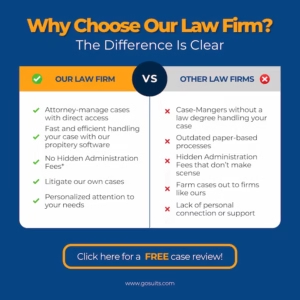
Here’s the short version of who we are. GoSuits is a personal injury firm that leans heavily on technology, and our attorney team brings more than 30 years of combined legal experience to the table. We practice in California, Texas, and Illinois. The thing that actually makes us different though? Every client gets a real attorney handling their case. Not a case manager. Not some paralegal relay system passing your file around. An actual lawyer, from intake through to whatever the outcome turns out to be. You get direct access. No gatekeepers. Which honestly just means you’re not sitting around wondering what’s happening with your claim.
What Makes GoSuits Different?
We have developed proprietary case management software that allows our attorneys to process, track, and analyze case data faster than conventional methods without replacing the human judgment and client relationships that determine outcomes. Our technology supports our legal team; it does not substitute for it. This means we can move efficiently on time-sensitive tasks like evidence preservation, demand letters, and filing deadlines, while still giving each client the individualized attention their situation deserves.
Our attorneys bring real trial experience to every case, including auto accident cases in California involving serious injuries, wrongful death, underinsured drivers, rideshare vehicles, and commercial trucks. That trial readiness influences how insurance companies approach settlement negotiations adjusters and defense counsel respond differently when they know the opposing firm is prepared and willing to go to court.
What Practice Areas Does GoSuits Handle in California?
Our California personal injury practice includes:
- Car accident claims including rear-end collisions, intersection crashes, DUI accidents, and highway incidents
- Truck and commercial vehicle accidents including semi-trucks, delivery vehicles, and fleet vehicles
- Motorcycle accidents for riders injured by negligent drivers throughout Southern California
- Wrongful death claims representing families who have lost loved ones in fatal crashes
- Rideshare accidents Uber and Lyft accident claims across Los Angeles and Orange County
- Workplace injuries and construction accidents
- Slip and fall and premises liability
Our team has recovered meaningful compensation for clients across a wide range of motor vehicle accident cases in California. You can review examples of past client outcomes on our prior cases page. To learn more about who we are and how we work, visit our about us page or browse our attorneys. A full overview of our services is available on our practice areas page.
When Should You Contact GoSuits After a California Car Accident?
The straightforward answer: as soon as you are physically able to do so. Reaching out early does not commit you to anything but it does give our team the time to preserve evidence, identify all potentially liable parties, and build the strongest possible foundation for your claim. Waiting costs you time, and time is the one resource the California car accident claim deadline does not give back.
Schedule your free consultation today by visiting our contact page. There is no fee unless we recover for you.
References and Resources
- California Code of Civil Procedure § 335.1 Two-Year Statute of Limitations for Personal Injury California Legislative Information
- Statute of Limitations Legal Information Institute, Cornell Law School
- California Code of Civil Procedure § 352 Tolling for Minors and Persons with Disabilities California Legislative Information
- California Government Code § 910 Government Claims Act Presentation Requirements California Legislative Information
- California Government Code § 945.6 Time Limit to Sue Public Entity After Claim Rejection California Legislative Information
- California Code of Civil Procedure § 338 Three-Year Statute of Limitations for Property Damage California Legislative Information
- California Code of Civil Procedure § 377.60 Wrongful Death Actions Who May Bring Them California Legislative Information
- California Civil Code § 1714 Pure Comparative Fault Standard California Legislative Information
- Fatality Analysis Reporting System (FARS) National Highway Traffic Safety Administration (NHTSA)
- California Courts Official Website of the California Judicial Branch
- Overview of the U.S. Court System United States Courts (uscourts.gov)
- U.S. Department of Justice Official Website