- What Is a Hit and Run Accident Under the Law?
- How Common Are Hit and Run Crashes?
- What Should You Do Immediately After a Hit and Run?
- Why Is a Police Report After a Hit and Run So Important?
- What Evidence Helps a Hit and Run Injury Claim?
- What Is an Uninsured Motorist Claim and How Does It Help?
- How Do Hit and Run Accident Claims Actually Work?
- How Much Is My Hit and Run Car Accident Settlement Worth?
- What Happens When a Hit and Run Causes a Wrongful Death?
- How Do Hit and Run Laws Differ in Texas, California, and Illinois?
- Hit and Run Claims in Dallas, Chicago, Irvine, and Los Angeles
- What Are the Perspectives and Obligations of the At-Fault Driver?
- How GoSuits Helps Hit and Run Victims
- References
What Is a Hit and Run Accident Under the Law?
A hit and run accident occurs when a driver involved in a crash leaves the scene without stopping to exchange information, render aid, or notify law enforcement, as required by law. From a civil standpoint, the fleeing driver’s conduct creates a distinct personal injury claim separate fromand often in addition tothe standard negligence cause of action that arises in any motor vehicle collision. [1]
If you have been injured by someone who drove away, you may feel frustrated, confused, and unsure where to turn. You are not alone, and you do have legal options. Understanding how hit and run accident claims work is the first step toward recovering what you have lost.
Every state treats the failure to stop and identify oneself after a crash as both a criminal and civil matter. Criminally, a driver who flees faces misdemeanor or felony charges. Civilly, the victim has the right to pursue compensation through multiple avenues, including their own insurance policy’s uninsured motorist coverage, their own insurer’s collision coverage, and in some cases, a direct civil lawsuit if the at-fault driver is later identified. Personal injury lawyers who handle these claims understand how to navigate all of those channels at once.
How Common Are Hit and Run Crashes?
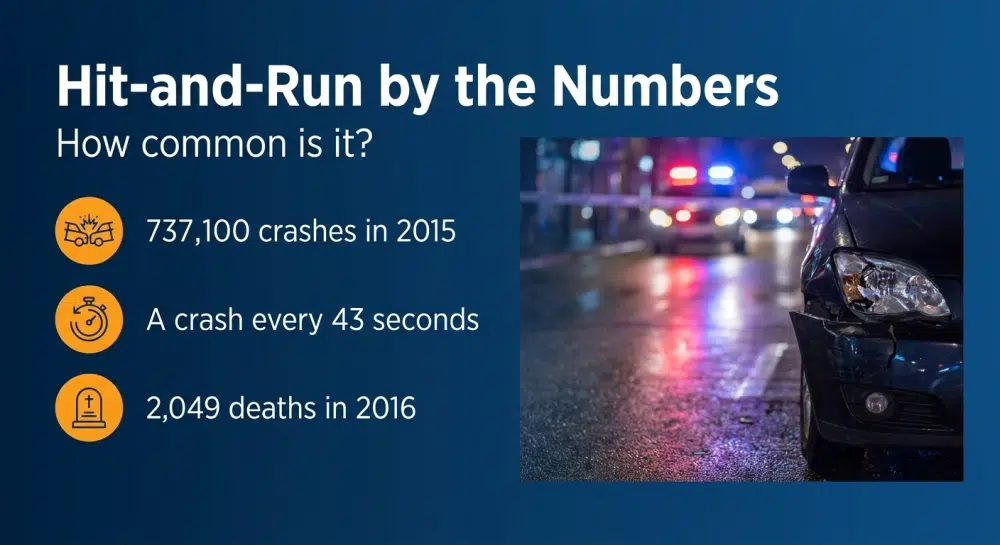
Hit and run collisions are far more common than most people realize, and the trend has been worsening. Research published by the AAA Foundation for Traffic Safety found that there were an estimated 737,100 hit and run crashes in the United States in 2015 alone, which translates to a hit and run happening somewhere in the country approximately every 43 seconds. [2] That same research found that 2,049 fatalities resulted from hit and run crashes in 2016, the highest number ever recorded at the time of the study.
Uninsured drivers. That’s a big chunk of the problem right there. The Insurance Information Institute says 15.4 percent of motorists were rolling around without coverage as of 2023, which works out to more than one in seven. [3] California’s pretty bad at 20.4 percent, Illinois isn’t far behind at 15.2, and Texas comes in at 14.5. Think about that for a second. A huge slice of the people sharing your lane don’t carry liability at all, and if one of them causes a wreck and bolts, your own coverage and your own legal strategy end up doing the heavy lifting.
Because car accident lawyers handle these files regularly, they know which insurance coverages apply, what investigation needs to happen quickly, and when the facts support a larger claim.
What Should You Do Immediately After a Hit and Run?
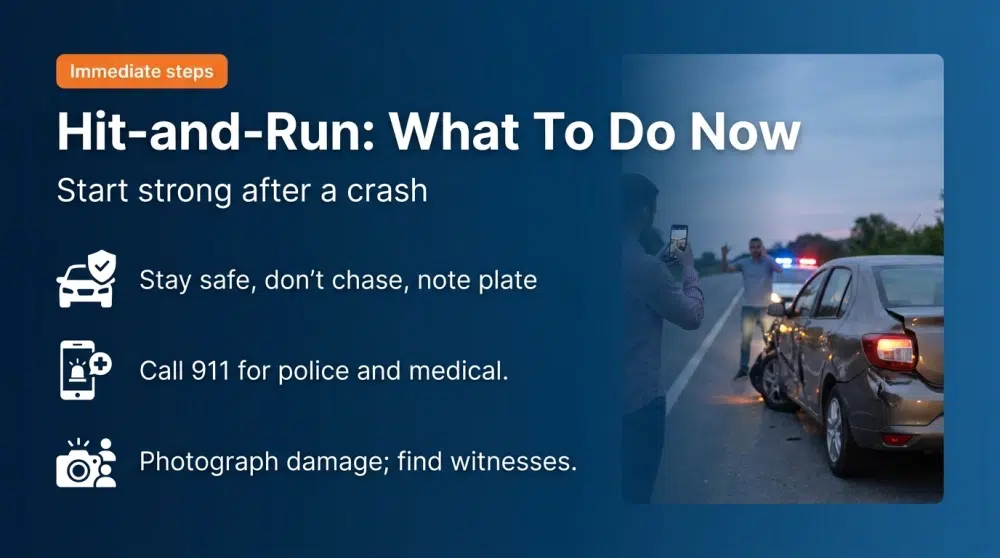
The moments right after a hit and run accident are critical both for your physical safety and for preserving your legal claim. Here is what you should try to do:
- Stay at the scene safely. Move out of traffic if possible, but do not chase the fleeing vehicle. Document any information you observed about the driver’s carcolor, make, model, partial license plate, direction of travel.
- Call 911 immediately. Request police and medical assistance. A law enforcement response creates the official record your claim will rely on.
- Photograph and document everything. Take photos of your vehicle damage, your injuries, the road conditions, skid marks, debris, and the surrounding area. If there are surveillance cameras nearby, note their locations.
- Gather witness information. Any bystander who saw the crash or the fleeing vehicle is valuable. Collect names and phone numbers before people disperse.
- Seek medical evaluation without delay. Even if you feel fine, some injuriesincluding traumatic brain injuries and internal injuriesmay not produce obvious symptoms immediately. A medical record ties your condition to the accident.
- Notify your own insurance company. Because the responsible driver is unknown or uninsured, your uninsured motorist (UM) coverage may be your primary recovery tool.
- Contact a personal injury lawyer before giving recorded statements. Insurers sometimes attempt to minimize claims. Speaking with an attorney first protects your rights.
Acting quickly on each of these steps gives your legal team the strongest foundation to work from. Every hour that passes can mean lost evidence, faded witness memories, and deteriorating camera footage that may have captured the fleeing car.
Why Is a Police Report After a Hit and Run So Important?
A police report after a hit and run is not just helpfulit is often required to activate your uninsured motorist coverage and to file a hit and run injury claim with your insurer. Most insurance policies contain language requiring that you report the collision to law enforcement within a specified window after the event. [4]
The report establishes the official record of when, where, and how the crash occurred. It captures witness statements and any vehicle description information while that information is most reliable. Law enforcement agencies may also have access to traffic and surveillance camera systems that private individuals cannot easily locate or subpoena on their own. In Dallas and Chicago, for example, city and county camera networks can sometimes capture a fleeing vehicle that would otherwise never be identified.
If the at-fault driver is eventually identified from the police investigation, the existence of a formal report also strengthens any subsequent civil lawsuit against that driver. Accident victim rights depend in part on having preserved the evidentiary record through proper reporting.
What Evidence Helps a Hit and Run Injury Claim?
Building a strong hit and run injury claim requires assembling multiple categories of evidence, because the at-fault driver may not be identified and you may need to establish the facts primarily through your own documentation. The most valuable forms of evidence include:
- Surveillance and dashcam footage. Businesses, traffic signals, parking structures, doorbells, and nearby residences may have captured the collision or the fleeing vehicle. This footage must be requested and preserved quickly, because many systems overwrite data within days.
- Witness statements. Any person who observed the crash, the vehicle, or the driver can support your account of events.
- Medical records and treatment documentation. These link your injuries directly to the collision and form the foundation of your damages calculation.
- Physical evidence from the scene. Paint transfer on your vehicle, debris, or tire tracks can sometimes be matched to a suspect vehicle.
- Vehicle damage photographs and repair estimates. These quantify your property damage and can also help reconstruct the mechanics of the impact.
- Your own written account. Write down everything you remember about the incident as soon as possible, while details are sharpest.
- Social media activity. In some cases, posts or messages from the fleeing driver have been used as evidence after their identity was discovered.
Gathering this evidence on your own while recovering from an injury is genuinely difficult. That is one reason working with personal injury lawyers early in the process produces better outcomesan experienced legal team moves immediately to preserve time-sensitive evidence before it disappears.
What Is an Uninsured Motorist Claim and How Does It Help?
An uninsured motorist (UM) claim is a mechanism within your own auto insurance policy that allows you to seek compensation for injuries and, in some states, property damage caused by a driver who either fled the scene or had no liability insurance. [5] In a hit and run scenario, the fleeing driver is treated as an uninsured motorist for purposes of this coverage because their identity is unknown and they cannot be held directly accountable.
Illinois mandates that all drivers carry uninsured motorist coverage as part of their required insurance package, with minimum bodily injury limits of $25,000 per person and $50,000 per accident. [3] Texas does not mandate UM coverage but allows drivers to purchase it, and it is common. California similarly makes UM coverage available but does not require it universally, though many Californians carry it given the state’s high uninsured driver rate. [6]
A UM claim is filed against your own insurer, not against the responsible driver. Your insurer is contractually obligated to treat the claim as if the uninsured driver were the defendant. However, insurers frequently dispute the severity of injuries, the mechanics of the collision, and the amount of recoverable damages. They are represented by skilled adjusters whose goal is to minimize payouts. This is exactly why working with a hit and run lawyer rather than navigating the claim alone produces fundamentally different results for most victims.
To explore how a Dallas hit and run claim under the made-whole doctrine and UM coverage works, see our detailed discussion at dallas hit and run made whole doctrine um claims.
How Do Hit and Run Accident Claims Actually Work?
Hit and run accident claims follow a distinct path depending on whether the at-fault driver is ever identified. Understanding both scenarios helps you see where your legal team directs its energy at each stage.
When the At-Fault Driver Is Not Identified
If the driver is never found, your recovery comes through your own insurance policy’s uninsured motorist coverage. Your attorney files the UM claim, gathers evidence to document your injuries and the collision mechanics, and negotiates with your insurer. If your insurer refuses to offer a fair amount, the claim may proceed to arbitration or litigation depending on your policy’s dispute resolution provisions.
In this scenario, you are essentially litigating against your own insurance company. Insurance companies are sophisticated adversaries. They will conduct their own investigation, request detailed medical records, potentially send you to an independent medical examination, and may argue that your injuries preexisted the crash or were not as severe as claimed. A personal injury lawyer who has handled hit and run accident claims knows these tactics and how to counter them.
When the At-Fault Driver Is Later Identified
If law enforcement or your own investigation identifies the driver who fled, you now have the ability to file a direct civil lawsuit against that person in addition to pursuing the UM claim. The civil lawsuit seeks compensation for economic damages such as medical bills, lost wages, and property repair costs, as well as non-economic damages such as pain and suffering, emotional distress, and loss of quality of life.
Punitive damages may also be available in jurisdictions where the defendant’s conductspecifically the deliberate act of fleeingis considered sufficiently egregious. In Texas, Illinois, and California, courts have awarded punitive or exemplary damages in hit and run cases, though each state has specific standards for such awards. [7]
What Is the Role of Your Own Attorney?
Whether the driver is identified or not, your attorney performs several critical functions: preserving evidence before it disappears, analyzing all available insurance coverage layers, sending preservation letters and spoliation notices to third parties who hold video footage, evaluating the total value of your damages, and managing communications with all parties so you do not accidentally compromise your claim. Working with personal injury lawyers from the earliest possible moment in this process gives your case the best structural foundation.
How Much Is My Hit and Run Car Accident Settlement Worth?
This is one of the most common questions accident victims ask, and the honest answer is that no one can tell you a precise number without a thorough analysis of your specific situation. Online calculators that claim to produce instant figures are not reliableyour case is not a formula. That said, the factors that drive the value of a hit and run car accident settlement are well-established, and understanding them helps you recognize what is at stake.
Economic Damages
- Past and future medical expenses. Every treatment you have received or will needemergency care, hospital stays, surgery, physical therapy, prescription medications, assistive devicesis compensable. Future care costs often make up the largest portion of serious injury claims.
- Lost wages and loss of earning capacity. If your injuries prevented you from working or permanently reduced your ability to earn, those losses are part of your claim. This includes both past lost income and projected future earnings you will not be able to realize.
- Property damage. The cost to repair or replace your vehicle and any personal property damaged in the crash.
Non-Economic Damages
- Pain and suffering. Physical pain is compensable, and the more severe and prolonged the injury, the higher this component of the claim becomes.
- Emotional distress and mental anguish. Post-traumatic stress, anxiety, depression, and the psychological impact of the collision and recovery process are recognized forms of damage in all three states addressed here.
- Loss of enjoyment of life. If you can no longer participate in activities that were important to you before the crash, that loss has real legal value.
- Loss of consortium. If the collision affected your relationship with a spouse or partner, that impact may be compensable as well.
The Role of Coverage Limits
In hit and run accident claims where the at-fault driver remains unidentified, your recovery is ultimately capped by your own UM policy limits unless you pursue other avenues such as underinsured motorist coverage or a separate dram shop or premises liability theory where applicable. This is why many attorneys review all coverage availableyour own auto policy, any umbrella policies, and in commercial contexts, the policies of third partiesbefore advising on strategy.
If the driver is identified and they had liability coverage, those limits also come into play. In Texas, the mandatory minimum liability coverage is $30,000 per person/$60,000 per accident/$25,000 property damage. In California, the baseline has historically been $15,000/$30,000/$5,000, though as of 2025 those limits increased significantly. In Illinois the minimums are $25,000/$50,000/$20,000. [3] Serious injuries frequently exceed these minimums, which is why UM/UIM stacking, umbrella policies, and identifying additional liable parties all matter in larger cases.
The only way to get a meaningful assessment of what your specific claim is worth is to sit down with car accident lawyers who review your actual medical records, the facts of the collision, the applicable insurance coverage, and the laws of your jurisdiction.
What Happens When a Hit and Run Causes a Wrongful Death?
When a hit and run driver kills someone, the surviving family members may bring a wrongful death claim against the at-fault driver (if identified) or a UM/wrongful death claim against the decedent’s insurer. Wrongful death lawyers handle these cases with a focus on both the economic losses suffered by the family and the non-economic losses that defy simple calculation. [8]
In Texas, wrongful death claims may be brought by the surviving spouse, children, and parents of the deceased. In California and Illinois, the class of eligible claimants is similarly defined by statute. Damages in a wrongful death hit and run case typically include:
- Funeral and burial costs.
- Loss of the decedent’s future earnings and financial support.
- Loss of companionship, guidance, and parental care (where children are involved).
- Emotional suffering of the surviving family members.
Fatal crash attorneys who work on these cases understand that no settlement can replace a person, but pursuing the claim serves multiple important purposes: it holds the responsible party accountable, compensates the family for real economic losses, and in some cases creates financial resources needed to support children or a surviving spouse going forward. The stakes in wrongful death hit and run cases are enormous, and the legal complexity makes professional representation essential.
How Do Hit and Run Laws Differ in Texas, California, and Illinois?

Texas
Under the Texas Transportation Code, Chapter 550, a driver involved in an accident resulting in injury or death must immediately stop at or near the scene, provide their name, address, and insurance information to the injured person or to a law enforcement officer, and render reasonable assistance including calling for medical aid. [9] Failure to stop when there are injuries or deaths is a third-degree felony in Texas, carrying a prison term of two to ten years and fines up to $10,000. Failure to stop after a crash resulting only in property damage is a misdemeanor.
From a civil perspective, Texas uses a modified comparative negligence system, meaning a plaintiff who is found to be more than 50 percent at fault loses the right to recover. In hit and run cases where the victim was not at fault for the underlying collision, this is rarely an issue, but it becomes relevant if the circumstances of the crash are complex.
California
California Vehicle Code section 20001 requires any driver involved in an accident resulting in injury or death to immediately stop at the scene and comply with requirements to provide identification and render aid. [10] A violation of this section where the accident resulted in death or permanent serious injury is punishable by imprisonment in state prison for two, three, or four years. If the accident resulted in only injury, the punishment includes state prison or county jail time of up to one year and fines between $1,000 and $10,000. If the driver also committed a separate vehicular manslaughter offense, an additional five-year prison term may be added consecutively.
California is a pure comparative fault state, which means that even if the plaintiff had some degree of fault in causing the underlying collision, their damages are reduced proportionally rather than being barred entirely. For hit and run victims in Los Angeles and Irvine, this means the pursuit of compensation remains viable even in complicated fact patterns.
Illinois
The Illinois Vehicle Code (625 ILCS 5/11-401 through 11-403) requires a driver involved in an accident resulting in injury, death, or property damage to stop immediately, identify themselves, and render aid where possible. [11] A failure to stop after an accident resulting in death or personal injury is a Class 4 felony, and if the victim suffered great bodily harm or permanent disability, it rises to a Class 1 felony. Illinois also mandates uninsured motorist coverage as part of every auto policy, which is particularly important for hit and run victims in Chicago.
Illinois follows a modified comparative negligence rule with a 51 percent threshold, similar in effect to Texas. Chicago-area accident victims benefit from Illinois’s mandatory UM coverage requirement, which means a path to compensation exists even when the at-fault driver is never found.
Hit and Run Claims in Dallas, Chicago, Irvine, and Los Angeles
What Makes Hit and Run Cases Different in Dallas?
Dallas and the broader Dallas-Fort Worth metroplex experience a high volume of hit and run incidents, particularly on major corridors including Interstate 35E, Loop 12, and the Dallas North Tollway. The Dallas Police Department and Texas Department of Public Safety both investigate these cases, and camera coverage across the city has improved substantially in recent years. However, identifying the fleeing driver still depends on quality witness information and early preservation of footage from local businesses and intersections. For victims in Dallas, Plano, McKinney, and Carrollton, the Texas legal framework and the UM/made-whole doctrine are the primary legal tools.
The made-whole doctrine in Texas prevents an insurer from exercising subrogation rights against a UM settlement until the insured has been fully compensated for all losses. This is a critical protection for hit and run victims in Texas. Our knowledge-base article covers this topic in more detail.
What Should Hit and Run Victims in Chicago Know?
Chicago consistently ranks among the most challenging environments for hit and run victims due to heavy traffic, limited witness reliability in urban environments, and the pressure many uninsured drivers face. Illinois’s mandatory UM coverage requirement means that most Chicago drivers have at least some protection. However, the claim process against your own insurer in Illinois can still be contentious, and having a personal injury attorney who knows Illinois arbitration and litigation procedures makes a material difference. Chicago neighborhoods including Naperville, Joliet, and Elgin also see significant hit and run incidents on major state routes.
How Are Hit and Run Claims Handled in Irvine and Orange County?
Orange County and Irvine in particular experience a high number of freeway-related hit and run incidents on the 405, 5, and 55 freeways. California’s pure comparative fault system and relatively victim-favorable UM law make the state one of the stronger jurisdictions for hit and run recovery, provided the victim acts quickly and has adequate coverage. In Irvine, Santa Ana, Newport Beach, and Costa Mesa, city and private camera systems have increasingly become useful tools in identifying fleeing vehicles. The California DUI-hit and run intersection is also commonwhere the driver fled because they were intoxicatedwhich can enhance civil liability significantly.
What Are the Key Considerations for Los Angeles Hit and Run Victims?
Los Angeles has one of the highest rates of hit and run collisions in the country. LAPD and California Highway Patrol both handle these investigations across the sprawling county. With California’s 20.4 percent uninsured motorist rateamong the highest in the nationUM coverage is particularly important for LA residents. The city’s extensive camera network (including red-light cameras and Metro CCTV) has helped identify fleeing drivers in many cases. Victims across the Los Angeles area, from Pasadena and Glendale to Long Beach and Lancaster, face the same fundamental challenge: building a claim when the driver responsible is either unknown or uninsured.
What Are the Perspectives and Obligations of the At-Fault Driver?
From the civil defendant’s perspective, being identified as the driver who fled a hit and run creates an extraordinarily difficult legal position. In addition to criminal exposure, the fleeing driver faces civil liability for all of the victim’s damages. Their act of fleeingrather than the accident itselfcan be independently treated as tortious conduct, and in jurisdictions that allow punitive damages, a jury may award significantly above the actual loss amount to punish the behavior.
Courts in Texas, California, and Illinois have each recognized that deliberately fleeing a scene of injury demonstrates conscious disregard for the victim’s welfare, which is precisely the type of conduct that punitive damage frameworks are designed to address. [7]
From a practical standpoint, drivers who flee are often motivated by fear of criminal prosecution, concern about a suspended license, or the awareness that they were uninsured or impaired. The civil system works alongside the criminal system, but the standards are different: a civil claim requires proof by a preponderance of the evidence, which is a significantly lower threshold than the criminal standard of beyond a reasonable doubt. This means a victim may successfully recover in civil court even when criminal charges are not filed or do not result in conviction.
How GoSuits Helps Hit and Run Victims
Why Should You Consult GoSuits After a Hit and Run?
Hit and run accident claims are among the most legally complex personal injury cases because they often involve multiple insurance carriers, uncertain defendant identity, time-sensitive evidence collection, and multi-state legal frameworks. A free consultation with one of GoSuits’ personal injury attorneys can help you understand which avenues of recovery apply to your situation, what the realistic value of your claim may be, and what needs to happen immediately to protect your case.
GoSuits serves clients across Texas, California, and Illinois, with dedicated attorney presence in Dallas, Los Angeles, Irvine, and Chicago. Every client receives direct access to their assigned attorneynot a case manager or paralegal pipeline. You will know your lawyer, you will be able to reach them, and they will know your case in detail.
How Does GoSuits’ Technology-Driven Approach Benefit Hit and Run Victims?
GoSuits has invested heavily in proprietary case-management software that accelerates every stage of the claims processfrom evidence tracking and medical record management to settlement negotiation workflows and litigation readiness. This technology is not a substitute for attorney judgment; it is the infrastructure that allows GoSuits attorneys to handle the administrative complexity of personal injury claims faster and more precisely than firms relying on traditional methods. The practical result for clients is faster case progression, fewer missed deadlines, and a legal team that can spend more time on strategy and advocacy rather than paperwork logistics.
This technology-driven approach does not mean you are dealing with a machine. GoSuits assigns a dedicated attorney to each client. There are no case managers standing between you and your lawyer. If you call with a question about your hit and run injury claim, you reach your attorney.

What Results Has GoSuits Achieved for Clients?
GoSuits attorneys bring over 30 combined years of personal injury experience to every case, including significant trial experience across Texas, California, and Illinois courtrooms. Trial experience matters in hit and run cases because insurance companies respond differently to a law firm that can and does take cases to verdict versus firms that settle all files. GoSuits’ prior cases reflect a track record of pursuing full compensation for clients through every available channel, from insurance negotiation to courtroom advocacy.
What Practice Areas Does GoSuits Handle?
In addition to hit and run accident claims, GoSuits handles the full range of motor vehicle accident claims including truck and commercial vehicle collisions, motorcycle crashes, rideshare accidents, and wrongful death cases. The firm also handles premises liability, construction accidents, and product liability claims. You can review the complete scope of representation at practice areas.
Whether you are a personal injury claim filer in Dallas, a Chicago resident whose vehicle was struck and the driver fled, an Irvine accident victim dealing with an uninsured driver, or a Los Angeles family navigating a wrongful death hit and runGoSuits has the team, the technology, and the trial experience to build and pursue your claim.
How Do You Get Started?
The consultation is free and carries no obligation. You can learn more about the attorneys who may handle your case at our attorneys, read about the firm’s background and values at about us, and then schedule a free consultation at any time. Time matters in hit and run casesdo not delay reaching out.
References
- Negligence – Legal Definition and Overview – Cornell Law School Legal Information Institute
- Hit-and-Run Crashes: Prevalence, Contributing Factors and Countermeasures – AAA Foundation for Traffic Safety
- Facts and Statistics: Uninsured Motorists – Insurance Information Institute
- Court Role and Structure – United States Courts
- Uninsured and Underinsured Motorist Coverage Overview – Cornell Law School LII
- California Vehicle Code Section 20001 – Hit and Run – California Legislative Information
- Civil Damages and Punitive Awards Framework – U.S. Department of Justice Civil Resource Manual
- Wrongful Death – Legal Definition – Cornell Law School Legal Information Institute
- Texas Transportation Code, Chapter 550 – Accidents and Accident Reports – Texas Legislature Online
- California Vehicle Code Section 20001 – Duty to Stop After Accident Causing Injury or Death – California Legislative Information
- Illinois Vehicle Code 625 ILCS 5/11-401 – Accidents Involving Death or Personal Injury – Illinois General Assembly
- Federal Diversity Jurisdiction and Civil Procedure – U.S. Government Publishing Office