- What Is Distracted Driving and Why Does It Matter Legally?
- What Are the Three Types of Driver Distraction?
- What Happens When You Are Distracted by a Cell Phone While Driving?
- Can a Passenger Be a Source of Distraction That Affects Liability?
- What Kind of Distraction Does Texting and Driving Create?
- How Deadly Is Texting and Driving?
- How Do You Prove Fault in a Distracted Driving Accident Claim?
- What Evidence Strengthens a Distracted Driving Case?
- How Do California, Texas, and Illinois Address Distracted Driving?
- What Compensation Can You Seek After a Distracted Driving Accident?
- What Should You Know If You Are the Defendant in a Distracted Driving Claim?
- What Happens When a Distracted Driving Accident Is Fatal?
- How GoSuits Can Help with Your Distracted Driving Accident Claim
- References and Resources
What Is Distracted Driving and Why Does It Matter Legally?
Distracted driving occurs any time a driver’s attention is pulled away from the primary task of operating a vehicle. When that inattention leads to a crash and someone is injured, the law treats it as a potential act of negligence. In civil cases, that means an injured person may have a right to seek compensation from the driver who caused the harm.
Here’s the thing about personal injury claims. They usually rise or fall on negligence. According to the Legal Information Institute at Cornell Law School, you’ve got to show the defendant owed you a duty, breached it, caused you harm, and that the harm was a foreseeable result of the breach [1] . A driver who picks up the phone, eats behind the wheel, or kind of zones out fiddling with the radio at highway speed? That’s a breach. Probably an obvious one. And it’s exactly the kind of breach a distracted driving accident claim gets built around.
Here’s the part that should stop you cold. The National Highway Traffic Safety Administration says distracted driving killed 3,308 people in 2022 [2] . That’s a lot of empty chairs at dinner. A lot of communities trying to make sense of something that didn’t have to happen. So if you’re reading this from Irvine, LA, Chicago, or Dallas after getting hurt, understanding how the claims process works is kind of step one toward making things right.
Because personal injury claims are civil matters, not criminal prosecutions, your burden of proof is lower. You do not need to prove that the distracted driver committed a crime. You need to show, by a preponderance of the evidence, that their inattention caused your injury. This article walks through how that process works, what evidence matters, and what both plaintiffs and defendants should understand before pursuing or defending a claim.
What Are the Three Types of Driver Distraction?
Not all distractions are the same, and understanding the categories helps you build a stronger claim. Traffic safety researchers and the federal government recognize three primary forms of distraction [2]:
- Visual distraction takes a driver’s eyes off the road. Looking at a text message, glancing at a navigation screen, or watching something outside the vehicle all fall into this category.
- Manual distraction takes a driver’s hands off the steering wheel. Reaching for an object, eating, applying makeup, or holding a phone are all manual distractions.
- Cognitive distraction takes a driver’s mind off driving. Daydreaming, engaging in a mentally demanding conversation, or becoming emotionally preoccupied all reduce the mental bandwidth available for the road.
Many of the most dangerous distractions combine all three categories simultaneously. That combination is precisely what makes certain behaviors so significant in both the statistical record and in the courtroom. When building a personal injury claim after a distracted driving accident, an attorney can use this framework to describe for a jury exactly how the defendant’s behavior deviated from that of a reasonable driver.
What Happens When You Are Distracted by a Cell Phone While Driving?
A cell phone is widely recognized as one of the most dangerous distractions a driver can introduce into a vehicle. The reason is straightforward: phone use frequently combines all three distraction types at once. A driver who holds a phone to read or type a message takes their eyes off the road (visual), removes at least one hand from the wheel (manual), and redirects mental attention to digital communication (cognitive).
Research published by the NHTSA shows that at 55 miles per hour, reading or sending a text takes a driver’s eyes off the road for approximately five seconds. In those five seconds, a vehicle travels the length of a standard football field [2]. This simple fact has been used effectively in courtroom presentations to help juries understand the magnitude of the distraction.
When you or someone you care about is injured by a driver who was on their phone, this behavior becomes the centerpiece of a negligence analysis. If you can show through phone records, witness testimony, or surveillance footage that the other driver was actively using a cell phone at the time of the crash, you have a compelling foundation for a distracted driving injury lawyer to build a case around.
For plaintiffs in California, California Vehicle Code Section 23123.5 is particularly relevant. That statute prohibits a person from driving while holding and operating a handheld wireless telephone or electronic wireless communications device unless it is configured for hands-free use [3]. A violation of this statute can serve as evidence of negligence per se in a civil claim, meaning the act of violating the law itself may satisfy the breach-of-duty element without requiring additional proof that the behavior was unreasonable.
In the Dallas area, drivers are governed by Texas Transportation Code Section 545.4251, which prohibits electronic messaging while driving statewide. Chicago and broader Illinois are governed by the Illinois Vehicle Code, which similarly restricts handheld phone use while operating a motor vehicle [4]. Across all four of our service areasLos Angeles, Irvine, Dallas, and Chicagothe legal infrastructure supports claims against distracted drivers who used their phones.
Can a Passenger Be a Source of Distraction That Affects Liability?
This question comes up more often than many people expect. A passenger who actively distracts a driverby grabbing the wheel, covering the driver’s eyes as a prank, or causing a significant emotional scene while the vehicle is in motioncan bear partial liability for an accident under certain circumstances. Passenger distraction is a real and legally recognized phenomenon.
However, most civil cases involving passenger distraction focus on the driver’s continued responsibility. Even when a passenger is being loud, engaging the driver in conversation, or demanding attention, the driver retains the duty of care to maintain control of the vehicle. Courts in California, Texas, and Illinois have consistently held that a driver cannot shift responsibility entirely to a passenger simply because the passenger was a source of disturbance.
That said, if a passenger physically interfered with the driver’s operation of the vehicle, a third-party negligence claim against the passenger may be viable. Evidence in such cases might include statements from other witnesses in the vehicle, cell phone footage, or driver testimony about the nature of the interference. If you were injured and suspect that a passenger’s conduct contributed to the crash, speaking with a car accident lawyers can help you assess whether a multiparty claim is appropriate.
From the defendant driver’s perspective, attempting to deflect blame to a passenger rarely succeeds unless the interference was truly physical and documented. Cognitive distraction caused by a conversation does not relieve the driver of their legal obligation to focus on the road.
What Kind of Distraction Does Texting and Driving Create?
Texting while driving is widely considered the single most dangerous form of distracted driving recognized by traffic safety researchers. The reason is that it simultaneously triggers all three distraction categories. When a driver reads or composes a text message:
- Visual distraction occurs because the driver’s eyes move to the screen rather than the road ahead.
- Manual distraction occurs because at least one hand leaves the wheel to hold or type on the device.
- Cognitive distraction occurs because the driver’s mental focus shifts to interpreting or composing language rather than monitoring traffic conditions.
This triple-threat nature of texting is why federal agencies, safety researchers, and lawmakers have treated it as a distinct category of dangerous behavior. The Centers for Disease Control and Prevention identifies texting as particularly alarming precisely because it combines visual, manual, and cognitive demands simultaneously [5].
In the context of a personal injury claim or distracted driving car accident compensation analysis, texting evidence is among the strongest proof available. Subpoenaed phone records can show exactly when a message was sent or received relative to the time of a crash. If those timestamps align with the collision, the evidence becomes nearly impossible to explain away.
If you were injured in a crash and suspect the other driver was texting, it is important not to approach them for their phone or attempt to access their records yourself. That is a function best handled through the legal process, where an attorney can submit the appropriate discovery requests or coordinate preservation of records before they are overwritten or deleted.
How Deadly Is Texting and Driving?
The numbers are sobering. According to the National Highway Traffic Safety Administration’s most recent distracted driving fatalities data, 3,308 people were killed in distraction-affected crashes in 2022 [2]. Hundreds of thousands more are injured each year in crashes involving some form of driver inattention.
Texting while driving is among the most frequently cited behaviors in these crashes, though underreporting is a recognized challenge. Drivers do not typically self-report that they were texting, and crash scene investigators cannot always confirm phone use without access to records. This means the true scope of texting-related fatalities is likely higher than official data reflects.
Young drivers are disproportionately represented in distracted driving fatality data. Research from both the NHTSA and the Insurance Institute for Highway Safety has documented that drivers under 25 are significantly more likely to report using a handheld phone while driving compared to older drivers [6]. This pattern has direct implications for civil litigationwhen a young driver causes a fatal crash through texting, it often results in a wrongful death claim filed by surviving family members.
If you are reading this after losing a family member to a distracted driver in Los Angeles, Irvine, Chicago, or Dallas, know that a wrongful death claim may allow surviving family members to seek compensation for loss of financial support, loss of companionship, and funeral expenses. The path is difficult, but the legal framework exists to pursue accountability. Our knowledge base article on finding a distracted driving accident attorney in Los Angeles provides further context on how these cases are approached.
How Do You Prove Fault in a Distracted Driving Accident Claim?
Proving fault in a distracted driving case requires demonstrating the four core elements of negligence: duty, breach, causation, and damages. While the legal structure is consistent across California, Texas, and Illinois, the rules around comparative fault and damages differ by state and affect how claims are valued.
What Is the Standard for Driver Negligence in a Distracted Driving Claim?
Drivers owe a duty of reasonable care to everyone on the road. A distracted driver who causes a crash almost certainly breaches that duty. In states that recognize negligence per se, a violation of a traffic statutesuch as using a handheld phonecan be treated as proof of breach without additional argument. This is particularly relevant to Los Angeles car accident lawyers handling phone-distraction cases under California Vehicle Code Section 23123.5 [3].
Causation requires showing that the distracted behavior directly caused the crash and resulting injuries. This is where physical evidence, timeline reconstruction, and sometimes accident reconstruction professionals become important. If you can show that the driver looked down at their phone in the seconds before impact, and that their vehicle drifted into your lane or ran a red light during that window, causation is established with reasonable clarity.
Does Comparative Fault Affect a Distracted Driving Claim?
Yes, and the rules vary significantly by jurisdiction. California uses a pure comparative negligence standard, meaning your recovery is reduced by your percentage of fault but never eliminated entirely [7]. Texas uses a modified comparative fault rule: you can recover as long as you are less than 51 percent at fault, but your recovery is reduced proportionally [8]. Illinois also follows a modified comparative fault rule with a similar 51 percent bar.
This is why defendants in distracted driving cases will often attempt to argue that the plaintiff was also distracted, speeding, or otherwise contributed to the accident. Do not underestimate how significant this challenge can be to your recovery. Working with a personal injury lawyer who understands the comparative fault rules in your jurisdiction can mean the difference between receiving fair compensation and receiving very little.
What Evidence Strengthens a Distracted Driving Case?
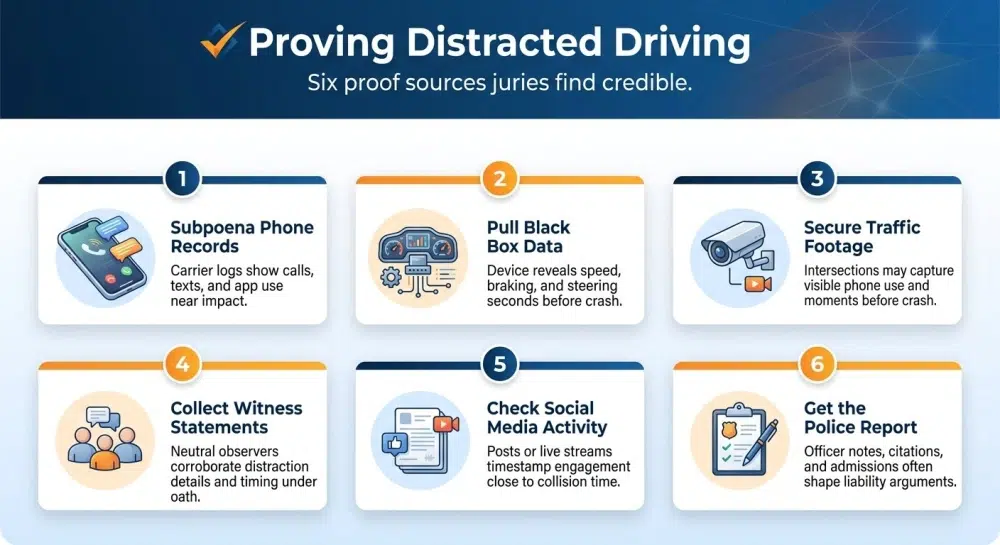
Building a strong distracted driving claim in Irvine, Los Angeles, Dallas, or Chicago typically involves gathering several types of evidence. The sooner you begin the process, the better, because much of this evidence has a limited preservation window.
What Types of Evidence Can Be Used to Prove Distracted Driving?
- Cell phone records: Subpoenaed records from a carrier can show call logs, text timestamps, app activity, and data usage at the time of a crash. This is often the most direct evidence available in phone-distraction cases.
- Event data recorders (EDR / black boxes): Most modern vehicles contain onboard data recorders that capture speed, braking, and steering inputs in the seconds before impact. This data can corroborate that a driver failed to brake or steer appropriately.
- Surveillance and traffic camera footage: Urban intersections in Los Angeles, downtown Chicago, and the Dallas-Fort Worth area are often covered by traffic cameras. This footage may capture the moments leading up to a crash, including visible phone use.
- Witness statements: Other drivers, pedestrians, or passengers may have observed the distracted behavior before the crash and can provide sworn testimony.
- Social media activity: In some cases, a driver’s social media posts, check-ins, or live stream activity timed near the crash can serve as corroborating evidence of phone engagement.
- Police reports: Officers trained to document distraction at crash scenes may note observations, citations, or driver admissions in their reports. Requesting and preserving the police report is one of the most important steps you can take immediately after a crash.
It is worth emphasizing that you should not attempt to gather cell phone records yourself or confront the other driver about their device. The legal discovery process exists specifically to handle this in a way that complies with privacy laws and produces admissible evidence. Speak with a car accident lawyers before taking steps that could compromise your case.
How Do California, Texas, and Illinois Address Distracted Driving?
Each of the states where GoSuits practices has enacted laws restricting distracted driving, and those laws affect how civil claims are built and argued.

What Does California Law Say About Phone Use While Driving?
California Vehicle Code Section 23123.5 broadly prohibits the handheld use of a wireless telephone or electronic wireless communications device while driving [3]. A driver may only interact with a device via a single tap or swipe when it is properly mounted. Violations are infractions. In Orange County communities like Irvine and in Los Angeles, California Highway Patrol and local law enforcement actively cite violations of this statute. In a civil claim, a citation for violating Section 23123.5 at the time of a crash is powerful evidence in support of a negligence finding.
What Does Texas Law Prohibit Regarding Distracted Driving?
Texas Transportation Code Section 545.4251, effective September 1, 2017, prohibits reading, writing, or sending electronic messages while driving statewide [4]. The Texas Department of Transportation has invested significantly in public awareness campaigns reinforcing that distracted driving crashes are among the leading causes of injury fatalities on Texas roads. In Dallas and Carrollton, as well as through the broader DFW metroplex including Plano and Irving, Texas law enforcement treats phone violations seriously. A conviction or citation for electronic messaging while driving in Texas can be used in subsequent civil litigation as evidence of negligence.
What Does Illinois Law Require of Drivers Using Phones?
The Illinois Vehicle Code prohibits the use of handheld devices while driving. Drivers in Chicago, Naperville, Elgin, and throughout Cook County are subject to these restrictions [4]. Illinois has also implemented hands-free requirements in school zones and construction zones. Violations in those areas carry enhanced fines. As in California and Texas, a traffic citation for distracted driving behavior in Illinois can serve as evidence of fault in a personal injury lawsuit.
What Compensation Can You Seek After a Distracted Driving Accident?
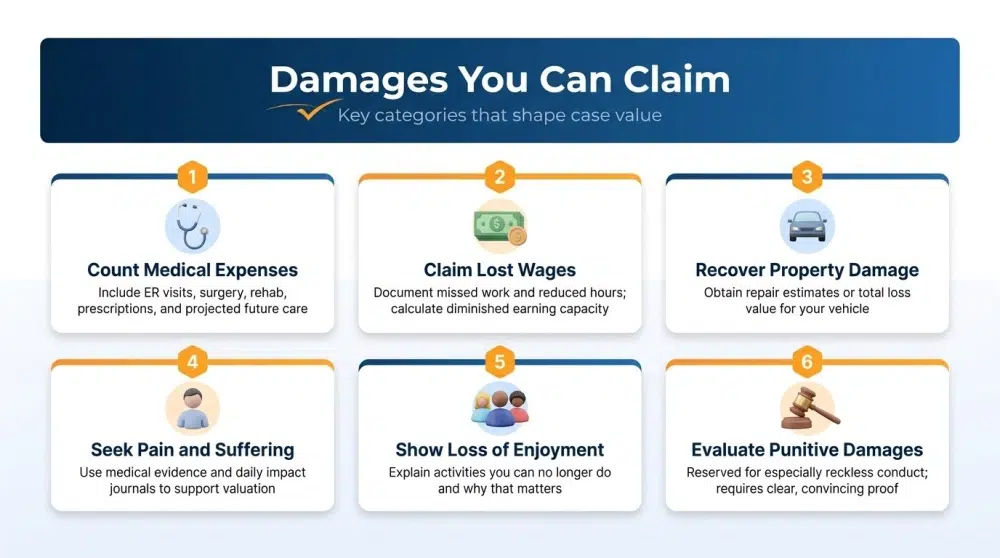
In a civil personal injury claim following a distracted driving accident, compensationcalled damagesis intended to address the losses you have suffered as a result of the other driver’s negligence. The specific categories and amounts depend on your state’s laws and the facts of your case.
What Are Economic Damages in a Distracted Driving Injury Case?
Economic damages are quantifiable financial losses. They typically include:
- Medical expenses: Emergency care, surgery, hospitalization, physical therapy, prescription medications, and future medical costs related to the injury.
- Lost wages: Income you were unable to earn because of your injuries, including future lost earning capacity if your injuries prevent you from returning to your previous occupation.
- Property damage: The cost of repairing or replacing your vehicle and any other personal property damaged in the crash.
What Are Non-Economic Damages in a Distracted Driving Claim?
Non-economic damages address harms that are real but not reflected on a balance sheet:
- Pain and suffering: Compensation for physical pain and emotional distress caused by the injury.
- Loss of enjoyment of life: When injuries prevent you from participating in activities you previously valued.
- Emotional distress: Anxiety, depression, and post-traumatic stress resulting from the accident.
Texas caps non-economic damages in certain types of civil cases, but those caps do not apply uniformly to all personal injury claims. California allows recovery of non-economic damages in most cases without a cap for traffic accident claims. Discussing the damages picture with a personal injury claim lawyer who knows your state’s rules is essential to understanding what your case may realistically be worth.
Victims who have suffered catastrophic injuries or who are pursuing a personal injury claim after distracted driving accident in the Los Angeles area can reach our Los Angeles personal injury team to better understand what recovery may look like in their specific situation. Our team handles cases throughout California, Texas, and Illinois.
What Are Punitive Damages and When Are They Available?
In some cases, particularly where the distracted driver’s behavior was especially recklesssuch as driving while texting at high speed in a school zone or while legally intoxicatedpunitive damages may be available. These damages are not tied to your actual losses; instead, they are designed to punish the defendant and deter similar behavior. Punitive damages are not available in every case and require a higher evidentiary threshold. Your attorney can assess whether the facts of your case support a punitive damages argument.
What Should You Know If You Are the Defendant in a Distracted Driving Claim?
If you caused a crash while distracted and are now facing a civil claim, understanding your position clearly is important. A civil claim is separate from any criminal charges, though both may arise from the same incident. The plaintiff in the civil case is seeking monetary compensation from youor more commonly, from your automobile insurance carriernot a prison sentence.
How Does Insurance Coverage Apply in a Distracted Driving Claim?
Your automobile liability insurance policy is typically the first source of funds to compensate an injured person. Your insurer will assign a claims adjuster and, if the case progresses to litigation, will typically provide legal representation up to your policy limits. If a judgment against you exceeds your policy limits, however, you may be personally liable for the difference.
This is one reason why defendants in these cases should not give recorded statements to the opposing party’s insurer without legal guidance. Anything you say can be used against you in the civil proceeding. If a claim has been filed against you, contacting a personal injury attorney to understand your rights under your own policy is a reasonable step.
Can a Defendant Argue That the Plaintiff Also Contributed to the Crash?
Yes. Under comparative fault rules in California, Texas, and Illinois, a defendant can raise the argument that the plaintiff was also negligent. If successful, this reduces the defendant’s liability proportionally. Evidence of plaintiff speed, their own phone use, or failure to observe traffic signals may support such a defense. However, this strategy requires substantive evidenceunsupported accusations rarely succeed.

What Happens When a Distracted Driving Accident Is Fatal?
When a distracted driving crash takes a life, the legal framework shifts to a wrongful death claim. In California, Texas, and Illinois, surviving family membersincluding spouses, children, and in some states parentsmay file a civil wrongful death suit against the at-fault driver. The purpose of such a claim is not to undo the tragedy but to provide financial accountability and support for those left behind.
Wrongful death damages may include the financial contributions the deceased would have made to the family over a lifetime, the cost of funeral and burial, and compensation for the loss of care, guidance, and companionship. fatal accident lawyers can help surviving families understand what these claims involve and what the expected timeline looks like, given that wrongful death litigation is often more complex than a standard personal injury case.
Texas, California, and Illinois each have their own wrongful death statutes that define who may bring a claim and what damages are recoverable. Statute of limitations periods differ as well. In California, the general statute of limitations for a wrongful death claim is two years from the date of death. Texas has a two-year window as well. Illinois also follows a two-year statute of limitations for wrongful death claims. Missing these deadlines forfeits your right to sue, so timely consultation with an attorney is critical [9].
GoSuits handles wrongful death claims for families throughout our service areas. You can review our approach to these cases through our wrongful death practice in Los Angeles and across all markets where we serve clients.
How GoSuits Can Help with Your Distracted Driving Accident Claim
Distracted driving accident claims are among the most evidence-intensive cases in personal injury law. Proving that a driver was on their phone, eating, or cognitively absent at the moment of impact requires fast action, skilled investigation, and a deep understanding of the legal rules in your jurisdiction. If you have been injured in Irvine, Los Angeles, Dallas, or Chicago, connecting with the right legal team matters enormously.
GoSuits was founded on the belief that injured clients deserve both skilled attorneys and modern tools working in their favor simultaneously. Our firm uses exclusive proprietary technology to move cases faster, organize evidence more efficiently, and track claim progress in real time. This technology does not replace attorney judgmentit amplifies it. Every GoSuits client is assigned a dedicated attorney, not a case manager. You have direct access to your attorney throughout your case, without intermediaries filtering your communications.
Our attorneys carry more than 30 years of combined experience in personal injury litigation across California, Texas, and Illinois. That experience includes trial work. Insurance companies adjust their behavior when they know an opposing firm is genuinely prepared to take a case before a jury. GoSuits has that trial readiness, and it shapes every negotiation we conduct on behalf of our clients.
Our practice areas in your region include car accident claims, truck accident cases, motorcycle crashes, wrongful death litigation, workplace injuries, rideshare accidents, and more. You can explore our full range of services on our practice areas page, read about the attorneys handling your region on our our attorneys page, and learn more about who we are on our about us page.
Our prior cases reflect years of work on behalf of clients who were injured, often through no fault of their own, by drivers who should have been paying attention to the road.
If you were injured by a distracted driverwhether that driver was texting in Los Angeles traffic, drifting while eating on a Dallas highway, or glancing away from the road on the Chicago expresswayyou deserve to know your options. GoSuits offers a free consultation so you can understand your claim without any financial commitment. To connect with our team, schedule a free consultation today. We serve clients across California, Texas, and Illinois and are ready to evaluate your case.
References and Resources
- Negligence – Legal Information Institute, Cornell Law School
- Distracted Driving – National Highway Traffic Safety Administration
- California Vehicle Code Section 23123.5 – California Legislative Information
- Federal Highway Safety Improvement Program and Distracted Driving – GovInfo.gov
- Distracted Driving – Centers for Disease Control and Prevention
- Distracted Driving – Insurance Institute for Highway Safety
- California Civil Code Section 1714 – Comparative Negligence – California Legislative Information
- Texas Civil Practice and Remedies Code Chapter 33 – Proportionate Responsibility
- Civil vs. Criminal Cases Overview – United States Courts
- Statute of Limitations Overview – U.S. Department of Justice