- What Are Employee Rights After a Workplace Injury in California?
- How Does the California Workers’ Compensation System Work?
- How Do You Report a Workplace Injury in California?
- What Medical Treatment Rights Do You Have After a Work Injury?
- What Types of Benefits Are Available to Injured Workers?
- How Do Temporary Disability Benefits Work in California?
- What About Permanent Disability Benefits?
- What Are Your Rights If Your Employer Retaliates After an Injury?
- Can You File a Third-Party Claim for a Workplace Accident?
- What Happens When a Workplace Injury Is Fatal?
- What Defenses Do Employers and Insurers Raise?
- How Do Federal OSHA Protections Apply to California Workers?
- How Do Texas and Illinois Compare to California?
- Frequently Asked Questions
- How GoSuits Los Angeles Helps Injured Workers
- References
What Are Employee Rights After a Workplace Injury in California?
First thing to know. If you got hurt on the job in California, you’re not the only one, and the law isn’t leaving you out in the cold. State and federal rules give injured workers a defined set of protections, things like prompt medical treatment, wage replacement, return-to-work options, and shielding from retaliation. The scale here is kind of staggering. The California Department of Industrial Relations clocked more than 460,000 nonfatal workplace injuries and illnesses among private industry employers in a recent year, and Los Angeles County keeps leading the state in claim volume [1] .
California’s system runs on a pretty simple idea. You’re covered. From day one. Doesn’t matter whose fault the accident was, most employees get workers’ comp protection the moment they start the job. Labor Code section 3700 requires almost every California employer to carry workers’ compensation insurance or go the self-insured route [2] . Figuring out what you’re entitled to, and the deadlines you can’t afford to miss, is probably the first real step toward keeping yourself and your family safe.
Workplace rights in California include:
- The right to prompt medical treatment for any injury or illness arising out of and in the course of your employment.
- The right to disability payments if you cannot work or can only work in a reduced capacity.
- The right to a fair claims process with set deadlines that the insurer must meet.
- The right to be free from retaliation for reporting an injury or filing a claim.
- The right to bring a separate civil claim against any third party whose negligence contributed to the injury.
For injured workers around Los Angeles, none of this stays abstract for long. The county is wall-to-wall construction sites, warehouses, ports, film studios, and a service economy that’s pretty much its own ecosystem. Fell from scaffolding in Downtown LA? Hurt your back at a Long Beach distribution center? Developed a repetitive-strain issue from years at a Pasadena office? Doesn’t really matter which one. If it happened on the clock, the law treats it as compensable.
How Does the California Workers’ Compensation System Work?
Here’s the basic shape of it. California runs a no-fault workers’ comp system. Which means? You don’t actually have to prove your employer did something wrong to collect. If you got hurt while doing your job, benefits are on the table even if you contributed to the accident. But there’s a real trade-off baked in. Comp is the exclusive remedy against your employer for most workplace injuries, lawyer-speak for you can’t sue your boss in civil court over the same thing [3] .
The system is administered by the Division of Workers’ Compensation (DWC) inside the California Department of Industrial Relations. Disputes are heard by the Workers’ Compensation Appeals Board (WCAB), not by traditional civil judges [4].
Who Is Covered, and Who Is Not?
If you’re a W-2 employee, you’re probably in. Part-time, seasonal, undocumented, doesn’t matter, the coverage net reaches all of you. Independent contractors are usually outside the system, but California’s ABC test under Assembly Bill 5 has made it a lot harder for employers to misclassify someone as a contractor when they’re really an employee [5] . And then there are the federal carveouts to keep in mind. Federal employees, certain railroad and maritime workers, plus some volunteers, are running on totally different rails, programs like the Federal Employees’ Compensation Act and the Longshore and Harbor Workers’ Compensation Act [6] .
If you have been told you are a contractor but your employer controls your schedule, tools, and tasks, you may actually be a misclassified employee with full rights to benefits. Document your working conditions and seek guidance before accepting that label.
How Do You Report a Workplace Injury in California?
Reporting promptly is one of the most important steps you can take. Under California Labor Code section 5400, you generally must give your employer written notice of the injury within 30 days [7]. Missing that window can give the insurer a reason to deny your claim, although exceptions exist for cumulative trauma and occupational illnesses that develop over time.
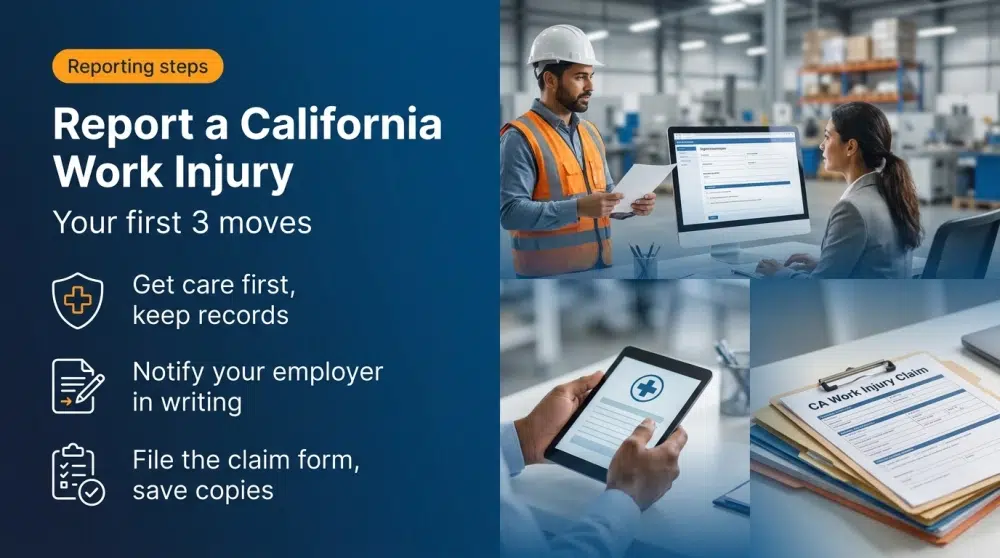
The reporting steps for a workplace injury in California are:
- Get medical attention immediately if the injury is serious. Call 911 or go to the nearest emergency department. Your health comes first.
- Notify your supervisor or employer in writing as soon as possible. Keep a dated copy.
- Request a DWC-1 claim form. Your employer must provide this form within one working day of learning about the injury.
- Complete and return the claim form to your employer. Keep a copy for yourself with the date you delivered it.
- Document everything, including witnesses, photos of the scene, and the names of anyone who treated you.
Once you submit the DWC-1, the employer has one working day to forward it to the workers’ compensation insurer. From that point, the insurer is required to authorize up to $10,000 in medical treatment while it investigates the claim [8]. You should not wait to receive treatment because of an unresolved claim status.
What Medical Treatment Rights Do You Have After a Work Injury?
Medical treatment after a work injury in California is paid for by the workers’ compensation insurer, not your private health plan. There are no copays and no deductibles for treatment that is reasonably required to cure or relieve the effects of your injury [9].
Who Chooses Your Doctor?
Doctor selection. This is where things get a little awkward. By default, your employer or its insurer is going to route your early care through a Medical Provider Network (MPN) or a Health Care Organization (HCO). You can sidestep that, but only if you planned ahead. Predesignating your personal physician before any injury, with the paperwork done correctly, lets you treat with your own doctor from day one. Otherwise, you’re picking from the MPN list for the first 30 days. After that 30-day window closes, your choices inside the network broaden quite a bit [9] .
What Happens If Treatment Is Denied?
If a treatment request is denied, you have the right to Independent Medical Review (IMR), a fast-track process that lets a neutral physician review the medical necessity of the disputed care. The DWC’s IMR system handles tens of thousands of disputes each year, and decisions are typically issued within 30 days of receiving complete records [10].
What Types of Benefits Are Available to Injured Workers?
California workers’ compensation provides five main categories of benefits:
- Medical care covers doctor visits, hospitalization, surgery, prescriptions, physical therapy, and durable medical equipment for as long as the injury requires.
- Temporary disability (TD) replaces lost wages while you recover and cannot work.
- Permanent disability (PD) compensates lasting impairments that remain after maximum medical improvement.
- Supplemental Job Displacement Benefit (SJDB) provides a voucher for retraining if you cannot return to your old job.
- Death benefits pay surviving dependents when an injury proves fatal.
Each category has its own formula and timeline. Skilled workers compensation rights California guidance can be the difference between a claim that pays full value and one that closes early.
How Do Temporary Disability Benefits Work in California?
Temporary disability benefits replace a portion of your wages while you cannot work. The standard rate is two-thirds of your average weekly earnings, subject to statutory minimums and maximums adjusted each year by the DWC [11]. For 2024, the maximum TD rate set by the DWC was $1,619.15 per week, and the minimum was $242.86 per week [11].
TD typically begins after a three-day waiting period, unless you are hospitalized or out of work for more than 14 days, in which case the first three days are also paid. Most injured workers can receive TD for up to 104 weeks within five years of the date of injury, with longer durations available for certain serious conditions like severe burns or chronic lung disease.
What If You Can Work Light Duty?
If your treating physician releases you for modified or alternative work and your employer offers a position that fits the restrictions, you must generally accept it or risk losing TD. If wages from light duty are lower than your pre-injury wages, you may receive temporary partial disability benefits to bridge the gap.
What About Permanent Disability Benefits?
Once your treating physician declares you have reached maximum medical improvement, also called permanent and stationary status, your case shifts toward evaluating any lasting impairment. A doctor assigns a whole-person impairment rating using the AMA Guides, which is then converted into a permanent disability percentage using California’s Permanent Disability Rating Schedule [12].
That percentage drives the dollar value. A 25% PD rating, for example, will pay a different total than a 60% rating. Ratings of 100% qualify the injured worker for lifetime benefits. Disputes over PD ratings are common, and many injured workers benefit from a Qualified Medical Evaluator (QME) review when they disagree with the treating physician’s assessment.
If your employer cannot accommodate your permanent restrictions and does not offer regular, modified, or alternative work within 60 days, you are entitled to a Supplemental Job Displacement Benefit voucher worth up to $6,000 that can be used for skill-enhancement training, certification fees, or tools to help you transition to new work.
What Are Your Rights If Your Employer Retaliates After an Injury?
California law strongly protects injured workers from retaliation. Labor Code section 132a makes it unlawful for an employer to discharge, threaten to discharge, or in any way discriminate against an employee because the employee filed or intends to file a workers’ compensation claim [13]. Violations can result in increased compensation up to $10,000, reinstatement, and reimbursement of lost wages and benefits.
Retaliation can take obvious or subtle forms:
- Termination shortly after a claim is filed.
- Demotion or reduction in hours after returning from medical leave.
- Schedule changes that effectively force a resignation.
- Hostile treatment by supervisors who pressure you to drop the claim.
- Refusal to accommodate reasonable medical restrictions.
Section 132a is just one piece of the puzzle. The toolkit actually runs deeper. The federal ADA and California’s FEHA both make employers offer reasonable accommodations for qualifying disabilities, and honestly, a lot of serious workplace injuries probably check that box [14] . And then OSHA stacks on top. The Occupational Safety and Health Act makes it flat-out illegal for employers to retaliate against workers who report unsafe conditions [15] .
If you suspect employer retaliation for workplace injury in California, save every email, text, and performance review, and write down the dates and substance of every conversation. Documentation often makes or breaks a retaliation case.
Can You File a Third-Party Claim for a Workplace Accident?

Workers’ compensation is your exclusive remedy against your employer, but it does not bar civil claims against third parties whose negligence caused or contributed to your injury. Common third-party defendants include:
- Negligent drivers who hit you while you were driving for work.
- Equipment manufacturers whose defective machinery caused the injury.
- General contractors or subcontractors on a multi-employer construction site.
- Property owners who failed to address hazards on premises where you were working.
- Chemical or product suppliers whose dangerous goods caused harm.
A third-party workplace injury claim in California is filed in civil court. Unlike workers’ compensation, it allows you to recover pain and suffering, your full lost wages, and loss of consortium damages for your spouse. The catch is that you have to prove the third party was at fault, and the workers’ comp insurer usually places a lien on your recovery to get back what it paid you in benefits.
Construction sites in particular often involve multiple employers, equipment vendors, and property owners, opening up several avenues for recovery beyond the workers’ compensation file. A coordinated approach with experienced injury attorneys protects both your comp benefits and your civil claim.
What Happens When a Workplace Injury Is Fatal?
The U.S. Bureau of Labor Statistics recorded 5,283 fatal work injuries nationally in 2023, with California consistently among the states with the highest absolute numbers due to its workforce size [16]. Behind every statistic is a family suddenly facing grief and financial uncertainty.
California provides death benefits to surviving dependents through workers’ compensation. Total dependents (such as a spouse with no other income or minor children) receive payments up to $320,000 for one dependent, $360,000 for two, and $400,000 for three or more, with additional benefits for fully dependent minor children. Burial expenses up to $10,000 are also covered [17].
Here’s where it gets bigger. If somebody outside the employer caused the death, like a negligent driver or a defective equipment maker, surviving family members can file a wrongful death suit under California Code of Civil Procedure section 377.60. The civil claim reaches stuff comp simply doesn’t, lost financial support, household services, companionship, protection, the whole human cost. And good fatal accident lawyers will run that case alongside the comp file so the family doesn’t leave money on the table.
What Defenses Do Employers and Insurers Raise?
Understanding the defense playbook helps injured workers prepare. Common defenses on the workers’ compensation side include:
- The injury did not arise out of employment, often raised when the worker was on a break, commuting, or engaged in personal activity.
- The injury was caused by intoxication or willful misconduct, which Labor Code section 3600 lists as bars to recovery.
- Pre-existing condition arguments aimed at apportioning a portion of the disability to non-industrial causes.
- Late notice or late claim filing beyond the statutory windows.
- Independent contractor status, often disputed under the ABC test.
On the third-party civil side, defendants may raise comparative negligence, assumption of risk, and the sophisticated user defense in product cases. California is a pure comparative fault state, so even a worker found 70% at fault can still recover 30% of damages from a third-party defendant [18].
From the defense perspective, careful documentation, surveillance, and aggressive use of medical-legal evaluations are routine. From the plaintiff’s side, the response is the same: thorough records, credible witnesses, and a treatment history that matches the mechanism of injury.
How Do Federal OSHA Protections Apply to California Workers?
California operates its own state-plan occupational safety and health program, Cal/OSHA, which is at least as protective as federal OSHA [19]. Under Section 11(c) of the federal OSH Act, workers have the right to:
- Report unsafe conditions without fear of retaliation.
- Refuse imminently dangerous work in narrowly defined circumstances.
- Request a Cal/OSHA inspection and have a representative accompany the inspector.
- Receive training in a language the worker understands.
- Access exposure and medical records related to workplace hazards.
OSHA citations and Cal/OSHA reports can become powerful evidence in a third-party civil case, even though they generally cannot be used directly against the employer in workers’ compensation due to the exclusive remedy rule. If you have been injured on the job, requesting the inspection file is often a smart early step.
How Do Texas and Illinois Compare to California?
Although California is the focus, similar issues arise across the country. The frameworks differ in important ways.

Texas
Texas is the only state where private employers may opt out of workers’ compensation, called nonsubscribers. Roughly 28% of Texas private-sector employers are nonsubscribers, leaving their employees free to sue in civil court but without the safety net of guaranteed benefits [20]. Subscribing employers, by contrast, enjoy the same exclusive remedy that California employers do.
Illinois
Illinois follows a traditional workers’ compensation model administered by the Illinois Workers’ Compensation Commission. Reporting deadlines are 45 days for traumatic injuries, and the system pays a similar two-thirds wage replacement rate. Illinois also strongly protects against retaliatory discharge under Kelsay v. Motorola and its progeny.
No matter the jurisdiction, the basic message is consistent: report quickly, document everything, and get qualified injured-worker counsel before signing any settlement.
For more on the broader process and what steps to take immediately after a workplace incident, the knowledge base article on steps to take after a workplace injury a legal overview walks through documentation, deadlines, and how comp and civil claims interact.
How GoSuits Los Angeles Helps Injured Workers
If you or someone you love has been hurt on the job, the first conversation with a personal injury team should be a free, no-pressure consultation. GoSuits offers that consultation so you can understand your options before any claim form is signed or any insurance adjuster pressures you to settle. We serve clients across California, Texas, and Illinois, with offices anchored in the major metro areas where our clients live and work.
Why a Technology-Driven Approach Matters
Workers’ compensation and third-party injury cases generate enormous volumes of medical records, wage documents, deposition transcripts, and insurance correspondence. Our firm uses proprietary case-management software built in-house to organize that data, surface key deadlines, and model settlement values in real time. The result is faster case development, fewer missed details, and stronger negotiating positions for our clients. We use the technology to expedite the case, not to replace human judgment.
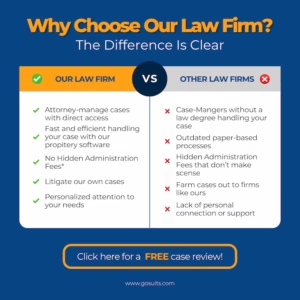
Designated Attorneys, Direct Access
Every client at GoSuits is assigned a designated attorney from intake through resolution. We do not route clients to case managers or assistants for substantive questions. You have unfettered access to your attorney by phone, email, or text, and your file is never handed off mid-stream. That continuity matters when an injured worker is balancing medical treatment, missed paychecks, and a confusing claims process.
Trial-Ready Representation
Many injury firms settle every case. Insurers know which firms file lawsuits and try them and which firms do not, and that knowledge directly affects settlement offers. Our attorneys carry significant trial experience, and we prepare every case as if it will be tried. When the insurer’s offer falls short, we are ready to step into the courtroom rather than push clients to accept less than the case is worth.
Practice Areas and Combined Experience
Our team brings 30 years of combined experience across personal injury practice areas, including workplace and construction injuries, motor vehicle and truck collisions, rideshare incidents, premises liability, product defects, and wrongful death. That breadth matters because workplace cases often involve overlapping civil claims, and a firm that handles only one slice of injury law may miss recovery avenues. You can review our practice areas, meet our attorneys, and read about us on our main pages.
Past Results
We have recovered substantial verdicts and settlements for clients with workplace injuries, fatal crashes, and catastrophic harm. Without making promises about future cases, we publish a sample of outcomes on our prior cases page so prospective clients can see the kinds of matters we handle and the seriousness with which we pursue them.
If you are ready to discuss your situation with a Los Angeles workplace injury attorney, you can schedule a free consultation at a time that works for you. There is no fee unless we recover for you.
References
- California Workplace Injury and Illness Statistics – California Department of Industrial Relations
- California Labor Code Section 3700 – California Legislative Information
- Workers’ Compensation FAQ for Injured Workers – California DWC
- Workers’ Compensation Appeals Board – California Department of Industrial Relations
- Independent Contractor Versus Employee – California DIR
- Office of Workers’ Compensation Programs – U.S. Department of Labor
- California Labor Code Section 5400 – California Legislative Information
- A Guidebook for Injured Workers – California DWC
- Medical Treatment for Injured Workers – California DWC Medical Unit
- Independent Medical Review – California Division of Workers’ Compensation
- Temporary Disability Benefits – California DWC
- Permanent Disability Rating Schedule – California DWC
- California Labor Code Section 132a – California Legislative Information
- Employment Discrimination Under FEHA – California Civil Rights Department
- Whistleblower Protections – U.S. Occupational Safety and Health Administration
- National Census of Fatal Occupational Injuries – U.S. Bureau of Labor Statistics
- Death Benefits – California Division of Workers’ Compensation
- Comparative Negligence – Cornell Legal Information Institute
- Cal/OSHA – California Division of Occupational Safety and Health
- Texas Workers’ Compensation for Employers – Texas Department of Insurance