














































What areas around Dallas do our truck accident lawyers serve?
If you were hurt anywhere in the Dallas area, GoSuits is ready to help. Our office is in Dallas, but our truck crash team serves clients throughout North Texas, from Downtown Dallas and Deep Ellum out to Plano, McKinney, Carrollton, Greenville, and Irving. We know the freight corridors that move goods across the region, and we know where commercial trucks tend to cause the worst wrecks.
Truck collisions happen everywhere: on I-35E heading south toward Waxahachie, on I-635 around the LBJ interchange, on US-75 north through Lake Highlands, and on the Dallas North Tollway running up through Addison. They also happen on local arterials feeding warehouses near Stemmons Freeway and at construction zones along Woodall Rodgers. No matter where your crash occurred, we bring local knowledge and legal experience to protect your rights and pursue full compensation.
Dallas County is home to more than 2.6 million residents, and Texas Department of Transportation (TxDOT) crash data for 2025 shows 38,533 crashes involving a commercial motor vehicle statewide, including 3,778 in Dallas County, where 37 people were killed in those crashes (data as of April 7, 2026). We know the unique risks across different parts of the area, and we adjust our approach accordingly.
Areas we commonly serve:
- Central Dallas: Downtown, Deep Ellum, Bishop Arts, Uptown, Oak Lawn, Victory Park
- South and West Dallas: Oak Cliff, Cedar Hills area, West Dallas, Trinity Groves
- North Dallas: Lake Highlands, Preston Hollow, Far North Dallas, Vickery
- North DFW satellites: Plano, McKinney, Carrollton, Greenville, Irving
- Freight corridors: I-35E, I-635 (LBJ), I-30, US-75 (Central), Dallas North Tollway, Stemmons Freeway
Wherever you are in the Dallas area, we’re a call away and ready to step in when you need legal guidance after a commercial truck crash.
What types of truck accident cases do we handle in Dallas?
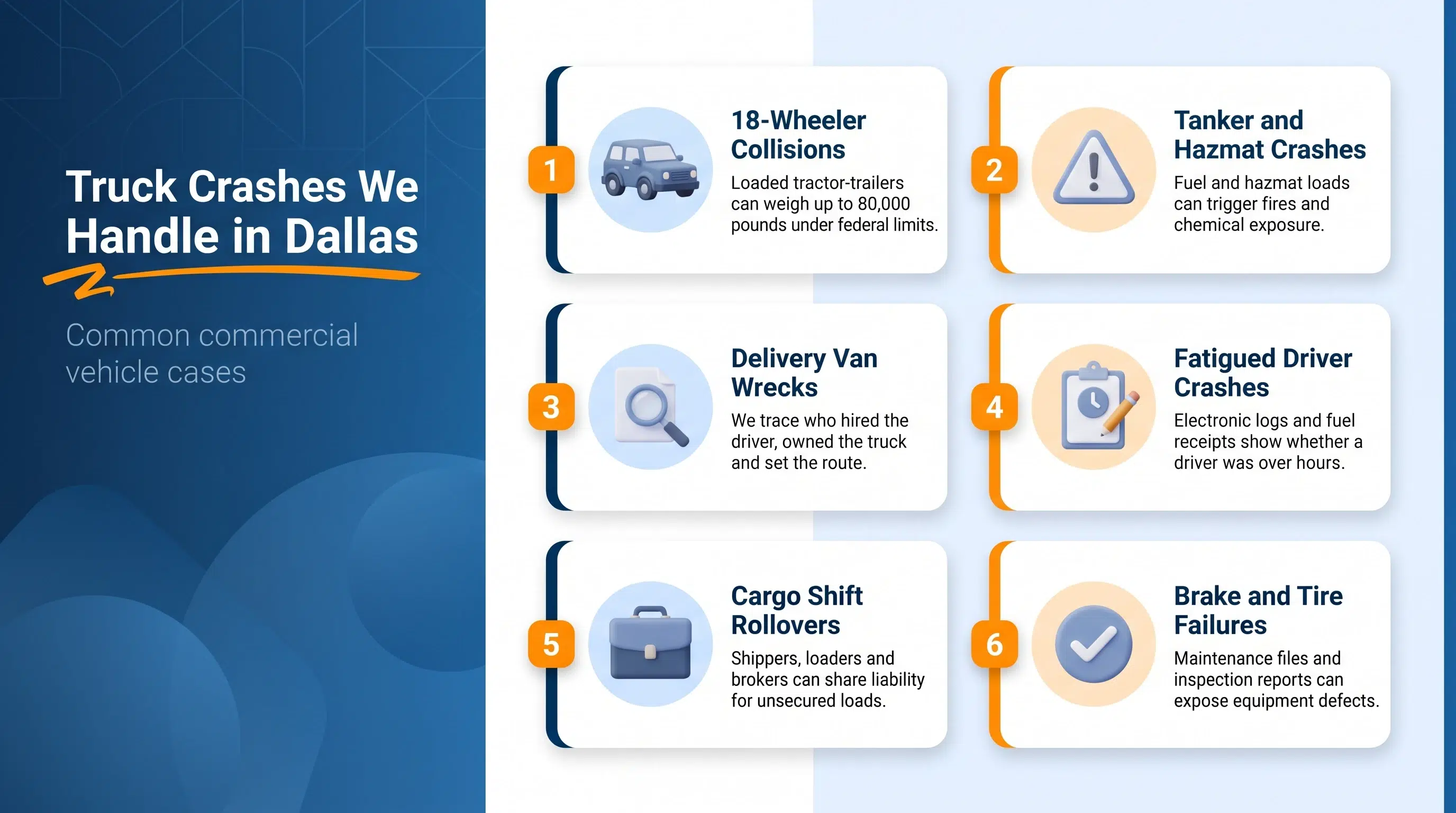
Truck wrecks come in many shapes, but they share a few legal traits: heavy federal regulation, multiple potentially liable parties, and time-sensitive electronic evidence. At GoSuits, we’ve helped clients across Dallas County recover after collisions involving every major class of commercial vehicle. Here’s how we approach the most common case types.
18-wheeler and tractor-trailer collisions
A loaded tractor-trailer can weigh up to 80,000 pounds under federal limits, and at highway speed on I-35E or I-635 the physics are unforgiving. Our team moves immediately to send a spoliation letter to the motor carrier, preserve the engine control module (ECM) and event data recorder (EDR) data, and subpoena driver logs kept under the FMCSA’s electronic logging device rule. We also pull dashcam, lane-departure, and telematics records before they’re routinely overwritten.
Tanker, flatbed, and hazmat truck crashes
Crashes involving fuel tankers or hazmat loads can trigger fires, chemical exposure, and secondary collisions on routes like I-635 and the Dallas North Tollway. We coordinate with hazmat response logs, the carrier’s safety permits, and TxDOT incident records, and we work with crash reconstruction professionals to map out exactly what happened.
Delivery van and box-truck wrecks
Last-mile delivery has exploded across Dallas, and box trucks and sprinter vans now flood neighborhoods like Bishop Arts, Deep Ellum, and Lake Highlands. These cases often involve contractor-versus-employee disputes that the carrier uses to dodge responsibility. We trace the chain of control: who hired the driver, who owned the truck, who set the route, and who insured the load.
Hours-of-service and fatigued-driver crashes
Federal hours-of-service rules under 49 CFR Part 395 limit how long a commercial driver may stay behind the wheel, generally capping driving at 11 hours after 10 consecutive hours off duty for property-carrying drivers. When a Dallas crash happens late at night or near the end of a long haul, fatigue is a likely factor. We pull electronic logs, fuel receipts, weigh-station records, and phone data to show whether the driver was over hours.
Improper loading and cargo-shift crashes
A shifting or unsecured load can roll a tractor-trailer on a tight curve like the I-635 ramp at US-75. Liability often extends beyond the driver to the shipper, the loader, and the broker. We examine bills of lading, load securement records, and the carrier’s compliance with FMCSA cargo rules under 49 CFR Part 393.
Maintenance failure and equipment defect cases
Brake failures, tire blowouts, and steering defects cause some of the worst wrecks on Texas highways. We pull the truck’s maintenance file, DVIRs (driver vehicle inspection reports), and any recent FMCSA inspection results from the SAFER system. When the failure traces to a part defect, we add the manufacturer to the case.
Underride and override collisions
When a passenger car slides under a trailer, or a tractor-trailer rides up over a smaller vehicle, injuries are catastrophic and often fatal. We examine rear and side underride guards, evaluate compliance with federal standards, and work with biomechanical professionals to document the injury mechanism for the jury.
Wrongful death from commercial truck crashes
Losing a loved one in a fatal truck collision on US-75 or I-30 leaves families with grief plus a stack of decisions they did not ask to make. Our team handles investigations, insurance filings, and paperwork while you focus on family. Where the facts call for it, we coordinate the truck case with our Dallas wrongful death practice to pursue full damages under Texas law.
What evidence wins a Dallas truck accident case?
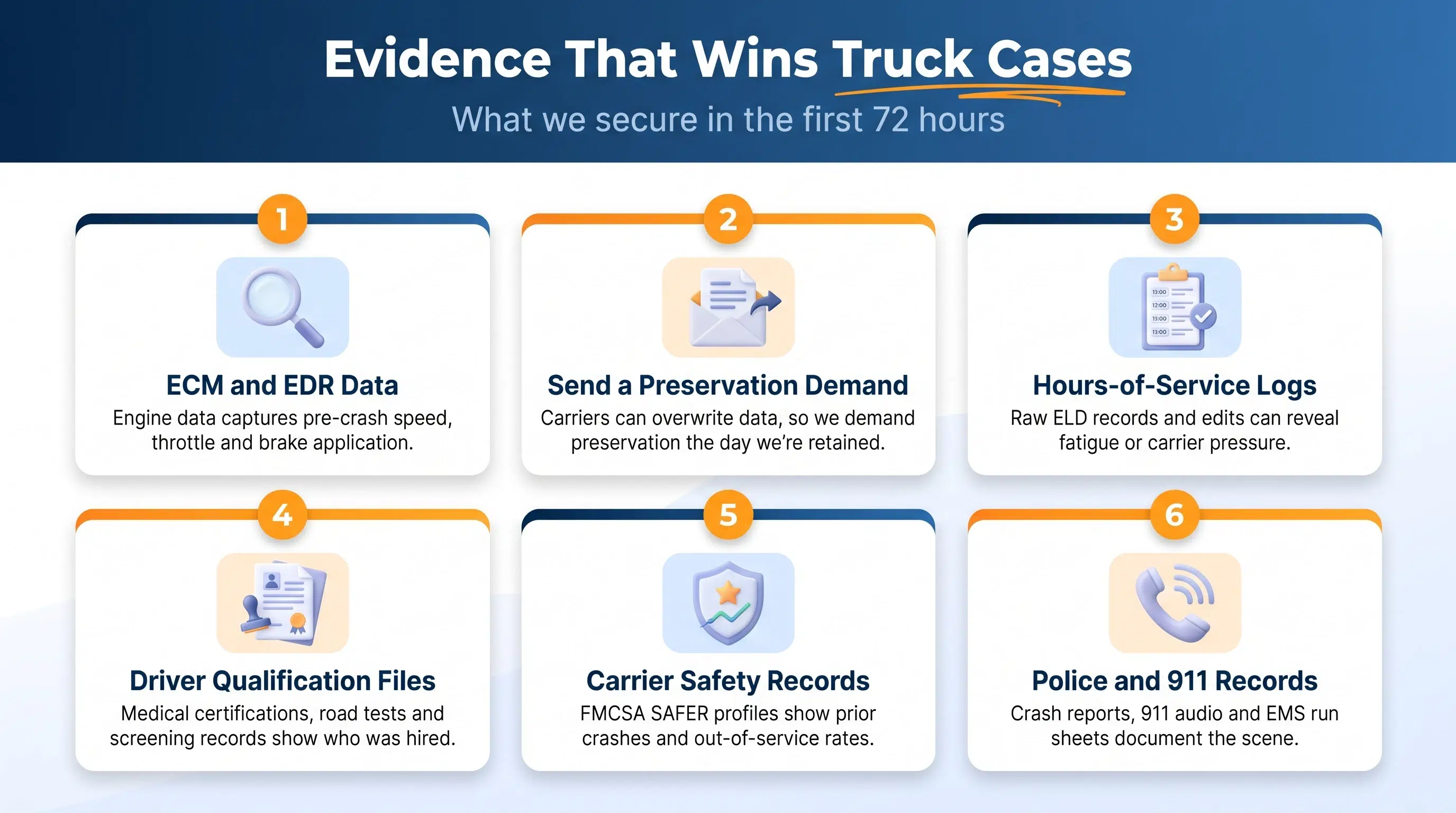
Truck cases are won and lost on electronic data and federal compliance records, and most of that evidence has a short shelf life unless someone goes after it fast. Here’s what we move on in the first 72 hours.
ECM and EDR data
Modern tractors carry an engine control module that captures pre-crash speed, throttle position, brake application, and engine RPM. Many also carry an event data recorder. Carriers can lawfully overwrite this data on a routine cycle, so we send a written preservation demand the day we’re retained and follow up with a court order if the carrier delays.
Hours-of-service logs and ELD data
Under 49 CFR Part 395, most interstate commercial drivers must record duty status using an electronic logging device. We subpoena raw ELD records (not just summaries), driver qualification files, and any record of duty status corrections. A pattern of edits often shows fatigue or carrier pressure.
Driver qualification and drug/alcohol records
The FMCSA requires carriers to keep driver qualification files including medical certifications, road test results, and pre-employment screening. Texas Transportation Code Chapter 522, the Texas Commercial Driver’s License Act, layers state requirements on top. We pull both.
Carrier safety scores and prior violations
The FMCSA’s SAFER system publishes carrier safety profiles, prior crashes, roadside inspection results, and out-of-service rates. A pattern of unsafe driving violations or vehicle maintenance flags can support a punitive damages claim against the motor carrier.
Police, EMS, and 911 records
For Dallas crashes, we obtain the Texas Peace Officer’s Crash Report (CR-3), 911 audio, EMS run sheets, and any DPD or Dallas County Sheriff’s photos. For crash reports specifically, the Dallas Police Department Records Unit handles requests at 1400 Botham Jean Boulevard, and CR-3 reports are also available through TxDOT’s Crash Records Information System.
Choosing the right Dallas truck accident legal representation
Finding a truck accident lawyer in Dallas after a serious crash can feel like merging onto I-35E at rush hour, overwhelming and full of options, but the choice you make in the first week shapes your entire recovery.
You need more than a lawyer who occasionally handles auto cases. Look for a firm that focuses on personal injury and has actually handled commercial motor vehicle litigation, including FMCSA-regulated carriers. Ask how often they go to trial, how they preserve ECM data, and how they plan to keep you informed. A clear legal strategy and willingness to communicate in plain English are signs you are in good hands.
Local experience is also key. A truck accident attorney in Dallas who knows the Dallas County District Courts, local judges, and the area’s major hospitals can spot delays and move your case forward faster. Most trusted firms, including GoSuits, offer free consultations and take cases on contingency. That means you only pay if we win.
Top-rated truck injury lawyers vs. generalists: why it matters
If you needed spinal surgery, you would not see a general practitioner. You would find a board-certified spine surgeon. The same logic applies to your lawyer after a commercial truck crash.
Top-rated personal injury attorneys limit their practice to accident claims, serious injuries, and wrongful death cases. They understand how to preserve crash data, how to litigate against motor carriers, and how to work with reconstruction professionals who support your claim. At GoSuits, our entire team is focused on personal injury law, and our attorneys have earned recognition from groups including TopVerdict, the National Trial Lawyers, Super Lawyers, and Best Lawyers.
Generalist attorneys may miss federal preservation deadlines, may not know how to read an ELD audit trail, and may not have working relationships with the orthopedic surgeons, neurologists, and economists who help prove damages. When you choose a firm that concentrates on truck injury cases, you gain stronger negotiation power and, when needed, real trial readiness.
Understanding Texas truck accident laws
Texas follows a modified comparative fault system under Texas Civil Practice and Remedies Code Chapter 33. If you are found 51% or more at fault, you recover nothing; if you are 50% or less at fault, your recovery is reduced by your percentage of fault. So if your damages total $200,000 and a jury assigns you 20% fault, your recovery is reduced to $160,000.
Timing also matters. Most Texas personal injury claims must be filed within two years of the crash under Texas Civil Practice and Remedies Code Section 16.003. Wrongful death claims also generally carry a two-year deadline under Section 16.003(b). If a government vehicle or agency is involved, the Texas Tort Claims Act requires written notice within six months, and some cities require notice even sooner under their charters.
Damages in a Texas truck accident case are typically split into economic and noneconomic categories. Economic damages cover medical expenses, lost wages, and future care needs. Noneconomic damages cover pain, mental anguish, and reduced quality of life. In rare cases involving gross negligence by a carrier or driver, exemplary (punitive) damages may apply under Chapter 41 of the Texas Civil Practice and Remedies Code.
Federal law layers on top. The FMCSA regulates interstate motor carriers under 49 CFR Parts 350 to 399, including hours-of-service (Part 395), driver qualifications (Part 391), vehicle inspection and maintenance (Part 396), and cargo securement (Part 393). The Texas Transportation Code Chapter 644 adopts most of these federal rules for intrastate Texas carriers as well, so a Dallas-only freight run is still subject to nearly the same standards.
How GoSuits Dallas truck accident lawyers can help you
Recovery after a commercial truck crash is hard enough. Our team steps in early to manage the legal side so your attention stays on your health and your family. From the moment you call us, we begin gathering the Texas Peace Officer’s Crash Report, sending spoliation letters to preserve ECM and EDR data, subpoenaing driver logs, and pulling the carrier’s FMCSA safety profile from the SAFER system.
Then the everyday recovery work begins. From the moment you call us through the day your settlement clears, we coordinate a rental car so you can keep getting to work, connect you with Dallas-area doctors who treat on a medical lien with no money out of your pocket, and, at the end of the case, negotiate those medical liens down so more of the settlement actually lands in your hands. We also work with care planners to project long-term costs like future surgery, physical therapy, and lost earning capacity, so the demand we make reflects the full picture, not just today’s bills.
Our deep knowledge of the Dallas legal field is what sets us apart. We know how to navigate the Dallas County District Courts, anticipate the moves national defense firms make in commercial trucking cases, and keep your case moving without unnecessary delays. You’ll receive regular case updates, secure access to your file, and a prompt response when you reach out. If the carrier’s insurer won’t negotiate fairly, we are fully prepared to take your case to trial, and our trial team has tried cases to verdict in the Dallas County District Courts when that’s what the case demands.
We also work on a contingency fee basis, which means you don’t pay anything up front. You only owe a fee if we recover compensation on your behalf. When you’re ready, you can schedule a free consultation with our Dallas personal injury team any time, day or night.
For more resources, explore our Knowledge Base, where we cover topics like how long it takes to settle a truck accident case in Dallas, Texas and what the average truck accident settlement looks like in Dallas, Texas.