- What we know about the Far North Dallas parking lot tragedy
- Where the investigation stands
- How Texas civil law views vehicle strikes after a disturbance
- Who can bring a wrongful death claim and a survival claim in Texas
- Could the business or property owner be civilly liable?
- Evidence to secure right away
- How to obtain official reports and records
- Insurance issues to consider after a parking lot vehicle strike
- Key Texas deadlines and timelines to keep in mind
- Far North Dallas context and safety reflections
- Practical next steps families and injured community members can take
- Call-to-action: Why acting now matters
- Commentary from Gosuits Dallas, Texas Personal Injury Attorney
- References
What we know about the Far North Dallas parking lot tragedy
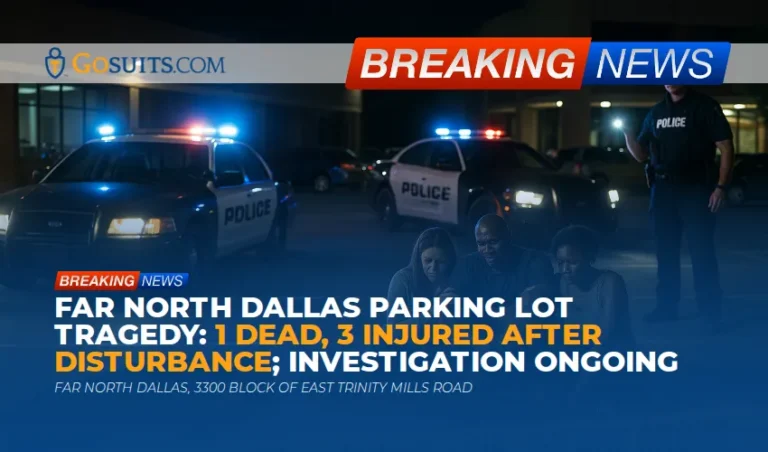
Shortly after 4:20 a.m. on Friday, April 17, 2026, a disturbance inside a business in the 3300 block of East Trinity Mills Road in Far North Dallas spilled into the parking lot. Investigators report that a female driver then got into a vehicle and struck multiple people in the lot. One person, 32-year-old Kiara Lewis, was transported by Dallas Fire-Rescue in critical condition and was later pronounced deceased. Three additional victims, a man and two women, were taken to a hospital by private vehicle and later released. At the time of reporting, police had not announced an arrest and said the investigation remains ongoing.
East Trinity Mills Road runs along a busy corridor near the Dallas and Carrollton line, not far from the Dallas North Tollway and the President George Bush Turnpike. Overnight, parking lots in this area can be active as late-night workers finish shifts and early-morning crews arrive. When a dispute erupts and moves outdoors, cars and crowds mix in ways that raise serious safety concerns.
Where the investigation stands
Dallas police have described the event as a disturbance between two groups that moved from inside the business to the parking lot. What happened next is still being pieced together. In cases like this, detectives generally review surveillance video, interview witnesses from inside and outside the business, and examine vehicle damage patterns to understand speed, angle of impact, and paths of travel.
It is common for investigators to seek physical evidence such as paint transfers, skid or yaw marks, broken auto components left at the scene, and electronic data from vehicle systems. They may also gather any 911 call recordings and CAD logs to build a timeline. As the investigation proceeds, the civil implications for the injured and for Ms. Lewis’s family become clearer, regardless of any criminal process that may or may not follow.
How Texas civil law views vehicle strikes after a disturbance
Under Texas civil law, when a person is injured or killed by the actions of another, two separate civil claims often arise: a wrongful death claim brought by certain surviving family members and a survival claim brought on behalf of the deceased person’s estate. The Texas Wrongful Death Act allows designated relatives to seek relief for losses they personally suffer because of a death caused by another’s wrongful act, neglect, carelessness, unskillfulness, or default [1]. Texas law also recognizes a survival claim so that damages the deceased person could have sought if they had survived may be pursued by the estate [1]. The general time limit to bring these types of claims is typically two years from the date of injury or death, subject to limited exceptions [2].
When a driver uses a vehicle in a way that causes harm in a parking lot after a confrontation, potential civil theories can include negligence, gross negligence, or intentional torts such as assault or battery. Which theory applies depends on the facts. Even if criminal charges are never filed, or if they lead to a different outcome, the civil standard of proof and the focus on compensating losses rather than punishment mean families can still bring wrongful death and survival claims.
Families often ask where to even start. Many turn to fatal accident lawyers to help sort out the interplay of insurance policies, evidence preservation, and claims timing. Because these cases can involve both intentional and negligent acts, and potentially multiple parties, early strategic guidance can matter.

Who can bring a wrongful death claim and a survival claim in Texas
Texas law specifies who can file a wrongful death claim. The deceased person’s spouse, children, and parents may bring a wrongful death action, individually or together, for losses they experienced because of the death [1]. If they do not file within a certain period, an executor or administrator may pursue the claim on behalf of all eligible beneficiaries. Separately, the estate’s representative may bring a survival claim for the decedent’s own damages that accrued before death, such as conscious pain and suffering, medical expenses, and similar losses [1].
Each family’s situation is unique. Some will prioritize final expenses and immediate needs; others need help coordinating with life insurance, employer benefits, or child support obligations that do not pause after a tragic loss. In many Dallas cases, beneficiaries reside across multiple cities or states, which adds logistical layers to signatures, probate, and communication. Seasoned Dallas fatal accident lawyers often help align beneficiaries, open or coordinate with the estate, and ensure each category of claim proceeds on the right track and within the right timeline.
Could the business or property owner be civilly liable?
A serious question in incidents that start inside a business and move outside is whether the property owner or business could bear civil responsibility. In Texas, property owners and operators must take reasonable steps to keep their premises reasonably safe for lawful visitors. When injuries arise from third-party conduct, one civil framework sometimes evaluated is negligent security under premises liability. That analysis is very fact-specific. It can involve questions like whether prior similar incidents made the risk foreseeable, whether staff tried to de-escalate or separate groups, how quickly security or management responded, and whether the property’s layout or lighting contributed to harm.
Importantly, the existence of a heated disturbance followed by a vehicle strike does not automatically impose liability on a business. But families and injured people should know that, in some circumstances, a business or property owner might share responsibility when inadequate measures contributed to a preventable injury on their property. Establishing that responsibility often requires fast action to preserve video footage, incident logs, staff schedules, and maintenance or security vendor contracts.
Evidence to secure right away
When an incident unfolds in a parking lot near businesses and busy cross-streets like East Trinity Mills Road, much of the best evidence can vanish quickly. Lighting cycles off at daybreak, security footage overwrites in a matter of days, and witnesses disperse. Here are key categories of evidence families and injured community members often try to preserve early:
- Surveillance video and audio: Footage from inside the business and exterior cameras covering entrances, exits, and the parking lot. Ask for the exact recording window and retention policy.
- Incident and 911 records: Dispatch audio, CAD logs, and any internal incident or patron complaint logs maintained by the business.
- Witness information: Names, phone numbers, and any photos or recordings patrons captured on smartphones.
- Vehicle evidence: Photos of damage positions, glass or debris patterns, and marks on curbs, bollards, or landscaping. If available, electronic data from the involved vehicle may show speed, braking, or accelerator position at critical moments.
- Medical documentation: EMS run sheets from Dallas Fire-Rescue, ER intake records, and treating physician notes. Accurate symptom descriptions on Day 1 can help clarify causation weeks later.
- Business policies and staffing: Written policies on disturbances, ejection, and security responses; staff schedules and assignments for the night in question; and any third-party security contracts.
Because evidence requests can be sensitive and time-limited, it is common to coordinate these efforts through an attorney who can send preservation notices immediately and handle communications in writing. This helps ensure nothing is misunderstood and that there is a trackable paper trail.
How to obtain official reports and records
Official documents can clarify timelines and support insurance or civil claims. Here are common records and the statewide paths many Texans use to request them:
- Texas crash report: If police determine the event meets reportable criteria, a crash report may be available through the Texas Department of Transportation’s crash records portal. TxDOT provides a statewide process for obtaining traffic crash reports [3].
- Inquest and autopsy context: In Texas, inquests and autopsies are governed by the Code of Criminal Procedure, Chapter 49, which outlines when and how postmortem examinations occur [4]. County medical examiners maintain the official autopsy file. While each county has its own procedures for requesting documents, the statewide framework comes from Chapter 49 [4].
- Death certificate: Certified copies of Texas death certificates can be requested through the Texas Department of State Health Services Vital Statistics Section [5]. A death certificate is frequently required to manage life insurance, banking, and probate matters.
- Open records for public information: Texas residents have rights under the Texas Public Information Act to request public information from governmental bodies. The Office of the Attorney General publishes clear guidance on how the process works and how to make requests [6].
If you are handling paperwork while grieving, consider using a simple, organized checklist. Many families find it helpful to review a practical guide like the Dallas Wrongful Death Paperwork Checklist for Families to understand typical documents, the sequence to request them, and how to keep copies.

Insurance issues to consider after a parking lot vehicle strike
Parking lot incidents often involve a web of potential insurance policies. The driver’s auto liability policy may be primary for bodily injury and wrongful death damages. If the driver used a vehicle owned by someone else, the owner’s policy might be implicated. Umbrella liability policies, if they exist, can also come into play.
On the victim side, certain coverages may help with immediate needs. For example, some auto policies include Medical Payments (MedPay) or Personal Injury Protection (PIP) that can help with early medical costs. Uninsured or underinsured motorist coverage may apply if the at-fault driver is uninsured or carries limits that do not cover the losses. If a business or property owner is potentially involved under a premises theory, a commercial general liability policy may be relevant. The interplay among these policies, subrogation rights, and hospital liens can be complex, which is why families often consult fatal accident lawyers even before initiating any insurance claim communications.
Before calling any insurer to give a recorded statement or accept an early offer, consider calling an attorney first. What people say to an insurance company in the first few days can be used against them later. An attorney can help prepare a concise, accurate statement supported by documentation and can push back against pressure to sign broad medical or employment releases.
Key Texas deadlines and timelines to keep in mind
Texas generally allows two years to bring wrongful death and survival claims, although rare exceptions can change the clock [2]. Because evidence degrades quickly, the practical deadlines are often much sooner. Preservation letters to a business or property owner ideally go out within days. Surveillance video in North Texas retail areas is frequently overwritten within 7 to 30 days.
For families handling end-of-life logistics, ordering certified death certificates early can help avoid delays in banking, mortgage discussions, and benefit claims [5]. If a public information request is necessary, the Texas Public Information Act process has defined response timelines for agencies and mechanisms for resolving disputes with the help of the Office of the Attorney General [6].
Far North Dallas context and safety reflections
Far North Dallas neighborhoods see a steady flow of late-night activity near major roads like East Trinity Mills, Frankford, and Midway. Parking lots serve as spillover spaces where people gather, wrap up bar or restaurant tabs, and say goodbyes close to closing time. Add vehicles idling at the curb and drivers cutting through lanes looking for exits and the risk can rise.
Safety advocates often emphasize simple steps: keep groups calm as they exit, use well-lit routes to vehicles, and avoid standing in drive aisles even briefly. National public health agencies continue to highlight pedestrian vulnerability when vehicles are in motion near crowds. The CDC provides an overview of pedestrian injury risk and prevention strategies communities can adopt [7]. NHTSA similarly offers resources focused on pedestrian safety and driver awareness [8].
As our city processes this loss, it is natural to ask whether better lighting, clearer traffic flow, bollards, or different staffing patterns might reduce risks in the future. While those broader questions are important, families today often need help with immediate steps to gather records, coordinate benefits, and understand their civil rights.
Practical next steps families and injured community members can take
Below are actionable steps that many Dallas families and injured residents consider in the first days. Every situation is different, but this outline can help you get organized and protect important rights.
- Preserve video immediately: Deliver a written request to the business and any neighboring properties that may have captured the lot or street approaches. Ask for the specific time window from at least one hour before to one hour after the incident.
- Gather medical documentation: Request Dallas Fire-Rescue transport information and emergency department records. Keep copies of discharge instructions and prescriptions.
- Identify all potential insurance policies: Confirm the at-fault driver’s insurer and policy number if available. On the victim side, review auto, umbrella, and any employer-provided benefits.
- Be cautious with insurer communications: Consider consulting an attorney before giving any recorded statements. Insurers often request broad releases that are not necessary at early stages.
- Track expenses and time loss: Save receipts for funeral costs, travel, parking, childcare, and counseling. If missing work, keep pay stubs and employer notes.
- Order certified death certificates: Plan for multiple copies to handle financial institutions, life insurance, and other accounts [5].
- Request official records: If a crash report is available, use the statewide TxDOT process [3]. Consider public information requests guided by the Texas Public Information Act if you need certain governmental records [6].
- Consider victim assistance resources: Texas offers a Crime Victims’ Compensation Program that may assist with certain out-of-pocket costs for eligible victims and families [9].
In the midst of grief, it is easy to feel overwhelmed. Many families find it helpful to let a legal team coordinate preservation letters, records requests, and insurer communications so relatives can focus on care, community, and memorial plans. Some begin with a simple consultation to map out who will do what over the next few weeks.
For those evaluating legal support across different practice areas, some start by speaking with fatal accident lawyers to understand both immediate and long-term decisions, from funeral bill management to potential complex claims involving multiple parties.
Call-to-action: Why acting now matters
What should be done next? Identify and preserve time-sensitive evidence, organize essential documents, and clarify which insurance policies may apply. Early action protects key footage, prevents records from being lost, and sets a clear foundation for any insurance or civil claims.
- Benefit of acting promptly: Surveillance video is often overwritten within days, and witnesses become harder to locate. Securing evidence early increases the likelihood of accurately reconstructing what happened.
- Urgency: Texas civil claims have firm deadlines, and some benefits programs require timely applications. The sooner the documentation and requests start, the fewer delays later.
- When it matters: The first 7 to 30 days are critical for evidence. Aim to send preservation notices this week, request medical and transport records right away, and begin organizing financial documents to avoid gaps later.
- How this helps: A clear, early record can reduce disputes with insurers, avoid repeated requests, and minimize the risk that important proof is lost.
Before making any recorded statement to an insurance company, consider speaking with an attorney to understand rights and risks. Statements given now can impact what is recoverable later, and signing broad releases can open unrelated records to scrutiny. A brief, informed consultation helps set the right course.

Commentary from Gosuits Dallas, Texas Personal Injury Attorney
Our hearts are with Ms. Lewis’s loved ones and with the three injured community members who were treated and released. We are deeply sorry for the pain this incident has caused. This discussion is intended to share general information and community-focused guidance. It is educational in nature and not tailored to any single person’s situation.
From a civil perspective, a vehicle striking multiple people in a business parking lot after a disturbance raises serious questions about driver conduct and whether any on-site measures could have reduced risk. The law in Texas allows families and injured people to pursue civil claims even while law enforcement continues its work. The central inquiries will likely include how the dispute moved outdoors, what happened in the seconds before impact, and what the on-site environment contributed to the path of the vehicle and the crowd’s position.
Insurance companies and corporate property owners often move quickly to secure their own interests. Early in a case, insurers may seek broad medical releases, pressure people into recorded statements, or suggest low early payments framed as “help.” Without context, some families sign documents that complicate claims later. Corporations may also retain footage for only short periods unless they receive a timely preservation letter.
A free consultation can serve as a low-pressure way to understand rights, learn which documents to request, and decide how to handle insurers. It can also help families coordinate the parallel tracks of wrongful death and survival claims and organize who should request what, and when. Even one conversation often brings clarity during a week that otherwise feels chaotic and overwhelming.
References
- Texas Wrongful Death and Survival Statutes, Chapter 71 – Texas Statutes
- Statute of Limitations, Sec. 16.003 – Texas Statutes
- Traffic Crash Reports – Texas Department of Transportation
- Inquests and Autopsies, Chapter 49 – Texas Code of Criminal Procedure
- Death Records – Texas Department of State Health Services
- Your Right to Know: Texas Public Information Act – Texas Attorney General
- Pedestrian Safety – Centers for Disease Control and Prevention
- Pedestrian Safety – National Highway Traffic Safety Administration
- Crime Victims’ Compensation Program – Texas Attorney General