













































Two counties, two courthouses
Naperville sits mostly in DuPage County and partly in Will County, and the two parts can look alike from the street. The DuPage side files in the Circuit Court of the 18th Judicial Circuit, at the courthouse at 505 N. County Farm Road in Wheaton. The Will County side files in the 12th Judicial Circuit, whose courthouse is in Joliet. Illinois trial courts are circuit courts. There are no district or superior courts for injury claims.
Venue is generally proper in the county where the injury happened or where a defendant lives or does business. That means a Naperville resident hit by a driver from another county may have more than one place to file, and the choice can affect speed, jury pool and convenience. We weigh those factors before we file, not after.
I-88, Route 59 and the intersections that cause trouble
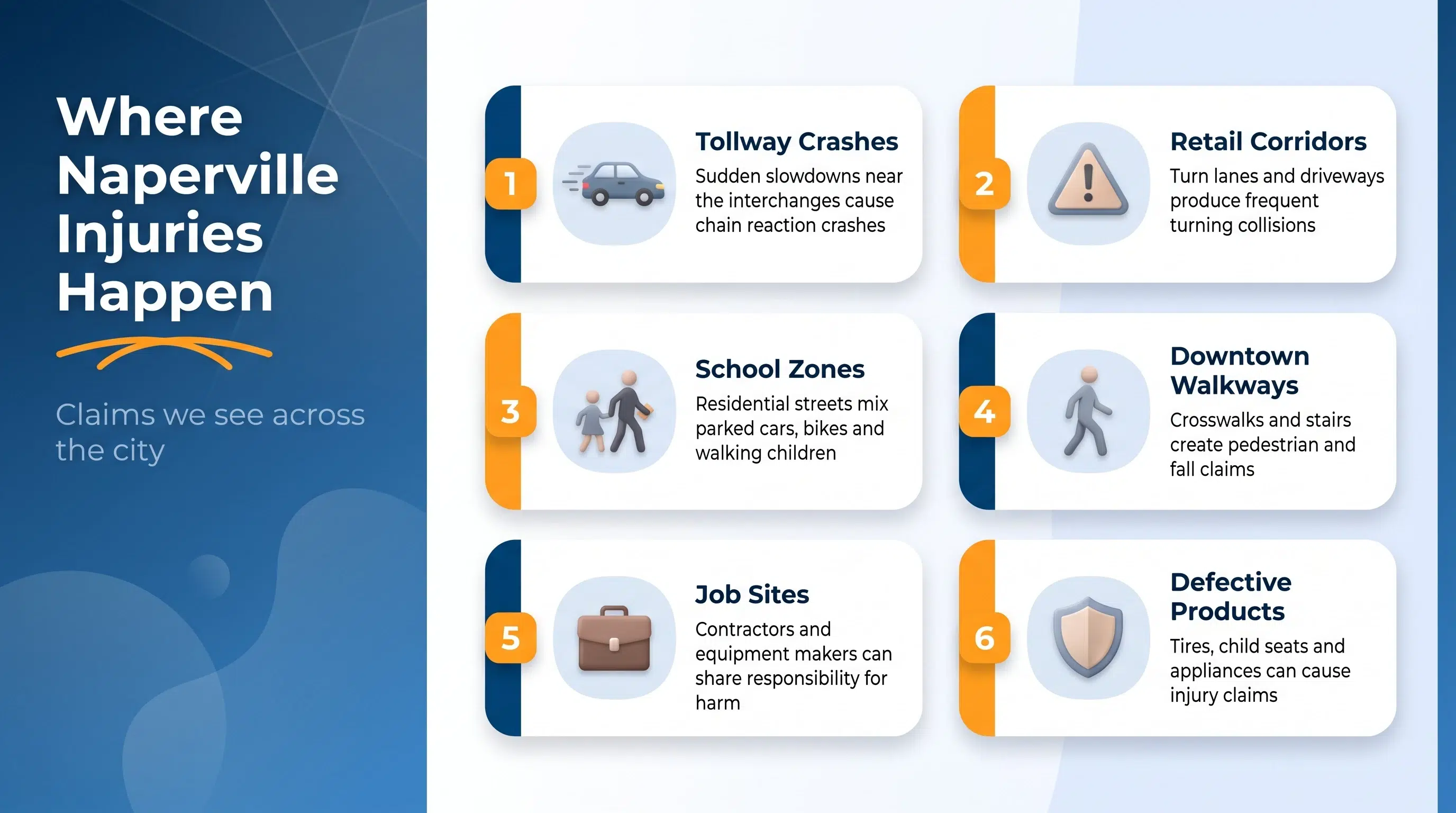
I-88, the Ronald Reagan Memorial Tollway, runs across the northern part of Naperville and carries commuters toward Chicago and trucks headed to the west. When traffic slows suddenly near the Route 59 interchange, rear-end collisions and chain reactions follow. Fault in a multi-vehicle crash is often disputed, so photographs, vehicle data and witness statements carry real weight.
Route 59 itself runs north and south through the city’s shopping areas, with turn lanes, driveways and heavy retail traffic. Ogden Avenue (US-34) meets Route 59 and is another corridor with frequent turning collisions. In the southern part of the city, where Naperville reaches into Will County, a crash can raise questions about which agency wrote the report and which court applies.
A common Naperville claim does not involve a dramatic crash at all. It is a driver who rolls through a stop sign near a school, someone who is looking at a phone while turning right, or a person who steps out of a parked car into traffic. These are the cases where the physical evidence is thin and the argument over fault is the main event.
School zones and neighborhood streets
Many Naperville streets are residential and lined with parked cars, bikes and children walking to school. A driver who is a little late, a little distracted or a little over the limit can do serious harm in seconds. When a child is hurt, the claim has its own rules about who brings it and how any settlement is approved, so a parent should not sign anything without advice. Witnesses on these streets are often neighbors, and a quick knock on doors can turn up a doorbell camera that caught the whole thing.
Pedestrians, the Riverwalk and downtown
Downtown Naperville has a lot of foot traffic. Visitors walk along the Riverwalk beside the West Branch of the DuPage River, cross streets at mid-block, and park in garages. The Metra station sits close to the center, served by the BNSF line, so commuters also cross tracks and busy streets on their way to a train.
When a driver strikes a pedestrian in a crosswalk, the insurer’s first move is to say the pedestrian was not paying attention. Signal timing, camera footage from nearby businesses and witness accounts help answer that. A person who falls on a poorly maintained walkway or stairs may have a claim against the property owner instead.
How long do you have, and how much fault is too much?
An Illinois personal injury lawsuit generally has to be filed within two years of the injury. That deadline is in 735 ILCS 5/13-202. Cases against public entities can be subject to shorter notice rules, so be careful if a village, school district or park district is involved.
Shared fault is the other major rule. Under 735 ILCS 5/2-1116, you cannot recover if a jury finds you more than 50 percent at fault. If you are 50 percent or less responsible, your damages are reduced by your percentage. Insurers press hard on this point because every percentage point reduces what they pay.
What does a case take, start to finish?
People want a timeline, and the honest answer is that it depends. A straightforward claim with a clear at-fault driver and full recovery may settle within months. A case with surgery, a disputed accident or a commercial defendant can take a year or more, and a lawsuit adds time. Our post on how long a personal injury lawsuit takes in Illinois goes through the stages.
Rushing to settle before you know the full extent of your injuries is the most common mistake. Once you sign a release, you cannot return for more if a surgery you did not expect turns out to be necessary.
Where do the people who live here get hurt?
Naperville is known for its schools and neighborhoods, but it also has corporate offices, healthcare facilities, retail centers and construction sites. Workers are injured on all of them. In many cases workers’ compensation is the primary remedy, and a third party such as a contractor or equipment maker can also be responsible. If an employer failed to carry the workers’ compensation insurance Illinois requires, the worker may be able to sue the employer in civil court.
Consumers are hurt by defective products, from tires and child seats to appliances. If you think a product caused your injury, keep it, and do not send it back to the company.
Homeowners and tenants have claims too, when a contractor’s work or a landlord’s neglect causes harm. And families sometimes face the worst case, a death caused by someone else’s negligence, where a personal representative may bring a claim for the family.
Taking care of yourself and the paperwork
Edward Hospital is in Naperville, and you should go there or to the nearest emergency room right away if you are hurt. Tell the doctors what happened and describe every symptom. Follow the treatment plan, since missed appointments suggest that you were not hurt as badly as you claim.
For the police report, Naperville reports are handled by the Naperville Police Department. You can submit a request through the city’s online FOIA form or go in person to the Records Section, 1350 Aurora Avenue, Naperville, IL 60540. Have the date, location and names of the people involved ready. If the crash happened on the tollway, the Illinois State Police may have the report. Check it for mistakes, and let us know about any.
How insurers look at a Naperville claim
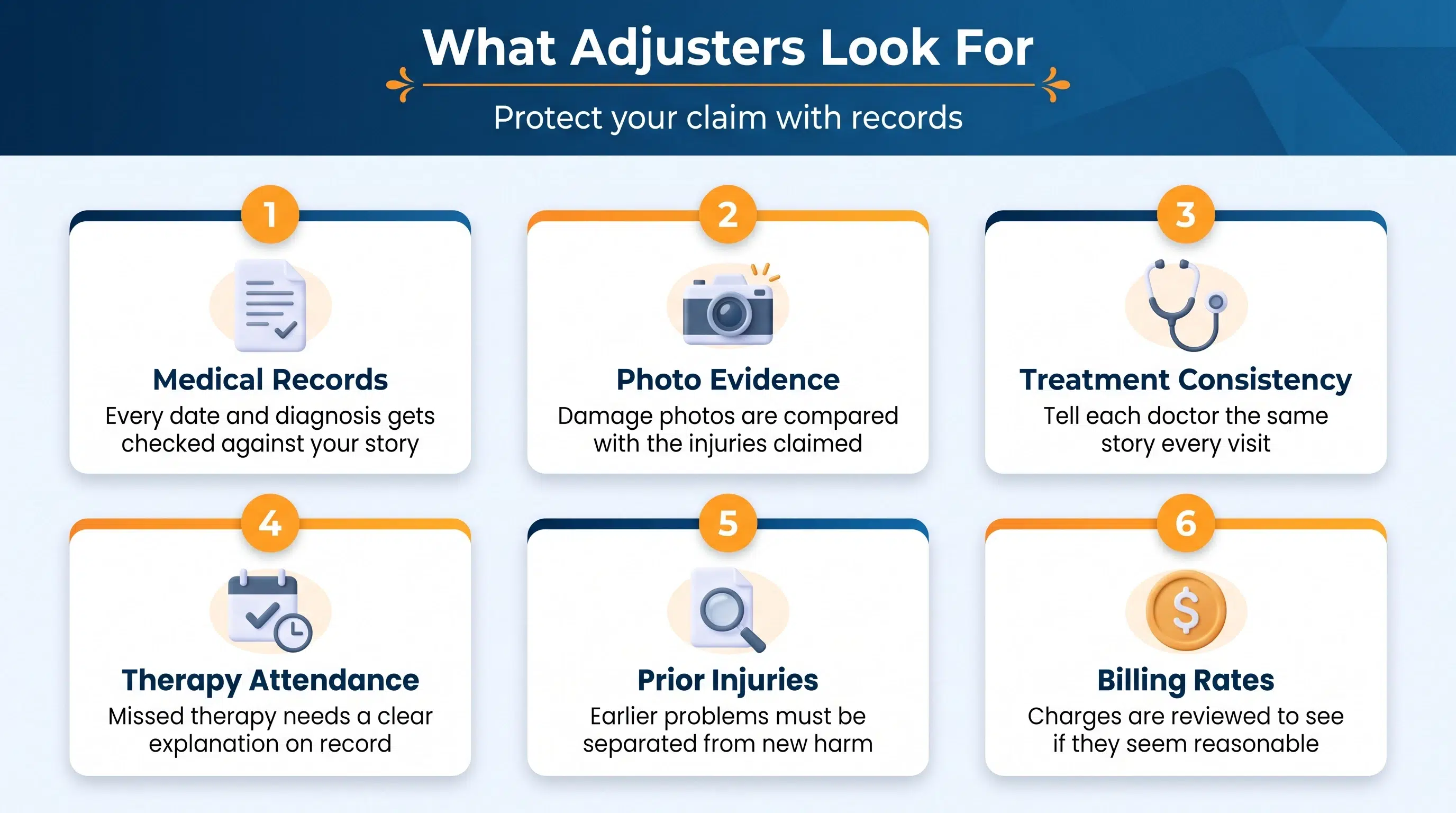
Adjusters work from the file, not from the person. They read the medical records, check the dates, compare the diagnosis to the property damage photographs and look for anything that suggests the injury is smaller than claimed. In a suburb with good medical care and good insurance, bills can climb quickly, and that draws scrutiny: was the treatment necessary, was it too long, was it billed at a reasonable rate.
What helps most is consistency. See the doctors your condition calls for, tell each one the same story, and keep notes on how the injury changes your days. If a doctor recommends physical therapy, go. If you stop, say why. A gap that is explained is much less damaging than one that is not.
Insurers also check for prior injuries to the same part of the body. A prior back problem does not end a claim for a new back injury, but it means the records need to be clear about what changed.
Cars with no insurance, and drivers who leave
If the other driver has no insurance or flees, your own policy’s uninsured motorist coverage may apply. Policies set limits, and many require prompt notice, so read yours or have us read it. Report a hit-and-run to police right away and keep any evidence, including paint transfer, debris and witness information. The claim then runs against your own insurer, and the same care applies as with any other.
Delivery vehicles, rideshares and company cars
Suburban roads are full of vehicles working for someone: delivery vans on residential streets, contractors’ trucks outside a job site, rideshare drivers on the way to O’Hare or the train. When a driver is on the job, an employer or a company policy may be involved, and the coverage can be much larger than the driver’s own. The first question is always whose vehicle it was and what the driver was doing. We ask for the answer in writing and for the records that back it up.
What a claim can include
Injured people can pursue compensation for medical expenses, future care, lost wages, reduced earning ability, pain and suffering, and loss of normal life. The value depends on the evidence, the severity of the injury and the effect on your work and daily activities. No lawyer can promise a particular amount, but a clear record of treatment and limitations makes a claim harder to discount.
Which Naperville cases do we take?
Most of the Naperville cases we see begin on the road. Collisions on I-88, Route 59, Ogden Avenue and 95th Street are handled by our Chicago-area car accident lawyers. When a semi or a delivery truck is involved, the carrier and its insurer become part of the case, and our Chicago-area truck accident team works it from the start.
When negligence takes a life, an Illinois wrongful death claim is brought by the personal representative of the estate for the surviving spouse and next of kin. Our Chicago-area wrongful death lawyers handle those cases. We also take pedestrian, workplace, product and premises injury cases from Naperville.
Next step
If you were hurt in Naperville, you can speak with our Illinois personal injury attorneys and schedule a free consultation. We will review what happened, explain which court would hear your case and tell you the deadline that applies.
