















































What makes a death legally wrongful in Illinois?
A death is wrongful when it was caused by another person’s or company’s wrongful act, neglect or default, and the person who died could have brought an injury claim had they survived. That covers a crash caused by a distracted driver, a fall on a poorly maintained property, a defective product, a fatal workplace incident and many other situations. It does not require criminal charges. A prosecutor may decline to file, or a jury may acquit, and the family can still bring a civil claim, because the standard of proof and the purpose are different.
The Illinois Wrongful Death Act, 740 ILCS 180, is the framework. It does not try to put a price on a life. It gives the survivors a way to hold the responsible party accountable and recover for what they have lost.
Two details are worth knowing early. The claim belongs to the family as a group, not to one person, and it covers deaths from injuries as well as deaths that happen at once, including a person who lived for days or weeks in a Naperville hospital before dying.
Who brings the claim, and who receives the money?
Under the Act, the action is brought by the personal representative of the person who died, and any recovery is for the benefit of the surviving spouse and next of kin. If there is a will, it usually names an executor. If not, the family asks the probate court to appoint someone, often a spouse or an adult child. Getting that appointment done early prevents delay later.
The money does not simply go to the estate. The court divides it among the surviving spouse and next of kin according to each person’s relative dependency on the person who died. A spouse and young children who relied on one income would usually have a different share than adult children who were independent. If family members disagree, that is a matter the court can resolve, and an attorney can help a family talk through it before it becomes a fight.
What losses can a family recover?
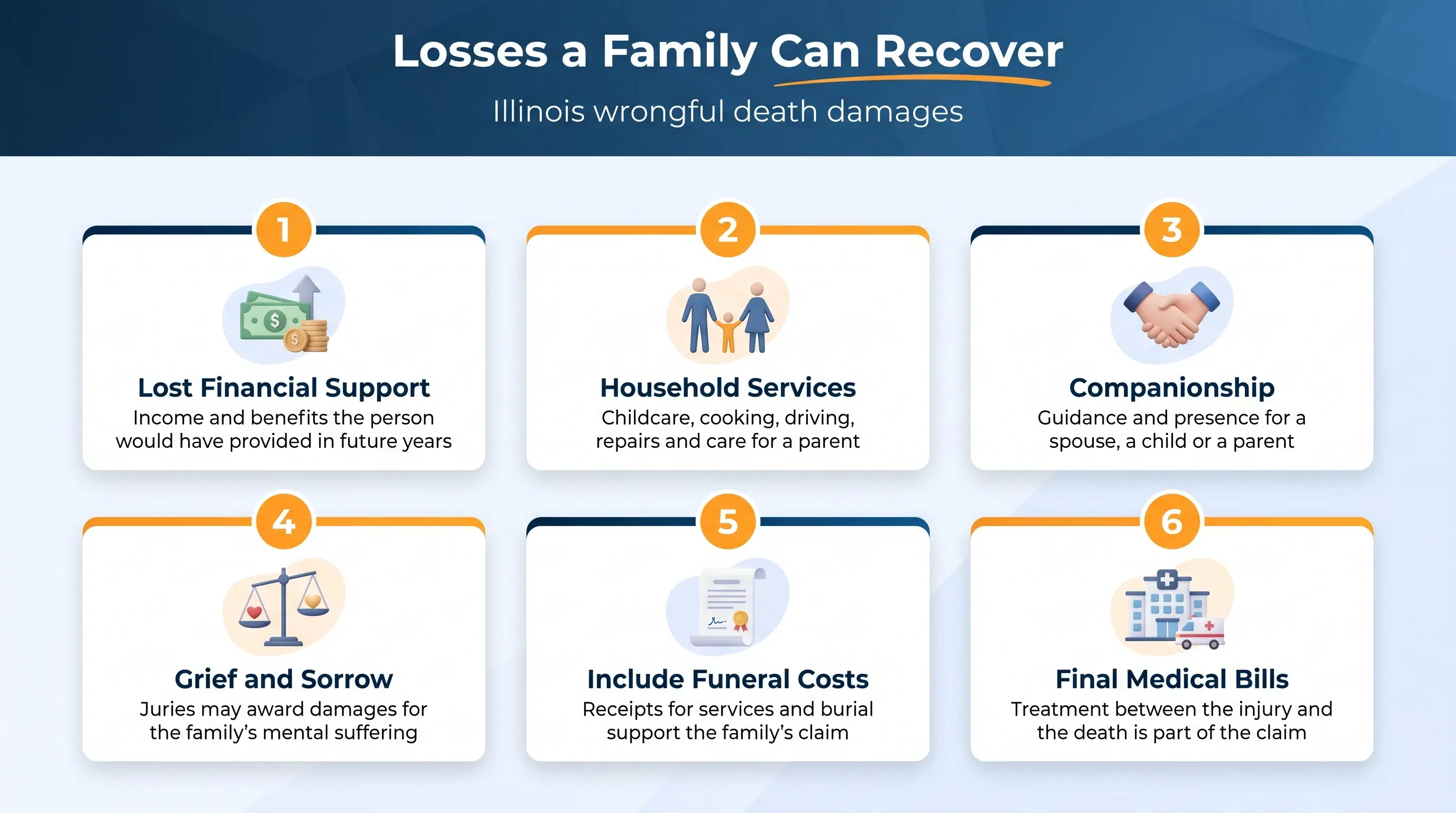
The statute allows fair and just compensation for the pecuniary injuries resulting from the death, and a jury may also award damages for grief, sorrow and mental suffering to the surviving spouse and next of kin. In practice, that covers several kinds of loss.
Financial support is the first: the income and benefits the person would have provided over the years ahead. Household services come next, such as childcare, cooking, driving, home repairs and care for a parent. Companionship, guidance and the loss of a parent for a child or a spouse for a partner are part of the picture, along with the family’s grief. Funeral and burial costs and medical bills for treatment between the injury and the death are commonly part of the claim as well.
Value depends on facts. The age and health of the person who died, their work and earning potential, the number of people who depended on them, and the strength of the evidence about responsibility all matter. An economist can estimate lost earnings, while the human side of the loss is shown through the people who knew the person.
Net recovery matters too. Beyond pursuing the settlement from the responsible party’s insurer, we negotiate with hospitals and lien holders to reduce what is owed out of the award.
How long does a family have to file?
The general rule under the Act is that the case must be started within two years after the death. There are exceptions. Where a death resulted from violent intentional conduct, a claim against the person who committed it can be brought within five years, and where the person responsible was charged with certain crimes, a suit against that person can be filed within one year after the criminal case ends. A beneficiary who was under 18 when the claim arose may have two years after turning 18. These extensions depend on who is being sued and what was charged, so they should not be assumed.
Claims against a city, school district or other public body can carry separate notice requirements that are shorter, so tell us right away if a government vehicle, building or road is involved.
Waiting has costs beyond the calendar. Witnesses move, memories fade and the equipment or vehicle involved may be repaired or sold. You can ask an attorney now and decide later.
How do wrongful death cases arise in Naperville?
Most start on the road. I-88, Route 59, Ogden Avenue and 75th Street carry heavy traffic, and a severe collision with a passenger vehicle, a tractor-trailer, a motorcycle or a pedestrian can end in a fatality. Many of these cases involve driver negligence, but some trace back to a vehicle defect, a carrier’s hours-of-service violations or a road design problem.
Other cases come from places where people should have been safe. A hazardous condition at a store or apartment complex, an unsafe construction site, a defective appliance or medical device, or an employer’s failure to follow safety rules may all be involved. When a death follows an injury at work, a workers’ compensation claim may exist alongside a claim against a third party, and the two need to be considered together.
Edward Hospital, at 801 South Washington Street, is a hospital in Naperville with an emergency department, and its emergency staff and records are often part of the story when someone dies after a crash. If the person died at the scene, the coroner in the county where it happened will have records too. Both DuPage and Will counties have their own.
What does the estate claim for what the person went through before dying?
A death sometimes follows a period of pain, fear or treatment, and the person’s own claim for what they suffered does not simply end. The Illinois Survival Act (755 ILCS 5/27-6) allows a separate claim by the estate for injury to the person before death, in addition to the family’s wrongful death claim. These claims are filed together and rely on the same evidence, but they compensate different losses, and they are handled differently in the way the money is distributed.
We look for this claim in every case. Medical records, emergency personnel accounts and hospital timelines can show whether there was conscious pain or a period of survival.
What should a family do in the first weeks?
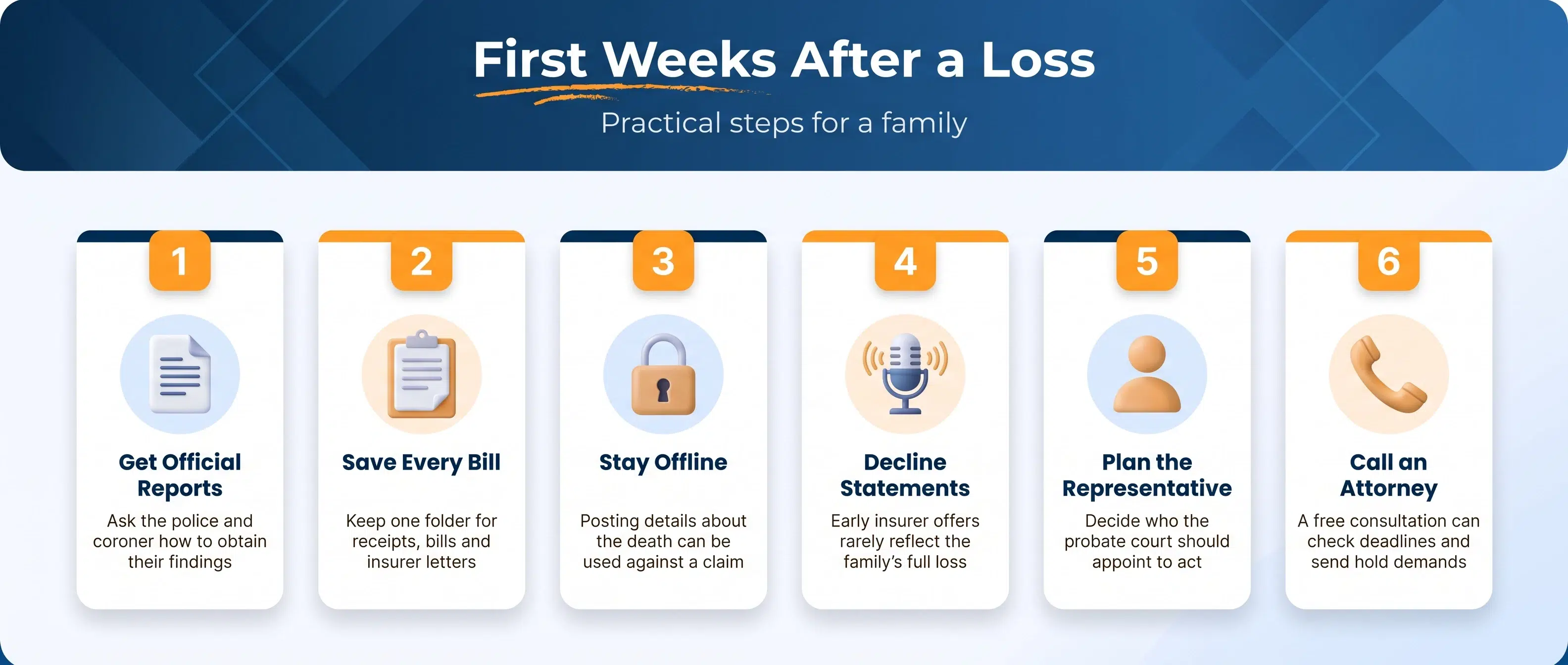
There is no required order, but a few things help. Ask the police and the coroner how to obtain their reports. Keep a folder with every bill, receipt and letter. Do not post details about the death online, and decline any request from an insurer for a statement. If a representative offers a quick payment, treat it as a conversation starter rather than an answer, because the amount offered early is rarely based on a full picture of the family’s loss.
Think about who is going to be appointed as personal representative, and gather the documents a court will ask for. Then contact us. We will explain the process, check the deadlines, and send legal hold demands to any company or agency that holds records.
What do defendants and insurers argue after a death?
The arguments are predictable, and they hurt to read. A defendant may say the person who died was partly at fault, that a pre-existing health condition played a bigger role than the crash or fall, or that the family’s loss is smaller than it appears. In a road case, the point may be a lane change, a speed estimate or a missing seat belt. In a premises case, it may be that the hazard was obvious.
Illinois lets a defendant raise the decedent’s own share of responsibility, and a high enough share can cut off or reduce a recovery. That is one reason we collect scene evidence, video and recorded vehicle data early, since they are the most direct answer to a story that cannot be corrected by the person who died.
Insurers also tend to value a death in narrow terms, often counting only earnings and bills. We present the broader picture the law allows, including household work, guidance for children and the years of companionship that would have followed. Retired people and stay-at-home parents have real losses too, and a claim for them is not weaker because there was no paycheck.
Where is the case filed, and how long does it take?
Naperville lies mostly in DuPage County and partly in Will County. A wrongful death suit can be filed in the county where a defendant lives or where the death occurred, under 735 ILCS 5/2-101. That could mean the Circuit Court of DuPage County, part of the 18th Judicial Circuit in Wheaton, or the Circuit Court of Will County, part of the 12th Judicial Circuit in Joliet. The probate case that appoints the personal representative is a separate proceeding in the same county system.
How long a case takes depends on the evidence, the number of defendants and whether liability is disputed. Some resolve in months and others take years. Our article on how long it takes to settle a wrongful death lawsuit explains what affects the timeline.
If you are not sure where to start, our Chicago personal injury team can talk it through with you, and you can contact our team at any hour.
Which Naperville wrongful death cases do we take?
We represent Naperville families after fatal crashes on I-88, Route 59, Ogden Avenue and 75th Street, and after deaths caused by unsafe property, defective products or workplace negligence. In Illinois the claim is brought by the personal representative of the estate for the surviving spouse and next of kin, and our Chicago-area wrongful death lawyers handle these cases together with the estate’s survival claim.
Wrongful death cases are handled through our Chicago personal injury office. When a semi or another commercial vehicle caused the death, our Chicago-area truck accident team works with the family’s case from the start, because the carrier’s records are often the key evidence.
