














































What makes a truck crash legally different from a car crash?
Size is the obvious difference, but the legal gap is wider than the physical one. A loaded tractor-trailer can weigh many times what a passenger car does, so even a moderate-speed collision can cause catastrophic injuries. And unlike a private driver, a commercial truck is run by a business that is regulated.
The Federal Motor Carrier Safety Administration sets rules for interstate carriers and their drivers. Under its hours-of-service regulations, a property-carrying driver gets 11 hours of driving time inside a 14-hour window, and must take a break of at least 30 minutes after 8 cumulative hours of driving. Those limits exist because tired drivers cause crashes. When a driver is over the limit, or a carrier pushed a schedule that made it impossible to stay under, that fact can change the case.
Records are a second difference. A car has an owner and an insurance card. A truck has a driver qualification file, logbook data, maintenance records, inspection reports, bills of lading and dispatch communications, and many of them sit with the carrier rather than the driver.
Fault rules still apply. Illinois bars recovery if a claimant is found more than 50 percent at fault under 735 ILCS 5/2-1116, so carriers sometimes argue that a smaller vehicle changed lanes or stopped short. Evidence from the truck is often the strongest answer to that argument.
Who is actually liable when a truck causes the crash?
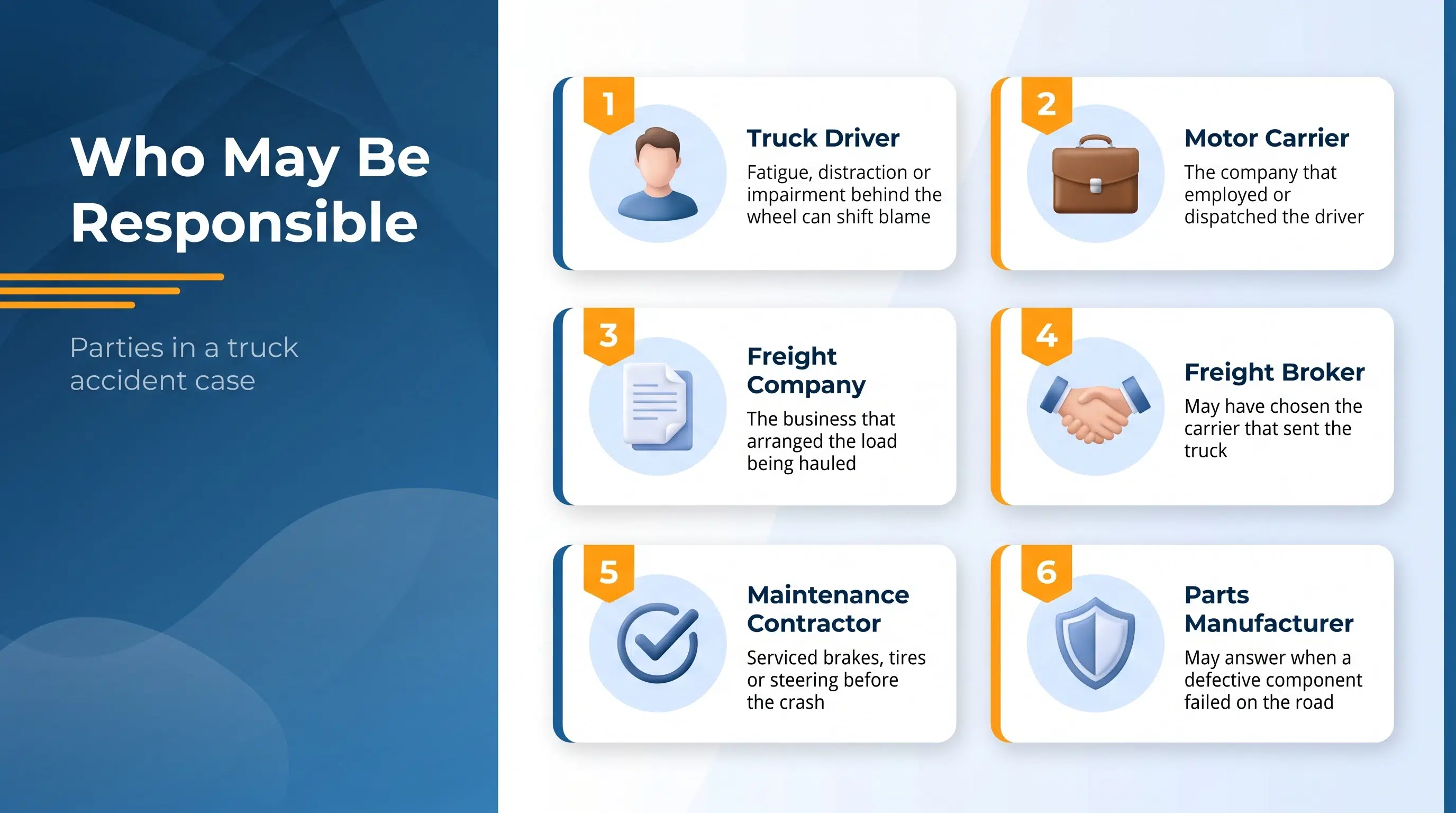
The driver is the first name on the report, but frequently not the only one. Depending on the facts, responsibility can reach the motor carrier that employed or dispatched the driver, a freight company that arranged the load, a broker that selected the carrier, a maintenance contractor that serviced the brakes or tires, a company that loaded the cargo, and a manufacturer whose part failed.
Each party may have its own insurer and its own lawyer, and each has a reason to point at someone else. A carrier will say the driver ignored policy. A maintenance shop will say the carrier deferred repairs. A shipper will say the cargo was fine when it left the dock. Our work is to collect enough records to show where responsibility sits, and to bring the right parties into the case before the deadline passes.
Whether an outside driver was an employee or an independent contractor, and who actually controlled the work, can affect who is responsible. Our knowledge-base article on CDL violations and negligence in Illinois truck crashes covers one way those facts surface.
Which evidence disappears first after a truck wreck?
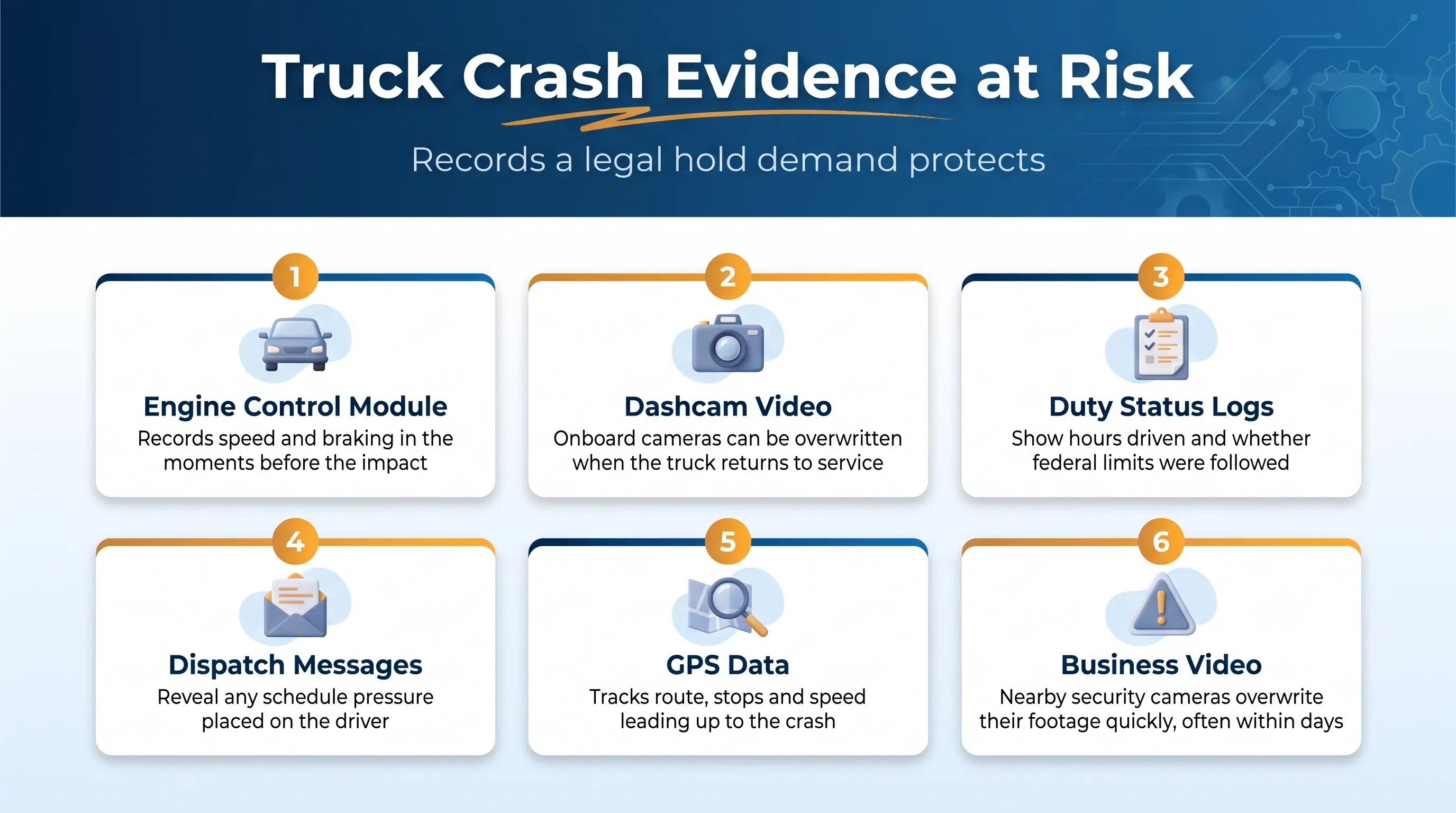
Start with the truck itself. Its engine control module and any onboard cameras record speed, braking and sometimes following distance, and can be overwritten when the truck returns to service. A tractor that is repaired and put back on the road is a different tractor than the one that hit you.
Federal rules require a motor carrier to keep records of duty status and supporting documents for at least six months under 49 CFR 395.8(k). Six months sounds like a long time until you consider that a lawsuit usually comes later, and a company that gets no demand letter has no reason to hold onto anything else. Dashcam clips, dispatch messages and GPS data may have much shorter retention periods, and some of them are not covered by that rule at all.
At the scene itself, tire marks fade, debris is swept and a fallen load is cleared. Witnesses leave. Nearby businesses on Route 59 and Ogden Avenue overwrite security video, sometimes within days.
That is why the first thing we do on a truck case is send written preservation demands to the carrier, the driver and any other company that might hold records, and why we arrange an inspection of the vehicle quickly.
Where do trucks and traffic collide in Naperville?
I-88, the Ronald Reagan Memorial Tollway, crosses the north side of the city and carries a steady stream of tractor-trailers moving freight to and from the rest of the Chicago area. The diverging diamond interchange at Route 59 asks every driver, including a driver hauling a trailer, to cross to the left side of the road for a short stretch, and a truck driver unfamiliar with it has less room to correct a mistake.
Route 59 itself is a retail corridor, and retail means deliveries. Box trucks and delivery vans stop at store lots and back out into traffic, and large trucks make wide turns across several lanes. On Ogden Avenue (US 34), driveways come every few hundred feet and trucks entering or leaving them can catch a following car by surprise. 75th Street and 95th Street carry trucks between subdivisions, work sites and the expressway.
Closer to downtown, narrow streets and pedestrians make a delivery truck’s blind spots more dangerous. A box truck backing into a loading spot near Washington Street can strike someone who never appeared in the mirrors.
Weather adds its own problems. Ice on I-88 or a wet ramp changes a truck’s stopping distance far more than it does a car’s, and a carrier that dispatched drivers in poor conditions may have to explain that choice.
How do injuries from truck collisions affect a claim?
The forces involved lead to injuries that are different in kind. Crush injuries, spinal damage, traumatic brain injuries, multiple fractures and internal bleeding appear in these cases more often than in ordinary fender-benders. Some people need surgery, months of rehabilitation and ongoing care. Some cannot return to the work they did.
Because the injuries are lasting, the claim has to look forward. A case that covers only the first hospital bill leaves out future surgeries, therapy, home changes, lost earning ability and the effect on family life. We work with treating providers and, where needed, life care planners and vocational professionals to put those costs on paper. Settling before you know what your recovery will look like is one of the most expensive mistakes in a serious injury case.
Emotional harm counts as well. Fear of trucks, nightmares and trouble driving are real consequences and can be part of the claim.
How many insurance policies can be involved?
Commercial carriers carry higher coverage than private drivers, and larger ones may stack a primary policy under an excess policy. A freight broker, a shipper and a maintenance contractor each may have their own. A driver’s personal auto policy may not cover work driving at all, so which policy applies is a question to answer with documents, not assumptions.
We request the full policy information early, including declarations pages and any excess layers, so that we know how much coverage stands behind each party before a demand goes out. When coverage is thin compared with the harm, your own underinsured motorist coverage may also matter.
Insurers on commercial claims often have rapid-response teams that contact people within hours. Their job is to collect information that helps them. You are not required to talk to them.
What is a truck accident claim worth?
There is no number that applies to every case. The value turns on the injuries and their permanence, medical bills past and future, lost income, the strength of the liability evidence, and the policy limits available. A case with a documented violation, such as hours-of-service records that do not add up, can be valued differently from one in which the driver did nothing wrong and the cause was a road defect or another vehicle.
It also depends on net recovery. Beyond pursuing money from the at-fault insurers, we negotiate with hospitals, ER groups and lien holders at settlement so that more of the award reaches you.
What if the carrier’s adjuster or a company representative contacts you?
Expect the call. A representative may be polite and may offer to cover a rental car or a first bill, which can feel like help. It is also the start of the carrier’s file on you. Anything you say about speed, lane position or how you felt at the scene can be quoted back later.
You can give your name and tell them you are getting legal advice. Keep the medical paperwork, do not sign a release, and send every later contact to your attorney. If a representative shows up at the hospital or your home, you can say no thank you and close the door.
Where is the case filed, and what is the deadline?
Most of Naperville is in DuPage County, and part of the city is in Will County. Under 735 ILCS 5/2-101, a lawsuit can be filed in the county where a defendant lives or where the transaction or crash occurred, so a truck case from Naperville might go to the Circuit Court of DuPage County (the 18th Judicial Circuit, in Wheaton) or the Circuit Court of Will County (the 12th Judicial Circuit, in Joliet). Because trucking companies are often based elsewhere, there may be a question of which county works best, and an out-of-state carrier may try to move the case to federal court.
Most injury lawsuits in Illinois must be filed within two years of the crash under 735 ILCS 5/13-202. Do not wait that long. Records are easier to preserve in the first weeks than in the second year. The simplest next step is to schedule a free consultation, and if you were hurt in a crash with a commercial vehicle in Naperville or the western suburbs, our Chicago personal injury team can get started.
Which Naperville truck accident cases do we take?
We take Naperville crashes involving tractor-trailers on I-88, box trucks and delivery vans along Route 59 and Ogden Avenue, and work trucks on 75th Street and 95th Street. These cases can reach the driver, the motor carrier, a broker, a maintenance shop or the company that loaded the cargo, and our Chicago-area truck accident lawyers handle them from the first preservation letter through settlement or trial.
Truck cases are handled through our Chicago personal injury office. When a truck crash takes a life, an Illinois wrongful death claim is brought by the personal representative of the estate for the surviving spouse and next of kin, and our Chicago-area wrongful death lawyers handle those cases.
