- What We Know About the Bartlett Motorcycle and Pickup Truck Crash
- Location and Local Context at Lake Street and Naperville Road
- Evidence and Official Records to Request After a Serious Crash
- Rights and Liability Basics for Illinois Motorcycle Crashes
- Insurance Considerations and How Companies Typically Respond
- Safety Patterns: Intersections, Rear-End Dynamics, and Motorcyclist Risk
- First-Days Steps for Families and Loved Ones After a Critical Injury
- Where to Get Key Documents and Help in the Region
- Community Notes on Traffic, Weather, and Roadway Conditions
- Why Acting Now Matters: Practical Next Steps
- References
- Commentary from Gosuits Bartlett, Illinois Personal Injury Attorney
What We Know About the Bartlett Motorcycle and Pickup Truck Crash
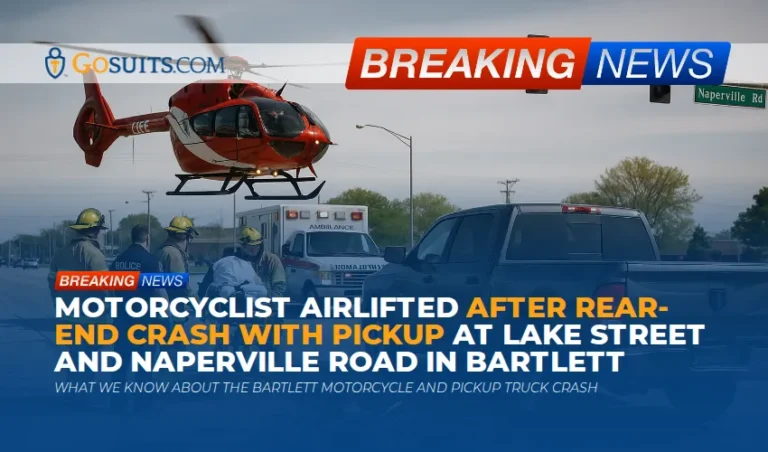
On Wednesday afternoon, April 22, 2026, a serious traffic crash occurred at Lake Street and Naperville Road in Bartlett. Police reported that a motorcyclist traveling along Lake Street collided with the back of a pickup truck that was turning north onto Naperville Road. The rider was airlifted from the scene in critical condition. Investigators closed the surrounding roads for roughly three hours and then reopened them after on-scene work concluded. No additional official information was available at the time of this report.
While facts are still developing, several things are already clear. First, this was a high-energy impact in a signalized intersection where through traffic on Lake Street often meets turning traffic moving toward or away from nearby neighborhoods and business corridors. Second, the airlift decision reflects concerns about the severity of injury. Third, determining how and why the rear-end contact occurred will likely depend on evidence from the roadway, vehicle damage profiles, any available video, and witness accounts. We outline how families can protect those facts in the sections below.
Location and Local Context at Lake Street and Naperville Road
Lake Street is known locally as US 20 as it runs across the northwest suburbs. The Lake Street and Naperville Road intersection ties together daily commutes to and from residential pockets and shopping areas around Bartlett and neighboring communities. Midweek afternoons often bring steady volumes, frequent signal cycles, and turns as drivers head home, run errands, or connect to other arterials. If you live nearby, you have probably seen just how fast things can change during a yellow phase at this intersection. A single quick decision can put one vehicle in the path of another in a matter of seconds.
For residents, the crash serves as a sobering reminder that familiar stretches like Lake Street demand extra attention, especially at intersections that handle a mix of through traffic and left or right turns. It is natural to have questions. Was the turn made on a protected green arrow or a permissive green? Did signal timing or sight lines matter? Were there sudden slowdowns or conflicting movements through the box? These are all fair questions, and they are precisely the types of details an investigation seeks to confirm with records and physical evidence.
Evidence and Official Records to Request After a Serious Crash
When a loved one suffers critical injuries, preserving evidence quickly can make a meaningful difference in understanding what happened. Some items must be secured immediately or they may be lost.
Time-sensitive items
- Photos and video from the scene taken by bystanders, nearby businesses, or vehicles with dashcams. If you know there were witnesses, note their contact info right away. Some local businesses overwrite security video in as little as 48 to 72 hours.
- 911 recordings and CAD dispatch logs, which can help lock down timing, calls, and unit assignments. These are often requestable through a public records process under the Illinois Freedom of Information Act, the state’s open-records law [7].
- Traffic signal timing sheets or controller logs if maintained by the municipality or the Illinois Department of Transportation for US 20. IDOT District 1 is the Chicago-area district that oversees state routes and may have relevant records [8].
Core investigative materials
- The police crash report and any supplement that identifies involved vehicles, diagrams movements, lists possible contributing factors, and names witnesses. Municipal police reports are typically obtainable through the local department’s records unit, often via a written request.
- Scene data and reconstruction materials such as measurements, photographs, and any specialized analyses if a reconstructionist was called to the scene.
- Vehicle inspections and damage documentation for the motorcycle and the pickup. This can be important to infer speeds, braking, and angle of impact.

Medical and transport records
- Air medical transport records and EMS run sheets which document vital signs, observed injuries, Glasgow Coma Scale scores, and timelines from dispatch to hospital arrival.
- Hospital records including imaging and notes that detail diagnosed injuries and immediate treatment. Federal rules give patients the right to access their own medical records, subject to limited exceptions [10].
Riders and families who want a structured, step-by-step list tailored for the Chicago area may find this helpful: Chicago Motorcycle Crash Evidence Checklist for Riders.
Rights and Liability Basics for Illinois Motorcycle Crashes
Illinois uses a modified comparative negligence framework for injury cases. In simple terms, a person’s compensation can be reduced by their percentage of responsibility. If someone is found to be more than 50 percent at fault, they are barred from recovery. The statute describing this standard is 735 ILCS 5/2-1116 [4].
What does that mean in a rear-end collision in an intersection like Lake Street and Naperville Road? Illinois law requires drivers to follow at a reasonable and prudent distance given traffic and road conditions [5], and to drive at a safe speed for the circumstances even if that speed is within the posted limit [6]. Those rules often come into play in rear-end cases. However, fault is not automatically assigned to the rear driver in every situation. If a lead vehicle turns, slows unexpectedly, or makes a maneuver that is unlawful or unsafe under the circumstances, that conduct can factor into the allocation of fault. It is the totality of the evidence that matters, not a single presumption.
Seasoned motorcycle accident lawyers are often involved early to ensure the right records are secured, the vehicles are preserved, and witnesses are interviewed while memories are fresh. Because Illinois cases can turn on fine-grained details such as signal phasing, line of sight, and approach speeds, an early evidence plan helps prevent important facts from going missing.
Insurance Considerations and How Companies Typically Respond
On the insurance side, expect adjusters to move quickly to lock in narratives that minimize their exposure. It is common to receive a recorded call request or a medical authorization form soon after a crash. Before any contact with an insurer, it is wise to consult a qualified attorney. What a person says to an insurance company can be used against them later, even if they believe they are simply answering routine questions.
In our experience, Chicago motorcycle accident lawyers frequently see carriers rely on broad assumptions about motorcyclist speed or lane position that are not supported by the physical evidence. That is why collecting and preserving concrete proof is so important. The right to pursue personal injury claims in Illinois is generally subject to a two-year statute of limitations for actions based on injury to the person [11]. There are exceptions and special timelines, but this general period underscores the urgency of investigating promptly.
Other coverage issues that may arise
- Medical payments coverage under the rider’s own policy, which can help with immediate bills.
- Uninsured or underinsured motorist coverage if liability coverage is limited or contested.
- Health care liens and subrogation under Illinois statutes such as the Health Care Services Lien Act, which may affect how settlement funds are distributed among providers and insurers [12].
Finally, if this crash were to lead to a fatality, separate wrongful death and survival claims could be considered by the family. The wrongful death route brings different damages considerations and next-of-kin questions. None of this changes the core fact that time is critical to secure the evidence and records needed to answer what happened at Lake Street and Naperville Road.
Safety Patterns: Intersections, Rear-End Dynamics, and Motorcyclist Risk
Intersection conflicts are a recurring national safety concern. Federal highway safety research has long noted that complex vehicle movements, signal timing, and driver decision-making at intersections increase crash risk, especially where left turns or permissive turns occur [2]. Rear-end collisions in these settings are often tied to speed choices, following distance, and rapid signal phase changes that prompt last-second decisions.
For riders, the risks are heightened. NHTSA has consistently reported that motorcyclists face greater injury severity in equivalent crashes because they are less protected than occupants of passenger vehicles [1]. Protective gear can reduce certain injuries, and helmets are highly effective at preventing head trauma, but the laws and usage patterns vary by state. Whatever the circumstances, the mismatch of mass between a pickup truck and a motorcycle typically means the rider takes the brunt of the energy transfer when rear-end contact occurs.
If you spend time along US 20, you already know how quickly an intersection can go from orderly to chaotic as driver attention shifts, a turn phase activates, or a driver hesitates mid-turn. That is why crash analyses in cases like this often focus on questions such as approach speed, decision points during a yellow or flashing phase, the pickup’s turn radius and path, and any evasive actions by the rider. Traffic engineering documents, like signal timing charts and phasing plans, become relevant here because they help frame what a reasonable driver could expect as they moved through the intersection.
First-Days Steps for Families and Loved Ones After a Critical Injury
In the first several days, organized steps can protect both your loved one’s health and the information needed to understand the crash.
- Prioritize medical stability. Keep a written log of symptoms, medications, and updates. Ask treating providers for a clear list of diagnoses and next steps. Patients have a right to their records, including imaging and discharge notes [10].
- Secure evidence immediately. Identify any businesses or residents near Lake Street and Naperville Road that may have cameras facing the intersection. Ask them to preserve footage from the date and time of the crash. Note the exact time window as best you can.
- Write down witness details. If you know of anyone who stopped to help, write down their name and number. Even a short voicemail you save can be invaluable later.
- Request core records. Submit a written request for the police crash report and any supplemental or reconstruction materials once available. Consider FOIA requests for 911 audio or dispatch logs [7].
- Do not provide recorded statements to insurers right away. Speak with an attorney first. Initial statements can lock in details before you have the full picture.
- Track costs. Keep receipts for transport, medical co-pays, mobility aids, and lost work. These details help quantify documented losses later.
Where to Get Key Documents and Help in the Region
Here are practical places and processes to consider for official documents. Availability and process can vary, so a quick call to confirm current procedures is always a good idea.
Police report and crash investigation materials
- Bartlett Police Department Records. Crash reports and supplements are typically requested through the department’s records office. When you submit your request, include the intersection, date, and approximate time, plus any known report number.
- FOIA requests for 911 and dispatch. If you need call audio or CAD logs, use the Illinois Freedom of Information Act process. The FOIA statute outlines response deadlines and exemptions [7].
Traffic signal and roadway records
- IDOT District 1. Because Lake Street is US 20, IDOT may hold signal timing sheets, maintenance logs, or traffic counts. District 1 covers the Chicago metro region and provides public contact channels for records requests [8].
Medical and trauma designations
- Hospital and EMS records. Patients generally have a right of access to their own records under federal privacy rules administered by HHS [10].
- Illinois trauma system information. The Illinois Department of Public Health maintains statewide trauma system standards and designations, which can help families understand levels of care after an airlift [9].
Coroner or medical examiner
If a crash later becomes fatal, an autopsy or medical examiner report is typically handled by the county where the death is pronounced or where jurisdiction lies. Bartlett spans more than one county. Families can confirm the correct county with the investigating agency and then contact the appropriate office. For reference, the official county pages for medical examiner or coroner services in the area include Cook County, DuPage County, and Kane County [13] [14] [15].
Community Notes on Traffic, Weather, and Roadway Conditions
Local residents know that weather along US 20 can flip quickly in the shoulder seasons, and sun glare can be a real factor on bright afternoons depending on the approach direction. While we do not have confirmed weather data tied to this specific crash time, investigators typically review basic conditions like precipitation, surface condition, and visibility, and they weigh how those factors could influence speed and stopping distance. IDOT crash data tools also offer trends for statewide roadway and intersection crashes, which can help contextualize how common intersection conflicts are in Illinois [3].
Community feedback can be useful as well. If you regularly travel through Lake Street and Naperville Road and have observed signal coordination issues, queue spillback, or near misses, note those observations with dates and times. This kind of local detail can guide targeted records requests, such as asking for specific days of signal timing logs, or clarifying whether a protected-only turn phase was in effect during the relevant hour.
Why Acting Now Matters: Practical Next Steps
Here is what should be done to protect health, facts, and rights after a serious motorcycle crash at a complex intersection:
- Secure legal guidance before insurer contact. A brief consultation helps clarify immediate do’s and don’ts. It is important to speak with counsel before giving any recorded statement. What is said to an insurer can be used later to challenge fault or minimize injuries.
- Preserve video and witness accounts within days. Ask nearby businesses to save footage and send a written request. Some systems overwrite video within a few days. The same urgency applies to locating dashcam footage from good Samaritans.
- Request the police report and core records. Submit a written request for the report and supplements as soon as a report number is available. Consider FOIA requests where appropriate for 911 audio and dispatch logs [7].
- Document all medical care and out-of-pocket costs. Keep a folder with EOBs, receipts, mileage to appointments, and notes about symptoms and limitations. These documents will matter later.
- Mind the statute of limitations and notice issues. In Illinois, most personal injury claims must be filed within two years of the injury [11]. Acting now helps ensure deadlines are met, evidence is preserved, and the crash is investigated while details are still fresh.
In serious cases like this one, families are often overwhelmed with medical updates, logistics, and calls. Early organization is the payoff. Even three or four well-timed records requests and a handful of preserved videos can change the clarity of the crash picture.

References
- Motorcycles – National Highway Traffic Safety Administration
- Intersection Safety – Federal Highway Administration
- Crash Data – Illinois Department of Transportation
- 735 ILCS 5/2-1116 Modified Comparative Negligence – Illinois General Assembly
- 625 ILCS 5/11-710 Following Too Closely – Illinois General Assembly
- 625 ILCS 5/11-601 General Speed Restrictions – Illinois General Assembly
- Illinois Freedom of Information Act, 5 ILCS 140 – Illinois General Assembly
- IDOT District 1 Information – Illinois Department of Transportation
- Trauma Program – Illinois Department of Public Health
- Individuals’ Right under HIPAA to Access Health Information – U.S. Department of Health and Human Services
- 735 ILCS 5/13-202 Limitations for Personal Injury – Illinois General Assembly
- Illinois Health Care Services Lien Act, 770 ILCS 23 – Illinois General Assembly
- Medical Examiner – Cook County Government
- Coroner – DuPage County Government
- Coroner – Kane County Government
Commentary from Gosuits Bartlett, Illinois Personal Injury Attorney
Our hearts are with the rider, their family, and everyone affected by this crash at Lake Street and Naperville Road. When a neighbor is airlifted from the scene in critical condition, it hits close to home for all of us in the northwest suburbs. The thoughts here are for educational purposes and general information to help the community make sense of the process that follows a serious traffic injury.
Based on what is publicly reported, investigators will likely focus on how the approach on Lake Street aligned with the pickup’s northbound turn onto Naperville Road, what the signal phase was at the moment of decision, and whether any driver action departed from what Illinois traffic rules require under the circumstances. In Illinois, rear-end contact does not automatically resolve fault. The careful work lies in analyzing speed, following distance, turn path, and timing. Intersection cases often turn on small but crucial details that can only be confirmed through records and physical evidence.
In the days after a crash like this, insurance companies and sometimes corporate risk managers work very quickly to shape the story. They might ask for recorded statements or push broad assumptions about how the collision must have happened. Those tactics exploit how overwhelming the early days feel. People want to cooperate and be polite, but they may not realize that offhand remarks can be used later to dispute fault or downplay injuries. Having a skilled advocate translates to a plan for protecting the truth of what happened as the facts come into focus.
It is important to understand the value of a free consultation in this setting. A short conversation can help clarify immediate steps such as preserving video, requesting the right records, and avoiding missteps with insurers. Even if no formal representation follows, getting oriented early can prevent the loss of time-sensitive proof and help a family stay grounded during an incredibly difficult period.