- What Does Texas Law Say About Rideshare Insurance?
- What Are the Three Coverage Periods for Uber and Lyft in Texas?
- When Does the $1M Coverage Actually Apply?
- What Happens During the Dangerous Period One Gap?
- What Are Your Rights as a Passenger Injured in an Uber or Lyft?
- How Does Insurance Work from the Driver’s Perspective?
- What If a Third-Party Driver Caused the Crash?
- What If the Rideshare Driver Is Uninsured or Underinsured?
- What Steps Should You Take After a Rideshare Accident in Dallas?
- What Is the Deadline to File a Rideshare Injury Claim in Texas?
- How GoSuits Dallas Can Help You
- References & Resources
What Does Texas Law Say About Rideshare Insurance?
If you have ever been in a rideshare vehicle in Dallas, on the LBJ Freeway, Uptown Dallas or anywhere else in Texas, you may have wondered: who is actually responsible if something goes wrong? The answer depends heavily on a layer of Texas state law that most passengers never know exists until they need it.
Texas regulates Transportation Network Companies (TNCs) such as Uber and Lyft under Chapter 2402 of the Texas Occupations Code [1]. That statute defines a TNC as an entity that uses a digital network to connect passengers with drivers using their personal vehicles for a fee. Because TNC drivers use their own cars and their own personal auto policies, the Legislature created specific insurance requirements to fill the gaps that personal policies leave open.
Under Texas Occupations Code Section 2402.061, a TNC must either directly maintain insurance or require each of its drivers to maintain coverage that satisfies the minimums set out in the statute [1]. The coverage amounts change depending on whether the driver is logged into the app, has accepted a ride, or has a passenger physically in the vehicle. Understanding these stages is the single most important factor in any rideshare accident claim in Texas.
According to data compiled by the Texas Department of Transportation, there were 15,299 serious-injury crashes and 4,283 fatal crashes on Texas roadways in a recent reporting year [2]. As rideshare trips become an ever-larger share of total vehicle miles traveled in the Dallas-Fort Worth metroplex, a growing number of those crashes involve an Uber or Lyft vehicle in one role or another. Knowing exactly what coverage applies can be the difference between a fully compensated injury claim and a coverage dispute that drags on for years.
What Are the Three Coverage Periods for Uber and Lyft in Texas?
Both Uber and Lyft structure their insurance around three distinct coverage periods. Texas law tracks this same framework through Chapter 2402 of the Occupations Code [1]. Each period carries a different level of protection for you, the injured person.
Period Zero: App Offline
When the driver has the app turned off entirely, he or she is simply a private motorist. Only that driver’s personal auto insurance applies. A Texas driver must carry a minimum of $30,000 per person / $60,000 per accident in bodily injury liability and $25,000 in property damage liability under the Texas Transportation Code [3]. There is no TNC coverage at all during this period. If you are struck by an Uber driver who was not logged in, your claim is against the driver’s personal policy alone.
Period One: App On, Waiting for a Ride Request
Once the driver logs into the platform but has not yet accepted any ride, a contingent layer of TNC coverage becomes available. Under Texas law and the Uber and Lyft insurance structures disclosed in their public safety pages, this contingent coverage provides at least $50,000 per person / $100,000 per accident in bodily injury liability and $25,000 for property damage [4]. This coverage is contingent, meaning it only applies if the driver’s own personal policy does not cover the loss or denies the claim.
Period One is widely regarded as the most dangerous coverage gap in rideshare insurance. Most personal auto policies contain exclusions for commercial or transportation-for-hire activity. The moment a driver logs into the Uber or Lyft app, many insurers treat that as a commercial use and deny the claim. The TNC’s contingent coverage then steps in, but at relatively low limits. If you are injured during Period One, your personal injury lawyers will need to investigate both the personal policy and the TNC contingent layer simultaneously.
Period Two: Ride Accepted, En Route to Passenger
Once the driver accepts a trip request and is driving toward the passenger, Uber and Lyft’s primary $1 million liability policy activates for third-party bodily injury and property damage, plus contingent comprehensive and collision coverage for the driver’s vehicle (if the driver maintains comprehensive and collision on his or her personal policy) [4]. This is the full platform policy. Even though no passenger is yet in the vehicle, the company treats an accepted-ride status as the beginning of the active trip.
Period Three: Passenger in the Vehicle
From the moment a passenger enters the vehicle until he or she exits, the full $1 million liability coverage remains in force. This is the period most people think of when they picture an Uber or Lyft ride. The $1M liability coverage applies to bodily injury and property damage caused to third parties, and contingent physical damage coverage protects the driver’s vehicle as well [4]. If you were riding in the back seat of an Uber on I-35E and were injured in a collision, you are in Period Three, and the full platform limit is potentially available to you.
When Does the $1M Coverage Actually Apply?
The $1 million coverage applies in two specific situations: (1) the driver has accepted a ride and is en route to pick up a passenger (Period Two), and (2) there is a passenger in the vehicle (Period Three). Both Uber and Lyft publicly confirm these coverage thresholds in their safety information [4] [5].
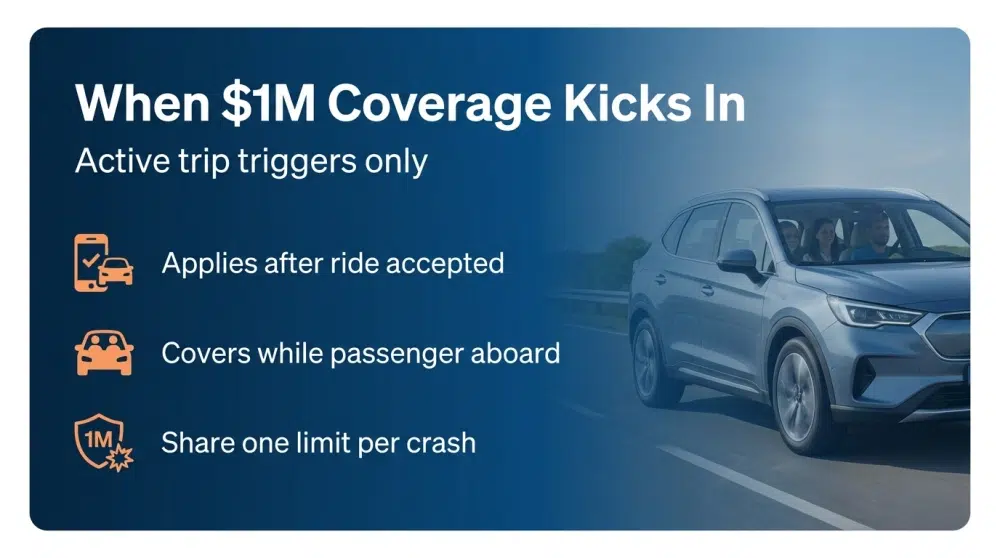
The $1M figure represents the per-accident limit for bodily injury and property damage liability owed to third parties. From a plaintiff’s standpoint, this means an injured passenger, a pedestrian struck by an active rideshare vehicle, or an occupant of another car that was hit by an Uber or Lyft driver during an active trip can potentially pursue a claim against that $1M limit.
Defense has a real argument worth respecting. Just because an Uber or Lyft driver caused the wreck doesn’t mean automatic payout. Proving negligence is still your job, and it’s not nothing. Texas works on modified comparative fault. Your recovery drops by your slice of the blame. Cross 50% and you’re done, no recovery [6] . That’s why locking down driver fault matters more than people probably think going into a Dallas rideshare case.
It is also important to understand that the $1M limit is not automatically paid to every injured person. It is a liability cap. If multiple people are injured in the same crash, all claims compete against that single per-accident limit. A wrongful death claim, a passenger injury claim, and a third-party vehicle damage claim may all draw from the same pool.
What Happens During the Dangerous Period One Gap?
Period One, the window between app login and ride acceptance, creates the most contested coverage battles in rideshare litigation. Here is why it matters so much for people injured in Dallas.
Here’s a real-world version. Driver’s cruising the Dallas North Tollway, app open, no passenger lined up. He blows a red and hits another car. The injured folks now have to run a two-step coverage gauntlet that probably ends in frustration. First step, the driver’s personal insurer, who almost always denies because the commercial-use exclusion fires the second the app goes live. Which kicks the claim over to the rideshare platform’s contingent Period One bucket at $50K per person, $100K per accident, and honestly? That money’s gone in a heartbeat once you’ve got serious injuries, hospital bills, maybe a fatality.
Here’s a useful one. The Texas Department of Insurance handles market conduct, so a sketchy-looking denial can go to their consumer division as a complaint [7] . But honestly, that’s a small part of the picture. The real reason you want an injury attorney who knows rideshare claims is because cracking open the overlap between the driver’s personal policy and the platform’s coverage takes quick, hands-on digging into which period the driver was in and what the app logs say. And evidence like that? It doesn’t hang around forever.

What Are Your Rights as a Passenger Injured in an Uber or Lyft?
As a paying passenger in an Uber or Lyft, you occupy the most protected position in the rideshare coverage scheme. During Period Three, you are covered by the full $1M platform liability policy regardless of whether the fault lies with the Uber or Lyft driver or with another driver who struck the vehicle you were riding in.
Your rights as a passenger include:
- The right to pursue a liability claim against the at-fault driver’s insurer, whether that is the rideshare platform or a third party.
- The right to seek uninsured/underinsured (UM/UIM) coverage if the at-fault driver has insufficient or no coverage. Texas requires insurers to offer UM/UIM coverage, and policyholders who reject it must do so in writing [3]. Both Uber and Lyft carry contingent UM/UIM coverage during active trips in Texas.
- The right to access the driver’s trip records through litigation discovery, including GPS data, app login times, and speed data if the vehicle was equipped with a black box.
- The right to seek all categories of damages available under Texas law, including medical expenses past and future, lost wages and earning capacity, pain and suffering, and disfigurement.
If you used the Uber or Lyft app to book the ride, preserve that evidence immediately. The app records include your trip receipt, the driver’s identity and license plate, and the trip route, all of which establish which coverage period was active at the time of the crash. This is the kind of evidence that our Dallas personal injury team works to secure quickly before it becomes unavailable.
How Does Insurance Work from the Driver’s Perspective?
Look at it from the driver’s side for a second. It tells you a lot about why coverage fights happen the way they do. In Texas, Uber and Lyft drivers are independent contractors. Not employees. That distinction matters because it’s what Uber and Lyft lean on to dodge vicarious liability for the everyday stuff drivers do wrong, and they point claimants toward the platform insurance instead. Which is kind of the whole game.
Here’s the rule. Texas rideshare drivers have to carry personal auto insurance, and the floor is the state’s statutory minimums [3] . A lot of drivers carry the floor. Or close to it. And as long as they’re not on an active trip, that policy is the only thing standing between them and personal exposure. But trip the commercial-use exclusion and watch the whole thing unravel. Personal carrier denies. TNC contingent coverage maxes out. Driver’s left holding the bag for whatever’s still owed. Kind of a brutal landing, if I’m being honest.
From a practical standpoint, this means that in any rideshare crash investigation, the personal injury attorneys representing an injured party should promptly send letters preserving evidence to both the rideshare platform and the driver’s personal insurer. Delay allows evidence to be lost, policies to lapse, and coverage arguments to harden against the injured party.
What If a Third-Party Driver Caused the Crash?
Not every rideshare crash is caused by the Uber or Lyft driver. A significant number of crashes involving rideshare vehicles in the Dallas area involve a third-party motorist who ran a red light, made an unsafe lane change on I-30, or drove impaired. In these situations, the coverage analysis is different.
If you are a passenger in an active rideshare trip and a third-party driver causes the crash, you have the following potential sources of recovery:
- The at-fault third-party driver’s personal liability insurance. If that driver carries only minimum Texas coverage ($30,000/$60,000), the limits may be inadequate for serious injuries.
- The rideshare platform’s UM/UIM coverage. Both Uber and Lyft carry uninsured and underinsured motorist coverage during active trips. If the at-fault driver’s policy limits are insufficient, the UM/UIM coverage stacks on top to bridge the gap [4] [5].
- Your own personal UM/UIM coverage. Your personal auto policy may provide an additional layer, depending on how your policy is written and whether Texas stacking rules apply to your situation.
Victims may also face wrongful death claims if injuries prove fatal. In Texas, surviving family members may bring a wrongful death action under the Texas Civil Practice and Remedies Code to recover damages for the decedent’s loss and for their own grief, loss of companionship, and financial dependence on the deceased [8]. In these cases our Dallas wrongful death lawyers can guide families through both the rideshare insurance claim and the civil litigation that may follow.
What If the Rideshare Driver Is Uninsured or Underinsured?
Texas law requires rideshare drivers to maintain insurance, but not every driver complies at all times. Policies can lapse, vehicles can change, and some drivers may not disclose a lapse to the platform before continuing to accept rides. For injured passengers, this is a serious risk. The GoSuits knowledge-base guide on what to do after an Uber or Lyft accident walks through the immediate steps you should take to protect your rights at the scene, including how to document the driver’s information before leaving.
Texas law requires that UM/UIM coverage be offered with every auto policy, and the insured must reject it in a signed writing to waive it [3]. If you carry UM/UIM on your own policy, that coverage may be available even when you are riding in someone else’s vehicle, depending on your policy’s terms. This is a nuance that an experienced Dallas injury claim attorney should analyze as part of your overall recovery strategy.
Both Uber and Lyft represent in their public safety materials that they carry UM/UIM coverage for passengers during active trips, which provides an important safety net for passengers whose injuries exceed the at-fault driver’s available insurance limits.
What Steps Should You Take After a Rideshare Accident in Dallas?
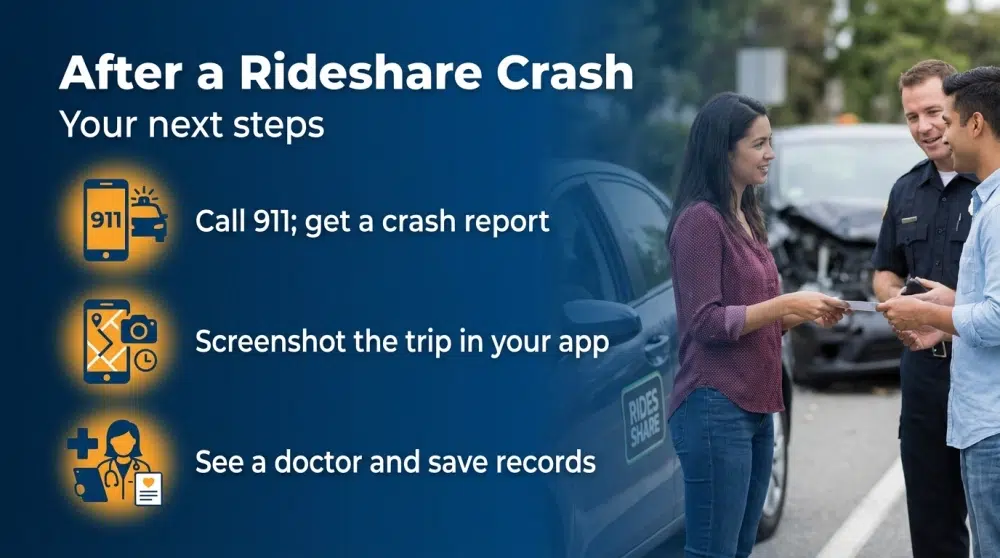
The actions you take in the first hours and days after a rideshare crash in Dallas directly affect the strength of your personal injury claim. Here is what you should do:
- Call 911 and wait for police. A Dallas Police Department or Texas DPS crash report documents the official version of the facts. Do not leave the scene without a report number. If you are on I-35E through downtown Dallas, traffic cameras and DPD body-cam footage may capture the crash and should be preserved.
- Screenshot your trip in the app. Before closing the Uber or Lyft app, screenshot the active trip screen showing the driver’s name, vehicle, route, and time. This documents that you were in a Period Three ride.
- Document the scene. Photograph the vehicle damage, road conditions, skid marks, and any visible injuries. If you are unable to do so, ask a bystander or companion.
- Seek immediate medical care. Even if you feel fine, some serious injuries are not immediately apparent. A prompt medical evaluation creates a medical record that links your injuries to the crash.
- Do not give a recorded statement. Neither the rideshare insurer nor the at-fault driver’s insurer is entitled to a recorded statement from you before you have legal representation. Statements made without counsel can be used to minimize your claim.
- Contact a Dallas rideshare accident attorney. Filing a claim against a rideshare platform involves navigating corporate claims departments that are experienced in minimizing payouts. Reach out for a consultation as soon as possible.
If your crash occurred in Dallas County, any litigation arising from the accident would be filed in the Dallas County District Court at the George L. Allen Sr. Courts Building on Commerce Street. Understanding this procedural landscape helps injured parties and their families set realistic expectations about the timeline and venue of their case.
What Is the Deadline to File a Rideshare Injury Claim in Texas?
In Texas, the statute of limitations for personal injury claims is two years from the date of the injury, as set out in the Texas Civil Practice and Remedies Code Section 16.003 [8]. Missing this deadline generally bars recovery entirely, regardless of how strong the underlying claim may be.
Two years sounds like a long time, but rideshare injury cases require substantial investigation. Preserving the app data, obtaining the platform’s trip logs through litigation discovery, securing medical records, retaining reconstruction analysts, and building a liability case all take time. Starting the process early protects you.
There are exceptions that can shorten the deadline in some circumstances. If a government-owned vehicle is involved, claims against governmental entities in Texas require a notice of claim to be filed within six months under some provisions. Additionally, claims on behalf of minors or incapacitated persons are subject to different tolling rules. Speaking with injury attorneys in Dallas promptly after a crash is the most reliable way to protect your timeline.

How GoSuits Dallas Can Help You
Navigating rideshare accident insurance in Texas requires understanding a multi-layer coverage structure that changes depending on the precise moment a crash occurred. If you or a loved one was injured in a rideshare accident anywhere in the Dallas-Fort Worth area, from Plano to Carrollton, or if you were struck on I-635 by an active Uber or Lyft driver, you are dealing with insurance systems designed to minimize payouts. You deserve skilled, knowledgeable attorneys on your side.
At GoSuits, we serve personal injury clients across Texas, California, and Illinois. Our Dallas team handles rideshare accident claims, motor vehicle personal injury claims, and wrongful death cases throughout the Dallas metro. We bring 30 years of combined experience and a track record of successful case outcomes reflected in our prior cases.
What distinguishes our team is the way we use technology in your service. GoSuits deploys proprietary software that accelerates case investigation and evidence preservation, so we are working faster and more thoroughly from day one than traditional case-management systems allow. Despite this technology-forward approach, every client at GoSuits is assigned a designated attorney, not a case manager. You have unfettered access to the attorney handling your matter throughout the entire process.
Our attorneys prepare every case as if it will go to trial. That trial-readiness has a direct effect on settlement outcomes, because insurers know we are prepared to litigate. We fight for the full value of your personal injury claim, including medical costs, lost income, pain and suffering, and all other damages recoverable under Texas law.
If you have been injured and are ready to discuss your options, we invite you to schedule a free consultation with our Dallas team. You pay nothing unless we recover for you. Learn more about us or explore our full range of practice areas.
References & Resources
- Texas Occupations Code, Chapter 2402: Transportation Network Companies – Texas Constitution and Statutes
- Annual Texas Motor Vehicle Crash Statistics – Texas Department of Transportation
- Texas Transportation Code, Chapter 601: Motor Vehicle Safety Responsibility Act – Texas Constitution and Statutes
- Uber Insurance Coverage for Drivers – Uber.com
- Lyft Third-Party Liability Insurance – Lyft Help Center
- Texas Civil Practice and Remedies Code, Chapter 33: Proportionate Responsibility – Texas Constitution and Statutes
- File a Complaint – Texas Department of Insurance
- Texas Civil Practice and Remedies Code, Chapter 16: Limitations – Texas Constitution and Statutes
- Negligence – Legal Information Institute, Cornell Law School
- Uninsured/Underinsured Motorist Coverage – Texas Department of Insurance