



















Who has standing to file a wrongful death claim in California?
California Code of Civil Procedure §377.60 spells out exactly who may bring a wrongful death lawsuit, and the answer is more specific than most families expect. Getting the eligibility analysis right at the start prevents disputes that can slow or derail a settlement later.
The surviving spouse or registered domestic partner may file. So may surviving children, including adopted children, and the issue of any deceased children, meaning grandchildren who step into the place of a child who predeceased the decedent. If none of those exist, the right passes to those who would inherit under California’s intestate succession laws, which in practice usually means parents and siblings.
Beyond the core family members, putative spouses and their children, stepchildren, and parents may qualify if they were financially dependent on the decedent. Certain minors who lived in the decedent’s household for at least 180 days before the death and depended on the decedent for at least half of their support also have a path to standing.
California requires all eligible heirs to be joined in a single action. Courts call this the one-action rule. It exists to protect the at-fault party from serial lawsuits over the same death, but it also protects every heir: no one gets left out of the recovery because they were not named in the original complaint. We identify every potential heir at the start of the case, including adult children from prior relationships and registered domestic partners, precisely because a missed heir can unwind a settlement that took months to negotiate.
What do families actually recover in a wrongful death case?
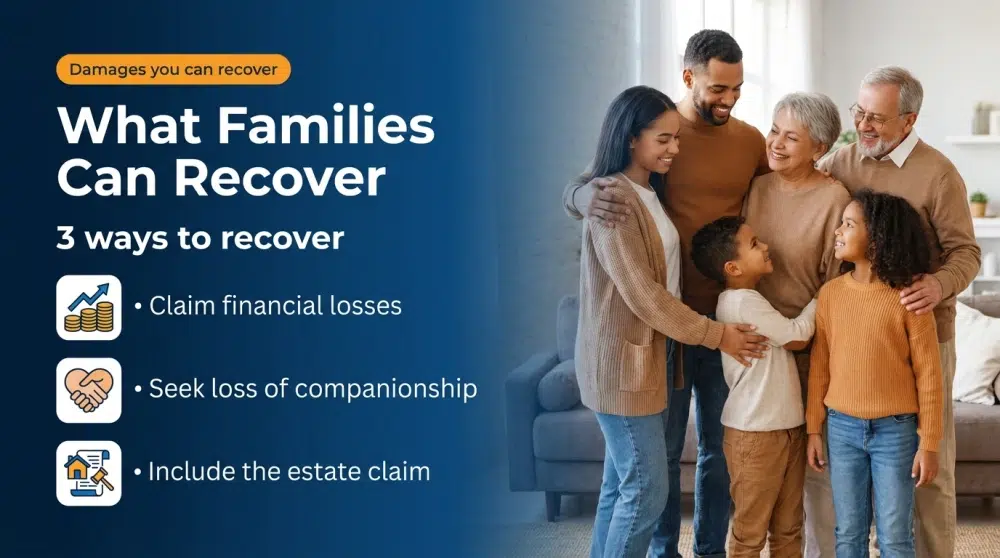
California wrongful death damages divide into three categories, and a well-built case pursues all of them simultaneously.
Economic damages cover the measurable financial losses the death caused. These include funeral and burial costs, the income and benefits the decedent would have contributed to the family over their statistical work-life expectancy, the value of household services (childcare, home maintenance, family logistics), and the gifts and inheritance heirs would reasonably have expected to receive. We work with forensic economists to project these figures from earnings histories, Bureau of Labor Statistics data, and actuarial models Orange County juries are familiar with. The numbers are documented, not estimated.
Noneconomic damages address the human cost. California allows recovery for loss of love, companionship, comfort, care, assistance, protection, affection, society, and moral support. For a surviving spouse or partner, loss of sexual relations is also recoverable. For surviving minor children, loss of parental training and guidance can be substantial. California imposes no cap on these damages in standard wrongful death cases. The figure a jury arrives at reflects the depth of each heir’s relationship with the person who was lost.
The third category sits in a parallel claim: the survival action under Code of Civil Procedure §377.34. That claim belongs to the decedent’s estate, not to the heirs directly, and it recovers what the decedent could have recovered had they survived. Pre-death medical expenses, wages lost between the injury and the death, and (under the 2022 amendment brought by AB 35) pre-death pain, suffering, and disfigurement in qualifying cases. Punitive damages, when the at-fault conduct was malicious, oppressive, or fraudulent, are also available exclusively through the survival action, not the wrongful death claim itself. That distinction has real dollar consequences, and it is one of the reasons filing both claims together, coordinated carefully, matters.
Beyond pursuing the gross recovery from the at-fault insurer, our team negotiates with hospitals, ER groups, and medical-lien holders at settlement to reduce what your family owes out of the award. The dollars that reach your account, not the demand-letter number, are what we measure ourselves by.
After a fatal accident in Irvine, what should a family do first?
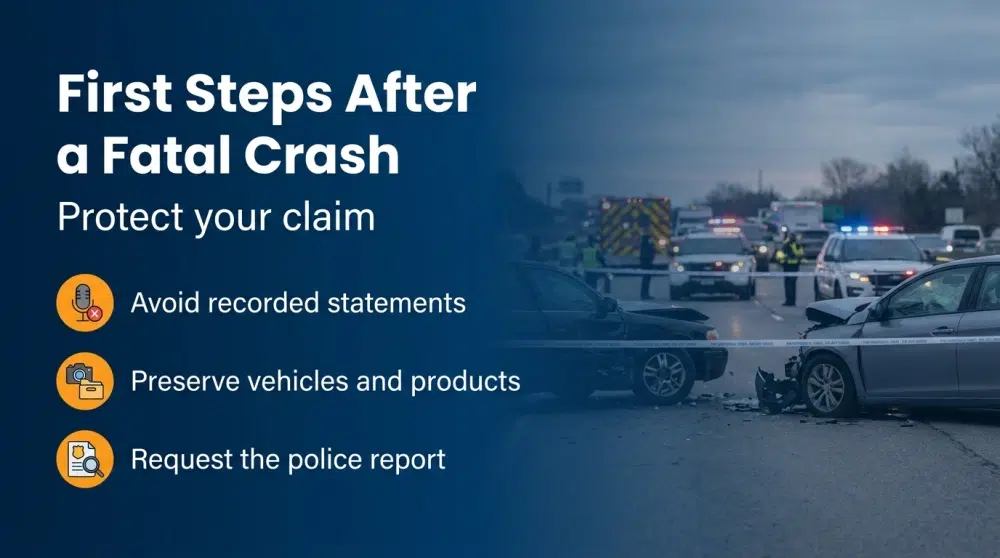
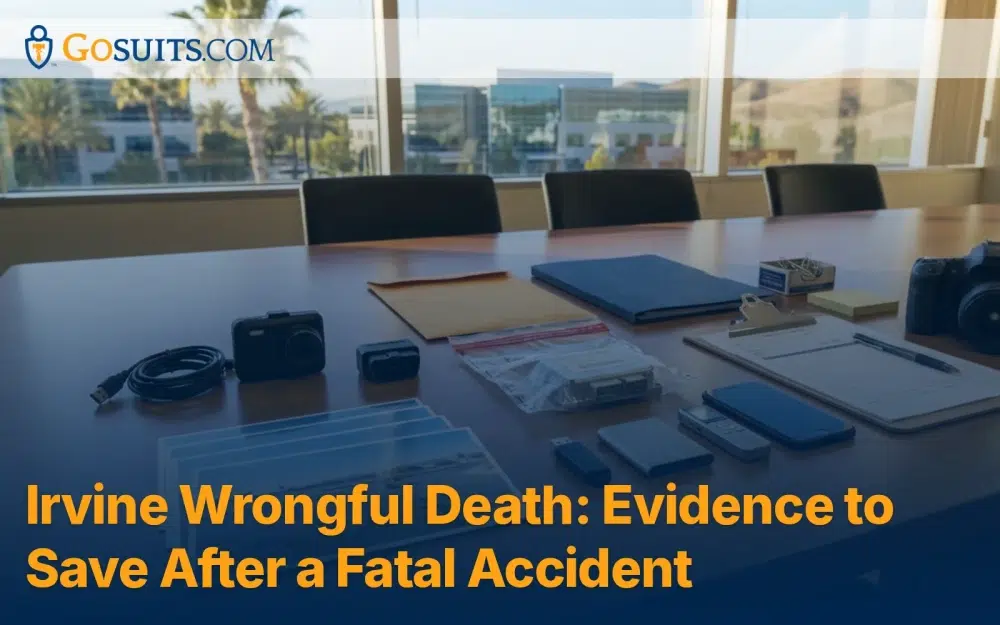
The first 72 hours are the most consequential for evidence. Electronic data that exists today may not exist next week.
On a freeway collision, the event data recorder inside the at-fault vehicle captures pre-crash speed, braking, and steering inputs. That data begins to overwrite when the vehicle is next started. A commercial truck’s electronic logging device records driver hours and location, but federal retention rules allow carriers to delete older data on rolling schedules. Traffic cameras near the intersection of Culver Drive and Alton Parkway, or at any of the on-ramps along the I-405, feed to municipal or private systems that typically retain footage for 7 to 30 days before it cycles. Businesses along MacArthur Boulevard or near the Irvine Spectrum often have their own cameras. All of it goes away if no one sends a legal hold demand.
The practical steps: do not give a recorded statement to any insurer before speaking with an attorney. Insurers send representatives to the scene or call within hours of a fatal crash. They are gathering information for their defense, not yours. Preserve whatever physical evidence exists at home (the decedent’s vehicle, any products involved in the incident). Request the CHP report or the Irvine Police Department report as soon as possible. And call us. A free consultation costs nothing and locks in the legal hold process before the evidence window closes.
How California’s comparative fault rule affects a wrongful death recovery
California follows pure comparative negligence. If the decedent is found partly at fault for the incident that caused their death, the family’s recovery is reduced by that percentage, not eliminated. A family with $5,000,000 in total damages and a 15% fault finding against the decedent recovers $4,250,000.
This rule matters specifically in wrongful death cases because the person who can no longer speak for themselves is often the easiest target for a fault assignment. Defense lawyers and insurance adjusters know this. The strategy is familiar: argue the decedent was speeding, not wearing a seatbelt, failed to yield, or contributed to the conditions that caused the crash. Every percentage point transferred to the decedent reduces the family’s recovery by that fraction of the total damages.
We push back with accident reconstruction, vehicle data, witness accounts, and signal-timing analysis. We do not accept a comparative-fault assignment that the evidence does not support.
Deadlines that apply to wrongful death claims in California
Code of Civil Procedure §335.1 gives families two years from the date of death to file a wrongful death lawsuit. Miss that deadline and the case is gone, regardless of how clear the negligence was.
Two situations shorten the window meaningfully. When a government entity caused the death, such as an OCTA bus, a city vehicle, or a public-agency employee acting in the scope of their duties, California Government Code §911.2 requires an administrative claim to be filed within six months of the death before any lawsuit can proceed. The Civic Center Plaza campus in Santa Ana, where the Orange County Superior Court sits, is also where county agencies receive these claims. Missing the six-month window is not correctable in most circumstances.
Product liability cases have a technical wrinkle: the two-year clock under §335.1 applies, but discovery rules can affect when the clock started if the defect was not immediately apparent. That analysis requires a lawyer.
The practical advice is simple. Contact an attorney as soon as the family is ready. Even an initial call to preserve evidence and calendar the deadlines does not commit anyone to filing a lawsuit. It keeps options open that staying silent will close.
Who is actually liable when a fatal accident involves a commercial truck or employer vehicle?
Multi-party liability is one of the things that separates wrongful death from an ordinary personal-injury claim. When a commercial vehicle causes a fatal collision on the I-5 through Orange County, the at-fault driver is rarely the only responsible party.
The motor carrier employs the driver and bears respondeat superior liability for on-duty negligence. The carrier also has independent duties under federal Motor Carrier Safety Regulations (49 CFR Parts 350-399) and California Vehicle Code §34500: maintaining the vehicle, verifying driver qualifications, enforcing hours-of-service limits, and conducting required inspections. Failures on any of those create independent claims against the company.
Beyond the carrier: a maintenance contractor who signed off on a brake system that failed may be liable. A freight broker who placed an unqualified driver with an unsafe carrier may have its own exposure. A cargo loading company that created an unstable load may share fault for a rollover. Each of those parties carries its own insurance, and identifying every layer of coverage is part of what we do before we send the first demand letter.
The same multi-party analysis applies to fatal incidents involving construction sites, defective products, and premises. Cal/OSHA citations, product-liability chains from manufacturer to retailer, and property-management contracts all create liability pathways beyond the most obvious defendant. We run that analysis at the start of every case, not after settlement discussions have already started.
How GoSuits handles wrongful death cases in Irvine and Orange County
From the moment you reach out, we begin gathering CHP and Irvine PD reports, preserving physical and electronic evidence, securing the vehicle or product involved, and documenting the scene before conditions change. We send legal hold demands to carriers, employers, municipalities, and any party with relevant data within hours of the intake call.
We work with forensic economists, vocational professionals, and life-care planners to build the full economic picture: decades of lost income, lost household services, lost benefits, and the present value of every category of support your loved one would have provided. On the survival action side, we coordinate with the estate’s representative and, if no estate is open, help initiate that process so the pre-death damages are not left on the table.
Members of our team are recognized by groups including TopVerdict, National Trial Lawyers, Super Lawyers, and Best Lawyers, and our trial team has tried wrongful death cases to verdict in Orange County Superior Court. That matters at the negotiation table. Insurance adjusters price a case against the probability that it will actually go to trial. A firm with a documented trial record changes that calculation.
We also handle the practical support that most families do not know to ask about. If a totaled vehicle has left the family without transportation, we arrange a rental so you are not stranded during the investigation. When grief and trauma produce physical symptoms, we connect surviving family members with local physicians and counselors who treat on a medical lien (no upfront cost). At the end of the case, we negotiate those liens down so a larger share of the recovery reaches the family rather than disappearing into provider invoices.
You work with our Irvine personal injury team throughout. There is no handoff to a junior associate after the intake call. When you are ready, schedule a free consultation and we will review your family’s options the same day.