
California Code of Civil Procedure section 998 gives any party to a civil lawsuit a formal mechanism to make a written offer of judgment before trial. If the party who received the offer fails to accept it and then fails to achieve a more favorable outcome at trial, that party loses the right to recover its own postoffer costs and becomes potentially liable for the offering party’s postoffer costs-including, in the court’s discretion, the fees of non-employee expert witnesses. The mechanism runs in both directions: a defendant can use it to pressure a plaintiff, and a plaintiff can use it to pressure a defendant. The stakes for ignoring a section 998 offer can be substantial, and the rules governing form, timing, and validity are precise.
Legal Snapshot
- Legal Topic: California Code of Civil Procedure § 998 – Statutory Offer to Compromise
- Case Stage: Pre-trial (offer must be made before commencement of trial or arbitration)
- Primary Legal Issue: Cost-shifting consequences of rejecting a valid § 998 offer
- Primary Authority: Cal. Code Civ. Proc. § 998 (as amended by Stats. 2024, Ch. 444, Sec. 2, effective January 1, 2025); Cal. Civ. Code § 3291 (prejudgment interest on plaintiff’s offers in personal injury cases)
- Jurisdiction: California State Courts
- Date Legal Authority Last Reviewed: July 2025
What Is a Section 998 Offer to Compromise?
Section 998 of the Code of Civil Procedure creates a statutory offer mechanism that is separate from ordinary settlement negotiations. A party who wants to use it must serve a written offer on the opposing party not less than ten days before the commencement of trial or arbitration. The offer must state the terms and conditions of the proposed judgment or award and must include a provision allowing the accepting party to indicate acceptance by signing a statement. Acceptance must be in writing and signed by counsel or, if unrepresented, by the accepting party directly. [1]
If the offer is accepted, the offer and the proof of acceptance are filed with the court or arbitrator, and judgment or an award is entered in accordance with the terms. If the offer is not accepted before trial begins or within thirty days after it is made-whichever comes first, the offer is deemed withdrawn and is inadmissible at trial. [1]
The statute treats a judgment or award entered pursuant to section 998 as a compromise settlement, not a contested adjudication. [1]
Who Can Make a Section 998 Offer?
Any party to a pending civil action or arbitration may serve a section 998 offer, plaintiff or defendant, cross-complainant or cross-defendant. The statute is bilateral: it creates pressure from both sides of the “v.” The definitions in the statute expressly state that “plaintiff” includes a cross-complainant and “defendant” includes a cross-defendant. [1]
Because the mechanism applies across practice areas, personal injury lawyers in Irvine and throughout Orange County deal with section 998 offers regularly in car accident cases, premises liability claims, product liability disputes, and wrongful death actions. Understanding the bilateral nature of the tool is foundational to evaluating any settlement strategy.
Form and Timing Requirements
The statute imposes three firm requirements on the form and timing of a valid section 998 offer.
Timing: The Ten-Day Window
A section 998 offer must be served not less than ten days before the commencement of trial or arbitration. [1] “Commencement” is defined precisely: trial or arbitration is deemed to commence at the beginning of opening statements, or if there are no opening statements at the time the first witness takes an oath or the first evidence is introduced. [1] Offers served fewer than ten days before that moment are invalid and carry no cost-shifting consequences.
The Thirty-Day Acceptance Window
Once served, a section 998 offer remains open for thirty days or until trial commences, whichever occurs first. If neither event has elapsed and neither side has acted, the offer expires. An expired offer is withdrawn by operation of law and cannot be introduced as evidence at trial. [1]
Written Form Requirements
A valid section 998 offer must be in writing. It must include the terms and conditions of the proposed judgment or award and must contain a provision that allows the accepting party to accept by signing a statement. [1] Courts have held that an offer that fails to include a signing mechanism, or that imposes conditions that make it ambiguous whether a judgment could actually be entered on the stated terms, may be challenged as invalid. [AUTHORITY TO VERIFY – specific California appellate decisions on offer ambiguity should be confirmed with current case law research]
What Happens When a Party Fails to Beat the Offer?
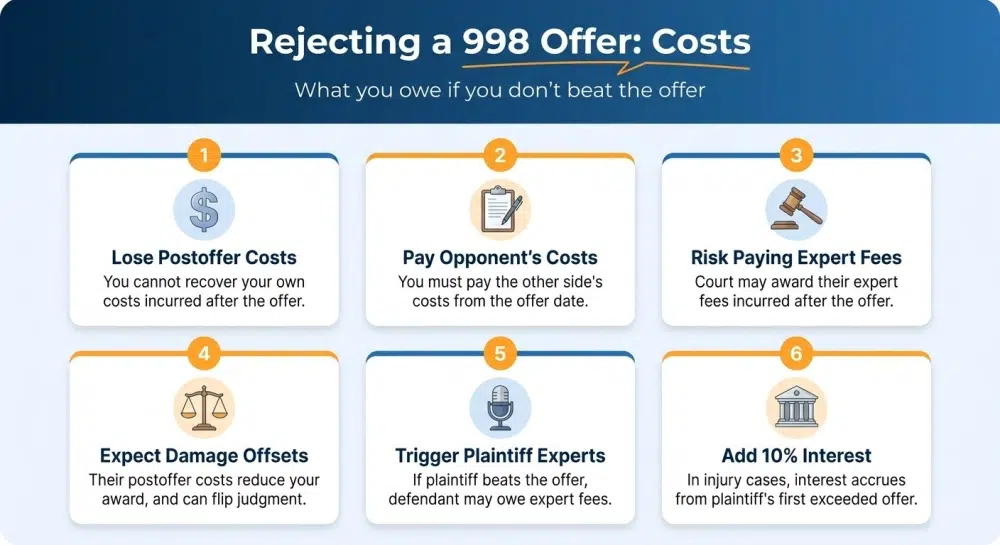
The cost-shifting engine of section 998 activates only after trial or arbitration, when the outcome can be compared to the rejected offer. The comparison works differently depending on which party made the offer.
When the Defendant Made the Offer
If a defendant made a section 998 offer that the plaintiff rejected, and the plaintiff then fails to obtain a judgment or award more favorable than that offer, two things happen automatically and a third may happen in the court’s discretion.
Mandatory consequence: The plaintiff forfeits the right to recover its own postoffer costs. In addition, the plaintiff must pay the defendant’s postoffer costs from the time of the offer. These are mandatory; the court has no discretion to waive them once the triggering conditions are met. [1]
Discretionary consequence: In any action other than an eminent domain proceeding, the court or arbitrator may also require the plaintiff to pay a reasonable sum covering the defendant’s postoffer fees for non-employee expert witnesses but only for services actually incurred and reasonably necessary in preparation for trial, during trial, or in both phases. [1] The court has genuine discretion here; it may decline to award expert witness fees even when the triggering conditions are met, based on factors such as equity, the good faith of the offer, and the circumstances of the case. [AUTHORITY TO VERIFY – California appellate decisions addressing the scope of trial court discretion under § 998(c)(1)]
Offset against the plaintiff’s damages: If the plaintiff still wins a net damages award, just one not exceeding the defendant’s offer, the defendant’s postoffer costs are deducted from the plaintiff’s damages award. If the accumulated costs exceed the plaintiff’s damages, the net amount is awarded to the defendant and judgment is entered accordingly. [1]
When the Plaintiff Made the Offer
If a plaintiff made a section 998 offer that the defendant rejected, and the defendant then fails to obtain a judgment more favorable than the plaintiff’s offer, meaning the plaintiff’s award exceeds the offer, the defendant may be required to pay a reasonable sum covering the plaintiff’s postoffer expert witness fees, in addition to the plaintiff’s ordinary costs. [1] This too is discretionary.
The practical effect is meaningful: a plaintiff who makes a well-documented, reasonable section 998 offer early in litigation creates substantial financial exposure for the defendant if the case goes to trial and exceeds that offer. For a plaintiff who has retained personal injury lawyers and can document strong liability and damages, the section 998 offer is an affirmative tool, not merely a defensive one.
How Is the Comparison Between Offer and Judgment Made?
After trial, the court must determine whether the judgment obtained was “more favorable” than the rejected offer. This comparison involves several technical rules that were expressly clarified in the statute. [1]
Postoffer Costs Are Excluded From the Comparison
When the court determines whether the plaintiff obtained a more favorable judgment than the defendant’s offer, the comparison excludes postoffer costs. This means the court looks at the core award-damages before adding costs, to determine whether the trigger was met. This rule was added to the statute specifically to supersede an earlier appellate holding that had treated attorney fees awarded to a prevailing party as part of the judgment rather than as costs for section 998 purposes. [1]
The practical implication: a plaintiff who wins a $95,000 damages award against a defendant who had offered $100,000 under section 998 has not beaten the offer, even if attorney fees and other costs push the total recovery above $100,000. The comparison is damages first, costs excluded.
Comparing Apples to Apples
When a section 998 offer includes non-monetary terms, a waiver of claims, a confidentiality obligation, or an apology clause, for example: determining whether the eventual judgment is “more favorable” requires evaluating whether the total package the plaintiff achieved at trial exceeds what was offered. Courts have wrestled with how to monetize non-monetary offer terms, and the analysis is fact-specific. [AUTHORITY TO VERIFY – specific California appellate decisions on comparison when offers contain non-monetary components]

Why an Offer Must Be Made in Good Faith
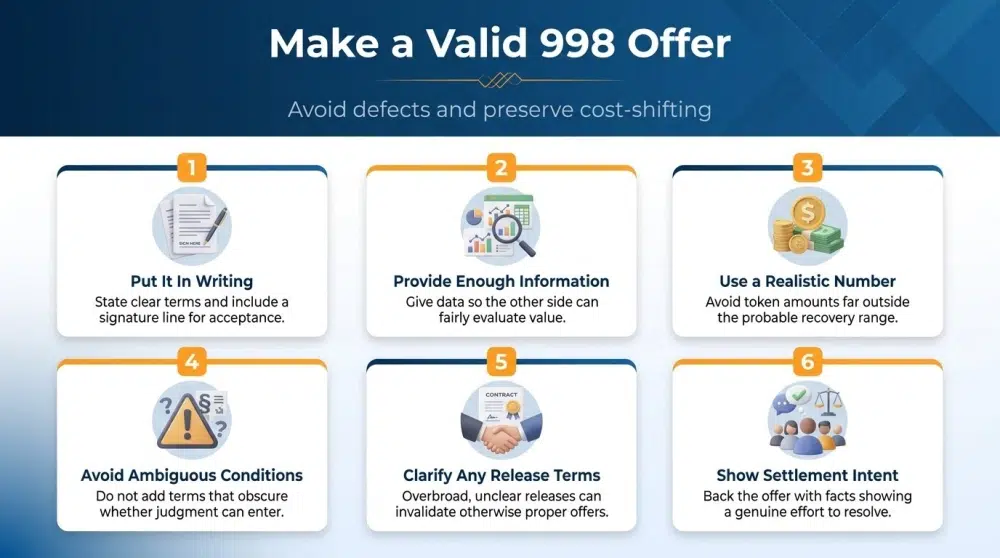
A section 998 offer that is not made in good faith, or that is not accompanied by sufficient information to allow the offeree to evaluate it, may be challenged and found invalid, stripping it of cost-shifting effect. The good-faith requirement is a judicial gloss on the statute. California courts have held that a valid section 998 offer must reflect a reasonable attempt to resolve the litigation; it cannot be used as a pure litigation tactic to manufacture future cost-shifting rights while having no actual settlement intent. [AUTHORITY TO VERIFY – California appellate decisions articulating the good-faith standard for § 998 offers, e.g., Elrod v. Oregon Cummins Diesel, Inc., and their progeny]
What Courts Look at When Assessing Good Faith
Factors that courts have considered include whether the offer was accompanied by enough information for the offeree to evaluate it, whether the offeror had information about the case’s value at the time of the offer, and whether the amount of the offer was so far outside the probable range of recovery that it was effectively a tactical zero rather than a genuine compromise. An extremely low-ball offer made by a defendant before discovery is complete, for example, may invite challenge on good-faith grounds.
Challenging a Token Offer
A plaintiff may challenge a defendant’s section 998 offer as a token offer, one so low relative to the plaintiff’s provable damages that it cannot constitute a genuine attempt to settle. If the court agrees, the offer is treated as invalid and its cost-shifting consequences are nullified. The challenging party typically bears the burden of producing evidence showing that the offer lacked a reasonable basis in relation to the facts and the potential range of outcomes. [AUTHORITY TO VERIFY – California appellate decisions on token offer challenges and allocation of the burden of proof]
Because the validity of a section 998 offer can be hotly contested after trial, the strategy of making or responding to such an offer warrants careful attention at the time it is served. For a broader look at how settlement offers fit into the personal injury process, the article on what makes a good personal injury settlement offer provides helpful context on the evaluation framework.
Expert Witness Fees Under Section 998
Expert witness fees under section 998 are discretionary rather than mandatory, which distinguishes them from ordinary postoffer costs. The statute authorizes the court or arbitrator to award “a reasonable sum” to cover postoffer expert witness services, but only for witnesses who are not regular employees of any party, and only for services actually incurred and reasonably necessary in preparation for or during trial or arbitration. [1]
There is a cap on expert witness fees authorized under section 998: the fees may not exceed the amounts specified in Government Code section 68092.5. [1] [AUTHORITY TO VERIFY – current fee schedule under Cal. Gov. Code § 68092.5]
The statute also treats police officers as expert witnesses for section 998 purposes. This has practical significance in personal injury cases in Orange County and across Southern California, where law enforcement testimony about accident reconstruction, DUI investigations, or incident documentation may be a component of trial preparation. [1]
Courts do not automatically award expert witness fees simply because the triggering conditions are met. Factors the court may weigh include the total amount of fees sought, the proportionality of those fees to the complexity of the issues, and the overall equity of the situation.
Prejudgment Interest in Personal Injury Cases: Civil Code Section 3291
In personal injury actions, a plaintiff who makes a section 998 offer has an additional weapon available if the defendant refuses and the case goes to trial with a favorable result. Under California Civil Code section 3291, if the plaintiff makes a section 998 offer that the defendant does not accept within thirty days or before trial-whichever comes first, and the plaintiff then obtains a more favorable judgment, the judgment bears interest at the legal rate of ten percent per year. [2]
That interest accrues from the date of the plaintiff’s first section 998 offer that is exceeded by the eventual judgment. It continues to accrue until the judgment is satisfied. [2]
This provision transforms the financial calculus of refusing a plaintiff’s section 998 offer in a personal injury case. A defendant who holds out for years while the case moves through the Orange County Superior Court or the Los Angeles County Superior Court-the courts handling most personal injury actions in the Irvine and Los Angeles areas-may owe substantial prejudgment interest in addition to the damages award and any expert witness fees.
Civil Code section 3291 does not apply to public entities or to public employees acting within the scope of their employment. [2]
Example (Hypothetical)
Example: A driver injured on the SR-73 Toll Road in a rear-end collision makes a section 998 offer for $275,000 approximately twelve months into litigation. The defendant insurer rejects it. Twenty months later, the jury returns a verdict of $400,000. Assuming the judgment exceeds the offer, the plaintiff is entitled to ten-percent-per-year prejudgment interest on the judgment from the date of the section 998 offer-roughly thirty-two months. On a $400,000 judgment, that adds approximately $106,000 in additional interest. The defendant’s decision to reject the offer becomes far more costly in retrospect.
This is a hypothetical example used to illustrate the operation of Civil Code § 3291. It does not represent the facts of any GoSuits case and does not guarantee any particular result.
What Section 998 Does Not Apply To
The statute expressly exempts certain proceedings. Section 998 does not apply to offers made by a plaintiff in an eminent domain action, and it does not apply to enforcement actions brought in the name of the People of the State of California by the Attorney General, the Insurance Commissioner, a district attorney, or a city attorney acting as a public prosecutor. [1] Labor arbitrations filed pursuant to memoranda of understanding under the Ralph C. Dills Act are also excluded. [1]
Section 998 in Orange County Personal Injury Litigation
Personal injury claims arising from crashes on the I-405, the I-5, the SR-55, and the SR-73 Toll Road corridors through Irvine, Newport Beach, Costa Mesa, and Santa Ana routinely involve section 998 offers as part of litigation strategy. Orange County Superior Court cases are typically filed at the Central Justice Center in Santa Ana for larger civil claims. [3]
The high daily commuter volumes on those corridors mean car accident claims, rear-end collisions in heavy stop-and-go traffic, merge-related incidents at freeway interchanges, and motorcycle crashes-generate a steady stream of personal injury cases where both defense counsel and plaintiff-side personal injury lawyers use section 998 as a negotiating lever.
In wrongful death cases, the calculus changes further. An unaccepted section 998 offer combined with a large jury verdict carries prejudgment interest at ten percent annually, a compounding financial consequence for defendants who miscalculate the case’s value. Families navigating those claims alongside the grief of losing a loved one benefit from working with lawyers who understand not only the emotional weight of the situation but also the procedural machinery that affects how much they ultimately recover.
How Section 998 Functions as a Plaintiff’s Tool
A well-timed section 998 offer from the plaintiff does several things simultaneously. It starts the clock on potential prejudgment interest exposure for the defendant under Civil Code section 3291. It creates discretionary expert witness fee exposure if the defendant fails to beat the offer at trial. And it signals to defense counsel and the insurer that the plaintiff has a realistic view of the case’s value, which can accelerate serious settlement negotiations.
The offer must be calibrated thoughtfully. An offer that is too high will be rejected without consequence, since the plaintiff is unlikely to obtain a verdict exceeding an inflated offer. An offer that is too low forfeits leverage the plaintiff already has. The analysis requires a hard-eyed assessment of liability strength, damages documentation, expert testimony, and the specific defendant’s exposure.
Plaintiffs who have been injured in accidents involving car accidents, rideshare vehicles on the I-405, or commercial trucks on Southern California freeways sometimes work with personal injury lawyers who are familiar with this calibration process. Our Irvine personal injury team regularly evaluates section 998 timing and amount as part of a comprehensive litigation strategy for injured clients throughout Orange County and Los Angeles.
How Section 998 Functions as a Defendant’s Tool
A defendant who makes a reasonable and well-documented section 998 offer shifts the risk of trial to the plaintiff. If the plaintiff rejects the offer and the trial outcome is equal to or less favorable than the offer, the plaintiff loses the right to recover postoffer costs and owes the defendant’s postoffer costs, plus potentially substantial expert witness fees.
This dynamic can be especially powerful in cases where damages are disputed but liability is relatively clear. A defendant who acknowledges liability but contests the extent of damages may use a section 998 offer as leverage to cap its exposure to a reasonable range, effectively daring the plaintiff to roll the dice at trial.
Defense counsel in Orange County and Los Angeles routinely structure section 998 offers to trigger maximum cost-shifting exposure while remaining defensible as good-faith attempts to settle. Plaintiffs and their lawyers must evaluate those offers with the same rigor, neither reflexively accepting nor reflexively rejecting without a full analysis of the probable trial range.
Timing and Deadlines to Keep in Mind
Several time limits govern the section 998 process.
- Ten-day minimum before trial: A section 998 offer must be served not less than ten days before commencement of trial or arbitration. [1]
- Thirty-day acceptance window: The offeree has thirty days to accept, or until trial begins, whichever is earlier. [1]
- General statute of limitations for personal injury: Under Code of Civil Procedure section 335.1, the general statute of limitations for personal injury claims is two years from the date of injury. A section 998 offer is only available once litigation has been commenced; it cannot be used as a pre-lawsuit device. [AUTHORITY TO VERIFY – CCP § 335.1]
- Government claims deadline: Claims against government entities may require filing a government tort claim within six months of the incident before a lawsuit is initiated. Separate deadlines may apply. [AUTHORITY TO VERIFY – Cal. Gov. Code § 911.2]
These deadlines require legal verification for any specific case. If your situation involves any of these timing issues, consult a personal injury attorney before deadlines pass.

What Should I Do Next?
If you have received a section 998 offer, or if you believe you may have grounds to make one-these steps apply regardless of which side of the offer you are on.
- Do not ignore a section 998 offer. The thirty-day acceptance window is a hard deadline. Silence is not acceptance; it is rejection, with potentially significant financial consequences if the case goes to trial.
- Gather the documents needed to evaluate the offer. Medical records, wage loss documentation, liability evidence, and expert opinions all bear on whether the offer is reasonable relative to the probable trial range.
- Assess liability and damages realistically. The section 998 mechanism rewards realistic case valuation. An honest assessment of the case’s strengths and weaknesses on both sides, is the foundation of a sound decision about whether to accept or reject.
- Consider timing carefully. An offer made too early in litigation, before full discovery, may be challenged as lacking a good-faith basis. An offer made too late may leave insufficient time for the offeree to evaluate it meaningfully.
- Consult a personal injury attorney before responding. Accepting or rejecting a section 998 offer is a consequential legal decision. The cost-shifting and prejudgment interest implications can significantly affect the total financial outcome of the case.
Talk With a GoSuits Attorney
998 offers hit hard. They’re probably one of the most consequential strategic tools anyone deals with in California personal injury litigation, and the math behind them can swing the outcome of a case by a lot. Doesn’t really matter what the facts look like. Maybe you’re staring at a defense offer after a rear-end crash on the I-405 near the Irvine Spectrum. Maybe your legal team is getting ready to serve one in a wrongful death case sitting in Orange County Superior Court. Either way, it’s not a decision to make on gut instinct. It deserves a careful, clear-eyed legal analysis before you sign or reject anything.
GoSuits represents injured clients in Irvine, Orange County, and throughout California. Our attorneys handle the full range of personal injury claims, from crash cases to product liability and workplace injuries and have experience litigating cases where section 998 offers and Civil Code section 3291 prejudgment interest were material to the final outcome. You can review our record on the prior cases page. For information about our attorneys, visit our attorneys page, or learn more about us at our about us page. Our full range of practice areas is available on the practice areas page.
To speak with an attorney about a section 998 offer you have received or are considering making, schedule a free consultation today. There is no fee unless we recover for you.
References and Resources
- California Code of Civil Procedure § 998 – Offers by a Party to Compromise – California Legislative Information (Amended by Stats. 2024, Ch. 444, Sec. 2, effective January 1, 2025)
- California Civil Code § 3291 – Prejudgment Interest in Personal Injury Actions – California Legislative Information
- Orange County Superior Court – Civil Division – occourts.org
- California Courts – The Judicial Branch of California – courts.ca.gov
- California Code of Civil Procedure § 1031 – Allowance of Costs – California Legislative Information
- California Code of Civil Procedure § 1032 – Prevailing Party Costs – California Legislative Information
- Offer of Judgment – Legal Information Institute, Cornell Law School
- California Code of Civil Procedure § 335.1 – Statute of Limitations for Personal Injury – California Legislative Information
- California Government Code § 911.2 – Government Tort Claims Deadline – California Legislative Information
- California Rules of Court – Judicial Council of California