Yes. When a child is injured at a Texas daycare or school, a civil personal injury claim may be available. The exact path forward depends on whether the facility is privately operated or publicly funded, what caused the injury, and whose negligence contributed to it. Texas law treats private daycares and public school districts very differently, and each route carries its own procedural requirements and deadlines. The statute of limitations is also extended in most situations because the injured person is a minor.
Legal Snapshot
- Legal Topic: Child injury at daycare or school Texas civil personal injury
- Case Stage: Pre-litigation / Investigation
- Primary Legal Issue: Negligence, premises liability, governmental immunity
- Primary Authority: Texas Civil Practice & Remedies Code §§ 16.001, 16.003, 101.001 et seq., 129.001–129.002; Texas Health & Safety Code Ch. 42; Texas Administrative Code, Title 26
- Date Legal Authority Last Reviewed: July 2025
What Does a Child Injury Claim at a Daycare or School Mean Under Texas Law?
A child injury claim is a civil action brought on behalf of an injured minor against the party or parties responsible for causing the harm. Because a child under 18 lacks the legal capacity to sue on their own behalf, a parent or legal guardian typically files the lawsuit as the child’s representative.
Two separate injury claims may arise from a single incident. The child’s own claim covers physical and mental injuries, pain, and future harm. The parents hold a separate claim for medical expenses they personally incur and, in some situations, lost wages from time taken off work to care for the child. These claims are legally distinct and have different statutes of limitations, a point that catches many families off guard.
Personal injury lawyers handling these cases must understand which type of facility is involved, what licensing standards applied, and how the injury occurred before determining the right legal theory.
What Does Texas Law Say About Daycare Negligence?
Private daycares and childcare centers in Texas are licensed and regulated by the Texas Health and Human Services Commission (HHSC) under Texas Health and Safety Code Chapter 42. [1] The HHSC enforces administrative rules found in Title 26 of the Texas Administrative Code, which set mandatory standards for child-to-staff supervision ratios, staff qualifications, facility safety, playground equipment, and health protocols. [2]
A privately operated daycare is not a government entity. It can be sued under ordinary Texas negligence law, which requires showing a duty of care, a breach of that duty, causation, and damages. Because these facilities voluntarily assume responsibility for children’s safety, courts recognize that daycares owe a high standard of care. A ratio violation: for example, placing fifteen infants under the supervision of one caregiver when the HHSC rule requires a much lower ratio, may constitute negligence per se or at minimum strong evidence of breach. Incident reports, HHSC inspection records, and licensing history are all potentially available through public records requests and can be critical pieces of evidence.
Why Are Public Schools Treated Differently?
A public school district in Texas is a governmental unit. It enjoys sovereign immunity unless the Texas Legislature has waived that immunity. The primary waiver is found in the Texas Tort Claims Act (TTCA), codified at Texas Civil Practice and Remedies Code Chapter 101. [3]
The TTCA waives immunity in limited circumstances, principally when the injury arises from:
- The operation or use of a motor vehicle by a government employee acting within the scope of their employment; or
- A condition or use of tangible personal or real property.
A child injured because a poorly maintained piece of playground equipment collapsed tangible property in a defective condition, may fall within the TTCA waiver. By contrast, an injury caused purely by inadequate supervision, without any connection to a physical property condition, is much harder to bring within the waiver’s scope. Courts have interpreted these categories narrowly.
Professional employees of a school district, teachers and administrators have an additional layer of protection under Texas Education Code Section 22.051, which grants qualified immunity for professional judgment decisions made in the course of employment. [4]
Importantly, the TTCA caps damages recoverable from a governmental unit. For a single occurrence, the cap is generally $100,000 per person and $300,000 per occurrence for bodily injury or death (subject to updated figures under the statute this figure should be confirmed at the time of filing). [5]
These restrictions make claims against Dallas Independent School District, Plano ISD, or any other public school district in the Dallas–Fort Worth metro area fundamentally different from a claim against a private daycare in the same neighborhood. The claims process, the applicable deadlines, and the damages available all differ.
How Does the Statute of Limitations Work for Injured Children?
Texas imposes a two-year statute of limitations for personal injury claims under Civil Practice and Remedies Code Section 16.003. [6] If an adult were injured at a daycare facility, they would generally have two years from the date of injury to file suit. However, a child is not held to the same deadline.
Texas Civil Practice and Remedies Code Section 16.001 provides that the two-year limitations period is tolled, meaning it does not begin to run while the claimant is a minor. [7] The child’s claim does not expire until two years after their eighteenth birthday. This means a child injured at a Dallas daycare at age three has until age twenty to file suit.
The parents’ separate claim for medical expenses is not tolled. Parents are adults, and their own claim for reimbursement of medical bills begins running on the date of injury. A parent who waits several years hoping the child’s condition will become clearer before consulting a lawyer may find that their own claim for past medical expenses has expired even though the child’s claim is still very much alive. This asymmetry has real financial consequences for families.
Claims against governmental entities, including public school districts, carry a separate pre-suit notice requirement under the TTCA. Notice of the claim must typically be provided to the governmental unit within six months of the incident. [8] [DEADLINE REQUIRES LEGAL VERIFICATION, consult an attorney promptly to confirm the applicable notice period for the specific governmental unit and the specific facts of your case.] Missing this notice deadline can bar a claim against a public school even though the child’s underlying limitations period has not expired.
What HHSC Supervision Ratio Violations and Safety Standards Apply?
The HHSC establishes minimum child-to-caregiver ratios in licensed childcare centers across Texas. These ratios vary by age group: infants and very young children require closer supervision than school-age children. [2] When a center violates these ratios, a child may be left unsupervised long enough for a preventable accident to occur.
HHSC inspection records are generally public documents. They document violations, corrective actions taken, and the history of a facility’s compliance. A pattern of repeated violations can be powerful evidence in a negligence case. HHSC records can often be obtained through an open records request to the agency.
Texas also regulates playground equipment and surfacing through the HHSC childcare rules. Standards address fall height, surfacing materials, equipment maintenance, and the removal of hazardous items. The Consumer Product Safety Commission (CPSC) publishes national guidelines for public playground safety that courts and experts may reference in evaluating whether playground conditions were reasonably safe. [9] Injuries from falls involving inadequate protective surfacing uncompacted wood chips, asphalt, or concrete beneath climbing equipment are among the most common serious playground injuries reported in Texas facilities.
How Does This Apply to a Real Case?
Example (hypothetical not a GoSuits case):
A four-year-old child at a licensed private childcare center in the Dallas area falls from an elevated platform on the outdoor playground and suffers a broken arm and a concussion. An investigation reveals that the facility had only one caregiver supervising twelve children on the playground, exceeding the maximum ratio permitted by HHSC rules. The fall occurred from a height that required six inches of protective surfacing, but the area beneath the platform had only packed dirt.
In this scenario, the parents could potentially bring claims against the daycare based on negligence (supervision failure) and premises liability (defective playground conditions). The child’s claim would be tolled until age eighteen; the parents’ claim for medical bills would need to be pursued within two years of the incident. Any settlement on behalf of the child would require court approval.
Example (hypothetical not a GoSuits case):
A seven-year-old student at a public elementary school in the Dallas area is injured when a piece of deteriorated playground equipment collapses. The family wants to pursue a claim against the school district. Because this is a governmental unit, the family must first provide timely notice to the district. The claim must fall within the TTCA’s property-condition waiver. Damages are capped by statute. The two-year limitations period applies, though it is tolled for the child’s own claim. A parent whose medical expenses exceed the cap may find that recovery is limited even if the facts clearly show the district knew of the dangerous condition.
What Evidence Can Matter?
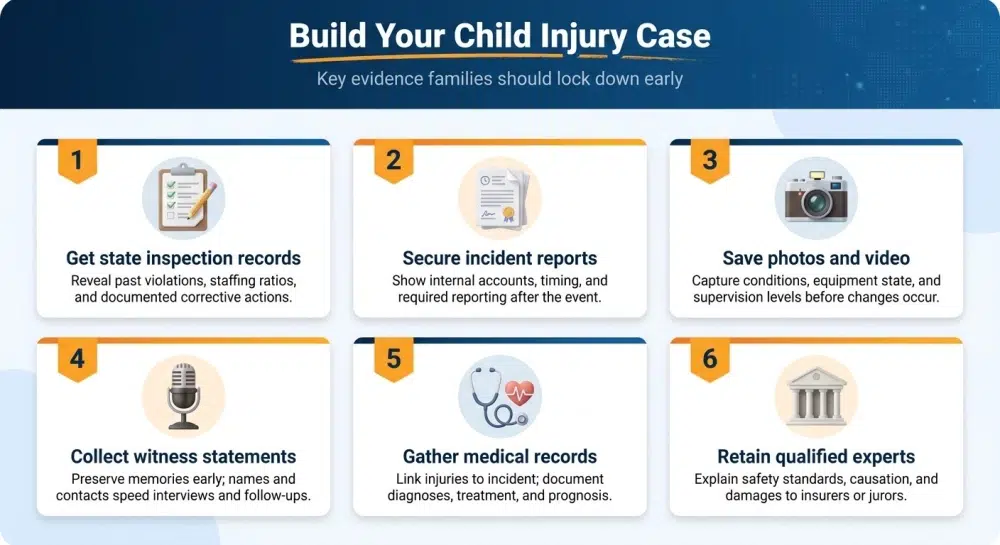
The evidence gathered early in a child injury case can shape the entire trajectory of a claim. Relevant categories include:
- HHSC Licensing and Inspection Records: These documents show whether a daycare had a history of violations, whether supervision ratios were being maintained, and whether cited problems were corrected. They are often obtainable through public records requests and can establish a pattern of neglect that goes beyond a single incident.
- Incident Reports: The daycare or school may have created internal incident reports. These should be preserved and requested as part of any legal action. Their contents or the absence of a report when one was required can be revealing.
- Photographs and Video: Images of the injury site, the playground equipment, and the surfacing conditions document what existed at the time. Surveillance video, if preserved promptly, may show what happened and how many adults were present. This evidence can disappear quickly if not secured.
- Witness Statements: Other parents, staff members, and older children may have seen what happened or have knowledge of recurring conditions. Early interviews are important because memories fade.
- Medical Records: Emergency room records, diagnostic imaging, treatment notes, and discharge instructions document the nature and severity of the injury. Ongoing medical records are equally important if the child requires continuing care.
- Staff Records and Training Logs: In a daycare case, records showing whether staff were properly trained, whether their certifications were current, and whether the facility was adequately staffed on the day of the incident may be obtainable through discovery.
- Expert Testimony: Playground safety experts, pediatric medical professionals, and childcare licensing specialists may be needed to explain to a jury what the standards required and how those standards were violated.
Evidence does not automatically prove liability. Each element of a negligence claim must still be established. However, preserving evidence as early as possible gives an injured family the best opportunity to support their claim.

What Damages or Remedies May Be Available?
Texas allows injured plaintiffs including children to seek compensation for several categories of loss. The specific damages available depend on the facts of the case, the severity of the injury, and who is sued.
- Past and Future Medical Expenses: Costs of emergency care, surgery, hospitalization, rehabilitation, and ongoing treatment. Future medical needs require expert projection, particularly when a child’s injuries may affect their development.
- Physical Pain and Mental Anguish: Both past pain and suffering and anticipated future pain are compensable for the child.
- Physical Impairment: Injuries that reduce a child’s ability to perform activities, walking, playing, learning both now and in the future.
- Loss of Earning Capacity: For serious injuries that will affect the child’s ability to work as an adult, courts may consider projected future earning losses.
- Disfigurement: Permanent scarring or physical changes from the injury.
- Parents’ Medical Expenses: A parent’s separate claim covers out-of-pocket medical costs incurred on behalf of the child. [Subject to applicable limitations periods see above.]
Claims against public school districts are subject to the TTCA’s statutory damage caps, which significantly limit maximum recovery. Claims against private daycares are not subject to these caps. The recoverability of each category of damages depends on applicable law and the specific facts of each case. No outcome is guaranteed.
How Does Court Approval of a Minor’s Settlement Work in Texas?
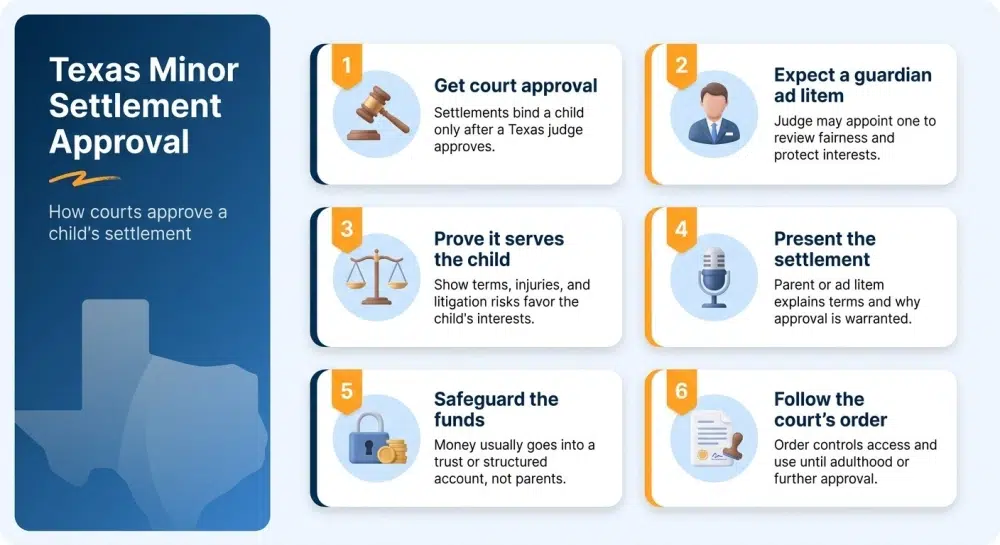
When an injured child is a party to a personal injury case whether it resolves before or after a lawsuit is filed any settlement of the child’s claim requires approval by a Texas court. This requirement exists to protect the child’s interests because a minor cannot legally bind themselves to a contract. [10]
Under Texas Civil Practice and Remedies Code Chapter 129, the court must approve settlements on behalf of minors when the gross value of the settlement meets certain thresholds. A parent or guardian ad litem presents the proposed settlement to the court and demonstrates that the terms are fair and in the child’s best interests. The court may appoint an independent attorney (guardian ad litem) to evaluate whether the settlement adequately serves the child if the amount is significant.
Once approved, settlement proceeds belonging to the child are typically deposited into a structured arrangement or trust, they are not simply handed to the parents to spend. The funds belong to the child, and the court’s oversight ensures they are preserved for the child’s benefit, such as for medical care, education, or financial security when the child reaches adulthood.
Parents who settle a child’s claim without court approval do so at their own risk. Courts have the authority to set aside improperly executed minor settlements. Anyone negotiating on behalf of an injured child should understand this requirement from the outset.
What If the Other Party Disputes Liability?
Daycares and school districts commonly dispute whether their conduct caused the injury, whether any violation of a rule was the proximate cause of the harm, or whether the injury resulted from a risk the child simply encountered through normal play. Texas applies a modified comparative fault rule under Civil Practice and Remedies Code Chapter 33: a plaintiff who is more than 51 percent responsible for their own damages cannot recover. For young children, questions about comparative fault are rarely applied because children of certain ages are legally incapable of negligence. [11]
Disputing liability is common in these cases. An experienced attorney can assess the strength of the evidence and advise the family on whether litigation or negotiation is more likely to achieve a fair result. Attempting to handle a liability dispute especially against a school district or a commercial daycare with its own legal team without legal assistance places the family at a significant disadvantage.
What If Insurance Is Involved?
Licensed childcare centers in Texas are typically required to carry liability insurance. The daycare’s insurer may contact the family early in the process. Recorded statements and early settlement offers from an insurance adjuster should be approached with caution. An adjuster’s job is to resolve claims cost-effectively for the insurer, not to ensure the family receives full compensation for all of the child’s losses including future medical needs and long-term effects that may not yet be apparent.
Public school districts are often self-insured or participate in risk pools. The claims process for a governmental unit typically runs through the district’s legal or risk management department rather than a private insurance carrier.
If you have been injured and are dealing with insurance company inquiries, reviewing our guide to the statute of limitations for personal injury in Texas can help you understand how deadlines interact with the insurance process.
How Long Do I Have to Act? Deadline Summary
Deadline Type Private Daycare Public School District Child’s claim (personal injury) Tolled until child turns 18; 2 years from 18th birthday Tolled for minority; 2 years from 18th birthday (subject to TTCA notice) Parents’ claim (medical expenses) 2 years from date of injury NOT tolled 2 years from date of injury NOT tolled Pre-suit notice (TTCA) Not required Approximately 6 months from incident [DEADLINE REQUIRES LEGAL VERIFICATION] Court approval of settlement Required before finalizing any settlement Required before finalizing any settlement
These deadlines are general summaries based on Texas law as reviewed in July 2025. Specific circumstances, including the identity of the defendant, the nature of the injury, and whether any additional parties are involved can affect these timelines. An attorney should review the facts of any specific case before relying on general deadline information.
What Should I Do Next?
If your child was injured at a daycare or school in Texas, a few steps can make a meaningful difference in protecting your family’s legal options:
- Seek medical care immediately. The child’s health is the priority. Medical records created promptly after an injury are also important evidence.
- Document the scene. If it is safe to do so, photograph the location, any equipment involved, and any visible conditions that contributed to the injury. Note the date, time, and names of anyone present.
- Request and preserve records. Ask the daycare or school for their incident report. Request HHSC inspection records. Save all medical bills and correspondence.
- Do not sign releases without legal advice. Any release of claims signed by a parent before consulting a lawyer and before the full scope of the child’s injuries is understood may limit what the family can recover.
- Consult a personal injury attorney promptly. Even though the child’s limitations period is tolled, the parents’ claim is not, and the notice period for governmental entities is short. Acting quickly preserves options.
Child injury cases involving daycares and school districts require an understanding of regulatory standards, governmental immunity, minor settlement procedures, and the careful preservation of evidence. An injury claim can also involve simultaneous insurance negotiations, competing deadlines, and questions about the long-term needs of a still-developing child. The Dallas personal injury lawyers at GoSuits can review the circumstances of your child’s injury and explain the legal options available under Texas law. Schedule a free consultation to discuss your situation.
Related Texas Personal Injury Resources
- Understanding Negligence Laws in Texas: A Comprehensive Guide
- The Personal Injury Claims Process in Texas Courts
- Types of Damages Available in Texas Personal Injury Cases
- Average Settlement for a Child in a Car Accident
- How to Claim Compensation After an Injury on Someone Else’s Property in Texas
Talk With a GoSuits Attorney
These cases are their own beast. Child injury claims against Texas daycares and school districts don’t move like a typical personal injury case, not even close. You’ve got regulatory standards layered on top of governmental immunity rules, tolling provisions that treat the kid’s clock and the parents’ clock differently, and settlement procedures that have to go through a judge. A lot to juggle. Families who move early just give themselves a better shot at everything, building the case, locking down the evidence before it disappears, and actually hitting the deadlines on both the child’s claim and the parents’ separate one.
Here’s where we come in. GoSuits represents personal injury clients across Texas, including a lot of families dealing with child injuries at daycare centers and schools around Dallas. Our Dallas personal injury team can look at what happened, explain what Texas law actually allows, and help you think through your options. No upfront cost. A personal injury claim for your kid is probably one of the heavier decisions you’ll face. Our Dallas personal injury lawyers are around to help you work through it.
You can also learn more about our Dallas personal injury practice and the types of cases our attorneys handle in the Dallas area and throughout North Texas.
If your child’s injury involved a fall, defective equipment, or unsafe conditions on another person’s property, our Dallas slip and fall lawyers handle those claims as part of our broader personal injury practice. In the rare and tragic event that injuries prove fatal, our Dallas wrongful death attorneys can explain the rights available to surviving family members under Texas law.
References and Legal Resources
- Texas Health and Safety Code Chapter 42 – Child Care Regulation – Texas Legislature
- Texas Administrative Code (Title 26) – HHSC Child Care Rules – Texas Health and Human Services
- Texas Civil Practice & Remedies Code Chapter 101 – Texas Tort Claims Act – Texas Legislature
- Texas Education Code Section 22.051 – Professional Immunity for Educators – Texas Legislature
- Texas Civil Practice & Remedies Code § 101.023 – Limitation on Damage Awards Against Governmental Units – Texas Legislature
- Texas Civil Practice & Remedies Code § 16.003 – Two-Year Limitations Period – Texas Legislature
- Texas Civil Practice & Remedies Code § 16.001 – Tolling for Minors – Texas Legislature
- Texas Civil Practice & Remedies Code § 101.101 – Notice Required Before Suit Against Governmental Unit – Texas Legislature
- Handbook for Public Playground Safety (Publication 325) – U.S. Consumer Product Safety Commission
- Texas Civil Practice & Remedies Code Chapter 129 – Approval of Minor’s Settlement – Texas Legislature
- Texas Civil Practice & Remedies Code Chapter 33 – Proportionate Responsibility (Comparative Fault) – Texas Legislature