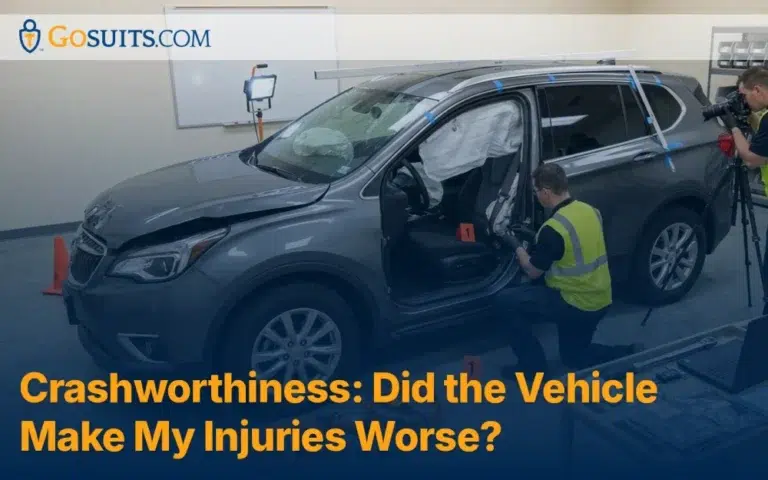
Yes. Under California law, a vehicle manufacturer can be held responsible for injuries that were caused or worsened by a defect in the vehicle’s design or construction, even when a different driver caused the collision itself. This legal theory is called a crashworthiness claim, or an enhanced injury claim. The core idea is that a manufacturer’s duty is not to prevent crashes but to design a reasonably safe occupant compartment for crashes that are foreseeable. If a defective airbag, collapsing roof, or faulty seat belt turned a survivable impact into a catastrophic one, the manufacturer may share legal responsibility for the additional harm.
Legal Snapshot
- Legal Topic: Crashworthiness / Enhanced Injury Doctrine
- Case Stage: Pre-litigation through trial
- Primary Legal Issue: Product liability for enhanced injuries caused by vehicle design or manufacturing defects
- Primary Authorities: California strict products liability (Greenman v. Yuba Power Products, Inc., 59 Cal.2d 57 (1963)); Doupnik v. General Motors Corp., 225 Cal.App.3d 849 (1990); Cronin v. J.B.E. Olson Corp., 8 Cal.3d 121 (1972); California Civil Jury Instructions (CACI) Nos. 1200, 1202, 1205
- Governing Jurisdiction: California; cases venued in Orange County Superior Court (Central Justice Center, Santa Ana) for Irvine-area incidents
- Date Legal Authority Last Reviewed: July 2025
What Is the Crashworthiness Doctrine?
The crashworthiness doctrine recognizes that vehicle manufacturers have a legal duty to design their products so that occupants are reasonably protected not only in normal operation but also in foreseeable accidents. California courts have long accepted this principle. In Cronin v. J.B.E. Olson Corp., 8 Cal.3d 121 (1972), the California Supreme Court confirmed that a manufacturer cannot defend against a defect claim simply by pointing out that an accident is not the vehicle’s “normal” intended use. [1] Vehicle collisions are foreseeable events, and manufacturers must account for them during the design process.
The doctrine was further refined in Doupnik v. General Motors Corp., 225 Cal.App.3d 849 (1990), a published California Court of Appeal decision arising from a rollover crash. The court confirmed that a manufacturer is liable when a defect in the vehicle, such as improperly welded roof pillars, is a substantial factor in producing injuries that would not have occurred in a properly built vehicle. The manufacturer’s responsibility does not require that it caused the underlying crash; it only requires that the defect made the resulting injuries worse. [2]
Irvine residents who drive on SR-133, the SR-73 Toll Road, and Interstate 405 through heavy Orange County traffic face the same collision risks as drivers everywhere. When those collisions happen and the vehicle fails to protect an occupant the way a reasonably designed vehicle should, a crashworthiness claim may be available in addition to, or instead of, a standard negligence claim against the at-fault driver.
How California Law Treats Enhanced Injury Claims
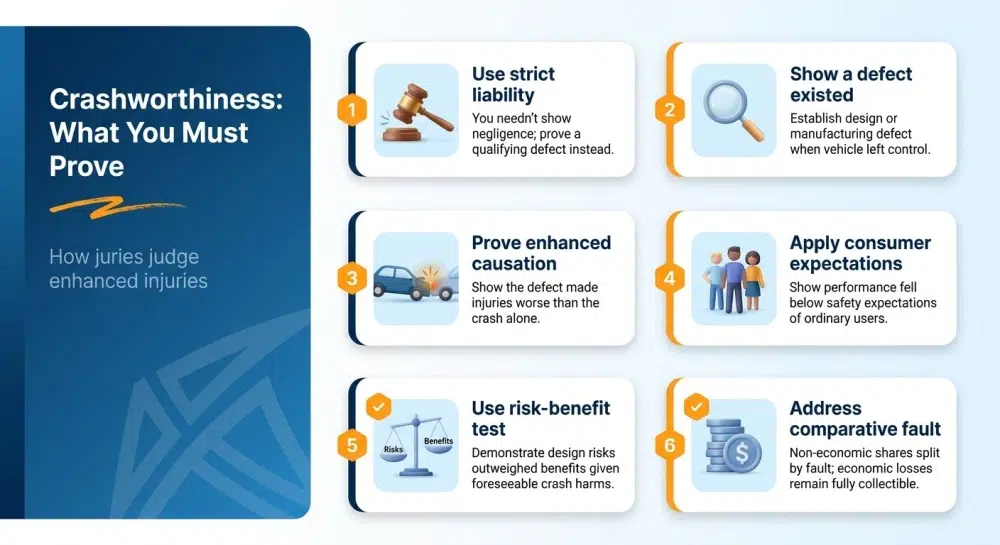
California applies strict products liability to defective vehicles. Under this framework, an injured person does not need to prove the manufacturer was negligent. Instead, the injured person must establish three things: (1) the vehicle had a defect in design or manufacture when it left the manufacturer’s control; (2) the defect was a substantial factor in causing the enhanced injuries; and (3) the injuries were of the kind that a reasonably safe occupant compartment would have prevented or reduced. [3]
California jury instructions, specifically CACI No. 1200 (manufacturing defect) and CACI No. 1202 (design defect under the consumer expectations test) and CACI No. 1205 (design defect under the risk-benefit test), set out the standards the jury applies when evaluating a crashworthiness claim. The consumer expectations test asks whether the product performed below the safety expectations of an ordinary consumer. The risk-benefit test asks whether the risks of the design outweigh its benefits, taking into account the likelihood and severity of foreseeable harm. [4]
California also uses a pure comparative fault system, which means that if the injured person bears some responsibility for the crash, damages are reduced proportionally rather than barred entirely. Importantly, California Proposition 51 allocates non-economic damages among multiple defendants based on each defendant’s percentage of fault, but leaves joint and several liability intact for economic damages. [5]
Separating the Enhanced Injury from the Underlying Crash Injury
One of the most technically demanding aspects of a crashworthiness case is separating the injuries that the crash itself would have caused from the additional injuries that the vehicle defect caused. Courts refer to this as the enhanced injury or incremental harm problem.
In Doupnik, the California Court of Appeal addressed this directly. The plaintiff was intoxicated when he lost control of his car, which rolled over. A properly welded vehicle should have protected the occupant compartment during that rollover. The defective A-pillar welds caused the roof to collapse, forcing the driver’s head into hyperextension and severing spinal cord function. The court upheld the verdict because expert testimony established the specific mechanism by which the defect produced the additional harm. The plaintiff was not required to rule out every possible hypothetical alternative cause; the standard is whether the defect was more probable than not a substantial factor in the additional harm suffered. [2]
In practice, this means an injured person must typically retain biomechanical engineers, automotive design engineers, and in some cases accident reconstructionists who can separate the baseline injury from the enhanced injury and connect the second category to the specific defect.
Recurring Failure Modes in California Crashworthiness Cases
Several categories of vehicle defects arise repeatedly in enhanced injury litigation. Each involves a different engineering standard and produces a different pattern of injury.
Airbag Non-Deployment or Aggressive Deployment
Federal Motor Vehicle Safety Standard 208 (49 C.F.R. Part 571.208) sets minimum performance requirements for occupant crash protection, including airbag deployment timing and force thresholds. [6] When an airbag fails to deploy in a crash that meets the threshold conditions, the occupant may suffer head, face, or chest injuries that the airbag was designed to prevent. When an airbag deploys too aggressively, it can cause facial fractures, chemical burns, or ocular injuries. Both failure modes, non-deployment and over-deployment, have generated product liability litigation in California.
Vehicles involved in rear-end collisions on congested stretches of the I-405 near the Irvine Spectrum, or in merge-related side impacts on SR-73, may reach deployment-threshold speeds. Whether the airbag system responded correctly to that specific crash pulse is a question that requires downloading the event data recorder, reviewing the supplemental restraint system (SRS) controller data, and comparing the recorded crash severity against the manufacturer’s deployment algorithm.
Seat Back Collapse in Rear Impacts
A seat back that collapses rearward during a rear-end impact can catapult the occupant into the back seat or cause severe spinal hyperextension injuries. Federal Motor Vehicle Safety Standard 207 (49 C.F.R. Part 571.207) sets a minimum static strength requirement for seating systems, but critics have long argued that the static test does not reflect the dynamic forces of a real collision. [7] California courts have allowed seat back failure claims to proceed under both the consumer expectations test and the risk-benefit test. Evidence in these cases typically includes testing data, internal manufacturer documents about seat design choices, and biomechanical analysis of how the rearward motion of the seat affected the occupant’s spine.
Roof Crush in Rollover Crashes
Federal Motor Vehicle Safety Standard 216 (49 C.F.R. Part 571.216) governs roof crush resistance. The standard was updated in 2009 to require greater roof strength, particularly for vehicles over 6,000 pounds gross vehicle weight. [8] A rollover that occurs at relatively low speed on the SR-55 or along the surface streets of Costa Mesa or Newport Beach can still produce catastrophic head and neck injuries if the roof structure fails and invades the occupant compartment. As the Doupnik court described, even a threshold rollover at dissipated speed can cause quadriplegia when the roof collapses because of structural defects.
Seat Belt Retractor and Pretensioner Failure
Modern seat belts include pretensioners that take up slack at the moment of impact and load limiters that control the force transferred to the chest. If a retractor fails to lock, the occupant can move forward far enough to contact the steering wheel, dashboard, or air bag at full force. If a pretensioner fails to fire, the occupant is not properly positioned when other restraints engage. Evidence in these cases includes the physical belt hardware, retractor spool analysis, and data from the SRS controller that records which restraints fired and when.
Door Latch Failure and Ejection
Federal Motor Vehicle Safety Standard 206 (49 C.F.R. Part 571.206) sets performance requirements for door locks and hinges. [9] A door that opens during a collision or rollover can eject an occupant onto the roadway. Ejection is one of the most lethal crash outcomes. Latch failure cases require metallurgical analysis of the latch components, review of the manufacturer’s testing history, and often a search for prior warranty claims or field reports involving the same hardware.
Post-Collision Fuel-Fed Fire
Federal Motor Vehicle Safety Standard 301 (49 C.F.R. Part 571.301) governs fuel system integrity. [10] When a fuel system fails in a crash and fire follows, burns may represent the most severe enhancement to an otherwise survivable collision. In Linert v. Foutz, 149 Ohio St. 3d 469 (2016), for example, an intoxicated driver struck a police vehicle from behind and a fuel-fed fire resulted, generating an enhanced injury claim against the car manufacturer. [11] The fire investigation in these cases requires examination of the fuel tank location, fuel line routing, and post-impact burn patterns.
How the Enhanced Injury Claim Survives a Third-Party Crash
A crashworthiness claim does not disappear because someone else caused the collision. The at-fault driver and the vehicle manufacturer are separate defendants with separate theories of liability. The at-fault driver’s negligence caused the crash; the manufacturer’s defect caused or magnified specific injuries within that crash. Both defendants may be named in the same lawsuit filed in the Orange County Superior Court, Central Justice Center in Santa Ana.
Under California’s comparative fault system, the jury apportions responsibility among all parties, including any share allocated to the injured person. The manufacturer’s share of liability is assessed independently of the driver’s share. A settlement with the at-fault driver’s insurer does not release the vehicle manufacturer unless the settlement agreement expressly says so and meets the requirements of California Code of Civil Procedure section 877.
Example
Hypothetical: A driver traveling on the SR-73 Toll Road is rear-ended at moderate highway speed by an inattentive driver. The impact is significant but below the speed typically associated with severe injury. The struck vehicle’s seat back collapses rearward, throwing the driver into the rear seat area. The driver sustains a spinal fracture. An accident reconstructionist determines the closing speed was consistent with an impact that should have been survivable in a properly designed seat. A biomechanical engineer concludes that the seat back failure, not the crash energy itself, was the mechanism that produced the spinal fracture. In this scenario, the injured person may have a claim against the at-fault driver for causing the crash and a separate claim against the vehicle manufacturer for the enhanced injury caused by the defective seat.
This example is hypothetical and is presented to illustrate a legal concept only. It does not represent any actual GoSuits case or actual event.
What Evidence Must Be Preserved Before the Vehicle Is Repaired or Disposed Of
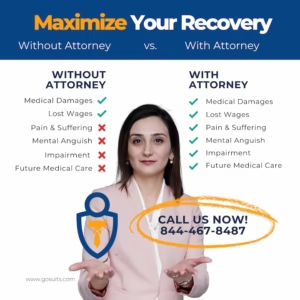
Preserving the vehicle is the single most time-sensitive action in a crashworthiness case. Evidence that is lost when a vehicle is repaired, salvaged, or sold at auction cannot be recreated. The following categories of evidence must be protected immediately.
The Physical Vehicle
The vehicle itself must be preserved in its post-crash condition, before any repair. Repaired structural components, replaced airbag modules, or installed replacement seats eliminate the very evidence that establishes whether a defect existed. The vehicle should be photographed extensively and stored in a covered, secure location.
Event Data Recorder and Electronic Control Modules
Most passenger vehicles manufactured after 2013 are equipped with an event data recorder (EDR) that captures pre-crash speed, throttle position, brake status, seat belt use, and airbag deployment data in the seconds before and during a crash. [12] The SRS controller records which airbag circuits fired and when. These modules can be destroyed in a fire, flooded in a submerged vehicle, or overwritten if the vehicle is powered on after the crash. They must be downloaded by a trained engineer using approved hardware before the vehicle is moved to a location where power might be applied.
Preservation Letters
A preservation letter is a written demand sent immediately to every party who controls the vehicle, including the vehicle owner, the insurance company, the body shop, the salvage yard, and the manufacturer’s regional office. The letter identifies the vehicle by VIN, describes all categories of evidence to be preserved, and places the recipient on notice that destruction of evidence may result in legal consequences, including a spoliation inference at trial. The letter should be sent by certified mail and email simultaneously, and copies should be retained.
If the insurer intends to declare the vehicle a total loss and send it to auction, a preservation letter combined with a request for a joint inspection can delay that process. The injured person’s legal representative must act within days, not weeks, because insurer-driven salvage timelines are short.
Joint Inspection
A joint inspection is a formal procedure in which the injured person’s engineering team and the manufacturer’s representatives examine the vehicle together. This process is arranged through counsel after litigation or a pre-litigation claim has been opened. Both sides document the physical condition of the vehicle simultaneously, which preserves the inspection record for both parties and reduces disputes about what the vehicle showed at a given point in time. Under California Code of Civil Procedure section 2031.010 and related discovery rules, inspection of physical evidence can be formally requested once litigation is filed. Arranging a voluntary joint inspection before litigation begins can establish goodwill and create a defensible chain of custody for the evidence.
Photographs and Video
Photographs of the interior, exterior, door latch hardware, seat back structure, airbag covers, roof pillars, fuel system, and wiring should be taken before the vehicle is moved from the scene when possible. Traffic cameras along the I-405 or SR-133 corridors, nearby business surveillance systems, and dashcam footage from other vehicles may also capture the crash dynamics and should be preserved through written demand to the relevant custodians before automatic deletion cycles erase the footage.
What Damages May Be Available in a California Crashworthiness Claim
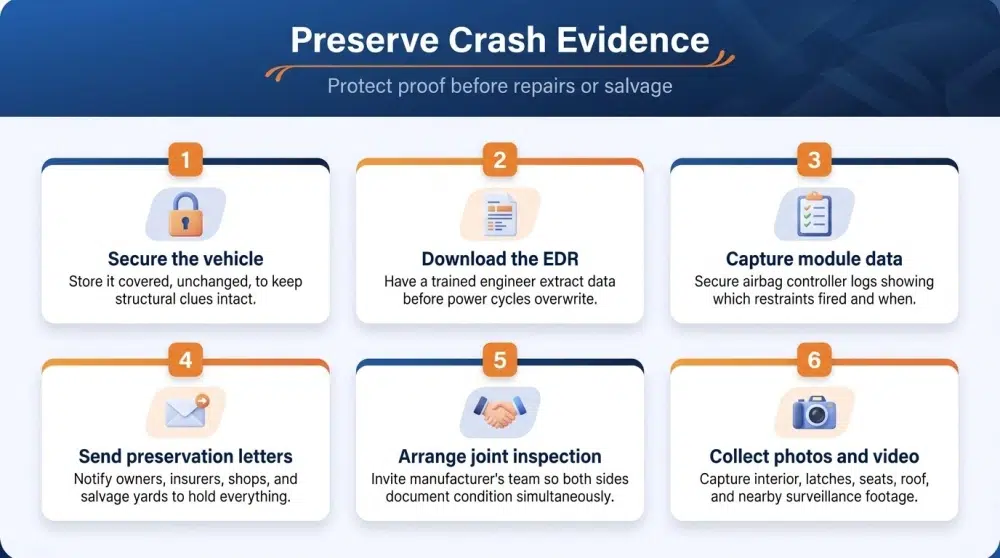
The damages recoverable in a crashworthiness claim are the same categories available in any California personal injury case, measured against the enhanced portion of the injury that the defect caused rather than against the total injury. Actual recovery depends on the specific facts, applicable law, and the evidence presented in any particular case.
- Medical expenses: Past and future medical costs caused by the enhanced injury, including hospitalization, surgery, rehabilitation, and ongoing care. California’s collateral source rule may affect how these are presented at trial.
- Lost income and lost earning capacity: Wages lost during recovery and, if the enhanced injury caused permanent disability, the present value of future reduced earnings.
- Physical pain and mental anguish: Non-economic damages for the pain, suffering, emotional distress, and loss of enjoyment of life attributable to the enhanced injury.
- Physical impairment and disfigurement: Separate non-economic damage categories recognized under California law for permanent functional limitations and visible scarring or deformity.
- Wrongful death damages: If the enhanced injury proved fatal, California Code of Civil Procedure section 377.60 and related statutes allow surviving family members to pursue wrongful death claims against the manufacturer.
- Punitive damages: California Civil Code section 3294 allows punitive damages when the defendant’s conduct constitutes malice, oppression, or fraud. Evidence that a manufacturer knew of a defect and concealed it from regulators or consumers can support a punitive damages claim, though the standard is demanding and requires clear and convincing evidence.
The personal injury lawyers at GoSuits work with medical professionals, life care planners, and economists to document the full scope of damages in product liability cases involving enhanced injuries.
What If the Manufacturer Claims the Accident Was Too Severe for Any Vehicle to Have Protected the Occupant?
Vehicle manufacturers frequently defend crashworthiness claims by arguing that the crash forces were so extreme that even a properly designed vehicle would not have prevented the injuries. This is known as the superseding cause or crash severity defense. California courts have addressed this argument directly.
The Doupnik court explained that a plaintiff is not required to prove the crash was mild. The plaintiff must show that the defect was a substantial factor in the enhanced injuries actually suffered. If a properly designed vehicle would have protected the occupant even in that crash, the fact that the crash was severe does not extinguish the manufacturer’s liability. The plaintiff must present engineering evidence connecting the specific defect to the specific injuries, not merely assert that the vehicle failed.
Manufacturers may also argue that compliance with a federal safety standard is a complete defense. Under federal preemption principles, compliance with a federal minimum standard does not automatically bar a state tort claim unless Congress has expressly or impliedly preempted such claims. The U.S. Supreme Court addressed this in Geier v. American Honda Motor Co., 529 U.S. 861 (2000), which found implied preemption in a specific airbag design claim, but preemption arguments are fact-specific and do not apply uniformly across all crashworthiness theories. [13]
What If Insurance Is Involved?
A crashworthiness claim against a vehicle manufacturer is typically a separate track from the bodily injury liability claim against the at-fault driver’s insurer. The injured person may pursue both simultaneously.
The at-fault driver’s insurer will evaluate its insured’s negligence liability. The vehicle manufacturer’s insurer, typically a large commercial carrier, will separately evaluate the product liability claim. These are different coverage agreements and different legal standards. A settlement of the bodily injury claim does not resolve the product liability claim, and accepting payment from the at-fault driver’s insurer before the product liability claim is resolved may affect the ultimate allocation of fault if not structured carefully.
Uninsured and underinsured motorist coverage under the injured person’s own policy generally does not extend to claims against a manufacturer, because the manufacturer is not an “uninsured motorist” under the policy definition. However, if the at-fault driver has inadequate coverage and the enhanced injury substantially increased the damages, the injured person may need to pursue both the UM/UIM claim and the product liability claim in parallel.
How Long Do I Have to Act in California?
California Code of Civil Procedure section 338 and related provisions govern the statute of limitations for product liability claims. The standard limitation period for personal injury claims, including crashworthiness claims, is two years from the date of injury under California Code of Civil Procedure section 335.1. [14] However, the discovery rule may extend or toll this period when the injured person could not have reasonably discovered the defect within the standard period.
Vehicle manufacturers are subject to California’s product liability limitations, but additional considerations may apply depending on the manufacturer’s location, whether any government entity is involved, and whether the claim involves a recall or known defect that the manufacturer concealed. These questions require legal analysis specific to the facts of the case.
Because the vehicle must be preserved before the statute of limitations becomes the primary concern, the practical deadline is much shorter than two years. Insurers can move a vehicle to salvage within days of a total-loss determination. The evidence preservation window is often measured in days, not months.
[DEADLINE REQUIRES LEGAL VERIFICATION for any specific case given the discovery rule, tolling provisions, and the circumstances of the particular vehicle and manufacturer.]
What Should I Do Next?
If you were injured in a crash in Orange County or the Irvine area and believe the vehicle may have contributed to the severity of your injuries, these steps matter:
- Do not allow the vehicle to be repaired, moved to salvage, or auctioned without first consulting a lawyer. Once structural components are replaced or the vehicle is crushed, critical evidence is gone.
- Request the crash data. Ask your insurer whether they downloaded the EDR and request a copy of the report. Some insurers routinely download this data as part of the claims process.
- Document your injuries and treatment. Keep records of every medical visit, every prescription, and every limitation the injury has imposed on your daily activities.
- Do not provide recorded statements to the vehicle manufacturer or its insurer without first speaking with legal counsel.
- Act quickly. The evidence preservation window is short. The statute of limitations gives you time to file, but the window for preserving the vehicle and downloading its electronics may close in days.
A crashworthiness case involves medical evidence, engineering analysis, insurance coverage questions, and legal deadlines that interact in ways that can affect the outcome of a claim. If you were injured in an Irvine-area crash and believe the vehicle made your injuries worse, a GoSuits personal injury lawyer can review the circumstances of your situation and explain your options at no cost to you.
Our Irvine personal injury lawyers represent clients whose injuries go beyond what the crash itself should have caused, including cases involving airbag failures, rollover roof collapse, and seat system failures across Orange County. If you need to speak with someone right now, schedule a free consultation with GoSuits.
Related California Personal Injury Resources
- How Recalls Affect Product Liability Claims
- Navigating Product Liability Claims: What You Need to Know
- What to Do After a California Car Accident
- How Attorneys Preserve Vehicle Black Box Evidence
- How Long Do You Have to Sue for Personal Injury in California?
Talk With a GoSuits Attorney
GoSuits serves injury victims throughout Orange County, including Irvine, Newport Beach, Santa Ana, Costa Mesa, and Fullerton. Our product liability lawyers handle cases where the vehicle itself contributed to catastrophic outcomes, including rollovers, rear-end seat failures, and airbag malfunctions. If you have questions about whether your vehicle may have played a role in your injuries, contact our Irvine personal injury team for a free case review. There are no fees unless we recover for you.
Reach us at gosuits.com/contact or call directly. We respond quickly because we know the evidence clock starts the moment the crash happens.
References and Legal Authorities
- Cronin v. J.B.E. Olson Corp., 8 Cal.3d 121 (1972) – Justia California Supreme Court
- Doupnik v. General Motors Corp., 225 Cal.App.3d 849 (1990) – CourtListener
- California Civil Jury Instructions (CACI) – Judicial Council of California
- CACI Nos. 1200, 1202, 1205 (Manufacturing and Design Defect) – Judicial Council of California
- California Civil Code Section 1431.2 (Proposition 51, Several Liability for Non-Economic Damages) – California Legislature
- 49 C.F.R. Part 571.208, Federal Motor Vehicle Safety Standard 208 (Occupant Crash Protection) – eCFR
- 49 C.F.R. Part 571.207, Federal Motor Vehicle Safety Standard 207 (Seating Systems) – eCFR
- 49 C.F.R. Part 571.216, Federal Motor Vehicle Safety Standard 216 (Roof Crush Resistance) – eCFR
- 49 C.F.R. Part 571.206, Federal Motor Vehicle Safety Standard 206 (Door Locks and Door Retention Components) – eCFR
- 49 C.F.R. Part 571.301, Federal Motor Vehicle Safety Standard 301 (Fuel System Integrity) – eCFR
- Linert v. Foutz (Ford Motor Co.), 149 Ohio St.3d 469, 2016-Ohio-8445 – CourtListener
- Event Data Recorders – National Highway Traffic Safety Administration (NHTSA)
- Geier v. American Honda Motor Co., 529 U.S. 861 (2000) – Legal Information Institute, Cornell Law School
- California Code of Civil Procedure Section 335.1 (Two-Year Statute of Limitations for Personal Injury) – California Legislature