When a product’s design rather than a manufacturing flaw or a missing warning is alleged to have caused an injury, California law gives an injured plaintiff a choice between two separate legal tests. Under the framework established in Barker v. Lull Engineering Co., 20 Cal.3d 413 (1978), a plaintiff may prove a design defect by showing either that the product failed to perform as safely as an ordinary consumer would expect, or that the design’s risks outweigh its benefits on balance. The second test, known as the risk-benefit test, carries a significant procedural advantage: once the plaintiff demonstrates that the product’s design caused the injury, the burden shifts to the manufacturer to prove the design is not defective. A later decision, Soule v. General Motors Corp., 8 Cal.4th 548 (1994), refined how courts apply the consumer expectation test, limiting it to situations where the circumstances of the alleged failure are within the common experience of ordinary jurors.
Legal Snapshot
- Legal Topic: Product Liability Design Defect Under California Strict Liability
- Jurisdiction: California (state law)
- Case Stage: Liability; Pre-litigation and litigation
- Primary Legal Issue: Which standard governs a design defect claim and how is the burden of proof allocated
- Primary Authority: Greenman v. Yuba Power Products, Inc., 59 Cal.2d 57 (1963); Barker v. Lull Engineering Co., 20 Cal.3d 413 (1978); Soule v. General Motors Corp., 8 Cal.4th 548 (1994)
- Date Legal Authority Last Reviewed: July 2025
- Attorney Review Recommended: Yes, fact-specific application of these tests requires legal analysis of the product involved, the injury, and available evidence
Where California Strict Liability Begins: Greenman v. Yuba Power Products
California’s modern product liability doctrine traces to Greenman v. Yuba Power Products, Inc., 59 Cal.2d 57 (1963). In that case, the California Supreme Court held that a manufacturer is strictly liable in tort when a product it places on the market proves to have a defect that causes injury. Under strict liability, an injured person does not need to prove that the manufacturer acted carelessly or negligently. The focus shifts to the condition of the product itself, not the conduct of the maker.
Greenman established strict liability as the governing theory for three recognized categories of product defects: manufacturing defects, design defects, and failure to warn defects. Each category asks a different question, and each is evaluated under distinct legal standards.
The Three Defect Theories in California Strict Liability
| Defect Type | Core Question | How It Is Identified |
|---|---|---|
| Manufacturing Defect | Did this particular unit deviate from the manufacturer’s own design? | Compare the injury-causing product to the intended design or to other units of the same product line |
| Design Defect | Was the product’s design itself applied to every unit deficient? | Consumer expectation test or risk-benefit test (see below) |
| Failure to Warn | Did the product lack adequate instructions or warnings about known risks? | Whether a reasonable consumer, if warned, would have used the product differently to avoid injury |
Why Design Defect Claims Present Unique Challenges
Manufacturing defects are the easy version, honestly. Something went wrong on the line, this particular unit doesn’t match the design, and you’ve basically got your smoking gun. Design defects are harder. A lot harder. Because the claim isn’t that one product came out wrong, it’s that every product came out exactly right and the design itself is the problem. You can’t just point at a deviation from the spec. The spec is the deviation, in a sense. The whole blueprint is what’s on trial, not the single unit that caused the injury.
California courts have recognized this difficulty for decades. The California Supreme Court noted in Barker v. Lull Engineering Co. that “a design defect cannot be identified simply by comparing the injury-producing product with the manufacturer’s plans or with other units of the same product line, since by definition the plans and all such units will reflect the same design.” [1] For this reason, the court developed two independent tests either of which can establish a design defect.
Here’s why the two-test setup actually matters. Somebody hurt by a household product, or a vehicle, or a medical device, or industrial gear at a warehouse in Orange County, they aren’t locked into a single path to a design defect claim. That flexibility is kind of the whole point. If your injury doesn’t quite fit what an ordinary consumer would’ve expected, that’s not the end of the road. You’ve still got the risk-benefit route.
The Barker v. Lull Framework: Two Alternative Design Defect Tests
The California Supreme Court decided Barker v. Lull Engineering Co., 20 Cal.3d 413 (1978), after a construction worker was seriously injured while operating a high-lift loader at a University of California construction site. The court used the case to articulate a dual standard for design defect liability that remains governing California law. [1]
Test One: The Consumer Expectation Test
The consumer expectation test is kind of the intuitive one. A product’s considered defective in design when it fails to perform as safely as an ordinary consumer would’ve expected, using it either as intended or in some reasonably foreseeable way. And that’s actually the whole point. Jurors just draw on their own common sense as consumers. You don’t need an expert on the stand. You don’t need a technical breakdown of what safety features cost versus what they save. The jury pretty much decides from everyday knowledge whether the product acted the way anyone would’ve expected.
The consumer expectation test traces its heritage to implied warranty principles and reflects a fundamental commitment in California law: when a product “implicitly represents that it will safely do the jobs for which it was built,” a manufacturer is strictly liable if it fails that minimum safety standard. Barker, 20 Cal.3d at 430 (quoting Greenman, 59 Cal.2d at 64). [1]
Test Two: The Risk-Benefit Test
The risk-benefit test asks whether, on balance, the benefits of a challenged design outweigh its risks of danger. Under this test, a plaintiff first must demonstrate that the product’s design was a proximate cause of the injury. Once the plaintiff makes that prima facie showing, the burden shifts to the defendant, the manufacturer or seller to prove that the design is not defective.
The burden shift matters. A lot. It’s kind of one of the most consequential features of California design defect law, and Barker spelled out why. The California Supreme Court’s reasoning went something like this: the manufacturer is the one who knows about alternative designs, what’s feasible to actually build, and how the cost-benefit math shakes out. That information lives inside the company, not out where a plaintiff can easily grab it. So the defendant is in a better spot to prove the design isn’t defective. [1] And that’s a burden of persuasion, by the way, not just producing some documents and hoping for the best.
When evaluating whether a design’s risks outweigh its benefits under this test, California courts have identified several relevant factors a jury may consider:
- The gravity of the danger posed by the challenged design
- The likelihood that the danger will cause harm
- The mechanical feasibility of a safer alternative design
- The financial cost of an improved design
- The adverse consequences to the product and to the consumer that an alternative design might create
This part matters a lot. The risk-benefit test doesn’t require any proof that the manufacturer was negligent. The jury looks at the condition of the product, full stop. Not at how careful the company was. A manufacturer who did everything right during the design phase, took every reasonable precaution, hired the best engineers, can still be found strictly liable if the jury sits with the evidence and decides in hindsight that the design is unsafe. [1]
Side-by-Side: The Two Barker Design Defect Tests
| Feature | Consumer Expectation Test | Risk-Benefit Test |
|---|---|---|
| Who bears the burden of proof? | Plaintiff must show product failed ordinary consumer expectations | Plaintiff shows design caused injury; burden shifts to defendant to show benefits outweigh risks |
| Is expert testimony typically required? | Not necessarily jurors apply common knowledge | Often yes, technical evidence about alternative designs is frequently needed |
| What does the jury evaluate? | Whether the product behaved as an ordinary consumer would have expected | Gravity of risk, feasibility of safer design, cost, and the defendant’s justification for the challenged design |
| Is proof of negligence required? | No | No |
| When is it most useful? | Products with simple, widely understood functions | Complex products where consumer expectations are not well-defined |
The Soule Limitation: When the Consumer Expectation Test Does Not Apply
The California Supreme Court revisited design defect in Soule v. General Motors Corp., 8 Cal.4th 548 (1994). The plaintiff was injured when a car collision caused the vehicle’s wheel assembly to collapse, driving the floorboard into her feet. She sued General Motors, claiming the car’s design was defective. The trial court allowed the jury to evaluate the claim under the consumer expectation test, and the jury found for the plaintiff. [2]
On appeal, the California Supreme Court reversed and clarified an important limitation: the consumer expectation test may only be given to the jury when the circumstances of the product’s failure are within the common knowledge of ordinary consumers. The court explained that “the jury must be instructed solely on the risk-benefit test” when the alleged design defect involves technical and mechanical details that the average juror would not be equipped to evaluate from everyday experience alone. [2]
The Soule court reasoned that asking jurors to apply their “everyday experience” to complex engineering questions such as how a wheel assembly should perform in a particular collision would mislead the jury rather than help it. In those circumstances, the risk-benefit test, supported by expert testimony, provides the appropriate framework because it focuses on verifiable technical data rather than uninformed consumer intuitions about a complex system.
This line matters in practice, and probably more than you’d think. Simple products, ones with functions everyone understands, are handled one way. A chair shouldn’t just collapse when you sit down. A bottle shouldn’t shatter without being dropped. Failures like that fit inside everyday experience, so jurors can be given the consumer expectation instruction. Complex engineering is a different beast entirely. Automotive crash dynamics. Medical device interactions. How industrial machinery actually behaves when it’s loaded up. Those cases almost always run under the risk-benefit framework, and you’re going to need expert testimony to really assess whether the design was adequate. [2]
Which Test Applies? Applying the Soule Guidance
| Type of Product Failure | Likely Applicable Test Under Soule |
|---|---|
| Simple consumer products with widely understood functions (e.g., a step stool that collapses, a latch that fails) | Consumer expectation test may be submitted to the jury |
| Complex mechanical or electronic systems (e.g., automotive crash safety systems, medical implants, industrial equipment) | Risk-benefit test; consumer expectation test typically not submitted; expert testimony required |
| Intermediate complexity products | Both tests may be submitted to the jury under appropriate jury instructions; plaintiff may choose either |
Hypothetical Example (Illustrative Only Not a GoSuits Case):
Imagine somebody buys a portable space heater, puts it in the living room, and uses it exactly how you’d expect. Then it ignites something nearby. Just during normal operation. Because ordinary consumers pretty much all understand that a space heater shouldn’t set materials on fire when it’s being used the way it was meant to be used, a court might let the consumer expectation test go to the jury. Jurors don’t need an expert on combustion engineering to work this one out. Everyday knowledge covers it.
Now flip the script. Picture a highway collision on SR-73 near Irvine where the driver claims the car’s side-impact air bag deployed all wrong and actually caused the injury instead of preventing it. Totally different situation. The questions you’d need to answer are engineering questions. Sensor thresholds. Deployment timing. How the car absorbs crash energy. None of that lives inside the common experience of ordinary drivers. Under Soule, the trial court would probably keep the jury inside the risk-benefit framework and make both sides bring in experts to talk about alternative designs and whether they were actually feasible.
Who Can Be Held Strictly Liable? The Chain of Distribution
California strict liability does not stop at the manufacturer. Every entity in the commercial chain of distribution of a defective product can be held strictly liable for resulting injuries. This principle traces to Vandermark v. Ford Motor Co., 61 Cal.2d 256 (1964), which extended strict liability beyond manufacturers to retailers. California courts have consistently applied that principle to include distributors, wholesalers, and any commercial seller who placed the defective product into the stream of commerce.
So what does this actually look like in practice? If you’re injured by a defectively designed product that came through a retail chain, and let’s say the manufacturer is a foreign corporation, or it went out of business years ago, or the distribution setup is just this tangled mess, you probably have claims against multiple parties. Not just one. The Orange County Superior Court, where civil cases get filed at the Central Justice Center in Santa Ana, regularly handles product liability lawsuits naming manufacturers, importers, distributors, and retailers together as defendants. And casting that wider net over the whole distribution chain matters strategically, especially when one defendant is judgment-proof or nearly impossible to serve.
For Irvine product liability lawyers, tracing the chain of distribution from component supplier through importer, distributor, and retailer is one of the foundational steps in case development. If you or someone you know has been injured by a consumer product, identifying every entity in that chain and preserving evidence of the sales transaction matters from the very beginning.

The Component Parts Doctrine
California recognizes something called the component parts doctrine, and it can actually shield a manufacturer of raw material or an unfinished component from strict liability, even when the finished product built around that component turns out to be defective. Here’s how it generally works. A component maker usually isn’t on the hook for defects in the finished product as long as two things line up: they had no real control over how the finished product was designed, and their own component wasn’t defective when it left their hands. That’s the core of it.
But this protection has real limits. If a component manufacturer helped integrate its component into the finished product’s design, or knew the component would be used in a way that created a foreseeable risk, or if the component itself was defective, they can still be strictly liable. Courts pretty much focus on two questions. Whether the component got substantially changed during integration. And whether the component manufacturer had any input into the design decisions that led to the injury. [3]
This doctrine frequently arises in cases involving industrial equipment, vehicles assembled from third-party parts, and pharmaceutical devices that incorporate components sourced from multiple suppliers.
The Sophisticated User Defense in Failure to Warn Cases
While the sophisticated user defense is most directly relevant to failure to warn claims, it can intersect with design defect analysis. Under this defense, a manufacturer may argue that it was not required to warn end users of a product’s known risks because the users typically professionals or trained industrial workers already possessed the relevant safety knowledge. The idea is that a warning directed at someone who already knows the risk would add no protective value.
California courts have applied the sophisticated user defense where an employer, rather than an individual end user, is the direct purchaser and is in a position to relay safety information to employees. The defense does not eliminate strict liability for a design defect; it operates primarily in the failure to warn context. However, in cases where a product is claimed to be defective both in design and in its lack of warnings, a defendant may invoke the sophisticated user defense as to the warning claim while still contesting the design defect claim on the merits. [3]
How Recalls and Prior Incident Reports Affect a Design Defect Claim
A product recall issued by a manufacturer whether voluntary or ordered by a federal agency such as the Consumer Product Safety Commission or the National Highway Traffic Safety Administration does not automatically establish that a design defect caused a specific plaintiff’s injury. A recall is evidence that a manufacturer or a regulatory body identified a safety concern with the product, but it does not eliminate the need to prove causation or damages in a civil case.
That said, a recall or a prior incident report can be highly significant evidence. It may show that the manufacturer had actual or constructive notice of the design problem before the plaintiff’s injury. That knowledge can bear on whether the manufacturer should have acted earlier to redesign or to pull the product from the market. Prior incident reports complaints to the manufacturer, reports to the CPSC, accident investigations by the manufacturer can support a plaintiff’s argument that the risk was foreseeable and the design was already known to be problematic.
Evidence of a recall or of prior similar incidents is subject to evidentiary rules, and courts analyze relevance and potential prejudice before admitting it at trial. For more background on how recalls connect to product liability claims, see our related article: How Recalls Affect Product Liability Claims.
Defendants routinely argue that prior incidents are distinguishable from the plaintiff’s accident in some material way, a different use scenario, a different product generation, or a different failure mode. These arguments underscore why analysis of the specific facts of each incident matters in product liability litigation.
Why the Product Must Be Preserved Exactly as It Was
In any product liability case, preserving the product in its post-accident condition is among the most time-sensitive and legally consequential obligations a potential plaintiff faces. The product itself is typically the central piece of evidence. An accident reconstruction expert, a mechanical engineer, or a materials scientist may need to inspect it, test it, or compare it to exemplar units.
If the product is lost, repaired, or altered before the defendant has an opportunity to inspect it, a plaintiff risks serious legal consequences including adverse jury instructions or even dismissal of claims under California’s spoliation doctrine. Courts treat the intentional or negligent destruction of evidence as evidence of consciousness of guilt or evidentiary weakness.
Practical steps that a person injured by a product should take immediately:
- Do not repair, modify, or dispose of the product keep it in the condition it was in at the time of the accident
- Photograph the product from multiple angles before anything is moved or cleaned
- Retain the original packaging, instructions, and any receipts or warranty documents
- If the product is already in the possession of a third party, an employer, a landlord, or a repair shop make a written demand for its preservation immediately
- Preserve all electronic communications, complaints, or service records related to the product
An attorney experienced in product liability claims can send a formal litigation hold letter to all parties who may possess the product or related records, triggering an affirmative duty to preserve.
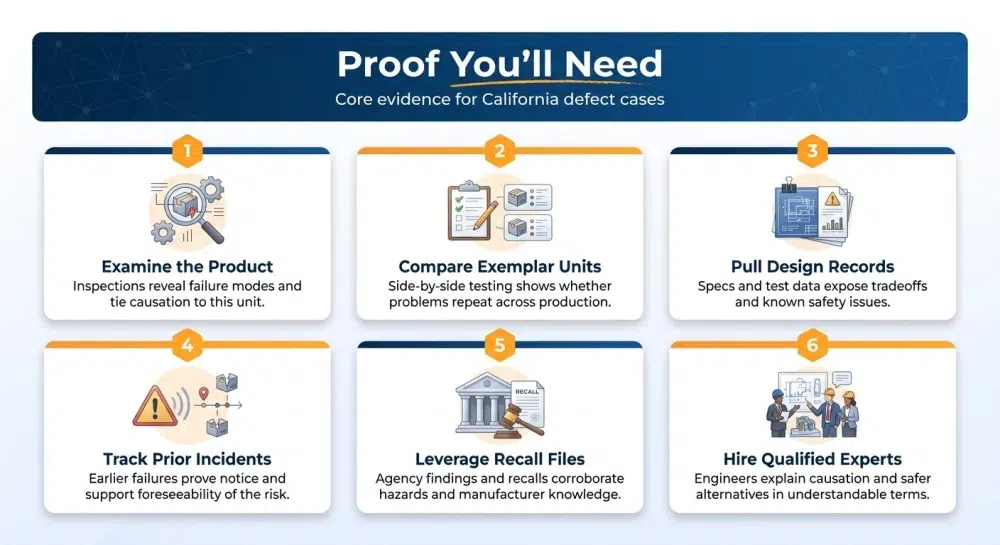
What Evidence Can Matter in a California Design Defect Case
Design defect cases are evidence-intensive. The following categories of evidence are commonly relevant, though not every category applies in every case, and the presence of evidence does not automatically establish liability.
- The product itself: Physical examination, dimensional measurement, materials testing, and functional testing of the injury-causing unit
- Exemplar products: Other units from the same production run or model year, used for comparison and testing
- Engineering and design documents: Design specifications, internal safety analyses, test results, and design revision history maintained by the manufacturer
- Prior incident and complaint reports: Records of similar failures reported to the manufacturer, to the CPSC, or to NHTSA before the plaintiff’s injury
- Recall and regulatory records: CPSC recall announcements, NHTSA investigations, FDA safety notices
- Expert testimony: Engineers, human factors analysts, accident reconstructionists, and economists who can assess the design, the failure, and the availability and cost of alternative designs
- Medical records and expert opinion: Establishing the causal link between the design defect and the specific injuries sustained
- Sales and distribution records: Tracing the product through the chain of distribution from manufacturer to the consumer
- Post-sale design changes: Evidence that the manufacturer redesigned the product after the plaintiff’s injury may be relevant subject to rules that limit admissibility of subsequent remedial measures for purposes of proving original negligence, though California Evidence Code section 1151 and related rules govern admissibility in strict liability contexts differently than in negligence contexts [3]
What Damages or Remedies May Be Available
California law allows a plaintiff in a strict product liability design defect case to seek compensation for a range of losses. Recoverability depends on the applicable law and the specific facts of the case. The categories below are illustrative, not exhaustive.
- Medical expenses: Past and future costs of treatment, surgery, rehabilitation, and long-term care caused by the injury
- Lost wages: Income lost because the plaintiff was unable to work during recovery
- Loss of earning capacity: Future reduction in the plaintiff’s ability to earn income as a result of lasting impairment
- Physical pain and suffering: Compensation for the physical pain caused by the injury and its treatment
- Mental anguish: Emotional distress, anxiety, and psychological harm resulting from the injury
- Physical impairment and disfigurement: Lasting limitations on physical function or changes in appearance
- Property damage: Damage to personal property caused by the defective product
- Wrongful death damages: Where a defective product causes a fatality, California law provides a separate wrongful death cause of action for surviving family members, and a survival action for losses sustained by the decedent before death see our Irvine personal injury team’s overview of wrongful death claims at the wrongful death lawyers Irvine page
California does not cap compensatory damages in personal injury cases. The amount recoverable depends on the evidence of actual harm and the jury’s assessment of that evidence. No recovery amount is guaranteed, and every case turns on its individual facts.
How Long Do I Have to Act? The Statute of Limitations
California imposes a two-year statute of limitations for personal injury claims, including those based on strict product liability design defects. The limitations period generally begins to run from the date of injury. California Code of Civil Procedure section 335.1 governs this period. [4]
The discovery rule can modify when the period begins to run. Under the discovery rule, the limitations period may not start until the plaintiff discovered or reasonably should have discovered that an injury occurred and that it may have been caused by a product defect. This rule is particularly relevant in cases involving latent injuries or injuries whose cause was not immediately apparent.
Separate deadlines may apply in specific circumstances:
- Claims against government entities in California are governed by the California Government Claims Act, which requires a written claim to be filed with the applicable government entity within six months of the accrual of the claim in most cases failure to comply bars the lawsuit
- Wrongful death claims have their own statute of limitations two years from the date of death in California, with potential tolling in some circumstances
- Claims by or on behalf of minors may be tolled until the minor reaches age 18
Deadlines in product liability cases should always be confirmed with an attorney who can analyze the specific facts and applicable law. Missing a filing deadline can permanently bar recovery regardless of the merits of the claim.
How These Tests Apply in Practice
Hypothetical Scenario (Illustrative Only Not a GoSuits Case):
Imagine a worker at a distribution center in Irvine is operating a commercially available pallet stacker. The stacker’s elevated load shifts unexpectedly and the worker is struck. The worker argues two alternative theories: first, that the stacker failed to perform as safely as an ordinary operator of warehouse equipment would expect when used in foreseeable conditions; second, that the manufacturer could have incorporated a load-stabilization sensor at minimal additional cost, reducing the risk without materially affecting the machine’s utility.
Under California law, both arguments can coexist. The worker may submit the consumer expectation theory to the jury if the trial judge finds that the circumstances of a shifting load on a pallet stacker and what an ordinary operator expects are within common experience. Simultaneously, the worker can present evidence under the risk-benefit test: expert testimony showing that the sensor technology existed, was commercially feasible, cost roughly $80 per unit to add, and would have prevented the accident. If the worker can show the design caused the injury, the manufacturer must then bear the burden of demonstrating why the benefits of the existing design outweigh its risks.
The manufacturer may attempt to argue that the worker misused the equipment, which depending on the circumstances could affect comparative fault or damages under California’s pure comparative negligence system, but would not automatically bar recovery.
What Should I Do Next?
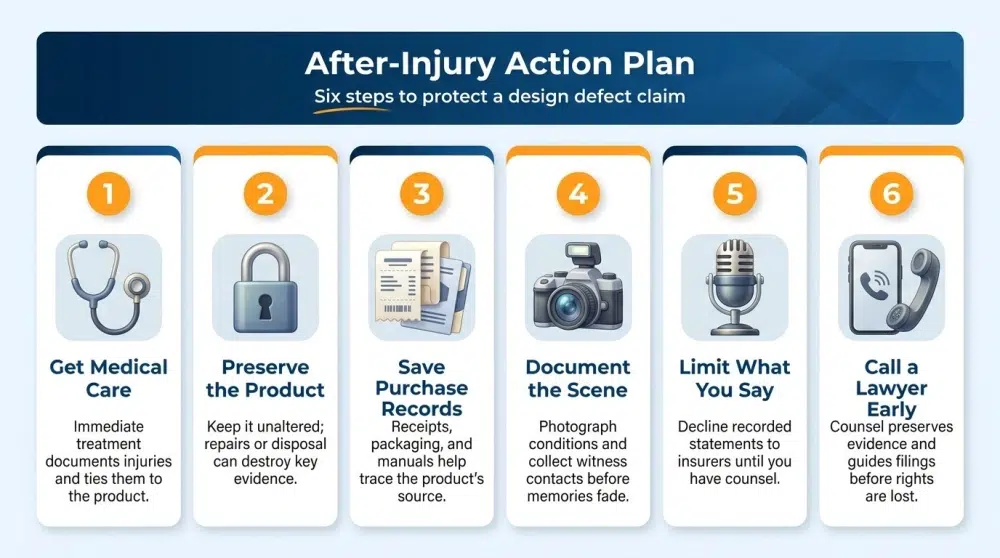
If you believe you were injured by a product with a defective design, the steps you take in the days and weeks immediately following the injury can significantly affect your ability to pursue a claim.
- Seek medical attention: document your injuries and treatment promptly
- Preserve the product: do not repair, discard, or alter it; photograph it as-is
- Retain all records: purchase receipts, packaging, manuals, warranty documents, and any prior service or complaint records
- Document the accident scene: photograph the location, note conditions, and gather contact information from witnesses
- Avoid statements to the manufacturer or its insurer: recorded statements made without legal guidance can be used adversely
- Consult with a personal injury attorney before the statute of limitations runs
Product liability claims are fact-driven and legally complex. They routinely require engineering analysis, expert witnesses, and discovery from manufacturers whose records are not publicly available. A GoSuits personal injury attorney can review the circumstances of your situation and explain whether a design defect claim may be viable. If you were injured by a product in Irvine, Newport Beach, Santa Ana, Costa Mesa, or anywhere in Orange County, schedule a free consultation to discuss your options.

Related California Personal Injury Resources
- California personal injury overview: Personal Injury Lawyers – California
- Product liability claims in Irvine: product liability lawyers information available through our Irvine office
- How recalls connect to product liability: How Recalls Affect Product Liability Claims
- Navigating product liability claims overview: Navigating Product Liability Claims – What You Need to Know
- California statute of limitations for personal injury: How Long Do You Have to Sue for Personal Injury in California?
Talk With a GoSuits Attorney
A design defect claim in California involves fact-specific legal analysis, choosing the right test, identifying and preserving evidence, building an expert witness team, and navigating the chain of distribution. If you or a family member were injured by a product you believe was defectively designed, speaking with a personal injury attorney early protects your rights and your ability to gather evidence before it disappears.
Our Irvine personal injury team handles product liability claims throughout Orange County, including cases arising from incidents in the Irvine Spectrum, Newport Beach, Santa Ana, and along the SR-55, SR-133, and SR-73 corridors. Contact GoSuits for a free consultation. There is no fee unless you recover.
Product liability lawyers can review the facts of your case, explain the applicable legal standards, and advise you on whether a design defect claim is worth pursuing. Our Irvine product liability lawyers are familiar with the Orange County Superior Court where product liability cases are heard at the Central Justice Center in Santa Ana and with the evidence that courts in this jurisdiction expect in design defect litigation.
References and Legal Authorities
- Barker v. Lull Engineering Co., 20 Cal.3d 413, 573 P.2d 443 (Cal. Supreme Court 1978) – CourtListener
- Soule v. General Motors Corp., 8 Cal.4th 548, 882 P.2d 298 (Cal. Supreme Court 1994) – CourtListener
- Greenman v. Yuba Power Products, Inc., 59 Cal.2d 57, 377 P.2d 897 (Cal. Supreme Court 1963) – CourtListener
- California Code of Civil Procedure § 335.1 – Two-Year Statute of Limitations for Personal Injury – California Legislative Information
- Vandermark v. Ford Motor Co., 61 Cal.2d 256, 391 P.2d 168 (Cal. Supreme Court 1964) – Extending Strict Liability to Retailers – CourtListener
- California Evidence Code § 1151 – Subsequent Remedial Conduct – California Legislative Information
- U.S. Consumer Product Safety Commission – Product Safety Information and Recall Notices
- National Highway Traffic Safety Administration – Vehicle Recalls and Defect Investigations
- Pruitt v. General Motors Corp., 72 Cal.App.4th 1480, 86 Cal.Rptr.2d 4 (Cal. Ct. App. 1999) – Applying Soule Consumer Expectation Limitation – CourtListener
- California Rules of Court – Judicial Council of California
- Lambert v. General Motors, 67 Cal.App.4th 1179, 79 Cal.Rptr.2d 657 (Cal. Ct. App. 1998) – Applying Dual Design Defect Standards – CourtListener
- California Supreme Court Opinions – Official Court Website