



































What types of commercial property damage cases do we handle in Irvine and Orange County?
Commercial property damage doesn’t really come in one shape. It shows up a dozen different ways. Fire. Water. A vehicle through the front. Vandalism. A contractor leaving you with a mess that costs more to fix than the original job. The pattern that matters across all of them is this: when someone else’s negligence is what caused the loss, you shouldn’t be the one absorbing the bill. We’ve worked with businesses across Irvine and the rest of Orange County on the physical damage piece, the business interruption math that nobody really wants to do, and the disputes that almost always tag along after a major loss.
Vehicle impacts into storefronts and commercial buildings
Drivers lose control constantly. In parking lots. On the surface street running right alongside your building. The end result tends to be the same either way, a vehicle through your storefront, your gas pump, or the front of your facade. What you’re left looking at is structural damage, broken glass, ruined fixtures, and probably weeks of closure while everything gets rebuilt.
Liability usually falls on the driver, plus the commercial employer if the vehicle was being used for work at the time. Vehicle-into-building crashes happen roughly 100 times a day across the United States, according to the Storefront Safety Council. The pieces that actually move the case are the surveillance footage, the police report, and the driver’s insurance disclosure. The kind of auto accident attorney Orange County owners trust gets to the scene fast, before footage cycles off the system and witnesses drift away.
Commercial vehicle and delivery truck damage
Big rigs. Delivery vans. Box trucks. When any of those slam into a loading dock, an awning, a drive-through canopy, or a parking structure, the property loss is usually some of the most expensive commercial damage we see in Orange County. The insurance side gets layered fast: the driver’s personal auto policy, the employer’s commercial auto policy, and any umbrella coverage sitting on top of both.
Locking down electronic logs, GPS data, and the company’s hiring and maintenance records early is genuinely critical. That data disappears or gets overwritten faster than owners expect. A lot of businesses end up searching for an Orange County commercial vehicle accident lawyer specifically because there’s a corporate defendant involved, and corporate defendants get litigated differently than regular drivers. Hours-of-Service violations, negligent hiring, and inadequate maintenance records can all shift liability well beyond the individual behind the wheel.
Fire and smoke damage from a neighboring tenant
Sometimes the fire that ruins your business doesn’t even start in your space. A grease fire in the kitchen next door, an electrical fault hidden in a shared wall, a contractor doing hot work on the floor above, any of those can push fire, smoke, and water-suppression damage right into your suite. The pieces that actually matter are the fire department’s cause-and-origin report, the shared-wall provisions in your lease, and the originating tenant’s insurance information. The business interruption number tends to outpace the physical damage figure pretty often, once lost revenue and extra expense get pulled in.
Water damage from plumbing, sprinkler, and HVAC failures
Supply line in the unit above gives way. A sprinkler kicks on during a maintenance check and runs way longer than it should. Rooftop HVAC condensate quietly drains itself straight into your server room over a long weekend. Any one of those means weeks of remediation and a real chunk of ruined inventory. Where the water actually came from changes the entire shape of the claim: was it a neighbor upstairs, a contractor’s mistake, or a property manager who let rooftop equipment slip on its maintenance schedule? Moisture mapping, mold assessment reports, and maintenance logs end up doing most of the work on that question.
The Insurance Information Institute consistently ranks water damage among the most common commercial property loss categories. When the source is a neighboring unit, a contractor’s open pipe, or a property manager’s failure to maintain shared equipment, you have a path to recovery that runs beyond your own first-party policy.
Construction and contractor-related damage
Excavation next door causing foundation cracks. Vibration from heavy equipment shaking loose interior fixtures. Material falling from a neighboring crane onto your roof. All of those generate third-party claims. California Civil Code section 832 governs lateral and subjacent support obligations between adjacent property owners, and a pre-construction survey of your property condition is the single most useful piece of evidence when adjacent work has started.
Contractor errors that show up months later, a roof installed incorrectly, plumbing run the wrong way, a slab that fails under load, are handled under California Code of Civil Procedure sections 337.1 and 337.15, which set four-year and ten-year outside limits for patent and latent defects respectively. Pulling the contractor’s license history with the California Contractors State License Board often reveals prior complaints and bond status that matter for both liability and recovery.
What evidence actually moves a commercial property damage case?
The playbook is pretty consistent regardless of which type of loss you’re dealing with. Get to the site fast. Photos and 3D documentation before repairs alter anything. Surveillance footage secured before retention cycles overwrite it. The police or fire report. Engineering or origin-and-cause findings. Two to three years of financial records to anchor business interruption math. Maintenance logs and prior inspection reports that establish what condition the property or equipment was in before the loss.
Evidence collected in the first 30 days carries the most weight. Once repairs begin and witnesses move on, the case gets harder. That’s one concrete reason why calling us early changes what we can do for you. Schedule a free consultation and we’ll map what evidence still needs to be preserved and what recovery paths are available to your business.
How California law shapes these claims
California follows a pure comparative fault system. If you’re found partially responsible for the loss, your compensation is reduced by your percentage of fault, but you’re not barred from recovering even if your share of fault is significant. For example, a $500,000 loss where you’re found 20 percent at fault yields a $400,000 recovery.
Filing deadlines matter. Most commercial property damage claims against private parties must be filed within three years from the date of the incident under Code of Civil Procedure section 338(b) for trespass and injury to real property, and section 338(c) for personal property including inventory and equipment. Contract-based claims against insurers or contractors generally fall under section 337, with a four-year limit for written contracts. If a government agency caused the loss, Government Code section 911.2 requires a written claim within six months, a deadline that does not flex easily.
California’s Unfair Insurance Practices Act, Insurance Code section 790.03, lists conduct insurers must avoid, including misrepresenting policy terms, failing to acknowledge claims promptly, and denying without reasonable investigation. Carriers that cross those lines can be held liable in tort for bad faith, with damages potentially exceeding policy limits. Beyond the gross recovery from the at-fault insurer, our team negotiates with hospitals, ER groups, contractor lien holders, and outstanding vendor balances at settlement to reduce what the client owes out of the award, so more of the dollars actually reach the business.
Vandalism, theft, and security failures
Smash-and-grab incidents, copper-wire theft from rooftop HVAC units, graffiti damage that takes serious money to fully restore. Orange County commercial and retail properties have been hit hard with all of it. The criminal actor is usually unknown, but that doesn’t end the recovery conversation. Landlords and property managers who promised security measures and didn’t follow through, who let lighting go dark or cameras stop recording, can be on the hook for the damage that resulted. The lease and any addenda where security features were promised are the central documents in that kind of claim.
Santa Ana wind events and severe weather damage
Santa Ana season means things go airborne. Signs come down, rooftop HVAC units shift or topple, and roof membranes peel back. The National Weather Service flags multiple high-wind advisories for Orange County every year, so this isn’t unusual, it’s practically calendared. The dispute on these claims is almost always the same: was it actual wind damage, which usually gets covered, or pre-existing maintenance the building never addressed, which usually gets excluded. NWS records for the date and location, roof inspection reports from before the loss, manufacturer specs on whatever piece failed, and post-event photos taken before anyone tarps or patches, those are the pieces that settle that argument.
Business interruption: the number that surprises owners most
The biggest dollar figure in many commercial property damage cases is not the broken glass or the ruined inventory. It’s the income you lose while the doors are closed. We work with forensic accountants to calculate lost revenue using prior-year financials, industry benchmarks, and projected growth, plus extra expense for temporary relocation, expedited shipping, and overtime payroll. Carriers know that owners under stress will accept a quick low offer on business interruption. We build the math the right way and push back on carrier-friendly assumptions about the period of restoration.
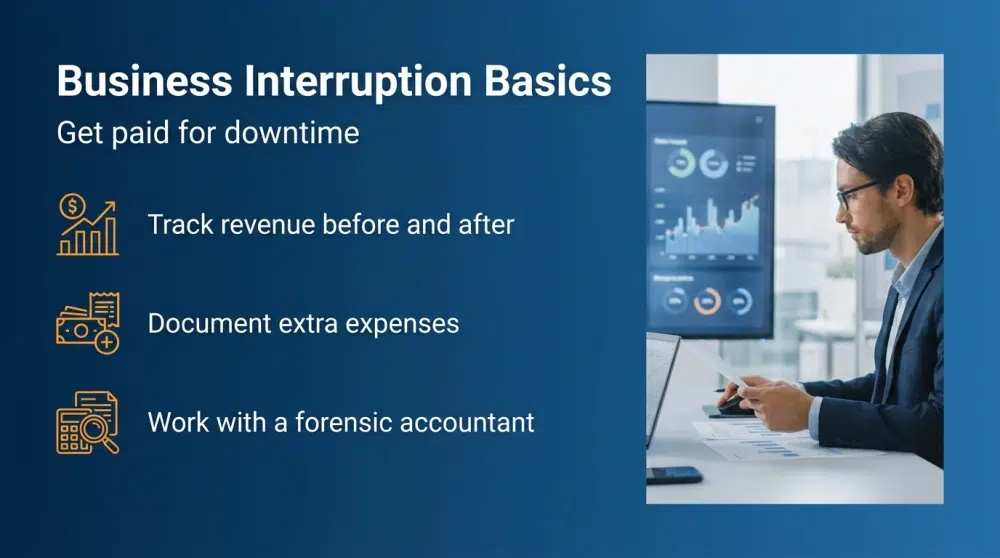
The I-405 through Irvine backs up hard at the SR-133 interchange, and rear-end collisions and commercial vehicle incidents along that corridor are common. The SR-73 and Jamboree Road corridors through the Newport Beach commercial zone see similar patterns. Businesses on or near those routes know how quickly a single incident can shut things down. When it happens to you, the business interruption clock starts immediately, and so should the documentation.
Areas we serve in Orange County
We handle commercial property damage cases for business owners throughout Orange County, including Irvine, Newport Beach, Huntington Beach, Costa Mesa, Santa Ana, Anaheim, Fullerton, Tustin, Mission Viejo, Lake Forest, Aliso Viejo, Laguna Niguel, Laguna Beach, Dana Point, San Clemente, Garden Grove, Westminster, Buena Park, Seal Beach, and surrounding communities. If your business is in Orange County, we’re reachable around the clock.