California law limits who may bring a wrongful death lawsuit. Only the people specifically identified in Code of Civil Procedure section 377.60 have legal standing to file. The statute places the surviving spouse or domestic partner and the decedent’s children at the top of the priority list. Other relatives and dependents may qualify under separate conditions. All eligible heirs are generally required to join a single lawsuit. If your family is dealing with the loss of a loved one in Orange County, understanding which family members have standing is the first practical step toward deciding whether to pursue a civil claim.
Legal Snapshot
- Legal Topic: Wrongful Death Standing and the One-Action Rule
- Primary Jurisdiction: California (Orange County / Irvine)
- Case Stage: Pre-filing, standing determination
- Primary Legal Issue: Which family members may file a wrongful death claim under California law
- Primary Authority: California Code of Civil Procedure § 377.60 (amended by Stats. 2020, Ch. 51, Sec. 1, effective September 9, 2020) [1]
- Related Authorities: CCP § 377.61 (damages); CCP § 377.62 (one-action rule); CCP § 335.1 (two-year limitations period); Government Code § 911.2 (six-month government claims deadline)
- Date Legal Authority Last Reviewed: July 2025
What Is a Wrongful Death Claim in California?
A wrongful death claim is a civil lawsuit brought by surviving family members when a person dies as a result of another party’s wrongful act or neglect. California’s wrongful death statute does not create a claim on behalf of the person who died. Instead, it creates a new, independent claim belonging to certain surviving family members who are recognized by law as the people most likely to have suffered a measurable loss from the death.
The civil claim is entirely separate from any criminal prosecution. A defendant can face criminal charges and a civil wrongful death lawsuit arising from the same incident. The outcomes of the two proceedings are independent of each other.
Wrongful death lawsuits are among the most procedurally demanding personal injury cases because they involve multiple potential claimants, strict deadline rules, and complex damage calculations. Whether a collision on the SR-55 freeway caused a fatality or a dangerous product failure took a life at home, the standing rules under CCP § 377.60 apply uniformly across California.
Who Has Standing Under CCP § 377.60?
Section 377.60 divides eligible claimants into three groups. The statutory text is controlling, and courts apply it strictly. [1]
Group One: Surviving Spouse, Domestic Partner, and Children (Subdivision (a))
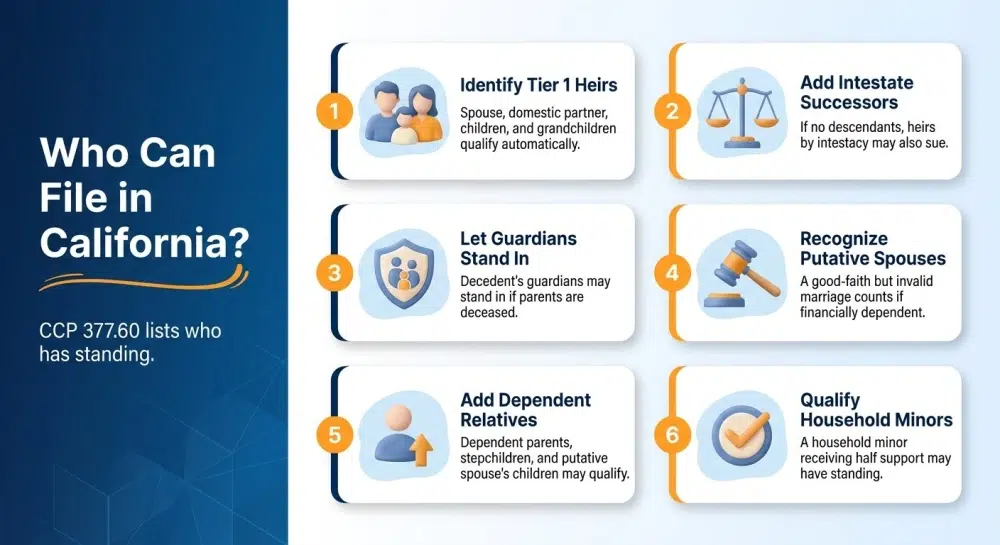
The statute’s first subdivision identifies the highest-priority claimants: the decedent’s surviving spouse, registered domestic partner, children, and the issue of any deceased children (grandchildren). These individuals have standing regardless of whether they were financially dependent on the decedent.
If there are no surviving issue of the decedent, the people who would inherit the decedent’s property under California’s intestate succession laws may also file under this subdivision. That group can include the surviving spouse or domestic partner as well as parents, siblings, or other relatives who would take under the Probate Code if the decedent had left no will.
One narrow provision applies to orphaned decedents: if the decedent’s parents would have had standing under this subdivision but are now deceased, the decedent’s legal guardians may step into the parents’ position and file the claim.
Group Two: Dependent Relatives (Subdivision (b))
Subdivision (b) extends standing to additional people if they were financially dependent on the decedent at the time of death, whether or not they also qualify under subdivision (a). This group includes:
- A putative spouse: the surviving partner of a void or voidable marriage who believed in good faith that the marriage was valid
- Children of a putative spouse
- Stepchildren
- Parents of the decedent
- Legal guardians of the decedent if the parents are deceased
Dependency is the critical threshold for this group. A parent who lived independently and received no financial support from the decedent generally will not qualify under subdivision (b), even if the parent is deeply grieving. A parent who relied on the decedent for housing, medical expenses, or regular financial assistance, however, may have standing.
Group Three: Dependent Minors in the Household (Subdivision (c))
Subdivision (c) creates a separate path for a minor child who does not otherwise qualify under subdivision (a) or (b). To have standing under this subdivision, the minor must have lived in the decedent’s household for the 180 days preceding the death and must have been dependent on the decedent for at least half of the minor’s financial support. This provision can apply to informally fostered children or other minors who shared the decedent’s home in a parental relationship.
Summary: Standing Categories at a Glance
| Category | Who Qualifies | Dependency Required? |
|---|---|---|
| Subdivision (a) – Tier 1 | Surviving spouse, domestic partner, children, grandchildren (issue of deceased children) | No |
| Subdivision (a) – Intestate successors | Those who would inherit if there are no surviving children | No |
| Subdivision (b) – Dependent relatives | Putative spouse, children of putative spouse, stepchildren, parents, legal guardians | Yes – must have been dependent on decedent |
| Subdivision (c) – Dependent household minor | Any minor who lived with decedent 180+ days and received 50%+ of support from decedent | Yes – household residency and 50%+ financial dependency |
The One-Action Rule: Why All Eligible Heirs Must Join
California’s wrongful death statute imposes what courts call the “one-action rule.” Code of Civil Procedure section 377.62 establishes that all wrongful death claimants must bring their claims in a single action, and any separate action may be dismissed upon motion. [2]
The policy behind the rule is straightforward: defendants should not face multiple successive lawsuits from different family members arising out of the same death. Courts and juries should assess the total harm to all survivors at once, and the defendant should not have to defend the same conduct in repeated proceedings.
What Happens When One Heir Refuses to Join?
So what happens when a family member who’s technically eligible just says no? It happens. Could be a strained relationship, could be a strategy disagreement, could be they want nothing to do with litigation at all, or their lawyer told them to stay clear. Either way, the one-action rule gets awkward fast. If a required claimant won’t join as a plaintiff, you can’t really move the case forward as a complete action, which is kind of the whole problem.
Here’s where it gets a little creative. Courts and lawyers in California have landed on a workaround pulled from general civil procedure, which is basically to name the heir who won’t join as a nominal defendant in the same case. It sounds harsh. It isn’t, really. It’s a procedural move, not an accusation, and the whole point is to formally bring that unwilling heir inside the case so the court can resolve everything in one go. The nominal defendant doesn’t face any liability. No adverse judgment, nothing like that. They’re just on the caption so the one-action rule is satisfied and the defendant doesn’t get hit with a second lawsuit down the road. But I’d be careful here. Before you name anyone as a nominal defendant, an attorney really needs to look at the specific facts and the procedural posture, because this is one of those things that goes sideways if the details aren’t right.
The Practical Effect on Orange County Families
Think about what a typical Orange County wrongful death matter actually looks like. Say, a fatal collision at a packed intersection near the Irvine Spectrum. Or a truck crash somewhere on the SR-241 toll road. Before anyone files anything, the family has to sit down and figure out every person who might be eligible to bring a claim. That part isn’t always clean. There might be a dependent parent out of state who could file but is hesitant to get involved. There might be an adult stepchild nobody’s talked to in years. Those are exactly the issues you want to deal with up front, or at least by the time the complaint goes in, because the one-action rule doesn’t give you a second shot.
Identifying Estranged or Previously Unknown Heirs
Families are not always aware of every person who might have standing. A decedent might have a child from a prior relationship, a putative spouse from a prior union that was legally void, or a dependent sibling who was not openly discussed. When there is any reason to believe such a person exists, a diligent investigation is needed before the lawsuit is filed.
Practical steps can include reviewing the decedent’s estate documents, prior tax returns listing dependents, prior court proceedings such as child support or domestic relations cases, and social media or public record searches. If an unknown heir surfaces after the lawsuit is already filed, the procedural consequences can be significant, and addressing that situation promptly is important.
The wrongful death attorneys at GoSuits assist personal injury clients in Irvine and throughout Orange County in identifying all eligible claimants before filing so that the case proceeds on solid procedural ground from the start. If you have questions about who in your family has standing, the Irvine personal injury claim process can be explained clearly in a free initial consultation.
Time Limits: How Long Do You Have to File?
The Standard Two-Year Limitation Period
California Code of Civil Procedure section 335.1 sets a two-year statute of limitations for personal injury and wrongful death claims. The clock generally begins to run on the date of the decedent’s death. [3] Missing this deadline ordinarily bars the claim entirely, regardless of how strong the underlying facts are.
Tolling for Minor Children
Here’s one that catches people off guard. If a claimant is a minor, the two-year statute is tolled, basically frozen, until they hit 18. From there they’ve generally got two more years to file, though a handful of other rules can come into play. The idea makes sense. A seven-year-old can’t exactly run her own lawsuit. But the tolling only protects the minor. In a case with multiple plaintiffs, where some adults are also entitled to file, those adults still have their own deadline running. Families sometimes assume the entire case is on pause because one heir is a kid. It isn’t. And that assumption can cost the adult heirs their claim entirely.
Government Claims Act Deadline: Six Months
If the death was caused by the act or omission of a California public entity such as a city, county, state agency, or public transit authority, an entirely different and much shorter deadline applies. Government Code section 911.2 generally requires that a claim be presented to the public entity within six months of the date the cause of action accrues. [4] Filing suit without first presenting a timely government claim can result in dismissal.
Say a fatal crash happens because of a bad road design on a public roadway in Costa Mesa or Anaheim. Or a public bus runs a light and someone dies. Those situations trigger the six-month government claim deadline, which is a lot shorter than families usually expect. The Central Justice Center in Santa Ana handles Orange County civil filings and sees wrongful death cases against public entities fairly often. The procedural requirements for those cases, honestly, look nothing like a standard private-party lawsuit. Different forms, different timelines, different boxes to check.
Because the government claims deadline is so much shorter than the general statute of limitations, families should seek legal guidance immediately after any death that might involve a public entity.
Table: Key Deadlines
| Situation | Deadline | Authority |
|---|---|---|
| Standard wrongful death lawsuit (private defendant) | 2 years from date of death | CCP § 335.1 |
| Minor claimant (tolling) | 2 years after turning 18 (subject to other limits) | CCP § 352(a) |
| Government entity defendant | 6 months to present claim; 6 months to file suit after rejection | Gov. Code §§ 911.2, 912.4 |
What Damages May Be Available?
Under CCP § 377.61, wrongful death damages are measured by the loss to the surviving claimants, not the loss to the person who died. [5] The categories of recoverable damages in a California wrongful death case generally include:
- Financial support: the income and financial contributions the decedent would have provided to the family
- Household services: the value of services the decedent performed at home, such as childcare, cooking, and home maintenance
- Loss of companionship, comfort, and society: the non-economic relational losses suffered by each surviving claimant
- Loss of guidance and training: particularly relevant for minor children who have lost a parent
- Grief and emotional distress of surviving family members: recognized as a compensable element under California wrongful death law
- Funeral and burial expenses
California wrongful death law does not permit recovery of the decedent’s pre-death pain and suffering as part of the wrongful death claim. Those damages, if any, belong to the decedent’s estate and are pursued through a separate survival action under CCP § 377.30. Families often bring both a wrongful death claim and a survival action simultaneously.
The recoverability and amount of each category of damages depend on the specific facts of the case, the applicable law, and the evidence presented. No outcome can be promised or guaranteed.
Families seeking to understand how wrongful death attorneys in Irvine approach damage valuation can find helpful background in our article on how long it takes to settle a wrongful death lawsuit.
What Evidence Can Matter in a Wrongful Death Case?
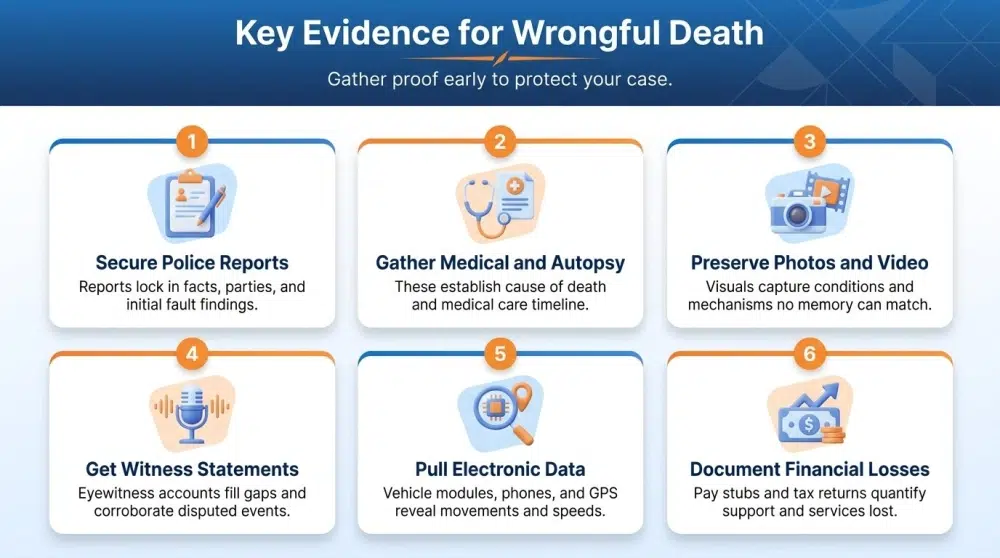
Evidence that may be relevant in a California wrongful death claim includes:
- Police or law enforcement reports documenting the incident and any initial determinations of fault
- Medical records and autopsy reports establishing cause of death and the circumstances of any medical care received
- Photographs and video from the scene, including dashcam footage, surveillance video, and cellphone recordings
- Witness statements from people who observed the incident or knew the decedent and the surviving family members
- Financial records pay stubs, tax returns, and bank records showing the decedent’s income and contributions to the family
- Employment records documenting career trajectory and earning capacity
- Expert testimony accident reconstructionists, economists, and medical experts may each play a role depending on the case
- Electronic data vehicle event data recorders, cellphone records, and GPS data can be critical in collision cases
- Insurance documents covering the defendant and any relevant umbrella or excess policies
- Records establishing dependency financial transaction histories, tax filings, or correspondence showing the economic relationship between the decedent and subdivision (b) or (c) claimants
Evidence does not automatically establish liability. Each piece of evidence must be evaluated in light of the full record and the applicable legal standards.
Applying the Rules: A Hypothetical Example
The following is a hypothetical example for educational purposes only. It does not represent an actual GoSuits case or any real event.
Scenario: A 42-year-old man is killed when a commercial truck runs a red light near the I-405 and SR-55 interchange in Irvine, California. He is survived by his wife of twelve years, two children ages 8 and 14, his mother who lives with the family and relies on him for housing and daily expenses, and an adult stepson from his wife’s prior marriage who lives independently in another city.
Standing analysis:
- The surviving wife has standing under subdivision (a) as the surviving spouse no dependency showing required.
- The two minor children have standing under subdivision (a) as the decedent’s surviving children no dependency required. Their claims are tolled during minority.
- The mother has potential standing under subdivision (b) as a dependent parent, she must show she was financially dependent on the decedent at the time of death. Her living arrangements and financial reliance on him support that showing.
- The adult stepson may have standing under subdivision (b) only if he was financially dependent on the decedent. If he lives independently and received no support from the decedent, he likely does not qualify.
One-action rule: All qualifying claimants, the wife, the two children, and the dependent mother (if she qualifies) must be joined in a single lawsuit. If the stepson does not qualify, he need not be joined. If the mother were reluctant to participate, the other family members and their attorney would need to evaluate whether naming her as a nominal defendant is the appropriate procedural step.
What If Insurance Is Involved?
In most California wrongful death cases arising from vehicle collisions, premises incidents, or product failures, one or more liability insurance policies will be at issue. The defendant’s auto liability policy, commercial general liability policy, or umbrella coverage may all be relevant. California law requires liability insurers to disclose their policy limits upon written demand in certain circumstances. [6]
The insurance company, not just the individual defendant, typically controls the defense and settlement decisions within the policy limits. When damages exceed those limits, the defendant’s personal assets may be at issue. Families should be aware that insurers have their own interests in the outcome, and those interests do not always align with the interests of the surviving family members.
Our Irvine wrongful death lawyers work with families to identify all sources of available coverage and to analyze whether underinsured or uninsured motorist coverage from the decedent’s own policies may also apply.
What If the Other Party Disputes Liability?
California follows a pure comparative fault system under Civil Code section 1714. A surviving family’s recovery can be reduced proportionally if the decedent is found to have been partially responsible for the incident causing death. California’s pure comparative fault rule does not bar recovery entirely, a claimant can recover even if the decedent was 99% at fault, but it does reduce the award by the percentage of the decedent’s own responsibility.
Liability is contested in many wrongful death cases. Insurance companies frequently argue that the decedent was at fault or that another party was responsible. The evidence-gathering process described above, police reports, reconstruction analysis, electronic data becomes especially important when fault is disputed.
What Should You Do Next?
Losing a family member is devastating. The legal decisions that follow do not need to be made immediately, but some especially the government claims deadline require prompt attention. Taking the following steps can help protect your family’s rights:
- Preserve all evidence. Do not discard any clothing, equipment, or items related to the incident. Request surveillance footage from nearby businesses or agencies before it is automatically overwritten.
- Obtain official reports. Secure copies of any police or law enforcement reports, coroner or medical examiner records, and incident documentation.
- Identify all potential claimants. Think carefully about everyone in the family who may have been financially dependent on the decedent, including stepchildren, dependent parents, and household minors.
- Note any government agency involvement. If the incident involved a public road, a public transit vehicle, a government employee, or any public entity, identify that involvement early so the six-month government claims deadline can be addressed.
- Consult a personal injury attorney promptly. The deadlines in wrongful death cases, particularly when government entities are involved can be unforgiving. An attorney can advise you on standing, deadlines, evidence preservation, and the one-action rule as they apply to your specific family’s circumstances.
The wrongful death lawyers at GoSuits serve families throughout Orange County, including those who have lost loved ones in communities across Irvine, Newport Beach, Santa Ana, Fullerton, and Huntington Beach. If your family is navigating this process, schedule a free consultation to discuss your situation.
Related California Personal Injury Resources
- GoSuits Irvine Wrongful Death Lawyers: wrongful death claim information for Orange County families
- Our personal injury team serving personal injury clients throughout Irvine and Orange County: Irvine personal injury lawyers
- Knowledge Base: How Long Does It Take to Settle a Wrongful Death Lawsuit?
- Knowledge Base: How Do You Value Someone’s Life in a Wrongful Death Lawsuit?
- Knowledge Base: Government Claims Act Deadline in Irvine
Talk With a GoSuits Wrongful Death Attorney
A wrongful death claim involves legal standing rules, strict deadlines, complex evidence, and the coordination of multiple surviving family members. If your family has lost someone due to another party’s negligence in Irvine, Newport Beach, Santa Ana, Costa Mesa, Huntington Beach, or anywhere in Orange County, a GoSuits wrongful death attorney can review the circumstances of your family’s loss and explain your legal options.
There is no charge for an initial consultation, and GoSuits handles personal injury and wrongful death cases on a contingency fee basis, you pay nothing unless your case resolves successfully. Contact GoSuits today to schedule a free consultation.
References and Legal Authority
- California Code of Civil Procedure § 377.60 – Wrongful Death: Who May File – California Legislative Information
- California Code of Civil Procedure § 377.62 – One-Action Rule – California Legislative Information
- California Code of Civil Procedure § 335.1 – Two-Year Statute of Limitations for Personal Injury and Wrongful Death – California Legislative Information
- California Government Code § 911.2 – Six-Month Claim Presentation Deadline – California Legislative Information
- California Code of Civil Procedure § 377.61 – Wrongful Death Damages – California Legislative Information
- California Civil Code § 3295 – Liability Insurance Disclosure – California Legislative Information
- California Code of Civil Procedure § 377.30 – Survival Action – California Legislative Information
- California Code of Civil Procedure § 352 – Tolling During Minority – California Legislative Information
- California Civil Code § 1714 – Negligence and Comparative Fault – California Legislative Information
- California Family Code § 297 – Registered Domestic Partnerships – California Legislative Information