
If you were injured in Irvine or anywhere in Orange County and a government agency may be responsible, the standard two-year personal injury deadline does not apply. Under the California Government Claims Act, you generally have only six months from the date of your injury to file a written claim with the responsible public entity before you can sue. Missing that deadline typically ends your right to recover, regardless of how serious your injuries are.
Legal Snapshot
- Legal Topic: Government Claims Act – Claim Presentation Deadline
- Jurisdiction: California (Orange County / Irvine)
- Case Stage: Pre-litigation – claim presentation
- Primary Legal Issue: Six-month claim deadline against public entities under California Government Code section 911.2(a)
- Primary Authority: California Government Code §§ 910, 911.2, 912.4, 912.6, 913, 945.4, 945.6, 946.6
- Date Legal Authority Last Reviewed: July 2025
What Is the California Government Claims Act?
California’s Government Claims Act (California Government Code, Division 3.6, §§ 810–998.3) is a body of state law that conditions a person’s right to sue a public entity on first filing a formal written claim with that entity within a specified time period. The Act applies to all California state agencies, counties, cities, school districts, transit authorities, and other governmental bodies.[1]
The purpose of the Act is to give public entities an early opportunity to investigate claims, correct mistakes, and potentially settle disputes before litigation begins. Because of this pre-filing requirement, an injured person who skips it, or files too late, generally cannot pursue a lawsuit in court, even if the claim itself would otherwise be strong.
For residents in Irvine and throughout Orange County, the Act has significant practical consequences. A crash on the SR-133 involving a Caltrans-maintained road feature, an injury on an OCTA bus near the Irvine Spectrum, or a fall on property maintained by the Irvine Unified School District can each trigger the Act’s requirements. Whether the incident occurs near Jamboree Road, the SR-73 Toll Road, or anywhere in the region, the pre-claim filing obligation is the same.
What Does California Law Say About the Six-Month Deadline?
California Government Code section 911.2(a) states that a claim relating to a cause of action for death or for injury to person or to personal property must be presented to the public entity not later than six months after the accrual of the cause of action.[2] The cause of action typically accrues on the date of the injury.
This six-month window contrasts sharply with the two-year statute of limitations that applies to personal injury claims against private parties under Code of Civil Procedure section 335.1. When a public entity is involved, the Government Claims Act pre-presentation requirement replaces and supersedes that two-year period.
A claim is considered timely presented when the public entity receives it within the six-month period. Section 911.2(b) addresses how the date is determined when a claim is submitted with a filing fee or fee-waiver affidavit to the Department of General Services for state-level claims.[2]
Once a claim is presented, the entity has 45 days to act on it (Government Code § 912.4).[3] If the claim is rejected in writing, the rejection notice under section 913 triggers a six-month window to file a lawsuit in court. That window runs from the date the notice is personally delivered or deposited in the mail (Government Code § 945.6(a)(1)).[4] If the entity fails to act within 45 days, the claim is deemed rejected (§ 912.4), and a different timeline applies.
Government Code section 945.4 makes the claim-presentation requirement a condition precedent to filing suit. Skipping it or filing a lawsuit before the claim is acted upon, can result in dismissal.[5]
Which Public Entities Commonly Appear in Irvine and Orange County Cases?
Each public entity has its own claim form, mailing address, and designated recipient. Identifying the correct entity before the six-month deadline expires is one of the most consequential steps in any injury case involving government property or operations. In the Irvine area and throughout Orange County, the entities that most frequently arise in personal injury matters include the following.
City of Irvine
The City of Irvine is responsible for municipal roads, sidewalks, parks, city-operated facilities, and city employees acting within the scope of their duties. Claims must be submitted to the City Clerk’s office. Incidents on Alton Parkway, Culver Drive, or inside city parks may fall under the City’s jurisdiction.
California Department of Transportation (Caltrans District 12)
Caltrans District 12 administers Orange County’s state highway system, including the I-405, I-5, SR-55, SR-133, and the SR-73 Toll Road corridor. If a dangerous condition of a state-maintained road or structure contributed to a crash or injury, Caltrans may be the responsible public entity. State claims are generally routed through the California Department of General Services, not submitted directly to Caltrans.[6] For late-claim petitions involving Caltrans, Government Code section 946.6(d) requires that service be made on the Attorney General or the Director of Transportation at the department’s Sacramento headquarters.[7]
Orange County Transportation Authority (OCTA)
OCTA operates bus routes throughout Orange County. A passenger injured on an OCTA bus, or a pedestrian struck by an OCTA vehicle, would present a claim to OCTA’s legal or claims department. OCTA is a distinct public agency from the City of Irvine, Orange County, and Caltrans – meaning a single incident near the Irvine Spectrum or at a transit stop on Sand Canyon Avenue might require a claim against OCTA specifically, not the city.
Transportation Corridor Agencies (TCA)
The Transportation Corridor Agencies operate the 73 (San Joaquin Hills Corridor), 241, and 261 toll roads in Orange County. Incidents on those facilities, including crashes related to road conditions on the toll road segments, may involve TCA as the responsible public entity. TCA is a joint powers authority, which is a form of public agency covered by the Government Claims Act.
Irvine Unified School District (IUSD)
IUSD is responsible for school buildings, school grounds, and school-operated vehicles. A child injured on school property, or a person struck by a school bus, would typically file a government claim with IUSD. School districts are public entities fully subject to the six-month claim deadline.
Regents of the University of California (UCI)
UC Irvine and its affiliated facilities are operated by the Regents of the University of California, a constitutional public corporation. Injuries occurring on the UCI campus, in campus buildings, parking structures, or on UCI-maintained walkways and roadways require a claim against the Regents. The University of California has a designated claims-processing office, and submitting a claim to the wrong address or the wrong entity can result in rejection.
County of Orange
The County of Orange operates unincorporated roads, county parks, the county jail, county-operated hospitals, and other facilities. Incidents on county-maintained roadways in unincorporated areas of Orange County, as distinct from city-maintained streets – may involve the County rather than any city.
Because these entities overlap geographically and functionally, it is not always obvious which one is responsible. A single incident could potentially involve multiple entities: for example, a collision at the intersection of a state highway and a city street near the Central Justice Center in Santa Ana. Submitting a claim to only one entity when two are responsible may leave part of the claim unprotected.
Our Irvine personal injury team works with clients to identify each potentially responsible public entity before the deadline expires. If you believe a government agency contributed to your injury, connecting with personal injury lawyers in Irvine early gives you the best chance of preserving all available claims.
What Must a Government Claim Include?
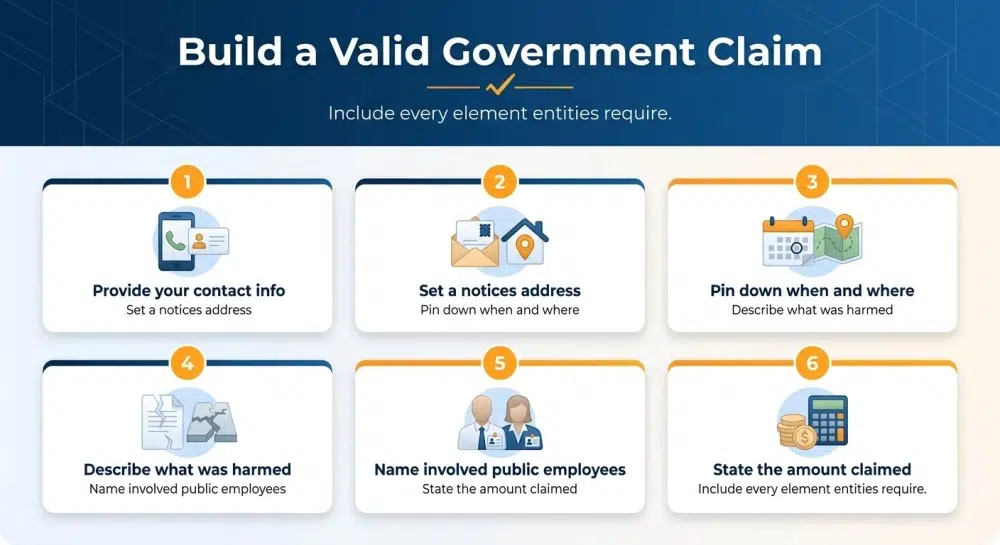
California Government Code section 910 sets out the minimum content of a claim. A properly filed claim must include:[8]
- The claimant’s name and mailing address
- The address to which notices are to be sent
- The date, place, and other circumstances of the occurrence that gave rise to the claim
- A general description of the injury, damage, or loss incurred
- The name or names of the public employee or employees who caused the injury, if known
- The amount claimed as of the date of the claim, if it totals less than $10,000; or a statement that the claim exceeds $10,000 if the amount exceeds that threshold (for limited civil cases, the amount claimed must be stated)
The claim does not need to be filed in a specific court-approved format, but most public entities provide their own official claim forms. Courts have held that a document can serve as a substantially compliant claim even if it does not perfectly follow the statutory form, provided it gives the entity the information it needs to investigate. However, a submission that omits critical information, such as the date and location of the incident, or the claimant’s identity is unlikely to be treated as substantially compliant. Whether a particular submission qualifies as substantially compliant is a fact-specific question that courts evaluate based on whether the entity was prejudiced by the deficiency.

What Happens If You Miss the Six-Month Deadline?
Missing the six-month deadline does not automatically end every possible avenue, but the available options are limited and procedurally demanding. Two potential paths exist: an application for leave to present a late claim, and a court petition for relief from the claim requirement.
Late Claim Application Under Government Code Section 911.4
A person who misses the six-month deadline may apply to the public entity for leave to present a late claim. This application must be filed within one year of the accrual of the cause of action – typically within one year of the injury.[9] The application must state the reason for the delay in presenting the claim within the original six-month period.
The entity may grant or deny the application. If the entity denies the application or fails to act on it within 45 days (making it deemed denied), the claimant’s next option is to petition the superior court.
Court Petition Under Government Code Section 946.6
Government Code section 946.6 allows a person whose late-claim application was denied to petition the superior court for an order relieving them from the claim-presentation requirement.[7] The petition must be filed within six months after the late-claim application is denied or deemed denied.
The court may grant relief if it finds that the late-claim application was made within a reasonable time (not exceeding one year after the accrual of the cause of action) and that one or more of the following grounds applies:
- Mistake, inadvertence, surprise, or excusable neglect – unless the public entity establishes that it would be prejudiced in its defense if relief is granted
- Minority – the injured person was a minor during all of the time allowed for claim presentation
- Physical or mental incapacity – the injured person was physically or mentally incapacitated during all of the time allowed for claim presentation and because of that disability failed to present a claim
- Death – the injured person died before the expiration of the claim-presentation period
In 2021, section 946.6 was amended to add provisions for claimants who were minors or incapacitated during any (not just all) of the six-month period, with the application to be presented within six months of turning 18 or regaining capacity, or one year after the claim accrues, whichever is earlier.[7]
The standard for excusable neglect under section 946.6 is essentially the same as the standard for relief from a judgment under Code of Civil Procedure section 473. Courts look at whether a reasonable person in the claimant’s position would have made the same error. Simple failure to know about the Government Claims Act, without more, has generally not been treated as excusable neglect on its own.
If the court grants relief under section 946.6(f), the claimant has 30 days from that order to file suit in the superior court.
How Does a Real Case Illustrate These Rules?
Hypothetical Example:
Suppose a driver is injured when her vehicle strikes a defective guardrail on the SR-133 near the I-405 interchange in Irvine, a road segment maintained by Caltrans. She sustains significant injuries and is hospitalized for several weeks. She assumes that the two-year statute of limitations applies and does not take any action for eight months.
At the eight-month mark, she consults an attorney and learns that the Government Claims Act required her to file a written claim with the state within six months of the collision. Because she missed that window, she must now apply for leave to present a late claim within one year of the crash date, explaining the reason for the delay. The state may deny the application. If it does, she would then have six months to file a section 946.6 petition in the Orange County Superior Court – which sits at the Central Justice Center in Santa Ana, asking the court to excuse her failure to timely file the claim on grounds of excusable neglect. The court would evaluate whether her mistake was the kind a reasonably prudent person might make under the same circumstances.
Had she consulted personal injury lawyers in Irvine within the first few weeks after the crash, the claim could have been filed on time with Caltrans and the complex late-claim procedure avoided entirely.
Second Hypothetical Example:
A passenger on an OCTA bus is injured when the bus stops abruptly at a stop along Culver Drive. She files a claim with the City of Irvine six weeks after the incident, believing the city operates the bus route. The City rejects the claim and informs her that OCTA, not the City, operates the route. By the time she receives that notice, five months have passed since her injury. She has less than one month left to submit a timely claim to OCTA, the correct entity, before the six-month deadline expires. Bus accident lawyers familiar with Orange County’s transit system can identify the correct agency from the outset, avoiding this kind of procedural problem.
What Evidence May Matter in a Government Claim Case?
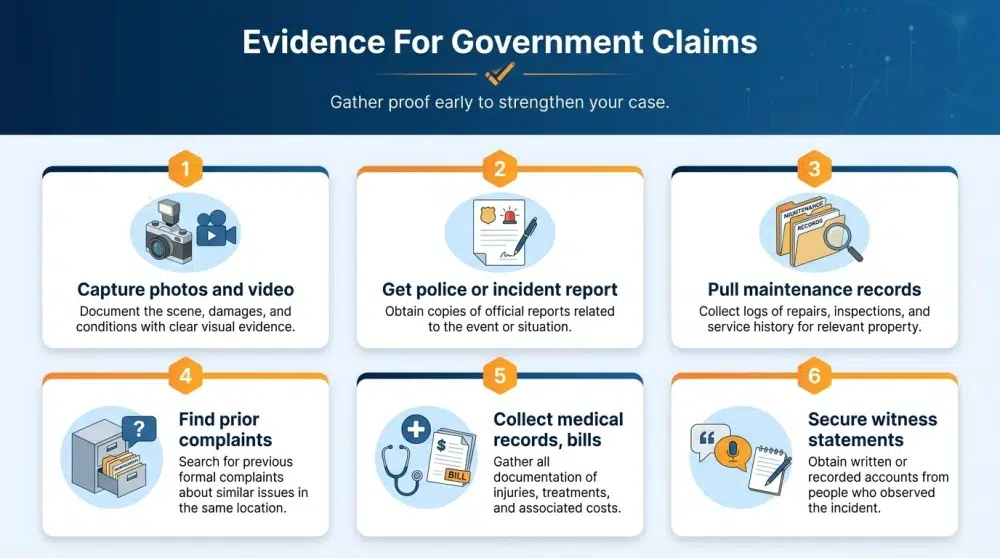
Because the claim must be filed quickly, often before a full investigation is possible preserving evidence from the beginning is critical. Evidence that may matter in cases involving public entities includes:
- Photographs and video of the location where the incident occurred, taken as soon as possible after the incident
- Police or incident reports documenting the date, location, and circumstances
- Maintenance records from the public entity showing whether a dangerous condition was known and what steps were or were not taken to address it
- Prior complaints or notices to the public entity about the same condition
- Medical records and bills documenting the nature and extent of injuries
- Witness statements from anyone who observed the incident or the condition
- Surveillance or dashcam footage that may have captured the incident
- Employment and financial records supporting claims for lost income
In public entity cases, an important additional concept applies: the “prior notice” doctrine. Under Government Code section 835, a public entity generally cannot be held liable for a dangerous condition of its property unless the entity had actual or constructive notice of that condition and failed to take reasonable protective action.[10] Evidence showing that the entity knew or should have known about the hazard – prior complaints, internal work orders, or prior incidents – is therefore significant.
What Damages May Be Available in Claims Against a Public Entity?
California law permits injured persons to recover a range of damages against public entities, including:
- Medical expenses – past and future costs of care reasonably required by the injuries
- Lost income – wages, salary, or other earnings lost because of the injury
- Loss of earning capacity – reduction in future earning ability if the injury is permanent or long-term
- Physical pain and suffering
- Mental anguish and emotional distress
- Physical impairment or disfigurement
- Wrongful death damages – if the injury results in death, surviving family members may have claims for loss of support, companionship, and related losses
California does not allow punitive damages against public entities. Government Code section 818 expressly bars punitive or exemplary damages from being awarded against a public entity.[11] This is a significant difference from claims against private parties, where punitive damages may be available if the conduct was malicious, oppressive, or fraudulent.
The recoverability and amount of any particular damages category depends on the specific facts of the case, the strength of the liability evidence, and applicable legal rules. No specific recovery can be predicted or guaranteed.
What Is the Deadline for Wrongful Death Claims Against Public Entities?
If a family member has died because of injuries attributable to a public entity’s dangerous condition or negligence, the surviving family members who may bring a wrongful death claim are also subject to the Government Claims Act. The same six-month deadline under Government Code section 911.2(a) applies to wrongful death claims as to personal injury claims.[2]
The six months runs from the date of death, not necessarily from the date of the incident that caused the injuries. If an injured person survived for a period before dying, the deadline for the wrongful death claim runs from the date of death, while a separate survival claim based on the decedent’s own injuries would run from the date of injury.
Given the compressed timeline for government claims – made even more urgent when a family is simultaneously coping with the loss of a loved one – connecting with wrongful death attorneys as early as possible is important.
How Long Do I Have to Act?
The key deadlines in California government entity claims are:
| Event | Deadline | Statutory Authority |
|---|---|---|
| Present written claim to public entity (personal injury or wrongful death) | 6 months from accrual (date of injury or death) | Gov. Code § 911.2(a) |
| File application for late claim with entity | 1 year from accrual | Gov. Code § 911.4(b) |
| File lawsuit after written rejection notice | 6 months from date notice mailed or delivered | Gov. Code § 945.6(a)(1) |
| File § 946.6 court petition after late-claim denial | 6 months from denial or deemed denial of late-claim application | Gov. Code § 946.6(b) |
| File lawsuit after court grants § 946.6 relief | 30 days from court order | Gov. Code § 946.6(f) |
These deadlines reflect California Government Code requirements verified as of July 2025. Individual circumstances – including claims by minors, incapacitated persons, or in other special categories – may be subject to different rules. An attorney should review the applicable deadlines for any specific situation.
What Should I Do Next?
If you believe a public entity in Irvine or Orange County may be responsible for your injury, the most important action is to move quickly. The six-month deadline under Government Code section 911.2 runs from the date of the incident, not from when you realize the government may be at fault. The following steps can help protect your claim:
- Document everything immediately. Photograph the location where the injury occurred, preserve any physical evidence, and write down what happened while your memory is fresh.
- Seek medical attention promptly. Medical records documenting your injuries from close in time to the incident are important evidence.
- Identify the responsible entity. Consider whether the location, vehicle, or employee involved belongs to the City of Irvine, Caltrans, OCTA, TCA, a school district, or another public body. In many cases, identifying the correct entity is not straightforward.
- Do not wait to consult an attorney. The six-month window closes quickly, especially when time is needed to investigate the incident, identify the correct entity, prepare the claim, and submit it properly. Claimants who contact personal injury lawyers in Irvine soon after an incident give their legal team the time needed to act before the deadline.
- Preserve all communications with any public agency. Any letters, emails, or notices from a government entity should be kept and shared with your attorney.
An injury claim against a government agency involves medical evidence, liability questions under Government Code section 835, the pre-presentation requirement, and strict procedural deadlines. If you were injured in an incident that may involve a public entity in Irvine or Orange County, a GoSuits personal injury attorney can review the circumstances of your case, identify the correct government entity, and explain what steps need to be taken. Schedule a free consultation to discuss your situation.

Related California Personal Injury Resources
- Claims Act Deadline in Los Angeles – GoSuits Knowledge Base
- Irvine Pedestrian Accidents: Your Rights If You Were Hit by a Car
- Top 5 Mistakes to Avoid After a Personal Injury in Irvine, CA
- Can You Sue Caltrans for Road Damage? – GoSuits Knowledge Base
- Negligence Laws in California: A Comprehensive Guide
Talk With a GoSuits Attorney
Government claim deadlines are strict, and the consequences of missing them are severe. If you or a family member was injured in an incident involving a public entity in Irvine, Newport Beach, Santa Ana, Huntington Beach, Costa Mesa, or anywhere in Orange County, GoSuits personal injury lawyers can help you understand what steps need to be taken and when.
Do not assume that the standard two-year limitation applies when a government agency may be involved. The six-month Government Claims Act deadline runs regardless of whether you know the entity is responsible. Act early, preserve your evidence, and get the information you need to protect your claim.
References and Legal Resources
- California Government Code, Division 3.6 – Claims and Actions Against Public Entities and Public Employees – California Legislative Information
- California Government Code § 911.2 – Six-Month Claim Presentation Deadline – California Legislative Information
- California Government Code § 912.4 – Entity’s Time to Act on Claim – California Legislative Information
- California Government Code § 945.6 – Time to File Suit After Rejection – California Legislative Information
- California Government Code § 945.4 – Claim Presentation as Condition Precedent to Suit – California Legislative Information
- California Department of General Services – Government Claims Program
- California Government Code § 946.6 – Court Relief from Claim Requirement (Late Claim Petition) – California Legislative Information
- California Government Code § 910 – Required Contents of a Claim – California Legislative Information
- California Government Code § 911.4 – Application for Leave to Present Late Claim – California Legislative Information
- California Government Code § 835 – Liability for Dangerous Condition of Public Property – California Legislative Information
- California Government Code § 818 – No Punitive Damages Against Public Entities – California Legislative Information