Bystander Emotional Distress: Can I Sue for What I Witnessed?
Under California law, a person who witnesses a loved one being seriously injured may have a civil claim for negligent infliction of emotional distress (NIED) — but only if three strict requirements are satisfied. The California Supreme Court set those requirements in Thing v. La Chusa (1989) 48 Cal.3d 644, converting what had been flexible guidelines under Dillon v. Legg (1968) 68 Cal.2d 728 into firm elements of the cause of action. A close family relationship alone is not enough. A bystander plaintiff must also have been present at the scene while the injury was happening and aware at that moment that the event was causing injury. Arriving afterward, learning of the injury by phone, or watching events unfold on a video call does not ordinarily satisfy the rule. This article explains the law, where it draws hard lines, and how the separate direct-victim theory differs from the bystander path.
Legal Snapshot
- Legal Topic: Negligent Infliction of Emotional Distress (NIED) — Bystander Recovery and Direct Victim Theory
- Case Stage: Pre-litigation / Civil Claim Evaluation
- Primary Legal Issue: Whether a plaintiff who witnesses injury to a close relative, or who is personally targeted by negligent conduct, may recover damages for emotional distress under California law
- Primary Authority: Thing v. La Chusa (1989) 48 Cal.3d 644, 771 P.2d 814 (California Supreme Court); Dillon v. Legg (1968) 68 Cal.2d 728, 441 P.2d 912 (California Supreme Court); Molien v. Kaiser Foundation Hospitals (1980) 27 Cal.3d 916, 616 P.2d 813 (California Supreme Court)
- Governing Statute: California Civil Code § 1714 (general duty of care); California Code of Civil Procedure § 335.1 (two-year statute of limitations for personal injury)
- Jurisdiction: California — Orange County Superior Court (Central Justice Center, Santa Ana) for claims arising in the Irvine area
- Date Legal Authority Last Reviewed: June 2025
What Is Negligent Infliction of Emotional Distress?
Negligent infliction of emotional distress is a recognized tort in California. It allows a person who suffers serious emotional harm because of someone else’s negligence to seek compensation — even when the plaintiff was not physically struck or physically injured in the incident. The underlying theory is ordinary negligence: the defendant owed a duty of care, breached that duty, and the breach caused serious emotional harm to the plaintiff. [1]
California courts have drawn a fundamental distinction between two categories of NIED plaintiffs:
- Bystander plaintiffs — people who witnessed injury being inflicted on someone else and suffered emotional distress as a result of observing it.
- Direct victim plaintiffs — people toward whom the defendant’s negligent conduct was itself directed, even if they suffered only emotional harm rather than physical injury.
Different legal rules apply to each category. Bystander plaintiffs must satisfy all three elements from Thing v. La Chusa. Direct victims do not face those same threshold requirements.
What Does California Law Say? The Thing v. La Chusa Rule
The foundation of modern California bystander NIED law is Thing v. La Chusa (1989) 48 Cal.3d 644, a decision by the California Supreme Court that resolved decades of conflicting lower-court rulings. The Court held that a bystander plaintiff may recover damages for emotional distress caused by observing the negligently inflicted injury of a third person only if all three of the following conditions are met: [1]
- Close relationship: The plaintiff is closely related to the injury victim.
- Contemporaneous presence and awareness: The plaintiff is present at the scene of the injury-producing event at the time it occurs and is then aware that the event is causing injury to the victim.
- Serious emotional distress: As a result, the plaintiff suffers serious emotional distress — a reaction beyond that which would be anticipated in a disinterested witness and which is not an abnormal response to the circumstances.
All three requirements must be met. A deficiency in any one of them is grounds for dismissal. The Court deliberately described these as elements — not merely factors to be weighed — precisely to create a workable boundary on liability. [1]
The historical backdrop matters. In Dillon v. Legg (1968) 68 Cal.2d 728, the California Supreme Court first recognized that a mother who watched a car strike and kill her child could sue the driver for her resulting emotional distress. Dillon articulated three flexible guidelines tied to foreseeability. Thing transformed those guidelines into hard elements, noting that 20 years of case-by-case adjudication had produced contradictory and unpredictable results. [2]
The Three Requirements Explained
Requirement 1 — Close Relationship
Recovery is limited to persons closely related to the injury victim. The California Supreme Court identified the core eligible group as parents, children, siblings, grandparents, and relatives residing in the same household. [1]
The relationship requirement does more than create a short list. Its purpose is to identify those persons who are most likely to suffer a level of emotional harm that goes beyond ordinary grief — harm greater than what a disinterested bystander would experience watching a stranger get hurt.
Courts have applied this element strictly. In Elden v. Sheldon (1988) 46 Cal.3d 267, the California Supreme Court held that an unmarried cohabiting partner did not qualify. The decision confirmed that foreseeability of emotional injury alone cannot substitute for the formal relationship the rule requires. Close friendships, dating relationships, or long-term companions who are not legally married and do not meet the household-relative test will generally not qualify under the bystander path. [3]
The close-relationship element is evaluated as a matter of law, meaning a judge — not a jury — typically decides whether a given relationship qualifies at the pleading or summary judgment stage.
Requirement 2 — Contemporaneous Presence and Awareness
This is the requirement most commonly at issue, and the one that eliminates the largest number of potential claims. The plaintiff must have been physically present at the scene of the injury-producing event at the moment it occurred and must have been aware, at that time, that the event was causing injury to the victim.
Both parts of the requirement matter. Physical presence is not enough if the plaintiff did not know during the event that someone was being injured. And awareness of the event is not enough if the plaintiff was not physically at the scene when it happened.
The Thing facts illustrate the rule directly. Maria Thing was nearby when a car struck her son, but she neither saw nor heard the collision. A daughter told her what had happened, and she then rushed to the scene where she found her son bloody and unconscious. The California Supreme Court held she could not recover: she did not observe the event as it was happening and was not contemporaneously aware it was causing injury to her child. Arriving after the fact, however quickly, does not satisfy the requirement. [1]
California courts have also made clear that the contemporaneous-awareness requirement does not demand visual observation. A husband who was in a car when a negligently driven vehicle approached his wife, knew her position, and perceived the impact through all available senses was treated as a percipient witness in Krouse v. Graham (1977) 19 Cal.3d 59. Sensory awareness at the moment of the injury-producing event, across any of the senses, can satisfy the requirement. [4]
But learning of an injury by telephone or video call — no matter how immediate — does not satisfy the rule. The key distinction the Thing Court drew is between distress caused by directly witnessing a traumatic event and distress caused by learning about it from another source. Receiving news of an injury, even devastating news received in real time, falls into the latter category. The Court noted that receiving such news, while painful, “is the type of experience for which in a general way one is prepared, an experience which is common,” distinguishing it from the abnormal experience of being personally present while injury unfolds before one’s eyes. [1]
A video call in which a person watches an event occur in real time presents a genuinely contested edge case that courts have not uniformly resolved. The majority of courts applying the traditional rule have continued to require physical presence at the scene, not remote observation. A person watching events on a screen from a separate location is generally not treated as present at the scene within the meaning of California’s bystander rule.
Requirement 3 — Serious Emotional Distress
The distress must be serious — that is, a reaction beyond what a disinterested witness would experience and one that a reasonable person of normal constitution would be unable to adequately cope with. Ordinary grief, sadness, or anxiety, even when significant, does not automatically meet this standard. Courts have looked to whether the plaintiff sought professional mental health treatment, was diagnosed with a recognized psychiatric condition such as post-traumatic stress disorder, depression, or anxiety disorder, or suffered physical symptoms resulting from emotional trauma. [5]
When Arriving Shortly Afterward Usually Fails
Suppose a crash occurs on the SR-73 near the Irvine Spectrum. A parent is driving behind the vehicle in which their child is riding, sees the collision in their mirror, and pulls over moments later to find their child seriously injured. Whether that parent satisfies the contemporaneous-presence requirement depends on whether they actually witnessed the impact — not merely the aftermath. If the parent saw the collision happen as it occurred, there is a strong argument for coverage. If they arrived even briefly after impact and only observed the resulting scene, the Thing rule creates a barrier.
Courts have denied recovery in exactly this scenario. In the Thing opinion itself, the Court discussed the earlier case of Arauz v. Gerhardt (1977) 68 Cal.App.3d 937, where a mother who arrived at an accident scene five minutes after her child was struck was denied recovery because she had no sensory perception of the impact. [1]
The Court acknowledged the harshness of the line: the same parent who would recover if present at the moment of impact might not recover if she arrived 30 seconds later to find her child in identical condition. The Court drew this line deliberately, accepting its arbitrariness as the cost of clear, administrable rules. The practical effect is that arriving “right after” is not the same as being present “during” under California law.
Similarly, a person who is somewhere else when an injury occurs — at work, at home, in a store on Alton Parkway — and receives a phone call describing what happened cannot satisfy the contemporaneous-presence element regardless of how close the family relationship is or how severe the resulting distress.
If a fatal accident occurs and a family member was not present at the scene, an NIED bystander claim is generally not available. Surviving family members may have other claims, including wrongful death claims under California Code of Civil Procedure § 377.60, which address a different set of harms and are governed by separate rules. Personal injury lawyers handling California wrongful death claims regularly navigate both paths for families in these situations.
Hypothetical Example A — Presence That May Qualify
A mother is standing on the sidewalk watching her daughter cross an intersection near Newport Beach. A car runs the signal and strikes the daughter in front of the mother. The mother sees the impact, hears her daughter cry out, and runs to her immediately. The mother subsequently develops severe PTSD requiring extended psychiatric treatment. Under Thing, she likely satisfies all three elements: the close-parent-child relationship, contemporaneous presence and awareness, and serious emotional distress documented through treatment records.
This is a hypothetical illustration only, not a description of any actual GoSuits case or result.
Hypothetical Example B — Presence That Likely Does Not Qualify
A father is waiting in the parking lot outside a restaurant in Costa Mesa. His spouse calls him from inside and describes an altercation in which their son, who was just seated, was seriously hurt by a negligently operated service vehicle. The father rushes inside within minutes and finds his son injured. Even if the relationship and severity of distress elements are met, the father’s claim fails the contemporaneous-presence test. He was not present at the scene when the injury occurred and was not aware of the injury as it was happening.
This is a hypothetical illustration only, not a description of any actual GoSuits case or result.
The Direct Victim Theory — A Different Path
The bystander rule from Thing applies when the plaintiff’s distress arises from observing harm being done to someone else. California recognizes a separate theory — the direct victim theory — for a plaintiff whose distress arises from negligent conduct directed at the plaintiff personally.
The California Supreme Court recognized direct victim liability in Molien v. Kaiser Foundation Hospitals (1980) 27 Cal.3d 916. In that case, a physician negligently and incorrectly diagnosed a patient with syphilis and directed the patient to inform her husband so he could be tested. The court held that the husband had a direct victim claim because the negligent conduct was, by its very nature, directed at him as well as at his wife. [6]
Under the direct victim theory, the plaintiff does not need to satisfy the three-part Thing test. There is no requirement that the plaintiff have been physically present at a scene, no requirement of contemporaneous awareness, and no close-relative requirement of the kind imposed on bystander claimants. Instead, the question is whether the defendant’s negligence was directed at the plaintiff — whether the defendant owed the plaintiff an independent duty whose breach caused the emotional harm. [7]
Direct victim claims arise most commonly where a defendant’s negligent conduct was, by the nature of the relationship or transaction, aimed at the plaintiff along with someone else. Examples courts have recognized include a patient’s spouse who was told to undergo medical testing based on a misdiagnosis of the patient, and a parent whose child’s physician engaged in negligent conduct specifically intended to affect the parent’s care decisions. The theory does not extend to every person who might foreseeably be distressed by negligence aimed at another.
The practical distinction: a parent who was at the scene and witnessed a collision involving their child pursues the bystander path under Thing. A parent who was themselves the target of the defendant’s negligent conduct — for example, a caregiver toward whom a hospital’s negligent omissions were directed — may pursue the direct victim path without satisfying the contemporaneous-presence requirement.
How Courts Have Treated the Close Relationship Element
California courts have taken the relationship requirement seriously as a gating mechanism. The following principles have emerged from the case law:
- Qualifying relationships: Parent, child, sibling, grandparent, and household co-residents are generally within the class. [1]
- Unmarried partners: Not covered under the bystander rule. Elden v. Sheldon held that California’s interest in formal marriage as a legal institution justified limiting recovery to legally married spouses and close blood relatives. [3]
- Distant relatives: Absent exceptional circumstances, cousins, aunts, uncles, and more distant relations do not qualify. [1]
- Legal relationships only: Stepchildren and adoptive children have generally been treated equivalently to biological children, consistent with the underlying purpose of the rule, though individual cases may vary.
- Friends and coworkers: A friend or coworker who witnesses horrifying events involving someone they care about does not have a bystander NIED claim under California law, regardless of the depth of the relationship or severity of resulting distress.
Courts in Orange County, including those sitting at the Central Justice Center in Santa Ana, have applied these standards as legal thresholds at the pleading and summary judgment stages. A complaint that fails to allege a qualifying relationship can be dismissed before trial.
What Evidence Can Matter in an NIED Claim?
Because the requirements are legal and factual, evidence goes to whether each element is satisfied and to the extent of compensable harm.
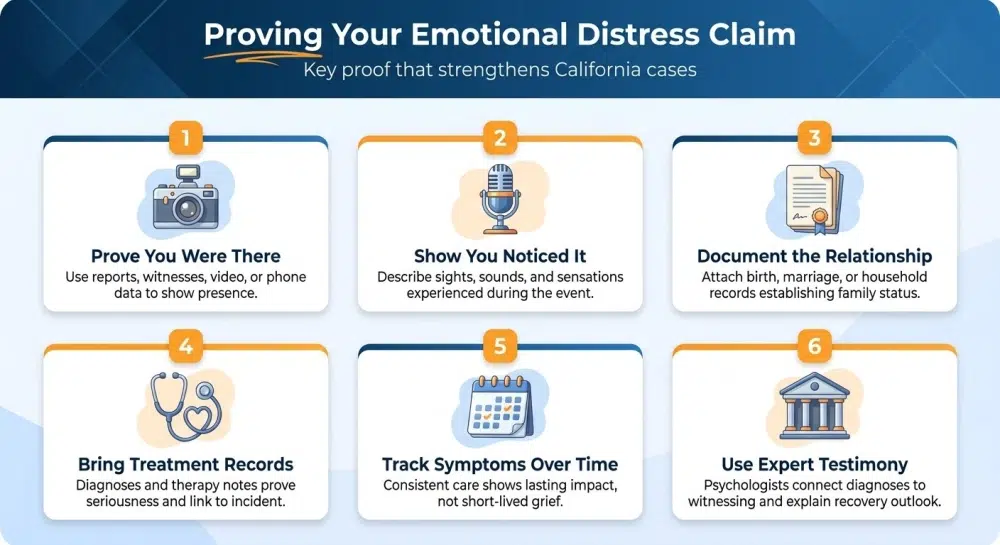
- Proof of presence: Police reports, witness statements, surveillance or dashcam footage, cell phone location data, and 911 records may help establish or contest whether the plaintiff was physically at the scene at the time of the injury-producing event.
- Proof of awareness: Testimony from the plaintiff and any witnesses about what the plaintiff saw, heard, or sensed at the moment of the event. The plaintiff’s own contemporaneous statements, including any 911 calls, are particularly relevant.
- Relationship documentation: Birth certificates, marriage certificates, and household records establish the family or legal relationship to the injured party.
- Medical and psychiatric records: Diagnoses of PTSD, major depressive disorder, acute stress disorder, anxiety disorders, or other recognized conditions, along with psychotherapy notes and prescription histories, document the severity and genuineness of the emotional distress. The fact that a plaintiff sought professional treatment shortly after an incident is significant evidence of serious distress.
- Treatment records over time: Ongoing treatment records showing sustained impairment help distinguish serious emotional distress from the transient grief that the law does not compensate.
- Expert testimony: A licensed psychologist or psychiatrist may testify about diagnosis, severity, prognosis, and the causal connection between witnessing the event and the resulting condition.
Evidence of distress alone — without evidence connecting it to witnessing the event as it occurred — does not overcome a failure of the contemporaneous-presence element. The causal and temporal connection between the event and the distress is itself part of what must be proven.
What Damages May Be Available?
California does not require proof of physical injury as a precondition for recovering damages in an NIED case. Following Molien v. Kaiser Foundation Hospitals (1980) 27 Cal.3d 916 and Ochoa v. Superior Court (1985) 39 Cal.3d 159, physical manifestation of distress is relevant to proving severity but is not an element of the claim itself. [6] [8]
Potential categories of recovery for an NIED plaintiff who satisfies all three elements may include:
- Past and future mental and emotional pain and suffering — the core non-economic loss in these cases, including anxiety, fear, grief, and the ongoing psychological impact of what was witnessed.
- Past and future medical expenses for psychiatric treatment — therapy, medication, and related care costs attributable to the emotional distress.
- Loss of enjoyment of life — where the emotional distress has impaired the plaintiff’s ability to engage in activities they previously valued.
- Physical symptoms traceable to the emotional distress — where emotional trauma has produced somatic symptoms (sleep disorders, appetite changes, physical manifestations of anxiety) that required medical attention.
Recoverability and the amount of any recovery depend on the specific facts of the case, applicable law, and how successfully the evidence supports each category. No particular outcome can be predicted or guaranteed in any individual case.
California’s pure comparative fault system applies. If the plaintiff is found partially at fault for the circumstances that caused the underlying injury to the direct victim, that comparative fault can reduce the bystander plaintiff’s recovery proportionally. [9]
Documenting Emotional Distress Through Treatment Records
The strongest NIED claims are supported by a clear record of psychiatric or psychological treatment that begins close in time to the incident and continues consistently. Courts and juries scrutinize the relationship between when treatment was sought and the timing of the traumatic event. A significant gap between the incident and the first professional consultation can raise questions about whether the distress was caused by witnessing the event or by other life circumstances.
A useful documentation framework:
- Seek professional evaluation promptly after the traumatic event, ideally from a licensed psychologist, psychiatrist, or clinical social worker.
- Be candid with your treatment provider about the specific incident, what you witnessed, and the effect it has had on your daily functioning.
- Maintain consistent treatment and follow through on recommended care plans.
- Keep records of any prescription medications prescribed as a result of the condition, and retain pharmacy receipts.
- Keep a private written record of how symptoms affect daily activities, sleep, work capacity, and relationships — sometimes called a pain journal. This contemporaneous account can be powerful corroborating evidence.
Personal injury lawyers in California who handle NIED claims routinely work with treating providers and retained mental health experts to establish the necessary foundation for this type of damage. Our California guide to pain and suffering damages explains how non-economic harm is evaluated in civil cases.
How Long Do I Have to Act?
California Code of Civil Procedure § 335.1 establishes a two-year statute of limitations for personal injury claims, which includes NIED claims. The limitations period generally begins to run from the date of the injury-producing event that the plaintiff witnessed. [10]
There are exceptions that can toll or extend the statute of limitations in specific circumstances, including where the plaintiff was a minor, where the plaintiff was legally incapacitated, or in certain discovery-rule situations. Those exceptions are fact-specific and require legal analysis.
Missing the statute of limitations typically bars the claim entirely, regardless of its merit. If you believe you may have an NIED claim arising from witnessing an incident in the Irvine area, Orange County, or elsewhere in California, prompt consultation with an attorney is advisable. Filing deadlines also govern related claims, such as wrongful death claims where the direct victim did not survive.
Important: Deadlines and exceptions must be verified against the facts of your specific case. This article does not constitute legal advice, and the applicable deadline in any individual situation requires attorney review. [DEADLINE REQUIRES LEGAL VERIFICATION for cases involving minors, government defendants, or discovery-rule issues.]
What If the Defendant Disputes the Bystander Claim?
Defendants in NIED cases have several lines of defense, each targeting one or more of the three Thing elements:
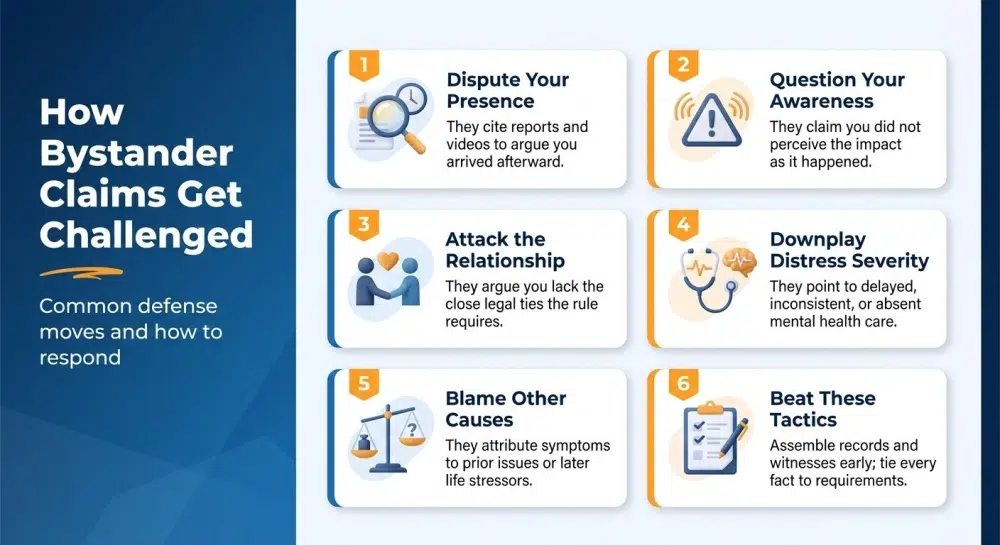
- Challenging presence: The defendant may argue that the plaintiff was not actually at the scene at the moment of the injury-producing event, relying on police reports, witness accounts, surveillance footage, or inconsistencies in the plaintiff’s own account.
- Challenging contemporaneous awareness: The defendant may argue that even if the plaintiff was present, they did not perceive the event as it happened — for instance, because their attention was elsewhere, they were inside a building, or they only turned to look after the injury was complete.
- Challenging the relationship: The defendant may challenge whether the legal or familial relationship meets the Thing standard.
- Challenging severity of distress: The defendant may argue that the plaintiff’s emotional response, while genuine, does not rise to the level of “serious emotional distress” as defined by law — particularly where treatment was delayed, inconsistent, or absent.
- Causation arguments: The defendant may argue that the plaintiff’s emotional distress was caused by pre-existing conditions, other life stressors, or subsequent events rather than by witnessing the incident.
Orange County Superior Court judges apply the Thing elements at the pleading stage and at summary judgment, meaning claims that cannot satisfy the threshold requirements as a matter of law may be dismissed before reaching a jury. Defendants in vehicle accident and premises liability cases regularly assert these defenses. Responding to them requires well-organized evidence and a thorough understanding of California NIED doctrine.
What If Insurance Is Involved?
NIED claims are typically pursued against the same defendant and through the same liability insurance coverage that applies to the underlying injury to the direct victim. In a car accident context, the at-fault driver’s auto liability policy is the primary target. In a premises liability context, the property owner’s general liability policy applies.
Insurance adjusters handling such claims may attempt to minimize or deny NIED damages by arguing that the plaintiff was not present, that the distress is insufficiently documented, or that the claimed amount is disproportionate to the nature of the incident. These are negotiating positions, not legal determinations.
California law imposes duties of good faith and fair dealing on insurers. Where an insurer unreasonably delays or denies a covered claim, the insured defendant may face exposure beyond the policy limits in a bad-faith action — but the bystander plaintiff’s direct remedy is against the tortfeasor defendant, not typically against the insurer directly.
Uninsured or underinsured motorist (UM/UIM) coverage, if available under the direct victim’s own policy or under the bystander plaintiff’s policy, may provide an additional source of recovery in some cases where the negligent party lacks adequate insurance. The availability of UM/UIM benefits for an NIED claim is a coverage question that depends on the specific policy language and applicable California law.
What Should I Do Next?
If you believe you may have an NIED claim as a bystander or direct victim in California, the most protective steps you can take are:
- Seek prompt mental health treatment — establishing a treatment record close in time to the incident is one of the most important things you can do for both your health and your potential claim.
- Preserve all evidence of presence — if you were at the scene, preserve any documentation of your location (receipts, cell phone records, witness contact information).
- Document your symptoms and their effect on daily life — keep a private, dated journal describing how you feel and how your symptoms affect your work, sleep, and relationships.
- Avoid giving recorded statements to insurance companies without legal advice — statements made early, before your claim is fully evaluated, can be used against you later.
- Consult an attorney promptly — California’s two-year limitations period runs from the date of the incident, and certain exceptions require early action to preserve.
NIED claims in California involve layered legal questions about whether the plaintiff qualifies under the bystander rule or the direct victim theory, whether the evidence meets each element, what damages are recoverable, and how the claim interacts with related wrongful death or personal injury claims by the direct victim. These questions are well-suited to a personal injury claim review by a California-licensed attorney familiar with Orange County courts and the Central Justice Center in Santa Ana.
If you or someone close to you was injured in Orange County or the surrounding area, our Irvine personal injury lawyers are available to evaluate the circumstances of your situation. Schedule a free consultation with GoSuits to discuss your options under California law.
Frequently Asked Questions
Q: I watched my child get struck by a car in Orange County. Does that automatically mean I have an NIED claim?
A: Witnessing your child get hurt satisfies the close-relationship element and likely creates the kind of distress California law recognizes. But you must also have been present at the scene at the moment the injury occurred and aware of it as it happened — not just present right afterward. You must also demonstrate serious emotional distress beyond the normal grief a bystander would feel. All three elements must be satisfied. An attorney can evaluate whether the specific facts of what you witnessed support a viable claim. For context on how fatal crashes and serious injuries affect families in Orange County, see this report on a fatal multi-vehicle crash in Huntington Beach.
Q: I wasn’t at the scene but I saw the accident on a security camera feed in real time. Does that count as being “present”?
A: Under current California law, almost certainly not. The contemporaneous-presence requirement in Thing v. La Chusa means physical presence at the scene of the injury-producing event. Remote observation — including watching events unfold on a monitor, a phone screen, or a video call — does not satisfy the requirement. Courts have consistently distinguished between directly witnessing a traumatic event with one’s own senses and observing it through a medium from a separate location.
Q: My spouse was injured in an accident I didn’t witness. I learned about it by phone. Can I still recover for my emotional distress?
A: Under the bystander path, no. Learning of an injury by phone — even immediately after it happens — does not meet the contemporaneous-presence requirement. However, if the circumstances involved negligent conduct that was directed at you personally (for example, a medical provider whose negligence was aimed at you in connection with your spouse’s treatment), a direct victim theory might be available. These are fact-specific inquiries requiring legal analysis. For related reading on how Orange County car accident claims proceed, see our coverage of Orange County car accident claims.
Q: What relationship qualifies as “closely related” under California law?
A: Parents, children, siblings, grandparents, and relatives residing in the same household are within the class. Unmarried partners — even long-term cohabiting partners — do not qualify under the rule established in Elden v. Sheldon (1988) 46 Cal.3d 267. Distant relatives such as cousins or aunts and uncles generally do not qualify absent exceptional circumstances. Close friends, regardless of the depth of the relationship, are excluded from the bystander path entirely.
Q: The person I watched get hurt didn’t die — they recovered. Can I still sue for what I witnessed?
A: Yes. The bystander NIED rule does not require that the direct victim have been killed. The rule requires that the plaintiff witnessed “the negligently inflicted injury” of a closely related victim. Serious physical injury is sufficient to establish the injury element. What matters is whether all three Thing requirements are met, not whether the victim ultimately survived.
Q: Can my NIED claim be filed alongside the injured person’s own injury lawsuit?
A: Yes, in most circumstances. California practice permits the bystander plaintiff’s NIED claim and the direct victim’s personal injury or wrongful death claim to proceed in the same action. Courts sitting in Orange County routinely handle cases where both the injured party and a witnessing family member assert claims arising from the same incident. Coordinating these claims requires careful attention to pleading requirements, discovery, and potential interactions between the two cases.
Q: How is serious emotional distress documented for purposes of a California NIED claim?
A: The most effective documentation comes from prompt and consistent treatment by a licensed mental health professional — a psychologist, psychiatrist, or licensed clinical social worker. Records showing a diagnosis of PTSD, acute stress disorder, major depression, or related conditions, combined with ongoing treatment notes and prescription records, provide the evidentiary foundation courts require. A personal written journal of daily symptoms and their impact on functioning can supplement clinical records. Expert testimony from a retained mental health professional may be necessary to link the diagnosed condition to witnessing the specific event. For related guidance on documenting an injury claim in the Irvine area, see our coverage of a serious pedestrian injury in Dana Point and how families navigate these events.

Q: How long do I have to file an NIED claim in California?
A: California Code of Civil Procedure § 335.1 establishes a two-year statute of limitations for personal injury claims including NIED. The clock generally begins running on the date of the incident. Tolling rules may apply in cases involving minors, persons under legal disability, or delayed discovery. Government entity defendants require presentation of a Government Tort Claim within six months under the Government Claims Act — a much shorter deadline. [DEADLINE REQUIRES LEGAL VERIFICATION in your specific case.] Consult an attorney promptly to ensure no deadline is missed.
Related California Personal Injury Resources
- California bystander NIED law — personal injury claims in Irvine: Thing v. La Chusa (1989) 48 Cal.3d 644
- Wrongful death standing in California: California Code of Civil Procedure § 377.60
- California pain and suffering damages: see our California pain and suffering damages guide
- Orange County Superior Court, Central Justice Center, 700 Civic Center Drive West, Santa Ana, California
- Irvine area personal injury resources: visit our Irvine personal injury lawyers page
Talk With a GoSuits Attorney
An NIED claim in California involves an initial legal threshold that must be assessed before any valuation of damages can occur. Whether your circumstances satisfy the bystander elements under Thing v. La Chusa, whether a direct victim theory may be available, and what evidence you will need to document the claim are questions that benefit from experienced legal review.
Regardless of how a claim begins — a crash on the I-405, a slip-and-fall incident near the Irvine Spectrum, or another event in Orange County — claims of this type often involve insurance negotiations, causation disputes, and deadlines that move quickly. If you are dealing with the aftermath of witnessing a serious injury to someone you love, a GoSuits personal injury attorney can review the circumstances and explain your options under California law.
Contact GoSuits to schedule a free case consultation.
References and Legal Authorities
- Thing v. La Chusa (1989) 48 Cal.3d 644, 771 P.2d 814 — Supreme Court of California (Justia)
- Dillon v. Legg (1968) 68 Cal.2d 728, 441 P.2d 912 — Supreme Court of California (Justia)
- Elden v. Sheldon (1988) 46 Cal.3d 267, 758 P.2d 582 — Supreme Court of California (Justia)
- Krouse v. Graham (1977) 19 Cal.3d 59, 562 P.2d 1022 — Supreme Court of California (Justia)
- Thing v. La Chusa — Full Opinion Text, CourtListener (Footnote 12 citing Rodrigues v. State (1970) 52 Haw. 156)
- Molien v. Kaiser Foundation Hospitals (1980) 27 Cal.3d 916, 616 P.2d 813 — Supreme Court of California (Justia)
- Ochoa v. Superior Court (1985) 39 Cal.3d 159, 703 P.2d 1 — Supreme Court of California (Justia)
- Hedlund v. Superior Court (1983) 34 Cal.3d 695, 669 P.2d 41 — Supreme Court of California (Justia)
- California Civil Code § 1714 — General Duty of Care — California Legislative Information
- California Code of Civil Procedure § 335.1 — Two-Year Statute of Limitations for Personal Injury — California Legislative Information
- California Code of Civil Procedure § 377.60 — Wrongful Death Standing — California Legislative Information
- California Courts — Official California Judicial Branch Website
Disclaimer: This article is provided for general informational purposes only and does not constitute legal advice. California law on negligent infliction of emotional distress is highly fact-specific. The outcome of any individual case depends on its particular facts, the applicable law, and many other variables. Reading this article does not create an attorney-client relationship. If you believe you have a claim, please consult a licensed California attorney to evaluate your specific situation.