Minor’s Compromise: What Happens to a Child’s Settlement?
When a child is injured in California, a parent or guardian cannot simply negotiate a settlement and pocket the money on the child’s behalf. California law requires court approval before any settlement of a minor’s claim becomes binding, and it imposes strict controls on how the funds are held, invested, and eventually released. The governing framework is found primarily in Probate Code sections 3500 and 3600 through 3613 and in related court rules. Attorney fees in these cases are set by the court rather than by private contract, and medical bills and liens must be addressed before any net recovery reaches the child. Separately, Code of Civil Procedure section 352 tolls, or pauses, the statute of limitations while the injured person remains a minor. Understanding these rules matters whether you are a parent managing the aftermath of a serious accident or an attorney guiding a family through the process.
Legal Snapshot
- Legal Topic: Minor’s Compromise — Court Approval of a Child’s Personal Injury Settlement
- Case Stage: Pre-litigation settlement through formal court petition; also applicable in pending civil actions
- Primary Legal Issue: Court oversight of settlement funds belonging to an injured minor; tolling of the limitations period during minority
- Primary Authority: California Probate Code §§ 3500, 3600–3613; California Code of Civil Procedure § 352; California Rules of Court, rule 7.950 et seq.
- Jurisdiction: California (state law)
- Date Legal Authority Last Reviewed: July 2025
What Is a Minor’s Compromise Under California Law?
A “minor’s compromise” is the court-supervised process by which a settlement of a child’s personal injury claim is reviewed and approved by a judge. California Probate Code section 3500 gives a parent the authority to compromise a child’s disputed claim, but that compromise does not become enforceable unless a court first approves it or the net recovery is below a threshold that allows a parent to act without court approval under certain limited circumstances set out in section 3500.
Once the settlement amount exceeds the threshold — or whenever the case involves a pending lawsuit — Probate Code section 3600 triggers. That section applies whenever a court approves a compromise of a minor’s disputed claim, approves a compromise of a pending action in which a minor is a party, or gives judgment for a minor, and the arrangement provides for the payment or delivery of money for the minor’s benefit.[1] In practice, most meaningful personal injury settlements involving children require a formal court petition and hearing.
Families in Orange County most often file minor’s compromise petitions in the Orange County Superior Court, with hearings held at the Central Justice Center in Santa Ana. The proceeding is not adversarial in the usual sense; instead, the court acts as an independent protector of the child’s interests, examining whether the settlement is reasonable given the injuries, the available evidence, and the potential risks of litigation.
What Must the Petition Contain?
California Rules of Court, rule 7.950, prescribes the content of a minor’s compromise petition. The petition must disclose the nature and extent of the child’s injuries, the medical treatment received, the treating providers, the minor’s current medical condition and prognosis, and any permanent or long-term impairment. The petition must also set out the terms of the proposed settlement, explain how the net recovery was calculated, and describe how the funds will be held or disbursed.
Courts look carefully at several factors:
- Injuries and diagnosis. What happened, what body parts were injured, and what the medical records say about severity and long-term outlook.
- Treatment received. The providers involved, dates of treatment, and costs incurred.
- Prognosis. Whether the child has fully recovered, whether future treatment is anticipated, and whether any permanent impairment has been documented.
- Reasonableness of the settlement amount. Whether the proposed recovery is in the child’s best interest given the strength of the liability case and the available insurance coverage.
- Attorney fees. The proposed fee, the fee agreement, and whether the fee is fair given the work performed (discussed in more detail below).
- Medical liens and bills. What amounts are owed to health insurers, Medi-Cal, or medical providers, and how they will be resolved.
Judges may request additional documentation, ask counsel to appear at a hearing, or require a guardian ad litem to be appointed to represent the child’s interests independently of the parents.
How Does the Court Independently Evaluate the Settlement?
The court’s role in a minor’s compromise is not rubber-stamp approval. Probate Code section 3601 authorizes the court to approve the compromise on terms and conditions it finds to be in the minor’s best interest. The judge reviews the medical documentation, the liability facts, and the proposed disposition of the proceeds — and the judge can reject a settlement the court finds inadequate, even if both the parents and the opposing party have agreed to it.
This independent review serves a protective function. A parent with the best of intentions may feel pressure to settle quickly, may not fully appreciate the long-term medical implications of a child’s injury, or may have a conflict of interest if the family’s finances are strained. The court steps in to ensure the child’s recovery is not compromised to satisfy adult concerns. Settlements involving traumatic brain injuries, spinal injuries, or other serious harm common in auto accidents on streets like Jamboree Road or the I-405 freeway in the Irvine area often receive especially close scrutiny because of the difficulty in predicting a child’s long-term medical needs.
Families navigating this process are well-served by working with personal injury attorneys who regularly handle minor’s compromise proceedings and understand what a particular court expects to see in the petition package. Personal injury lawyers experienced in Orange County practice can help ensure the petition is complete, the fee request is defensible, and the proposed fund structure meets statutory requirements.
Where Does the Money Go After Court Approval?
After approving a minor’s compromise, the court issues an order governing how the net settlement proceeds are to be held. Probate Code sections 3610 through 3613 describe the permissible options. The two most common are a blocked account at a financial institution and a structured annuity.
Blocked Accounts
A blocked account is a bank or credit union account into which the net settlement funds are deposited. The word “blocked” means no withdrawals can be made without a separate court order. Under Probate Code section 3611, a financial institution holding the funds will not release any money unless it receives written authorization from the court. Parents cannot make withdrawals for living expenses, tuition, or any other purpose without returning to court and demonstrating that the withdrawal serves the child’s interest.
When the minor turns 18, the funds are typically released without further court involvement, though the account holder must present documentation of age to the financial institution. Until that point, the blocked account structure ensures the settlement money is preserved for the child.
Structured Annuities
A structured settlement annuity is an insurance product that converts a lump-sum settlement into a stream of future payments. Courts frequently approve structures for larger settlements, especially those involving serious ongoing medical needs, because a structure can be tailored to the child’s life circumstances. For example, payments might be timed to coincide with the child’s 18th birthday, college age, and early adulthood. Some structures include a small amount of immediate cash for medical follow-up expenses, with larger guaranteed sums paid when the child reaches defined milestones.
Structured payments are generally not subject to federal income tax under Internal Revenue Code section 104, which can make them more efficient than equivalent lump-sum amounts that might otherwise be invested and taxed. Attorneys and financial consultants who work in the minor’s compromise space can help families evaluate whether a lump sum in a blocked account or a structured annuity better serves a particular child’s needs.
Withdrawals During Minority
Courts do permit some limited withdrawals from blocked accounts during a child’s minority when the withdrawal demonstrably serves the child’s needs — for example, to pay for ongoing medical treatment, adaptive equipment, or educational costs related to the injury. A petition for withdrawal must be filed with the court, the purpose must be clearly stated, and the court must find the requested use appropriate. This is not a simple process, and it is not designed to allow parents to draw on the settlement for general living expenses.
How Are Attorney Fees Set in a Minor’s Compromise?
In most California personal injury cases, attorney fees are governed by a contingency fee agreement between the client and the attorney. In a minor’s compromise proceeding, the court is not bound by that agreement. Probate Code section 3601(a) authorizes the court to approve attorney fees and costs “as the court determines to be reasonable.” The court reviews the fee request as part of the overall petition, and a fee that might be appropriate for an adult’s straightforward settlement may be reduced if the court finds it excessive relative to the work performed, the risks taken, and the result achieved.
California Rules of Court, rule 7.955 sets out the factors courts consider when evaluating attorney fees in minor’s compromise cases, including: the amount of the settlement, the nature and complexity of the litigation, the skill and experience of the attorney, the time and labor expended, the risks involved, and comparable fee awards in similar cases. Rule 7.955 also requires the attorney to file a declaration supporting the fee request.
Practically speaking, courts often approve fees in the range that would be customary for contingency work in similar cases — commonly 25 percent for pre-litigation settlements and 33 percent for cases that required significant litigation effort — but these figures are not guaranteed, and some courts apply them more strictly in cases where a child’s injuries were not severe or the case was resolved quickly. The attorney’s fee declaration must honestly describe the work performed so the court can make an informed decision.
Because the court exercises independent review of the fee, parents should understand that the fee amount shown in the petition is a request, not a foregone conclusion. If the court finds the fee request excessive, it will reduce it and the balance stays with the child.
How Are Medical Bills and Liens Handled?
Before the net recovery reaches the minor’s blocked account or structured annuity, medical bills and third-party liens must be addressed. The petition discloses all medical expenses incurred, identifies any health insurance or Medi-Cal payments, and specifies what amounts remain outstanding. The court order approving the compromise will typically direct that listed medical creditors be paid from the gross settlement proceeds before the remainder is transferred to the child’s account.
California’s Hospital Lien Act (Civil Code §§ 3045.1–3045.6) gives hospitals a lien on a personal injury recovery for the reasonable value of emergency and acute care services. Medi-Cal, California’s Medicaid program, has a right to recover from personal injury settlements when it has paid for the injured person’s care. Federal Medicare rules impose similar obligations when Medicare has paid. The petition must account for all of these interests, and in many cases negotiating the lien amounts down is an important step that increases the net recovery available to the child.
Understanding lien reduction strategies — including the application of Medi-Cal’s share-of-cost rules and the principles governing Medicare set-aside arrangements — is an area where experienced personal injury attorneys provide significant value. A well-negotiated lien can meaningfully increase the amount that ultimately goes into the minor’s account.
If you are researching how injury settlements handle medical costs more broadly, the knowledge base article on average settlements for children in car accidents addresses common cost and recovery patterns in Orange County and Southern California cases.
How Does the Statute of Limitations Work for Injured Children?
California Code of Civil Procedure section 352(a) contains a critical protection for injured minors: if a person entitled to bring an action is, at the time the cause of action accrued, under the age of majority, “the time of the disability is not part of the time limited for the commencement of the action.”[2] In plain terms, the standard limitations clock is paused while the injured person is a minor. A child injured in a car crash at age 5 does not forfeit the right to sue simply because no adult filed a claim within the ordinary two-year window applicable to adult personal injury claimants.
Under the general rule established by section 352, the tolled period runs until the minor reaches the age of majority (18 in California), at which point the standard limitations period begins to run. For most personal injury claims, that means the now-adult has two years from the 18th birthday to file suit — meaning a child injured at age 10 would have until age 20 to file under the general rule.
Important Exceptions
The tolling protection under section 352 has significant exceptions. Subdivision (b) of the same statute explicitly provides that the tolling rule does not apply to claims against a public entity or public employee when a government claim is required under the Government Claims Act (Government Code sections 900 et seq.).[2] This matters in cases involving accidents caused by government vehicles, dangerous conditions on public property (such as poorly maintained roads maintained by a city or county agency), or injuries occurring at a public school. In those situations, the government claim deadline — typically six months from the date of the incident — applies even when the victim is a child. Missing that deadline can permanently bar the claim.
Additionally, claims involving certain sexual abuse of a minor have their own specialized limitations rules that differ from section 352’s general framework; those rules are outside the scope of this article.
Practical Significance
The tolling rule does not mean a family should delay in investigating and preserving evidence. Witness memories fade, surveillance footage is overwritten, and physical evidence disappears. The sooner an investigation begins, the stronger the evidentiary record. Tolling preserves the legal right to file suit; it does not preserve the practical ability to build a strong case years after the fact.
For incidents on the I-405, the I-5, or surface streets in cities like Newport Beach, Costa Mesa, or Santa Ana, prompt investigation is especially important when commercial trucks, rideshare vehicles, or government entities may be involved. Personal injury attorneys serving the Irvine area and broader Orange County routinely identify the full scope of potentially responsible parties early in the process precisely because that investigation is most productive in the weeks immediately following the incident.
How Do These Rules Apply in Practice?
Note: The following examples are hypothetical illustrations of how the law operates. They are not descriptions of actual GoSuits cases or specific events.
Example 1: Minor Pedestrian Struck by a Vehicle
A nine-year-old child is struck by a car while walking through a crosswalk in a Newport Beach parking lot. The child suffers a fractured arm, a mild concussion, and soft-tissue injuries. The at-fault driver’s insurance carrier agrees to a $60,000 settlement. Because the net recovery (after attorney fees and medical bills) will exceed the minor threshold, a court petition is required. The parents’ attorney files a petition at the Central Justice Center in Santa Ana, attaching medical records, the treating physician’s narrative report describing the injuries and full recovery, and a fee declaration. The court reviews the petition, finds the settlement reasonable given the fully documented recovery and the risks of litigation, approves a 25 percent attorney fee, directs payment of the outstanding medical bill, and orders the net balance deposited into a blocked account at a local financial institution. The account is frozen until the child turns 18.
Example 2: Child with Ongoing Medical Needs
A seven-year-old sustains a traumatic brain injury in a multi-vehicle collision on the SR-73 toll road. The medical prognosis is uncertain, with possible long-term effects on cognition and learning. The case settles for a significant amount after extensive litigation. Given the child’s age and the uncertain long-term prognosis, the court approves a structured annuity with an initial cash component to fund near-term medical follow-up and larger periodic payments timed to the child’s 18th, 21st, and 25th birthdays. The Medi-Cal lien is negotiated down under the program’s applicable rules, increasing the net recovery. The court approves attorney fees after reviewing a detailed time record submitted by counsel.
Example 3: Government Entity Involved
A twelve-year-old is injured when a city bus fails to yield at an intersection in Orange County. Because the city is a public entity, the Government Claims Act requires that a formal claim be presented to the entity within six months of the incident date. CCP section 352’s tolling rule does not apply to this type of claim. A timely government claim is filed on the child’s behalf, preserving the right to sue. The claim is rejected, a lawsuit is filed, the case settles during litigation, and a minor’s compromise petition is filed with the court. The court approves the settlement after reviewing the city’s liability, the documented injuries, and the attorney fee request.
What Evidence Matters in a Child’s Injury Case?
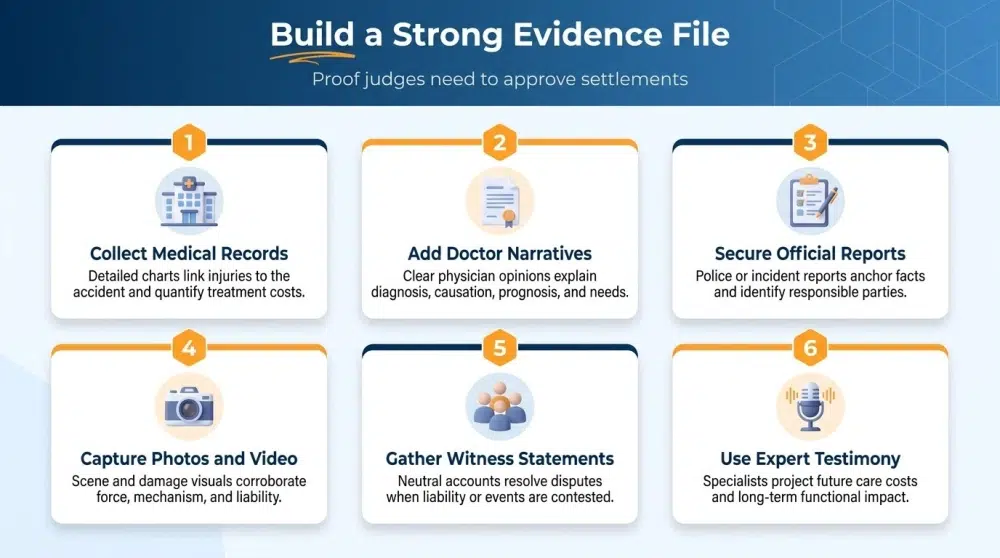
The quality of the evidence in the underlying injury case directly affects the reasonableness of any settlement and, in turn, what a court will approve. Key categories include:
- Medical records and bills. The foundation of the petition. Records must document the injury, treatment, recovery, and any residual or permanent impairment. Incomplete records make it difficult to evaluate settlement adequacy.
- Treating physician narratives. A written medical opinion explaining the diagnosis, cause, treatment, and prognosis. Courts often require this, and vague records tend to result in lower approved settlements.
- Police or incident reports. Establish the basic facts of how the injury occurred and who was involved.
- Photographs and video. Scene photographs, surveillance footage from nearby businesses, and vehicle damage photographs help establish liability and the severity of the incident.
- Witness statements. Particularly important when liability is disputed.
- School records. If the injury has affected the child’s academic performance or required accommodations, school records document that impact and may support damages for educational impairment.
- Expert testimony. In serious cases involving permanent injury, a medical expert may be needed to project future care costs and the long-term impact of the injury on the child’s life expectancy and earning capacity.
Evidence alone does not automatically prove liability or guarantee a particular recovery. Each case turns on its own facts and the applicable legal standards.
What Types of Damages May Be Recovered for an Injured Child?
California law permits injured children to recover the same categories of compensatory damages available to adult claimants, subject to the same requirements of proof. Potential categories include:
- Medical expenses. Past and future costs of treatment, including hospital bills, physician fees, physical therapy, occupational therapy, and prescription medication.
- Future medical expenses. Projected costs for ongoing care, surgery, or adaptive equipment, supported by expert medical opinion.
- Physical pain and mental anguish. Non-economic damages for the subjective experience of pain, fear, emotional distress, and loss of enjoyment of life.
- Physical impairment and disfigurement. Compensation for permanent limitations on physical function or visible scarring.
- Loss of earning capacity. In cases involving serious permanent injury, an economist or vocational expert may project how the injury affects the child’s future earning potential over a lifetime of work.
The recoverability and amount of any particular category of damages depends on the facts of the case, the applicable law, and what evidence is available. California’s Proposition 51 governs the allocation of non-economic damages among multiple defendants in certain cases, and California’s comparative fault rules can reduce a recovery if the injured party bears some share of responsibility for the incident.
Families whose child was injured in an Orange County car accident may also want to review general information about personal injury claims with the Irvine personal injury attorneys at GoSuits, who regularly assist injury victims across the county.
How Long Do Parents Have to Act?
The interplay of California’s deadlines for children’s injury claims is among the most nuanced in civil procedure. Key time considerations include:
- General personal injury claims against private parties: CCP section 352 tolls the limitations period during minority. The standard two-year period begins when the child turns 18. However, early investigation and preservation of evidence remain critical regardless of the tolled deadline.
- Claims against public entities: The tolling rule under section 352 does not apply. A government claim must generally be presented to the public entity within six months of the incident date. Miss this deadline and the claim may be permanently barred — even for a child.
- Medical provider liens: Some hospital lien and Medi-Cal reimbursement deadlines operate independently of the litigation limitations period and must be addressed before settlement funds are disbursed.
- Notice requirements for uninsured/underinsured motorist claims: Insurance policy deadlines may be shorter than the statutory limitations period and must be tracked carefully.
Because these deadlines vary by claim type and involve interaction between state statutes, government codes, and insurance contracts, families should not rely on the general tolling rule without confirming that it applies to their specific situation. Legal review of the applicable deadlines is strongly recommended.
[DEADLINE REQUIRES LEGAL VERIFICATION for any specific claim — applicable periods depend on the identity of all defendants, the nature of the incident, and any applicable insurance policy provisions.]
What Should a Family Do After a Child Is Injured?
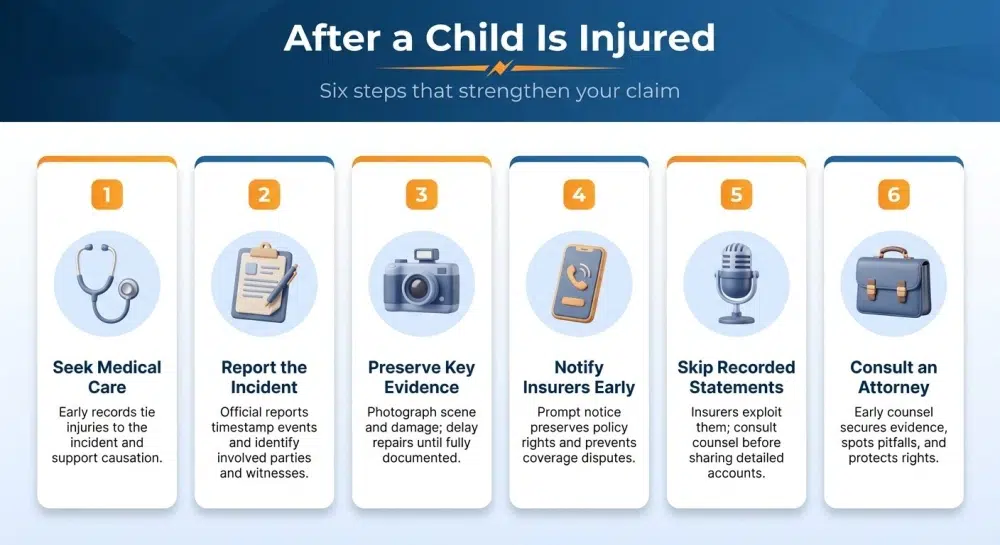
The steps that matter most in the immediate aftermath of a child’s serious injury include:
- Ensure the child receives prompt medical attention. Medical documentation begins at the first visit. Every treatment encounter creates a record that becomes part of the petition.
- Report the incident. A police report for a vehicle collision, an incident report for a premises injury, or a notice to a school or employer for a relevant incident creates an official contemporaneous record.
- Preserve evidence. Photograph the scene, the vehicle damage, and any visible injuries. Do not allow a vehicle to be repaired before it has been documented or inspected.
- Notify relevant insurance companies. Both your own insurer and the at-fault party’s insurer may need prompt notice under policy terms.
- Do not provide a recorded statement to the opposing insurer without first consulting an attorney.
- Consult a personal injury attorney promptly. Even if the limitations period is tolled, the investigation is most effective when begun early. An attorney can identify all potentially responsible parties, send preservation letters to ensure evidence is not destroyed, and evaluate whether a government claim deadline applies.
If your child was seriously injured in an accident anywhere in the Irvine area, Newport Beach, Costa Mesa, or elsewhere in Orange County, a GoSuits attorney can review the circumstances of your case, explain how the minor’s compromise process applies, and discuss your options for pursuing compensation. Schedule a free consultation with GoSuits.
Frequently Asked Questions
Can a parent settle a child’s personal injury claim without court approval?
In California, a parent has limited authority under Probate Code section 3500 to settle a minor’s claim without court involvement when the net proceeds (after fees and costs) do not exceed a certain threshold. For amounts above that threshold, or when a lawsuit has already been filed, court approval is required and the settlement is not binding without it. In practice, most significant personal injury recoveries for children go through the formal court petition process.
What happens to the settlement money until my child turns 18?
The court’s approval order specifies how the net proceeds are held. Common options are a blocked account at a bank or credit union — where withdrawals require a separate court order — and a structured annuity timed to pay out at milestones such as the child’s 18th, 21st, or 25th birthday. Parents do not have free access to the funds during the child’s minority. Limited withdrawals for documented needs like ongoing medical care may be authorized by the court on petition, but the default rule is preservation until the child turns 18. For more on how these settlements compare across age groups, the article on Orange County car accident claims provides relevant local context.
How is a child’s attorney fee different from an adult’s?
For an adult client, the contingency fee percentage is set by private contract and governs the attorney’s compensation. For a minor’s compromise, the court reviews the proposed attorney fee under Probate Code section 3601 and California Rules of Court, rule 7.955, and may approve, reduce, or modify the fee based on the factors specified in rule 7.955. The fee agreement the attorney signed with the parents is not binding on the court. Attorneys must submit a declaration supporting the fee request, and the court may reduce the fee if it finds the request excessive given the nature of the work and the result achieved.
Does the statute of limitations really pause during a child’s minority?
Yes, under Code of Civil Procedure section 352(a), the standard limitations period for a personal injury claim does not run while the injured person is under the age of majority. When the child turns 18, the applicable limitations period begins. For most personal injury claims, that is two years from the 18th birthday. There is an important exception: claims against public entities — cities, counties, school districts, government agencies — are not tolled under section 352. The Government Claims Act still requires a claim to be presented within six months of the incident, even for a child. Families should not assume the tolling rule protects all claims without verifying whether a government entity is involved.
What if a government vehicle or agency caused my child’s injury?
Claims against California public entities are governed by the Government Claims Act (Government Code sections 810 et seq.). A claimant — including a parent acting on behalf of a child — must present a government claim to the responsible public entity within six months of the date of the incident. Missing this deadline is generally fatal to the claim, even for a minor, because CCP section 352’s tolling rule expressly does not apply to claims requiring a government claim presentation. If your child was injured by a city bus, a government vehicle, or due to a dangerous condition on public property, prompt legal review of the applicable deadlines is essential. For general guidance on claims involving city and county streets in the region, see the Newport Beach SR-73 crash overview for factual context on how such incidents unfold locally.
Do medical liens have to be paid before my child’s settlement is deposited into the blocked account?
Yes. The court order approving the minor’s compromise will typically direct payment of documented medical liens and outstanding bills out of the gross settlement before the remainder is deposited into the minor’s account or used to fund a structured annuity. Hospital liens under California’s Hospital Lien Act, Medi-Cal reimbursement claims, and Medicare obligations must all be identified and addressed in the petition. Negotiating these liens down is often possible and can meaningfully increase the net recovery available to the child.
Can I access my child’s settlement funds for family living expenses?
No. Money held in a blocked account or paid under a structured annuity belongs to the child, not to the parents. A court order is required for any withdrawal during the child’s minority, and courts scrutinize withdrawal requests to ensure the purpose genuinely serves the child’s interests — for example, paying for documented ongoing medical treatment or educational needs related to the injury. General family expenses, mortgage payments, or unrelated costs do not qualify. The settlement is intended to compensate the child for the harm the child suffered and to be available when the child reaches adulthood.
Where in Orange County do minor’s compromise petitions get filed?
Most minor’s compromise petitions in Orange County are filed in the probate or civil department of the Orange County Superior Court. The primary civil courthouse is the Central Justice Center in Santa Ana, and many routine minor’s compromise hearings are conducted there. The assigned department and any specific local rules governing the petition format should be confirmed with the court or with an attorney familiar with local Orange County practice. For information about how Orange County personal injury cases unfold more broadly, the Santa Ana pedestrian incident coverage provides locally specific background on one type of case that may involve a minor’s compromise.
Talk With a GoSuits Attorney
A child’s personal injury claim involves medical documentation, insurance negotiations, lien resolution, court petitions, and strict procedural deadlines — many of which differ from the rules that apply to adult claims. If your child was injured in an accident anywhere in Orange County, including Irvine, Newport Beach, Costa Mesa, Huntington Beach, or Santa Ana, a GoSuits personal injury attorney can review the circumstances of your case and explain how the minor’s compromise process applies to your situation.
Our Irvine personal injury team handles claims arising from vehicle collisions on the I-405 and I-5, rideshare incidents, slip-and-fall injuries at commercial premises, and other accidents that injure children and adults throughout Orange County. We work with injured families on a contingency fee basis, meaning no attorney fees unless we recover for you.
This article is provided for general informational purposes only and does not constitute legal advice. The law applicable to any individual case depends on the specific facts, the jurisdiction, and the current state of applicable statutes and regulations, which may have changed since this article was written. No attorney-client relationship is created by reading this article. Please consult a licensed attorney about your specific situation before taking any legal action or relying on any information in this article.
References and Authoritative Sources
- California Probate Code § 3600 — Money or Property Paid or Delivered Pursuant to Compromise or Judgment for Minor or Disabled Person — California Legislative Information (leginfo.legislature.ca.gov)
- California Code of Civil Procedure § 352 — Tolling for Disability: Minority or Lack of Legal Capacity — California Legislative Information (leginfo.legislature.ca.gov)
- California Probate Code § 3500 — Compromise by Parent Without Court Approval — California Legislative Information (leginfo.legislature.ca.gov)
- California Probate Code § 3601 — Court Approval; Attorney Fees and Costs — California Legislative Information (leginfo.legislature.ca.gov)
- California Probate Code § 3611 — Disposition of Proceeds; Blocked Account — California Legislative Information (leginfo.legislature.ca.gov)
- California Rules of Court, Rule 7.950 — Petition for Court Approval of Compromise of Disputed Claim — California Courts (courts.ca.gov)
- California Rules of Court, Rule 7.955 — Attorney’s Fees for Services to Minor or Person With a Disability — California Courts (courts.ca.gov)
- California Government Code § 810 et seq. — Government Claims Act — California Legislative Information (leginfo.legislature.ca.gov)
- California Civil Code § 3045.1 — Hospital Lien Act — California Legislative Information (leginfo.legislature.ca.gov)
- 26 U.S.C. § 104 — Compensation for Injuries or Sickness (Tax Exclusion for Personal Physical Injury Damages) — Cornell Legal Information Institute (law.cornell.edu)