
There is no fixed dollar amount for a whiplash injury claim after a Chicago car accident. In Illinois, these claims are evaluated based on the evidence supporting the injury, including medical expenses, treatment records, lost income where documented, pain and suffering, and whether the available evidence connects the condition to the collision. Illinois does not apply a separate whiplash formula or assign a specific value based only on the diagnosis.
Many people searching this question are trying to understand whether an injury described as “whiplash” will be taken seriously during the claim process. The diagnosis is only one part of the evaluation. The medical timeline, consistency of treatment, documentation of symptoms, and evidence showing how the crash affected the person’s condition all play a role in how a claim is reviewed.
Key Takeaways:
- There is no fixed value for a whiplash claim in Illinois. The diagnosis alone does not determine what a claim may be worth.
- Evidence drives the evaluation. Medical records, treatment history, reasonable medical expenses, documented lost income, pain and suffering, functional limitations, and causation may all matter.
- Treatment history provides important context. Consistent documentation, recovery progress, provider observations, and any gaps in care can affect how the claim is evaluated.
- Minor vehicle damage does not automatically rule out an injury. Property damage may be considered as part of the causation analysis, but it is not the only evidence.
- An MRI or X-ray is not necessarily required to support a whiplash claim. Medical examinations, symptoms, provider observations, and treatment records may also provide relevant evidence.
- Medical bills and insurance payments are not necessarily treated as the same amount. Illinois collateral source principles affect how insurance discounts and medical expenses are considered.
- Liens and reimbursement claims can affect the net settlement amount, and an Illinois personal injury lawsuit generally must be filed within two years under 735 ILCS 5/13-202.

Is whiplash treated differently under Illinois law?
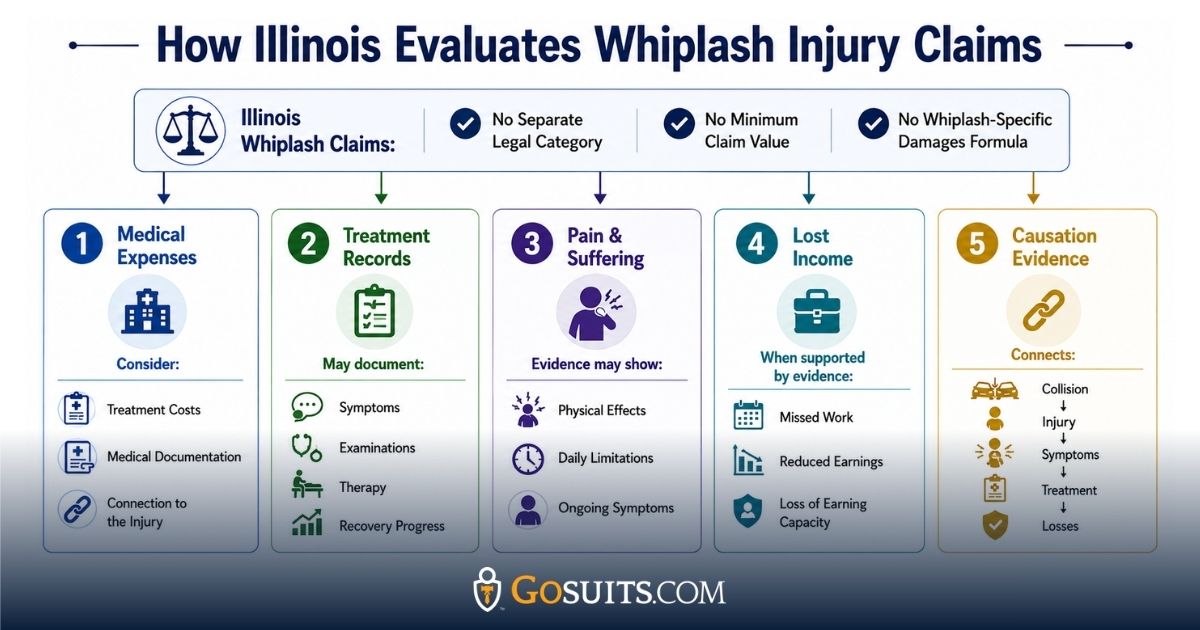
No. Illinois does not create a separate legal category, minimum value threshold, or damages formula specifically for whiplash injuries. A whiplash claim is evaluated under the same personal injury principles that apply to other crash-related injuries, with the focus placed on the evidence supporting the claimed injury and losses.
The diagnosis itself does not determine the value of a whiplash claim. Instead, the evaluation generally considers the overall claim record, including medical treatment, provider documentation, the connection between the collision and the reported symptoms, and the losses supported by the available evidence.
Factors that may affect how a whiplash claim is evaluated include:
Medical expenses: Reasonable medical expenses related to the injury may be considered as part of the damages evidence, subject to proof that the charges are reasonable and connected to the claimed injury. Illinois also applies the collateral source rule, which generally prevents defendants from reducing damages simply by showing that a collateral source, such as health insurance, paid less than the amount billed.
Treatment records: Medical notes, examinations, therapy records, and other treatment documentation may help show the timing, progression, and effects of symptoms after the collision.
Pain and suffering: Illinois recognizes pain and suffering as an element of personal injury damages when supported by the evidence. The evaluation depends on documentation of the physical effects of the injury and its impact on daily activities.
Lost income where supported: Documentation of missed work, reduced earning capacity, or other employment-related losses may be relevant when those losses are connected to the injury and supported by evidence.
Causation evidence: A claim generally requires evidence connecting the collision to the claimed symptoms and limitations. Medical records, treatment timelines, and provider opinions may all affect how that connection is evaluated.
Because whiplash does not have a separate legal formula, the important question is not simply whether the injury has that label. The more important question is what the available evidence shows about the injury, treatment, limitations, and losses connected to the crash.
What Actually Determines the Value of a Whiplash Claim?
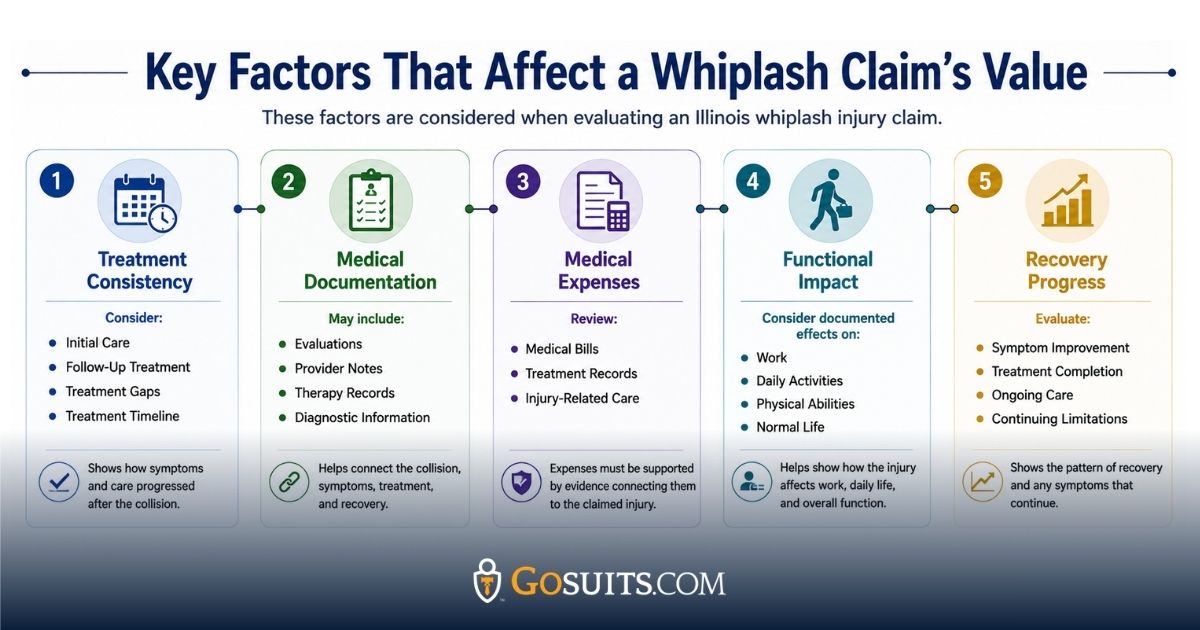
As with other Chicago car accident claims, a whiplash claim is evaluated through the available evidence, including medical records, treatment history, documented losses, and the connection between the collision and the claimed injury. Illinois does not assign a specific value based only on the diagnosis. Instead, the evaluation focuses on what the evidence shows about the injury, the treatment received, the limitations caused by the condition, and the losses supported by the claim record.
Several factors may affect how a whiplash claim is reviewed.
Treatment Consistency
The timing and progression of treatment can provide important context when evaluating a claim. A treatment record that shows the sequence from the collision to medical evaluation and follow-up care may provide more complete information about how symptoms developed and changed over time.
The evaluation may also consider whether there were gaps in treatment and whether the medical records explain those gaps. A documented treatment history may help show whether symptoms continued, improved, or changed after the collision.
Medical Documentation
Medical records are an important part of evaluating a whiplash claim. Providers may document examination findings, reported symptoms, functional limitations, treatment recommendations, and observations about the patient’s condition.
Relevant documentation may include:
- Initial medical evaluations after the collision
- Follow-up treatment notes
Physical therapy or rehabilitation records - Diagnostic information where medically appropriate
- Provider observations regarding symptoms and recovery progress
The diagnosis alone does not determine the value of the claim. The available evidence must also support the connection between the collision, the reported symptoms, the treatment provided, and the losses being claimed. Prior injuries or medical conditions may also become relevant when evaluating whether the collision caused or aggravated the symptoms documented after the crash.
Medical Expenses
Medical expenses are considered as part of the damages evidence in a personal injury claim.
Records such as itemized bills and treatment documentation may help show the medical services provided and their relationship to the claimed injury.
Illinois follows the collateral source rule, which generally prevents defendants from reducing a damages claim simply because health insurance or another outside source paid less than the amount billed. In Arthur v. Catour, 216 Ill. 2d 72 (2005), and Wills v. Foster, 229 Ill. 2d 393 (2008), the Illinois Supreme Court addressed how billed medical charges and collateral source payments are considered when evaluating damages.
This rule does not mean every billed amount automatically determines damages. Medical charges must still be supported by evidence showing that the treatment relates to the claimed injury and represents a proper element of damages.
Functional Impact
A whiplash claim evaluation may also consider how the injury affected a person’s daily activities, employment, or physical abilities when those effects are supported by evidence.
Relevant information may include:
- Documented work restrictions
- Limitations noted during medical visits
- Changes in daily activities
- Provider observations regarding physical limitations
Illinois personal injury damages may include economic losses and noneconomic damages, including pain and suffering and loss of normal life, when supported by the evidence.
Recovery Progress
The course of recovery may provide additional context when reviewing a whiplash claim.
Factors that may be considered include whether symptoms improved, whether treatment concluded, whether additional care was recommended, and whether the medical record documents continuing limitations.
A complete treatment timeline can help explain the progression of the injury from the collision through recovery or ongoing care.
The following factors commonly affect how a whiplash claim is reviewed, although no single factor determines the outcome of an individual claim.
Factors That Affect How a Whiplash Claim Is Evaluated |
|
|---|---|
| Factor | Why It Matters |
| Treatment Consistency | A clear treatment timeline may provide more complete information for evaluating the injury than unexplained gaps |
| Medical Documentation | Examination findings, treatment notes, and provider observations help establish the injury, treatment history, and reported limitations |
| Medical Expenses | Reasonable medical charges are evaluated as part of damages evidence under Illinois law, including collateral source principles |
| Functional Impact | Documented effects on work, daily activities, or physical abilities may provide context regarding the injury’s impact |
| Causation Evidence | The claim must be supported by evidence connecting the symptoms and claimed losses to the collision |
| Recovery Progress | Improvement, continued symptoms, and future treatment recommendations may affect how the claim record is evaluated |
| Property Damage Evidence | Vehicle damage may be considered as part of causation discussions but does not automatically determine whether an injury occurred |
These factors are commonly reviewed when evaluating a whiplash claim in Illinois. The importance of each factor depends on the specific facts, medical records, and available evidence.
How are medical bills evaluated in a whiplash claim?
Illinois evaluates medical expenses as part of the overall damages analysis in a personal injury claim. Medical bills, treatment records, and other documentation may be considered when determining the reasonable value of medical services related to the claimed injury.
The amount billed by a healthcare provider and the amount actually paid by an insurance company may differ because of insurance adjustments or negotiated reductions. However, Illinois generally does not allow a defendant to reduce a damages claim simply by showing that a collateral source paid less than the amount billed.
In Arthur v. Catour, 216 Ill. 2d 72 (2005), the Illinois Supreme Court explained that medical expenses must be shown to be reasonable and necessary. A paid bill can provide prima facie evidence of reasonableness, while an unpaid bill generally requires additional evidence establishing that the charges are reasonable. The court later addressed collateral-source payments in Wills v. Foster, 229 Ill. 2d 393 (2008), holding that a defendant generally may not use the discounted amount accepted from a collateral source simply to reduce the plaintiff’s claimed medical expenses.
Billed Amount vs. Amount Paid by Insurance |
||
|---|---|---|
| Category | Explanation | Authority |
| Billed Medical Charges | Provider charges may be evidence of reasonable medical expenses, subject to the required proof of reasonableness and necessity. | Arthur v. Catour |
| Insurance-Paid Amount | A discounted amount accepted from a collateral source generally cannot simply be used by the defense to reduce claimed medical expenses. | Wills v. Foster |
| Collateral Source Rule | Payments or benefits received from an independent collateral source generally do not reduce damages merely because they reduced what was actually paid. | Arthur v. Catour; Wills v. Foster |

The Illinois Supreme Court later reaffirmed the collateral source rule in Wills v. Foster, 229 Ill. 2d 393 (2008). Under that rule, evidence of payments from sources such as health insurance generally cannot be introduced simply to reduce a plaintiff’s damages claim.
For a whiplash claim, this distinction matters because billing records and medical records serve different purposes. Medical bills help document economic losses associated with treatment, while medical records help establish the injury, the course of care, and the relationship between the collision and the reported symptoms.
The collateral source rule addresses how damages evidence is evaluated. It does not create an automatic guarantee that every billed medical expense will be awarded. The overall evaluation still depends on the available evidence supporting the injury, treatment, and related losses. These same records may also be important when evaluating a settlement offer based on the documented damages in the claim.
Do insurance companies use software to value whiplash claims?
Some insurers use computerized claims-evaluation systems as one factor when reviewing injury claims. These systems may help organize claim information and evaluate certain characteristics of a claim, but they are not the only factor considered when determining how a bodily injury claim is reviewed.
Computerized evaluation tools may consider information such as:
- Claim characteristics: Information about the collision, reported injuries, and other details included in the claim file.
- Medical information: Data from medical records, injury descriptions, treatment information, and medical coding.
- Treatment history: Information regarding the type, duration, and progression of medical care.
- Claim history: Other claim-related information available to the insurer during the evaluation process.
One publicly discussed example of claims-evaluation software is Colossus, a system designed to assist with reviewing bodily injury claims. Public information does not establish that every insurer uses the same software, inputs, or evaluation methods.
Public descriptions of systems such as Colossus indicate that medical coding and information about injuries, treatment, and recovery may be among the inputs used to categorize and evaluate a claim. Because the details of these systems are largely proprietary, the specific inputs and weighting may vary by insurer and system.
Computerized tools are generally only one part of the review process. Insurers may also consider medical records, billing information, liability evidence, treatment history, and other claim documentation.
For whiplash claims, a clear record of the collision, medical treatment, symptoms, and recovery timeline provides information that may be reviewed by both claim professionals and any technology used during evaluation.
Claims-Evaluation Software Inputs |
|
|---|---|
| Input | Why It Matters |
| Diagnosis Information | Helps categorize the claimed injury |
| Treatment Information | Shows the type and course of medical care |
| Treatment Duration | Provides context regarding the treatment timeline |
| Medical Coding | Helps organize injury and treatment information |
| Gaps in Treatment | May affect how the available claim record is interpreted |
What If the Property Damage to My Car Was Minor?
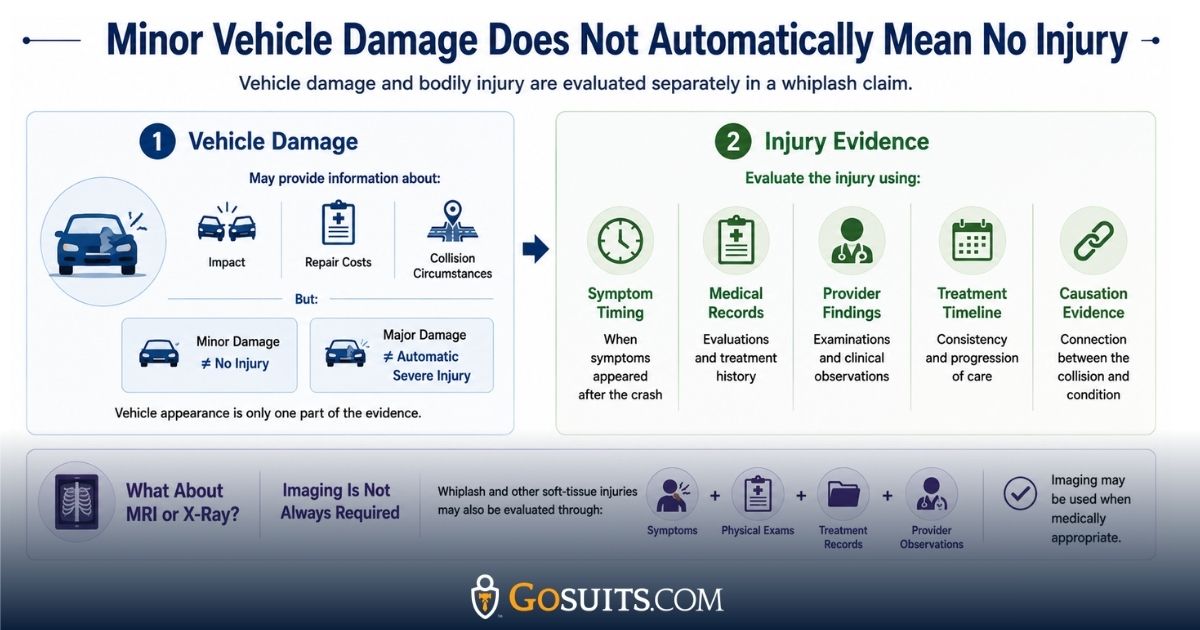
Minor vehicle damage does not automatically determine whether a person was injured, but it may become one factor considered during a causation analysis. Vehicle damage and bodily injury involve different questions. The appearance of a vehicle after a crash does not, by itself, determine whether a person experienced a compensable injury.
A low repair estimate does not create a legal rule that no injury occurred. Likewise, significant vehicle damage does not automatically establish the severity of an injury. Illinois evaluates injury claims through evidence, including medical records, treatment history, provider observations, and other facts related to the collision.
When reviewing a whiplash claim, vehicle damage may be considered as part of the overall factual record. Medical causation, however, depends on evidence connecting the collision to the claimed injury rather than on the vehicle’s appearance alone. Illinois courts generally require causation to be established through affirmative evidence rather than speculation (Allen v. Cam Girls, LLC, 2017 IL App (1st) 163340). Allen did not involve a low-property-damage collision, so this is a general causation principle rather than a specific rule governing minor vehicle damage.
Relevant evidence may include:
- The timing of symptoms after the collision
- Medical evaluations and treatment records
- Provider observations and examination findings
- The consistency of the treatment timeline
- Other evidence connecting the reported condition to the crash
The amount of vehicle damage is one fact that may be reviewed, but it does not alone determine whether an injury occurred or how a claim should be evaluated.
Do I need an MRI or X-ray to prove whiplash?
Not necessarily. A whiplash claim is not evaluated only through imaging results. Soft tissue conditions may be evaluated through symptoms, physical examinations, treatment records, and provider observations.
Imaging may be used when medically appropriate to evaluate a person’s condition, but the absence of imaging does not automatically resolve whether an injury occurred.
The overall medical record, including the timing of symptoms, treatment history, and evidence connecting the condition to the collision, is generally what supports the causation analysis.
How does pain and suffering factor into a whiplash claim?
Pain and suffering is evaluated as part of the overall damages picture in an Illinois personal injury claim rather than through a separate category or formula specifically for whiplash. The diagnosis alone does not determine the amount attributed to these damages.
Illinois Pattern Jury Instructions recognize pain and suffering experienced and reasonably certain to be experienced in the future as a compensable element of personal injury damages. In a whiplash claim, the evidence used to evaluate this element may include:
Physical discomfort: Medical records may document the nature, duration, and progression of reported pain or discomfort following the collision.
Documented limitations: Provider notes may describe restrictions or limitations associated with the injury and treatment.
Effect on daily activities: Evidence may address how the injury affected ordinary activities, when those effects are supported by the record.
Treatment history: The type, duration, and progression of treatment can provide context for evaluating the claimed pain and its course over time.
There is no fixed multiplier or whiplash-specific calculation for pain and suffering under Illinois law. Instead, the evaluation depends on the evidence presented about the nature and extent of the injury and its effects. A particular symptom, treatment duration, or diagnosis does not automatically correspond to a particular amount.
What can reduce what you actually keep from a settlement?
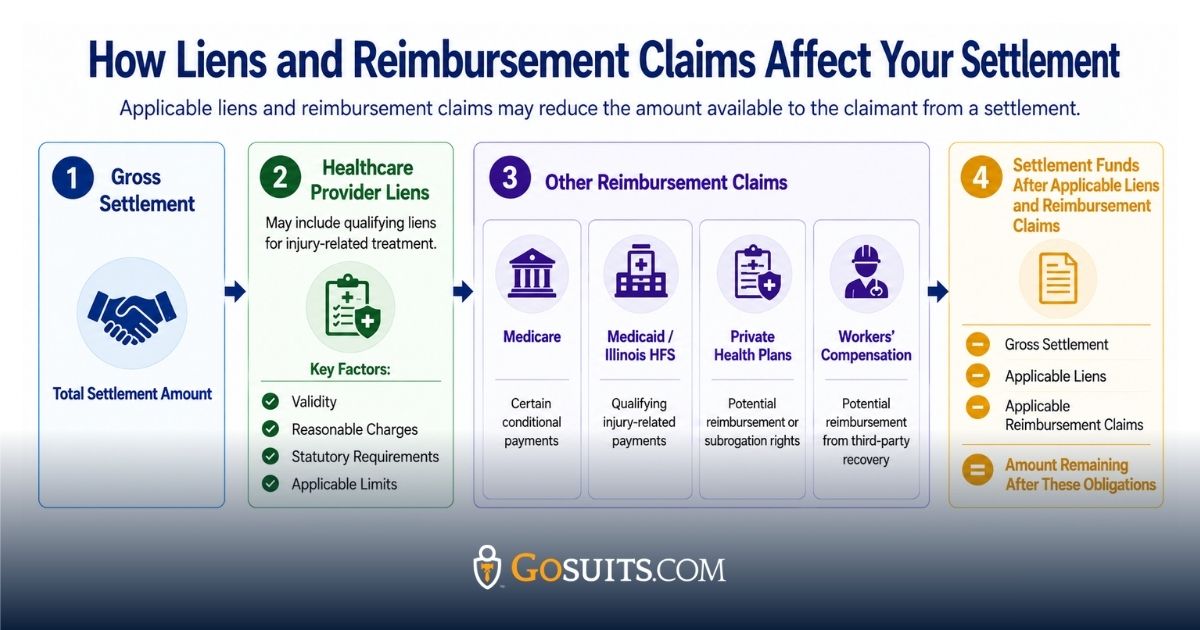
The amount remaining after a settlement may be affected by healthcare provider liens, reimbursement claims, and other obligations connected to medical treatment or benefits received. As a result, the gross settlement amount and the amount ultimately available to the claimant may be different.
Healthcare Provider Liens
Certain Illinois healthcare professionals and providers may assert liens against a personal injury recovery for reasonable charges related to treating the injury. Under the Illinois Health Care Services Lien Act (770 ILCS 23/10), qualifying liens are subject to statutory requirements and limitations, including an aggregate limit on liens governed by the Act.
Whether a particular lien is valid and how much must be paid depends on the circumstances and compliance with the applicable statutory requirements.

Other Reimbursement Claims
Other repayment or reimbursement interests may arise separately from the Health Care Services Lien Act. Depending on the benefits involved, these may include:
Medicare: Medicare may seek reimbursement for certain conditional payments related to an injury when a settlement, judgment, award, or other payment is obtained.
Medicaid and Illinois HFS: Illinois HFS may pursue recovery of Medicaid payments associated with a personal injury or casualty claim where another party is legally responsible for the medical expenses.
Private health plans: Reimbursement or subrogation rights may arise depending on the terms of the plan and applicable state or federal law.
Workers’ compensation: When workers’ compensation benefits have been paid and a responsible third party is involved, 820 ILCS 305/5(b) may create reimbursement rights that must be considered when resolving the third-party claim.
These interests may follow different statutes, plan provisions, and reimbursement procedures and are not all governed by the Illinois Health Care Services Lien Act. Because different reimbursement rules may apply, Chicago personal injury attorneys handling injury claims may need to account for applicable liens and reimbursement interests when determining the amount available for distribution after settlement.
The amount ultimately remaining from a settlement can also depend on how applicable medical liens and reimbursement claims are identified and resolved.
How long do you have to file a whiplash claim in Illinois?
A personal injury lawsuit for a whiplash injury in Illinois generally must be filed within two years of the date the injury occurred under 735 ILCS 5/13-202. This deadline applies to many personal injury actions, including claims arising from motor vehicle collisions.
Settlement discussions with an insurance company do not automatically extend the filing deadline. A claimant may continue communicating with an insurer while the limitation period is running, but negotiations alone do not preserve the right to file a lawsuit after the statutory deadline expires.
Ongoing medical treatment also does not automatically pause the limitation period. Although additional treatment may provide important evidence about the injury and recovery process, the filing deadline generally continues to run unless another legal rule changes how the period is calculated.
Because different Illinois injury filing deadlines may apply in certain situations, including claims involving minors, government entities, or other specific circumstances, the applicable limitation period depends on the facts of the claim.
Sources:
- Arthur v. Catour, 216 Ill. 2d 72 (2005)
- Illinois General Assembly — 820 ILCS 305/5, Workers’ Compensation Act
- Wills v. Foster, 229 Ill. 2d 393 (2008)
- Illinois Courts — IPI Civil No. 30.05, Pain and Suffering (official PDF)
- Illinois General Assembly — 770 ILCS 23/10
- CMS — Medicare’s Recovery Process
- Illinois HFS — Personal Injury & Casualty Recovery
- 735 ILCS 5/13-202, Code of Civil Procedure
- Illinois Courts — Allen v. Cam Girls, LLC, 2017 IL App (1st) 163340
- Nolo — How the Colossus Computer Program Estimates Accident Settlement Values
Frequently Asked Questions
How much is a whiplash injury worth in Illinois?
There is no fixed value for a whiplash injury claim in Illinois. These claims are evaluated based on the available evidence, including medical documentation, treatment history, reasonable medical expenses, lost income where supported, pain and suffering, and evidence connecting the injury to the collision.
Does Illinois have a separate whiplash settlement formula?
No. Illinois does not apply a separate settlement formula or legal category specifically for whiplash injuries. A whiplash claim is evaluated under general personal injury damages principles, with the focus on the evidence supporting the injury, losses, and connection to the crash.
Do insurance companies only pay what health insurance paid?
Not necessarily. Illinois follows the collateral source rule, which generally prevents defendants from reducing damages simply by showing that health insurance or another outside source paid less because of negotiated discounts. However, medical expenses must still be supported as reasonable damages related to the claimed injury.
Can minor car damage affect a whiplash claim?
It can become part of the causation discussion, but minor vehicle damage does not automatically determine whether an injury occurred. Illinois evaluates causation through evidence, including medical records, treatment history, and other facts related to the collision, rather than through a fixed rule based only on vehicle damage.
Do I need an MRI to prove whiplash?
Not necessarily. Whiplash and other soft tissue injuries may be evaluated through symptoms, physical examinations, medical observations, and treatment records. Imaging may be used when medically appropriate, but it is not the only type of evidence considered when reviewing an injury claim.
Does a gap in treatment affect a whiplash claim?
It can. Gaps in treatment may affect how the connection between the collision and ongoing symptoms is evaluated, depending on the circumstances and the explanation documented in the medical record. Treatment history is one factor considered along with other available evidence.
Do insurers use software to evaluate whiplash claims?
Some insurers use computerized claims-evaluation systems as one factor in reviewing injury claims. These systems may consider information such as treatment details, medical coding, and claim characteristics, but evaluation methods vary between insurers and are not the only factor involved in claim review.
How long do I have to file a whiplash claim in Illinois?
A personal injury lawsuit in Illinois generally must be filed within two years under 735 ILCS 5/13-202. Settlement discussions or ongoing treatment do not automatically extend that deadline. Different deadlines or tolling rules may apply in some circumstances, including claims involving minors, legal disabilities, or government defendants.
Can medical liens reduce my settlement?
They can affect the amount remaining after settlement. Certain healthcare provider liens, reimbursement claims, and other obligations related to medical treatment may need to be addressed before settlement funds are distributed. Different reimbursement claims may follow different legal rules depending on their source.