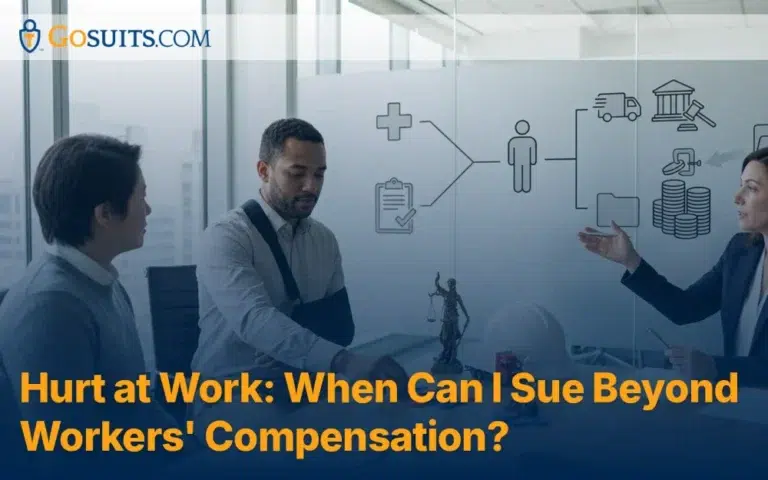
Hurt at Work: When Can I Sue Beyond Workers’ Compensation?
Workers’ compensation pays your medical bills and a portion of your lost wages when you are hurt on the job. What it does not pay is compensation for pain, suffering, emotional distress, full lost earnings, or future losses beyond what the statutory schedule allows. If a third party—someone other than your direct employer—was responsible for your injury, California law permits you to pursue a civil lawsuit for those additional damages at the same time your workers’ compensation claim is open. The two proceedings run in parallel, not in competition, but the money that flows from each is coordinated through a statutory lien and credit system that can significantly affect what you actually receive at the end of the case.
- Legal Topic: Third-party liability claims alongside workers’ compensation
- Case Stage: Pre-litigation through trial or settlement
- Primary Legal Issue: Exclusive remedy rule; Labor Code §§ 3600, 3852, 3856
- Primary Authority: California Labor Code; Witt v. Jackson, 57 Cal.2d 57 (1961)
- Jurisdiction: California (applies statewide, including Orange County)
- Date Legal Authority Last Reviewed: July 2025
What Is the Exclusive Remedy Rule?
California Labor Code section 3600 establishes the foundation of the entire workers’ compensation system. Under that statute, an employer’s liability to an injured employee is limited to the compensation benefits provided by the workers’ compensation division of the Labor Code “in lieu of any other liability whatsoever.” This means that, as a general rule, an employee injured at work cannot sue the employer in civil court for negligence, no matter how serious the injury or how careless the employer may have been.[1]
The rationale is a grand bargain: employees receive prompt medical care and wage benefits without having to prove fault, and employers receive protection from unlimited tort exposure. The tradeoff is that workers’ compensation benefits are capped and do not include compensation for pain and suffering, mental anguish, disfigurement, or full future wage losses.
Narrow Exceptions to the Exclusive Remedy Rule
Section 3600 itself points to narrow exceptions where a civil claim against the employer is permitted. Labor Code section 3602(b) allows a civil suit against the employer when the employer fraudulently conceals a work-related injury from the employee, when the employer does not carry required workers’ compensation insurance, or when a dual-capacity situation exists. Section 4558 allows a civil claim in limited circumstances involving removal of safety guards on machinery. These exceptions are fact-specific and uncommon. If none of them applies, the civil lawsuit against the employer itself is barred—full stop.
What the exclusive remedy rule does not bar is a civil claim against a party who is not the employee’s direct employer.
What California Law Says About Third-Party Claims
Labor Code section 3852 expressly preserves the injured employee’s right to pursue all available damages against any third party whose negligence caused or contributed to the injury.[2] The statute provides that a workers’ compensation claim “does not affect the claim or right of action for all damages proximately resulting from the injury or death against any person other than the employer.” The civil claim is entirely separate from the workers’ compensation proceeding. Filing for workers’ compensation does not release a third party from civil liability, and settling with a third party does not extinguish the right to workers’ compensation benefits—though settlement does trigger the employer’s lien and credit rights discussed below.
Injured workers who pursue work injury lawyers in Irvine for a third-party case often do so while simultaneously receiving workers’ compensation benefits. The two systems are designed to coexist under the California Labor Code.
Who Qualifies as a Third Party?
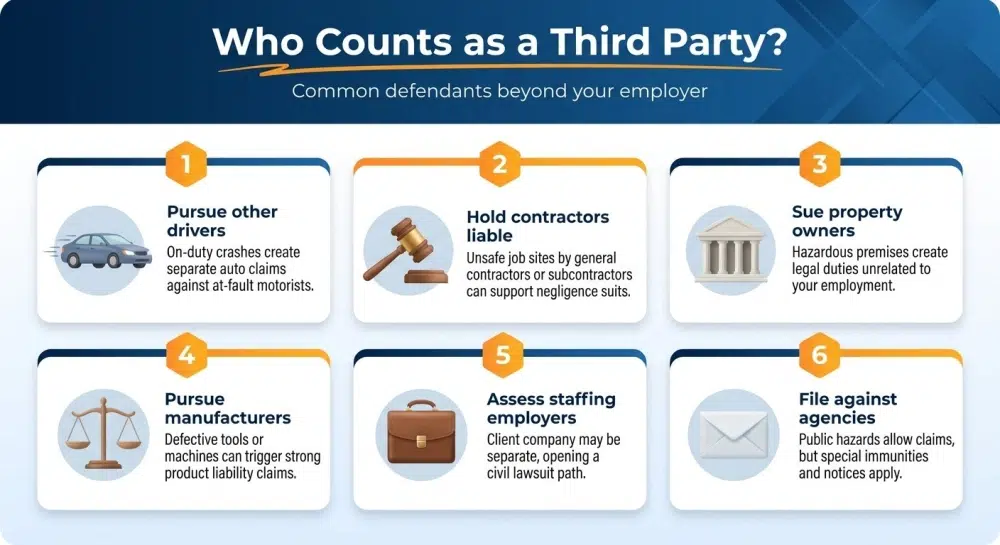
A third party is any person or entity other than the direct employer whose conduct caused or contributed to the injury. California cases have recognized a wide range of potential third parties. Common categories include:
- Another driver on the road. A delivery driver hurt in a collision on the SR-55 or the I-405 in Orange County may have workers’ compensation benefits through the employer and a separate auto liability claim against the at-fault driver.
- General contractors and subcontractors. In construction settings, a worker employed by a subcontractor may have a civil claim against the general contractor or another subcontractor whose negligence caused an unsafe condition at the job site.
- Property owners. The owner of the premises where the work is being performed may owe a duty of care independent of any employment relationship.
- Equipment manufacturers. A product liability claim may lie against the manufacturer of a defective tool, machine, or piece of protective equipment that failed and caused the injury.
- A separate employer in a staffing arrangement. Where a worker is placed through a staffing agency, the client company and the agency may have overlapping relationships. Depending on which entity is the “employer” for workers’ compensation purposes, the other may be a third party subject to a civil claim.
- Government entities. A dangerous road condition maintained by a public agency may give rise to a tort claim—though special notice requirements and immunity doctrines apply.
Illustrative Example — Not a GoSuits Case
A warehouse employee in Anaheim is struck by a forklift operated by a worker from a separate company sharing the same facility. The injured employee files for workers’ compensation through their employer and simultaneously pursues a civil personal injury claim against the other company that employed the forklift operator. The workers’ compensation claim covers immediate medical expenses and temporary disability while the civil claim seeks full damages including pain and suffering.
What Workers’ Compensation Pays—and What It Does Not
Understanding the gap between what workers’ compensation covers and what a civil judgment or settlement can provide is the central reason third-party claims matter.
| Category | Workers’ Compensation | Civil Third-Party Claim |
|---|---|---|
| Medical treatment | Yes (subject to medical provider network and utilization review) | Yes (all reasonable and necessary costs, including future care) |
| Temporary disability payments | Yes (approximately two-thirds of average weekly wage, subject to statutory cap) | Full lost earnings, without a statutory cap |
| Permanent disability | Yes (rated using AMA guidelines, subject to rating schedule and caps) | Full loss of earning capacity, unrated and uncapped |
| Pain and suffering | No | Yes |
| Mental anguish / emotional distress | No (except in limited psychiatric injury claims) | Yes |
| Disfigurement | Limited statutory supplement | Yes, as a recognized category of general damages |
| Loss of consortium (spousal claims) | No | Yes |
| Wrongful death damages for family | Death benefits (limited, formula-based) | Full wrongful death damages under Code of Civil Procedure § 377.60 |
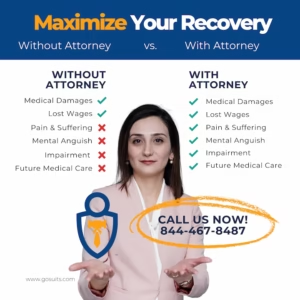
Pain and suffering is available only in the civil claim. This distinction often accounts for the largest share of total damages in a serious injury case. When a job-site accident causes severe orthopaedic injuries, a traumatic brain injury, or permanent impairment, the civil recovery can be substantially larger than anything available through the workers’ compensation system alone.
In the most serious cases involving fatalities, the wrongful death lawyers on our Irvine team can assess whether a third-party claim by surviving family members exists alongside any workers’ compensation death benefits.
How the Employer’s Lien Works
When an employer or its workers’ compensation insurer pays benefits to an injured employee and a third party is also at fault, the employer is not entitled to a windfall by the employee collecting twice. Labor Code section 3852 and section 3856 establish a lien mechanism to prevent double recovery.[2][3]
Under section 3856, if the injured employee recovers a judgment or settlement from the third party, the employer or carrier is entitled to be reimbursed from that recovery for the compensation benefits already paid. The lien encompasses medical expenses, temporary disability payments, permanent disability payments, and other benefits paid under the workers’ compensation system. The employer may intervene directly in the civil lawsuit, or the court may apportion the proceeds in a separate hearing.
Attorney Fees and the Lien Reduction
The employer’s lien is not taken from the gross recovery dollar-for-dollar. Under established California case law, the employer’s lien is reduced proportionally to account for the attorney fees and costs of suit that the employee’s attorney expended to create the fund from which the employer benefits. The rationale, developed through decisions including Quinn v. State of California, is that the employer should not receive a free ride on litigation efforts it did not finance.[4] In practice, this means the net lien that the employer or carrier actually collects from the civil recovery is less than the gross amount of benefits paid.
Illustrative Example — Not a GoSuits Case
A worker in the Newport Beach area receives $120,000 in workers’ compensation benefits after a serious fall at a construction site. The worker then settles a civil claim against the general contractor for $400,000. The employer’s gross lien is $120,000, but the attorney fees and costs in the civil case were $140,000 (35% of the $400,000 settlement). The lien is reduced proportionally: the employer collects approximately $78,000, not the full $120,000. The net recovery to the worker is the remaining balance after attorney fees, costs, and the reduced lien are paid from the $400,000 settlement.
The Witt v. Jackson Doctrine: Reducing the Employer’s Credit for the Employer’s Own Fault
One of the most important protections for injured workers in California third-party cases is the rule established by the California Supreme Court in Witt v. Jackson, 57 Cal.2d 57 (1961).[5] That decision addressed a scenario where the employer’s own negligence contributed to causing the injury alongside the third party’s negligence.
The principle from Witt is straightforward: an employer who is itself partly at fault for the injury cannot use the workers’ compensation lien to reduce the employee’s civil recovery by the full amount of the employer’s comparative fault. If a jury determines that the employer was 30% at fault and the third party was 70% at fault, the employer’s lien is reduced to reflect its share of responsibility. To permit the employer to collect a full lien in that situation would effectively allow a negligent employer to shift part of its own liability onto the third party defendant.[5]
The Witt doctrine remains influential in California construction accident cases, multi-employer work site cases, and any situation where the employer’s conduct contributed to the conditions that led to the injury. The employer’s comparative fault is typically disputed and may require expert testimony or accident reconstruction to establish at trial or in settlement negotiations.
The Credit Against Future Benefits
In addition to the lien for past payments, the employer or carrier receives a credit against the obligation to pay future workers’ compensation benefits. Once the employer’s lien has been satisfied from the civil recovery, the employer is not required to pay additional workers’ compensation benefits until the credit is exhausted. This means that if the employee’s civil recovery is large enough to fully reimburse the employer and leave a surplus, the employer will stop paying workers’ compensation benefits for a period—sometimes a long one—until future benefits again become due.
The interplay between the lien, the credit, the employer’s comparative fault reduction, and the attorney fee apportionment is one of the most technically complex aspects of California work injury law. Each element directly affects the net amount that reaches the injured worker.
Illustrative Example — Not a GoSuits Case
A truck driver based in Costa Mesa is injured when another truck runs a red light and causes a serious collision. The employer, who had failed to maintain the driver’s vehicle properly, is found 25% comparatively at fault. The third-party driver is 75% at fault. Applying the Witt v. Jackson doctrine, the employer’s lien is reduced by 25% to reflect its own negligence. The civil recovery is further reduced by attorney fees, and the employer receives a credit for future benefits. The precise numbers depend on the total damages, the amount of benefits paid, and the settlement or judgment amount—making careful calculation essential before any settlement is finalized.
What Evidence Can Matter in a Third-Party Work Injury Case
The strength of a third-party civil claim depends on the evidence available to establish liability and damages. Depending on the type of accident, relevant categories of evidence may include:
- Police reports and OSHA investigation records: Official investigations create a record of the scene, witness statements, and preliminary fault assessments.
- Photographs and video: Scene photographs, surveillance camera footage, and dashcam recordings can establish conditions at the time of the incident.
- Medical records and billing: Complete treatment records document the nature and severity of the injury and establish the medical expenses component of damages.
- Workers’ compensation records: The benefits paid by the employer’s carrier establish the lien amount and inform the credit calculation.
- Expert testimony: Accident reconstruction, vocational rehabilitation, and life care planning experts may be needed to establish causation, future medical needs, and lost earning capacity.
- Employment records: Wage records document the income the injured worker was earning and the economic impact of the injury.
- Product documentation: In equipment defect cases, design specifications, maintenance records, and recall history can be central to the claim.
- Communications and contracts: In multi-employer job site cases, contracts between the general contractor and subcontractors may define who was responsible for safety at the location where the injury occurred.
Evidence should be preserved as early as possible after an injury. Physical evidence deteriorates, surveillance footage is often overwritten within days, and witnesses’ recollections fade. Prompt action to secure and preserve evidence is critical.
What Damages May Be Available in a Third-Party Claim
The categories of damages recoverable in a California civil personal injury claim are broader than what workers’ compensation provides. Recoverable damages may include:
- Past and future medical expenses (without a cap tied to any schedule)
- Past lost wages and future loss of earning capacity
- Physical pain and suffering
- Mental anguish and emotional distress
- Physical impairment and disfigurement
- Loss of enjoyment of life
- Loss of consortium for a spouse or registered domestic partner
- In a fatality, wrongful death damages for surviving family members under Code of Civil Procedure section 377.60, including pecuniary loss, loss of companionship, and grief
Punitive damages are available in California civil cases in limited circumstances where the defendant’s conduct was oppressive, fraudulent, or malicious. In most ordinary negligence cases, punitive damages are not available. Recoverability of any damage category depends on the specific facts, applicable law, and evidence presented.
What If the Other Party Disputes Liability?
Disputes about who caused the injury are common. California applies a pure comparative fault system under Civil Code section 1714, as interpreted by the California Supreme Court. Under pure comparative fault, the injured party can recover even if found partially at fault, but the recovery is reduced proportionally to the plaintiff’s own fault percentage. There is no bar to recovery even if the plaintiff is found more than 50% at fault—unlike in some other states.
Disputed liability cases may require expert analysis, depositions of witnesses and corporate representatives, and extensive discovery before the full picture of fault becomes clear. The Orange County Superior Court—where civil cases arising in Irvine and surrounding cities including Anaheim and Santa Ana are typically filed—handles complex civil litigation regularly at the Central Justice Center in Santa Ana.
What If Insurance Is Involved?
Multiple layers of insurance may be relevant in a work injury third-party case:
- The workers’ compensation carrier pays benefits and holds the statutory lien.
- The third party’s liability insurer provides coverage for the civil claim, up to policy limits.
- If the third party is underinsured, the injured worker may have access to their own employer’s uninsured/underinsured motorist coverage in vehicle-related accidents.
- In construction cases, general contractor and subcontractor policies, additional insured endorsements, and umbrella layers may all be implicated.
Identifying all available coverage early in a case is an important step. Missing an insurance layer can leave significant compensation on the table.
How Long Do I Have to Act?
California’s statute of limitations for most personal injury civil claims is two years from the date of injury under Code of Civil Procedure section 335.1.[6] However, several factors can shorten or extend this period:
- Claims against government entities: If the third party is a public agency—such as a municipality, county, or state department—a government tort claim must be filed within six months of the date of injury under the Government Claims Act (Government Code section 945.4). Missing this deadline can bar the civil claim entirely.
- Discovery rule: In some cases where the injury or its cause was not immediately apparent, the limitations period may begin to run later.
- Death cases: Wrongful death claims generally carry a two-year limitations period running from the date of death.
- Minors: Special tolling rules apply when the injured person is a minor.
The workers’ compensation claim has its own separate deadlines. An injured worker generally must notify the employer within 30 days and file a workers’ compensation claim within one year under Labor Code section 5405. Missing workers’ compensation deadlines is a separate problem from the civil claim deadlines but both must be managed concurrently.
Because the deadlines for government entity claims are substantially shorter than the general civil limitations period, any case involving a potential government entity defendant requires prompt legal attention.
Deadlines in individual cases depend on the specific facts and applicable law. This information is a general overview, not legal advice for any specific situation. Any person with a potential claim should consult a qualified attorney promptly.
What Should I Do Next?
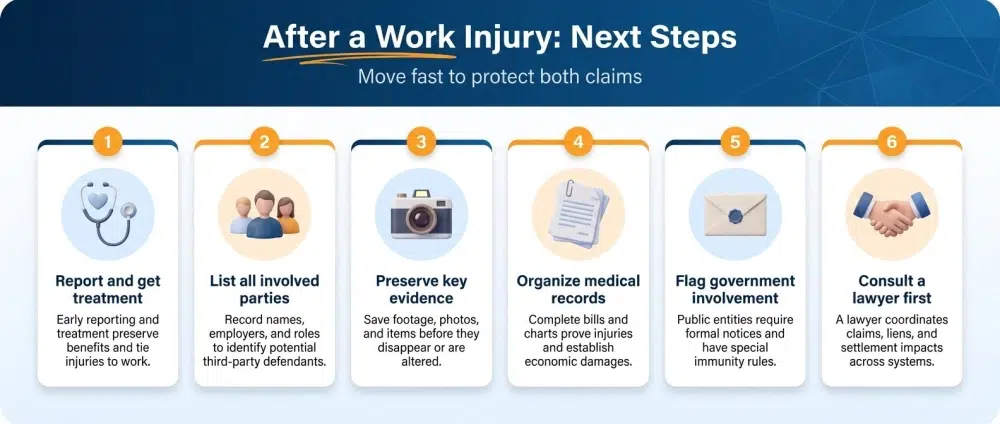
If you were injured at work and believe that someone other than your employer may have caused or contributed to your injury, several immediate steps matter:
- Report the injury to your employer and seek medical treatment. Preserving your workers’ compensation rights requires timely notice to the employer.
- Identify all parties who were present at the scene and their relationship to the worksite or the incident.
- Preserve evidence: request surveillance footage, photograph the scene, and retain any physical evidence before it is altered or discarded.
- Obtain and keep all medical records and billing statements.
- If the incident involves a government-owned location, vehicle, or equipment, note this immediately—the six-month government claim deadline may apply.
- Consult an attorney before accepting any settlement offer from the workers’ compensation carrier or any third party. A settlement can affect both proceedings and the calculation of the employer’s lien and credit.
An injury claim involving workers’ compensation and a third-party lawsuit requires tracking two proceedings simultaneously, managing the employer’s lien and credit, applying the Witt v. Jackson comparative fault reduction where applicable, and calculating the net recovery to the injured worker accurately. These are not tasks that resolve themselves favorably without careful attention to California law.
The Irvine personal injury lawyers on our team handle work injury cases involving third-party claims across Orange County and throughout California. If you were injured on the job and want to understand whether a third-party claim may exist alongside your workers’ compensation case, our Irvine work injury lawyers can review the circumstances and explain your options. For a free consultation, schedule a free consultation with our team today.
Frequently Asked Questions
Can I sue someone other than my employer after a work injury in California?
Yes. California Labor Code section 3852 expressly preserves the right to bring a civil claim against any third party whose negligence caused or contributed to a work injury, even while the workers’ compensation claim is pending. The exclusive remedy rule limits claims against the employer—it does not protect negligent third parties. For more information specific to vehicle accidents in Orange County, see our article on orange county car accident claims.
What is the exclusive remedy rule in California workers’ compensation?
Under Labor Code section 3600, workers’ compensation is the exclusive remedy against the employer for a work-related injury. The injured worker generally cannot sue the employer in civil court for negligence. Narrow exceptions exist under sections 3602(b) and 4558, covering situations such as an uninsured employer, fraudulent concealment of injury, or removal of required machine safety guards.
Who qualifies as a third party in a California work injury case?
A third party is any person or entity other than the direct employer whose negligence contributed to the injury. Common examples include other drivers on the road, general contractors, property owners, equipment manufacturers, and staffing entities that qualify as a separate employer from the workers’ compensation employer.
Can I collect workers’ compensation benefits and still sue a third party?
Yes. California law allows both claims to proceed simultaneously. Accepting workers’ compensation benefits does not waive the right to pursue a third-party civil claim. However, the employer’s workers’ compensation carrier holds a statutory lien under Labor Code section 3856 and is entitled to reimbursement from any civil recovery, reduced for attorney fees and proportionally reduced if the employer was itself partly at fault.
Is pain and suffering available in a California work injury third-party case?
Yes—but only through the civil third-party lawsuit, not through workers’ compensation. Workers’ compensation does not compensate for pain and suffering, mental anguish, or disfigurement. These damages are available only in a civil claim against the responsible third party. For background on how California courts value these damages, see our article on california uber accident settlements for a related discussion of how California civil damages are assessed in personal injury contexts.
What is the Witt v. Jackson doctrine and why does it matter?
The California Supreme Court’s 1961 decision in Witt v. Jackson, 57 Cal.2d 57, holds that an employer who is partly at fault for the injury cannot assert a full workers’ compensation lien against the employee’s civil recovery. The employer’s lien is reduced in proportion to the employer’s own comparative fault. This prevents the employer from effectively shifting its own liability costs onto the third-party defendant by collecting a full lien despite contributing to the harm.
What deadlines apply to a third-party work injury claim in California?
The general civil statute of limitations for personal injury in California is two years from the date of injury under Code of Civil Procedure section 335.1. If the third party is a government entity, a government tort claim must be filed within six months of the date of injury. The workers’ compensation claim also has its own deadlines, including a 30-day employer notice requirement and a one-year filing deadline under Labor Code section 5405. Missing any of these deadlines can permanently bar a claim.
Related California Work Injury Resources
For further reading on related legal topics, you may find these resources helpful:
- How Long Do I Have to Sue for Work-Related Injuries in California?
- Employee Rights: Workplace Injury in California
- Construction Site Injuries: A Comprehensive Guide to Your Legal Options
- Steps to Take After a Workplace Injury: A Legal Overview
Talk With a GoSuits Attorney
A work injury that involves a third party requires managing two separate legal proceedings at the same time while protecting your right to full compensation under California law. If you were injured on the job in Irvine, Anaheim, Santa Ana, or anywhere in Orange County, our Irvine personal injury and accident lawyers can review the facts of your case and explain your options—including whether a third-party civil claim may exist alongside your workers’ compensation case.
This article is for general legal information. It does not constitute legal advice and does not create an attorney-client relationship. The facts of every case are different, and outcomes depend on the specific circumstances, evidence, and applicable law. Do not rely on this information as a substitute for advice from a licensed California attorney.
References and Legal Authorities
- California Labor Code § 3600 — Conditions of Compensation Liability (Exclusive Remedy Rule) — California Legislative Information
- California Labor Code § 3852 — Employee’s Right of Action Against Third Persons; Employer’s Subrogation Rights — California Legislative Information (amended by Stats. 2025, Ch. 763, effective January 1, 2026)
- California Labor Code § 3856 — Employer Lien; Apportionment of Judgment — California Legislative Information
- Quinn v. State of California, 15 Cal.3d 162 (1975) — California Supreme Court — CourtListener
- Witt v. Jackson, 57 Cal.2d 57 (1961) — California Supreme Court — CourtListener
- California Code of Civil Procedure § 335.1 — Two-Year Limitation Period for Personal Injury — California Legislative Information
- California Labor Code § 3602 — Exceptions to the Exclusive Remedy Rule — California Legislative Information
- California Labor Code § 5405 — Statute of Limitations for Workers’ Compensation Claims — California Legislative Information
- California Government Code § 945.4 — Government Tort Claims Act; Presentation Requirement — California Legislative Information
- California Code of Civil Procedure § 377.60 — Wrongful Death Standing — California Legislative Information
This article is published for general informational purposes only. It does not constitute legal advice, does not create an attorney-client relationship, and should not be relied upon as a substitute for consultation with a licensed California attorney regarding the specific facts of your situation. Laws change, and the information above reflects law as of July 2025. Verify current legal authority before acting on any information in this article.