
A Texas personal injury claim generates more paperwork than most injured people expect. Before you reach the George L. Allen Sr. Courts Building in Dallas, and often long before any lawsuit is filed, you may be asked to sign a representation agreement, medical authorisations, a Letter of Protection, interrogatory responses, a settlement release, and a disbursement statement. Each document serves a distinct legal purpose. Some can be modified or revoked; others cannot. Understanding what you are agreeing to before you sign protects your interests at every stage of the process.
Legal Snapshot
- Legal Topic: Personal injury claim paperwork and consent documents, Texas
- Case Stage: Pre-litigation and litigation (all stages)
- Primary Legal Issue: Scope, enforceability, and revocability of signed documents in a Texas injury claim
- Primary Authority: Texas Civil Practice & Remedies Code, Chapter 16 (limitations); 45 C.F.R. § 164.524 (HIPAA access); Texas Health & Safety Code § 166.164 (medical records); Texas Rule of Civil Procedure 194 (disclosures)
- Date Legal Authority Last Reviewed: July 2025
- Jurisdiction: Texas (state law); federal HIPAA where applicable
The Representation Agreement
The first document most clients sign is a representation agreement, sometimes called a contingency fee contract. This contract establishes the attorney-client relationship, describes the scope of work the law firm will perform, and sets out the contingency fee percentage the attorney will collect if the case resolves in your favour.
Here’s the baseline. In Texas, a contingency fee agreement for a personal injury case has to be written down. Not a handshake, not a verbal okay. [1] The contract should lay out the fee percentage at different points in the case, and there’s almost always a lower number for pre-litigation and a bigger one if it goes to trial. It also needs to cover expenses, like filing fees, expert costs, chasing down medical records, and whether they come off the top or get deducted after the attorney fee. Which, by the way, can change your net recovery by thousands.
Can you undo it? Yes and no. Texas lets a client discharge an attorney at any point, for any reason or no reason at all. That part’s your right. The catch is that firing them doesn’t erase what you owe for work they’ve already done. Depending on when you pull the plug, the attorney might get paid under quantum meruit, which is basically the fair value of what they did up to that point, or they could be entitled to the full contingency fee if the discharge happens after a settlement is on the table. [2] My advice, read the termination and fee-on-discharge clauses before you sign. They’re usually buried near the back.
What to look for before signing:
- The exact percentage fee at each stage of the case
- Whether expenses come out before or after the attorney fee
- The scope of cases covered (some contracts cover only the immediate accident; others cover all related claims)
- How disputes between the client and the attorney will be resolved
- The rules governing what happens if you choose a different attorney mid-case
Medical Authorisations: Narrow vs. Blanket HIPAA Releases
Shortly after signing a representation agreement, and sometimes before one exists, you will encounter medical authorisations. These documents allow a specified person or entity to obtain records that would otherwise be protected under the Health Insurance Portability and Accountability Act (HIPAA).[3] The scope of what you authorise varies significantly depending on the language of the form.
Narrow Medical Authorisations
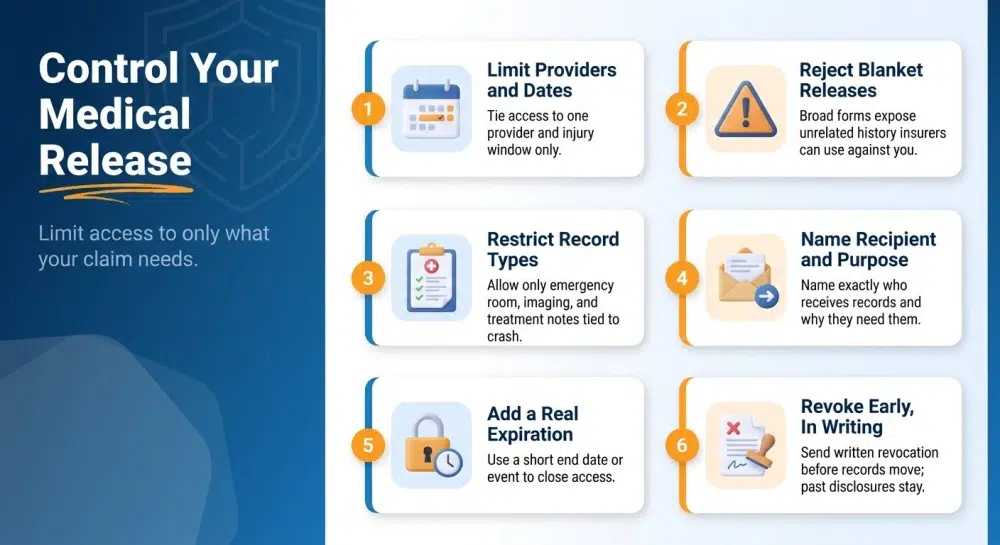
A narrow authorisation limits disclosure to a specific provider, a specific time period, and a specific category of records. For example, a narrow release might permit the requesting party to obtain only emergency room records from Parkland Memorial Hospital in Dallas for the three months following a collision on I-35E. This scope ensures that only injury-related records enter the claim.
Blanket HIPAA Releases
A blanket release authorises disclosure of all medical records from any provider over an extended period, sometimes your entire medical history. Insurance adjusters often present blanket releases immediately after an accident. Signing a broad release can expose records unrelated to your injury, including treatment for conditions that predate the accident. Those records can then be used to argue that your current complaints stem from a pre-existing condition rather than the accident.
Under 45 C.F.R. § 164.524, individuals have a right to inspect and obtain copies of their own protected health information.[4] You have the right to limit what you authorise others to access. A valid HIPAA authorisation must state what information will be disclosed, to whom, for what purpose, and include an expiration date or event.[5]
Can it be undone? HIPAA authorisations can generally be revoked at any time by providing written notice to the entity holding the records.[5] However, revocation does not undo disclosures already made. Once records have been produced, they remain in the recipient’s possession. Timing matters: revoking a broadly-worded authorisation after an insurer has already collected your records provides limited practical relief.
Practical note: In litigation, medical records become subject to formal discovery rules regardless of what authorisations you have signed. Even so, the scope of records exchanged before litigation is largely controlled by the authorisations you agree to.
Example: Suppose a driver is rear-ended in stop-and-go traffic on the Dallas North Tollway and treated for a neck injury. The at-fault driver’s insurer contacts the injured driver within days and presents a broadly worded medical authorisation. The injured driver signs without reading it carefully. The insurer then obtains records revealing a prior neck surgery from five years earlier. The insurer subsequently attributes the current neck injury to that pre-existing condition. A narrower, properly scoped authorisation could have prevented this outcome, at least at the pre-litigation stage.
Note: This is a hypothetical example for educational purposes. It does not represent any actual case or client.
The Letter of Protection
If you have been injured and do not have health insurance or your insurer will not cover accident-related care, a healthcare provider may agree to treat you in exchange for a Letter of Protection (LOP). This document is a contract between you and your attorney that instructs medical providers to be paid from the proceeds of any settlement or judgment, rather than billing you directly as treatment proceeds.
What an LOP does: The provider agrees to defer collection of their bill until the case resolves. In exchange, the LOP typically grants the provider the right to be paid from the first proceeds of a settlement, creating what functions as a medical lien.[6]
What an LOP does not do: An LOP is not a guarantee that the provider will collect. If the case resolves for less than the total amount of medical bills, or if no recovery is made at all, the patient may still owe the balance. The LOP typically creates a personal obligation to the provider that survives a failed or reduced recovery. Read the LOP language carefully to understand your exposure if the case does not resolve favourably.
Can it be undone? An LOP is a contract. Like any contract, it cannot simply be walked back by one party after the other party has performed (i.e., after the provider has rendered treatment). Disputes about LOP balances are resolved through negotiation between the attorney and the provider. Texas law provides mechanisms to negotiate and sometimes reduce medical lien balances, but this is a negotiation, not an automatic right to a lower bill.
For injured people in Dallas who need immediate care following an accident on I-35E, the LBJ Freeway, or other high-traffic corridors, Letters of Protection are a common pathway to receiving treatment. Understanding the financial obligations they create is important before signing.
Interrogatories and Disclosure Responses
Once a lawsuit is filed in a Texas district court, written discovery begins. Two of the most common discovery tools are interrogatories and requests for disclosure. Your responses to both carry legal weight.
Interrogatories
Interrogatories are written questions submitted by one party to another, answered in writing under oath.[7] In a Texas personal injury case, the defendant might ask you to describe how the accident occurred, identify any witnesses, list all healthcare providers who have treated you, identify your employers and income history, and describe each injury you claim resulted from the accident.
Your interrogatory responses become part of the official case record. Inconsistent responses, or responses that later prove incomplete, can be used to impeach your credibility at trial or during a deposition. Before you sign and verify interrogatory answers, review them carefully and confirm that every factual statement is accurate to the best of your knowledge.
Disclosures Under Texas Rule of Civil Procedure 194
Texas Rule of Civil Procedure 194 requires parties to automatically disclose core information about their claims and defences without waiting for a formal discovery request.[8] This includes identification of parties, witnesses, legal theories, and damage calculations. Responses to mandatory disclosure requests are verified and treated as part of the evidentiary record.
Can they be undone? Interrogatory and disclosure responses can be amended or supplemented as new information becomes available, but you are required to do so promptly when you learn that a prior response was incomplete or incorrect.[8] Failure to supplement can result in the exclusion of evidence at trial. Deliberately false responses made under oath carry serious legal consequences.
The Settlement Release
The settlement release is the most consequential document in a personal injury claim. When you sign a release and accept a settlement payment, you generally give up all future claims against the released party arising from the incident described in the release.
What a release does: A release extinguishes the legal claim. Once signed and the settlement check has cleared, you typically cannot return to court for additional compensation, even if your injuries turn out to be more severe than originally understood, or if you later incur medical expenses you did not anticipate.
Scope matters enormously: A broadly written release might cover not only the named defendant but also affiliated entities, insurers, employees, agents, and successors. Some releases attempt to cover future injuries or claims that have not yet manifested. Before signing, the release language should be reviewed to confirm exactly which parties and which claims are being released.
Can it be undone? In Texas, a release is a binding contract and can be set aside only on the same grounds that void any contract: fraud, duress, mutual mistake, or lack of legal capacity at the time of signing.[9] Courts do not set aside releases simply because a party later regrets signing or because subsequent medical developments revealed greater harm than the parties anticipated at the time. This is one reason why waiting until you have reached maximum medical improvement before settling is often advisable it allows for a more complete picture of the long-term consequences of your injuries.
Personal injury lawyers who handle injury claims in Texas generally advise clients to review the exact release language before accepting any settlement. The difference between a release of “this claim” and a release of “all claims, known and unknown, arising from any event,” can be legally significant.
Here’s a scenario. A driver gets caught in a multi-vehicle pile-up on US-75 near Plano, up by Central Expressway. She settles with the at-fault driver’s insurer, signs the release, and in her head the deal only covers that one driver. Months pass. Then she finds out a defective part in her own vehicle actually made her injuries worse, and she wants to bring a product liability claim against the manufacturer. Here’s where the release language matters. If it was written broadly, something like releasing all persons and entities in any way related to the crash, that product claim might be dead on arrival. A tighter, more carefully scoped release probably would’ve kept the door open.
Note: This is a hypothetical example for educational purposes only.
The Disbursement Statement
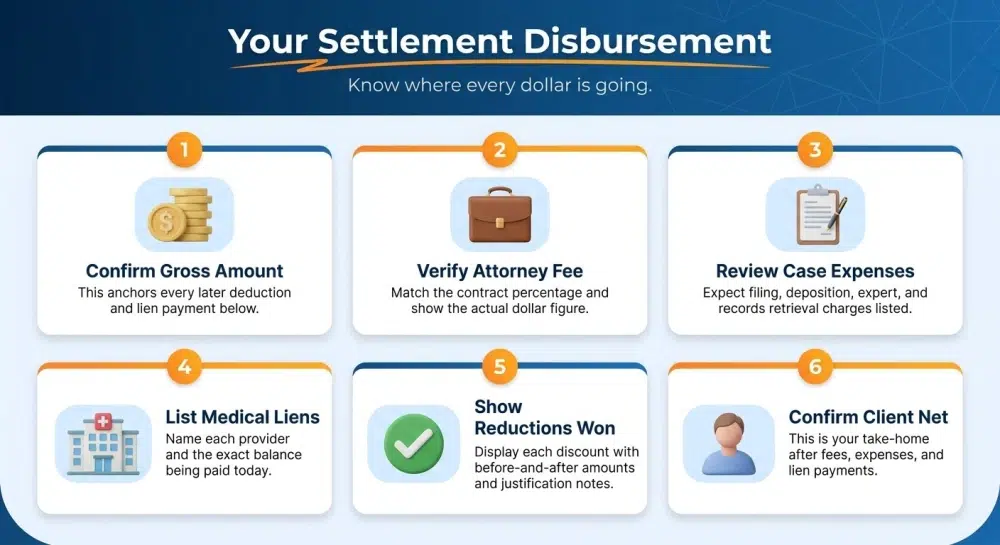
After a settlement is reached and the release is signed, the attorney prepares a disbursement statement, sometimes called a settlement statement or closing statement. This document itemises how the total settlement proceeds will be distributed: the attorney fee, case expenses, payment of any outstanding medical liens or Letters of Protection, and the net amount going to you, the client.
You can find a detailed explanation of how disbursement works in the GoSuits knowledge-base article on net settlement disbursement order in Texas, which walks through how lien payments and attorney fees are ordered against the gross recovery.
What the disbursement statement should show:
- Total gross settlement amount
- Attorney fee (stated as a dollar amount and the percentage basis)
- Itemised case expenses (court filing fees, deposition costs, expert fees, medical record retrieval, etc.)
- Each medical lien or LOP balance being paid, identified by provider and amount
- Any negotiated reductions of lien balances
- Net amount to be distributed to the client
Can it be undone? The disbursement statement reflects amounts that are, in most cases, already contractually committed. Once the release is signed and funds are received, the disbursement follows the terms of the representation agreement and any existing lien obligations. If you believe the statement contains an error: for example, a lien amount that was supposed to have been negotiated down but was not raise the concern before authorising distribution. After the funds are disbursed to the various payees, recovering overpaid amounts is difficult.
Texas law generally requires attorneys to provide clients with a complete accounting of settlement proceeds.[10] If you have questions about any line item on the disbursement statement, you have the right to ask for an explanation before signing off.

A Quick Reference: Texas Injury Claim Documents at a Glance
| Document | What It Does | Can It Be Undone? |
|---|---|---|
| Representation Agreement | Creates attorney-client relationship; sets fee | Yes, but attorney may be owed quantum meruit or full fee |
| Narrow HIPAA Release | Authorises limited, targeted records disclosure | Revocable in writing; records already disclosed remain with recipient |
| Blanket HIPAA Release | Authorises broad medical history disclosure | Revocable, but prior disclosures cannot be retrieved |
| Letter of Protection | Defers medical billing until case resolves; creates lien | No; provider has delivered treatment and retains lien rights |
| Interrogatory Responses | Sworn factual answers in litigation | Can be supplemented/amended; deliberate false answers carry consequences |
| Disclosure Responses | Mandatory production of key claim information | Can be supplemented; failure to supplement may exclude evidence |
| Settlement Release | Extinguishes claims in exchange for payment | Extremely difficult; requires fraud, duress, or mutual mistake |
| Disbursement Statement | Allocates settlement proceeds among all payees | Question errors before signing; recovery after disbursement is difficult |
Deadlines That Affect These Documents
The Texas statute of limitations for most personal injury claims is two years from the date of the incident.[11] This deadline applies whether or not any of the above documents have been signed. Signing a representation agreement does not stop the clock; neither does signing a medical authorisation or negotiating with an insurer.
The practical takeaway is this. When negotiations drag and the two-year statute of limitations is closing in, a lawsuit has to be filed, full stop, no matter what stage the settlement talks or paperwork are at. And some claims come with much shorter clocks. Claims against a Texas governmental entity, in particular. [12] So if your injury involves a government vehicle, a road defect that a public entity is supposed to be maintaining, or an accident inside a public facility, those shorter notice deadlines need attention right away. Probably sooner than you think.

Related Texas Personal Injury Resources
- The Personal Injury Claims Process in Texas Courts
- Reducing Medical Liens and LOPs in Texas
- Contingency Fees and Case Expenses in Texas
- Statute of Limitations for Personal Injury in Texas
- Settling Before Maximum Medical Improvement in Texas
Talk With a GoSuits Attorney
An injury claim involves medical evidence, insurance negotiations, legal deadlines, and a series of documents that carry lasting consequences. If you were injured in a Dallas accident and have questions about any of the paperwork you have been asked to sign, a GoSuits personal injury lawyer in Dallas can review the documents, explain what each one means for your case, and help you make informed decisions. Understanding the paperwork before you sign it is one of the most important steps you can take to protect your rights.
Personal injury lawyers who handle injury claims in Texas throughout the Dallas area are available to discuss your situation. Schedule a free consultation to learn how a GoSuits attorney can help.
If you have been injured and want to understand your options with a member of our Dallas personal injury team, visit our Dallas personal injury and accident lawyers page.
References and Legal Authority
- Texas Government Code § 82.065 – Contingent Fee Contracts – Texas Constitution and Statutes
- Texas Government Code Chapter 82 – Attorney Regulation – Texas Constitution and Statutes
- HIPAA Privacy Rule Overview – U.S. Department of Health & Human Services
- 45 CFR § 164.524 – Access of Individuals to Protected Health Information – Cornell LII
- 45 CFR § 164.508 – Uses and Disclosures for Which an Authorisation Is Required – Cornell LII
- Texas Civil Practice & Remedies Code Chapter 55 – Hospital and Medical Liens – Texas Constitution and Statutes
- Texas Rules of Civil Procedure Rule 197 – Interrogatories to Parties – Texas Courts
- Texas Rules of Civil Procedure Rule 194 – Requests for Disclosure – Texas Courts
- Texas Business & Commerce Code Chapter 2 – Contract Law Principles; Restatement (Second) of Contracts § 152 (mutual mistake) – Texas Constitution and Statutes
- Texas Disciplinary Rules of Professional Conduct, Rule 1.14 – Safekeeping Property (accounting obligation) – State Bar of Texas
- Texas Civil Practice & Remedies Code § 16.003 – Two-Year Limitations Period – Texas Constitution and Statutes
- Texas Civil Practice & Remedies Code § 101.101 – Notice of Claim Against Governmental Entity – Texas Constitution and Statutes