Sign the release too early and you’re stuck with whatever number you accepted, full stop. Doesn’t matter if the injury turns out to be way worse than anyone thought at the time. Texas treats a properly executed release of all claims as final, and there’s basically no do-over just because your condition got worse or a surgery you didn’t anticipate suddenly landed on the table. I think that’s what trips most people up. They don’t realize that understanding what MMI actually is, what the release language covers, and why insurers push early offers so hard, is honestly the whole ballgame.
Legal Snapshot
- Legal Topic: Settlement Releases, Maximum Medical Improvement, Future Damages
- Case Stage: Pre-litigation / Settlement Negotiation
- Primary Legal Issue: Finality of signed release; recoverability of future medical costs
- Primary Authority: Texas Civil Practice & Remedies Code § 16.003; Texas common law on contracts and releases
- Date Legal Authority Last Reviewed: July 2025
What Is Maximum Medical Improvement?
MMI. That’s the shorthand doctors and lawyers use. Maximum medical improvement basically means your body has healed as much as it’s realistically going to, or that any more active treatment probably isn’t going to move the needle much. It doesn’t mean you feel great. It doesn’t even mean the pain is gone. It just means the recovery curve has flattened out. Once a doctor hits that point, they can actually start answering the questions that matter for a claim, things like whether you’ve got a permanent impairment, what kind of maintenance care you’re going to need going forward, and whether surgeries or additional therapies are probably in your future. [1]
Legally speaking, MMI is when the medical picture is finally clear enough that somebody can actually put a defensible number on all the future costs tied to the injury. Before that? Everything’s kind of a guess. If you’re still in active treatment, you genuinely don’t know yet how much more physical therapy you’re going to need, whether a second surgery is going to become necessary, or whether you’re going to be walking around with a permanent limitation for the rest of your working life. Settling in that window means settling on a claim whose actual value is, honestly, still up in the air.
What Texas Law Says About Settlement Releases
Texas law treats a signed release of all claims as a contract. Courts generally enforce those contracts as written. The Texas Supreme Court has long recognized that parties are entitled to negotiate full and final settlements, and that enforcement of such agreements is critical to the finality of civil disputes.[2]
The language is the whole game. A release that reads “any and all claims, known or unknown, arising out of or related to the incident” is doing something specific. It’s killing off claims you don’t even know exist yet. If it’s broadly worded to sweep in future damages from the same event, you cannot come back later, months or years down the line, and ask for compensation because a condition developed or got worse after you signed. Even if you had no realistic way to know about it at the time. That’s just how the courts read the words. [3]
Texas does recognize narrow defenses to the enforcement of a release, including fraud, duress, mutual mistake, or lack of capacity. But these defenses are not easily established. Courts apply them sparingly. The argument that “I didn’t understand how bad my injuries were” is not, by itself, a basis to set aside a release under Texas law.
What a Release Actually Signs Away
A personal injury release in Texas is not simply a receipt for the settlement payment. It is a legal instrument that, when signed, surrenders claims that have already arisen and claims that may arise in the future from the same incident. A typical release will identify the parties, describe the incident, state the consideration being paid, and contain language releasing the settling party from all liability connected to the described event.
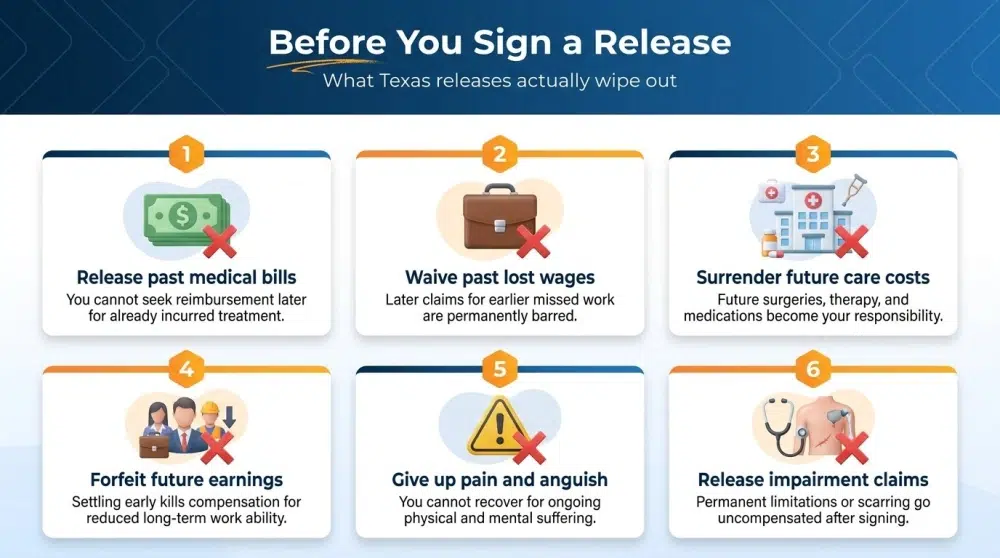
Specifically, a release can extinguish the right to recover for:
- Past medical bills already incurred through the date of signing
- Future medical expenses that have not yet occurred
- Lost wages already suffered
- Loss of future earning capacity
- Physical pain already experienced
- Physical pain likely to be experienced in the future
- Mental anguish, past and future
- Physical impairment and disfigurement
- Any other damages arising from the same incident
The breadth of what a release covers is governed by its specific language. Before signing, that language should be read carefully and, ideally, reviewed by a licensed Texas attorney who can explain what rights are being permanently surrendered.
How Future Medical Costs Are Estimated After MMI
Once a treating physician declares MMI, the evaluation of future medical costs can begin in earnest. Several methods are commonly used in personal injury claims:
Life care planning. A credentialed life care planner, often a registered nurse or rehabilitation specialist, reviews medical records and consults with treating physicians to construct a detailed, itemized plan for all anticipated future medical needs. The plan covers future surgeries, medication costs, physician visits, physical therapy, durable medical equipment, and modifications to the home or vehicle if needed. Life care plans are supported by current cost data and adjusted for inflation and geographic pricing.
Testimony from treating physicians. A treating physician who has followed the patient to MMI can offer opinion testimony about the reasonable probability that future treatment will be needed and the anticipated nature of that treatment. Texas courts permit treating physicians to testify about future medical needs and the costs associated with them, subject to evidentiary standards.[4]
Economic expert analysis. When significant future lost earning capacity is at issue, an economist or vocational rehabilitation expert can quantify how the injury affects a person’s ability to work and earn income over time. These calculations account for the person’s age, education, work history, pre-injury earning trajectory, and the nature of any permanent functional limitations.
None of these assessments can be completed with any confidence while treatment is ongoing and the endpoint of recovery is still unknown. That is precisely why settling before MMI creates significant risk for the injured person.
A Dallas County driver is rear-ended at a stop on the LBJ Freeway during evening rush hour. She treats for a cervical strain and receives an offer of $15,000 while she is still in physical therapy three months after the crash. She accepts, signs a release of all claims, and receives payment. Six months later, her neurologist determines she needs a cervical disc replacement surgery costing over $90,000, directly related to the impact. Because she signed a release of all future claims arising from that incident, she has no remaining legal avenue to recover those surgical costs from the at-fault driver or their insurer. The settlement was final.
This example is hypothetical and does not represent an actual GoSuits case or any specific outcome.
Why Insurers Send Early Offers While Treatment Is Still Underway
Insurers understand the financial pressures that injured people face. Medical bills accumulate quickly. Property damage may go unrepaired. Lost wages create immediate hardship. An injured person navigating the weeks after a serious crash on a Dallas highway or anywhere in North Texas is often in a position where money feels urgently needed.
Early settlement offers take advantage of that vulnerability. When an adjuster contacts an injured person early in the treatment process, the insurer knows several things that the injured person may not:
- The full extent of the injury has not yet been established
- Future medical costs have not been calculated
- A signed release will extinguish all future claims from the incident
- Once the release is signed, the exposure is capped at the settlement amount
From the insurer’s perspective, settling quickly and cheaply is sound business strategy. From the injured person’s perspective, it can mean accepting a fraction of the actual value of the claim before that value is even determinable.
There is no obligation under Texas law to accept any settlement offer, at any stage, and no penalty for waiting until treatment is complete. If the statute of limitations deadline is approaching, personal injury lawyers can take steps to preserve the claim, including filing suit, while medical treatment continues. The two-year period under Texas Civil Practice & Remedies Code § 16.003 applies to most personal injury claims, but the specific deadline in any given case depends on the date of the incident and the parties involved.[5]
Pressure tactics to recognize: Common insurer pressure tactics include telling an injured person that the “offer is only good for a short time,” suggesting that the claim is not worth more than the offer, or requesting that the injured person give a recorded statement without legal representation. None of these create a legal obligation to settle. Speaking with an attorney before providing any statement or signing any document is generally advisable.
How This Applies to a Real Injury Case
A Plano resident is injured when a distracted driver runs a red light on US-75 (Central Expressway) and strikes his vehicle. He sustains a herniated disc in his lumbar spine. While he is still attending twice-weekly physical therapy sessions, his insurer sends an offer accompanied by a full release of all claims. The offer covers his emergency room visit and a few weeks of therapy. His treating physician has not yet declared MMI and has not yet determined whether the herniation will require a microdiscectomy or whether conservative treatment will prove sufficient. If he signs, he releases the at-fault driver from liability for any surgery that later becomes necessary, any future therapy beyond what has already occurred, and any permanent impairment rating his physician might assign at MMI. Waiting until his physician declares MMI and evaluating the full picture gives his claim a foundation it does not yet have.
This example is hypothetical and does not represent an actual GoSuits case or any specific outcome.
Injured people who have personal injury lawyers involved early are generally better positioned because car accident lawyers can preserve evidence, respond to insurer communications, and ensure that no documents are signed that permanently close a claim before its value is established. Working with the Dallas personal injury team at GoSuits means having someone who understands the timeline pressures and can help navigate them without sacrificing the claim.

What Evidence Can Matter When Evaluating Future Damages
The strength of a future damages claim depends heavily on the quality and completeness of the medical record. Evidence that supports future medical need typically includes:
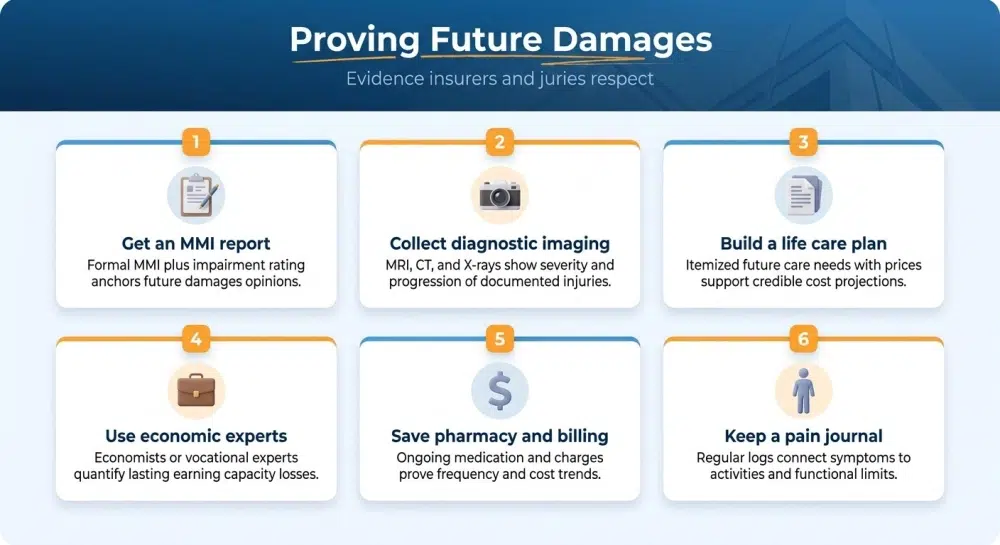
- Treating physician records and MMI determination: The formal declaration of MMI by the treating physician, including any impairment rating, forms the clinical foundation of any future damages argument.
- Diagnostic imaging: MRI, CT, and X-ray studies that document the nature and severity of the injury at various stages of treatment.
- Surgical records and operative notes: If surgery has already occurred, these documents support future claims for post-operative care and potential revision procedures.
- Life care plan: A credentialed life care planner’s written plan, supported by physician consultation and current cost data.
- Vocational and economic expert reports: Documents quantifying the impact on earning capacity.
- Pharmacy and billing records: Establishing the ongoing cost and frequency of medications already being used to manage injury-related symptoms.
- Pain journals and daily activity logs: Personal records kept by the injured person documenting how the injury affects daily function, which can support non-economic damage claims.
None of these evidentiary elements can be fully assembled while treatment is still active. They belong to the MMI phase of the case, not the early settlement phase.
What Damages May Be at Stake
Texas law recognizes multiple categories of recoverable damages in a personal injury case, subject to proof that the damages were caused by the defendant’s negligence and that recovery is reasonably probable. Categories that can be lost or undervalued by premature settlement include:
| Damage Category | Why Settling Too Early Creates Risk |
|---|---|
| Future medical expenses | Cannot be accurately projected before MMI; unknown surgeries, therapies, and medications may not be reflected in an early offer. |
| Physical impairment | Permanent impairment rating is only assigned at or after MMI; premature settlement forecloses recovery for impairment not yet identified. |
| Loss of future earning capacity | Functional limitations that affect long-term work ability can only be quantified once the permanent nature of the injury is established. |
| Future pain and mental anguish | Non-economic damages for ongoing suffering cannot be evaluated if the endpoint and severity of the injury are unknown at settlement. |
| Disfigurement | Whether scarring or other permanent disfigurement remains after healing is unknown during active treatment. |
Texas Civil Practice & Remedies Code Chapter 41 sets standards governing certain damage categories including exemplary damages, but there are no statutory caps on compensatory damages in most Texas personal injury cases.[6] Waiting until the damages are properly established gives a claim the evidentiary foundation it needs for an accurate and fair valuation.
What If the Insurance Company Disputes Liability?
Timing gets even messier when the other side’s insurer is fighting on liability. Because now there’s a whole different kind of pressure. If the at-fault driver’s insurer is signaling they might deny responsibility entirely, an injured person can start feeling like they should grab whatever’s on the table before the offer gets pulled. That pressure is real, and honestly, it’s understandable. But it doesn’t change the underlying math. Taking a lowball number for a serious injury can leave you sitting on big medical bills a year from now with no legal card left to play. That trade-off is worth thinking about hard before signing anything.
Texas uses what’s called modified comparative fault, which lives in Texas Civil Practice & Remedies Code § 33.001. The short version: if the jury pegs you at 51 percent or more at fault, you lose. You get nothing. Anything under that threshold, your recovery just gets trimmed by whatever percentage of fault they assign you. [7] Which is why liability disputes actually need to get worked through carefully as part of evaluating the claim. Not weaponized. Not used to squeeze you into an early, cheap settlement before anyone’s really looked at the evidence.
How Long Do I Have to Act in Texas?
Two years. That’s the general rule in Texas for filing a personal injury claim, running from the date the cause of action accrued, which is usually just the day the injury actually happened. It’s laid out in Texas Civil Practice & Remedies Code § 16.003. [5] And here’s the harsh part. If you miss it, the claim’s basically dead. Doesn’t matter how bad the injury is. Doesn’t matter how obvious the other side’s fault. Miss the window and, in almost every case, you’re out.
The two-year rule isn’t quite as clean as it sounds. A handful of things can shift when the clock starts running or whether the deadline gets tolled at all. Government entity involved? That’s separate notice requirements, and those come due way before two years. Injured person is a minor? The age question changes things. Latent injury that wasn’t discoverable right away? That’s its own analysis. These questions get answered case by case, based on the specific facts, and they’re not the kind of thing you want to guess at. If you’re at all unsure about your deadline, get in front of a lawyer quickly.
Let me be blunt about this. The two-year deadline is not a reason to grab any settlement offer that shows up. It’s a deadline to file a lawsuit, which preserves the claim, and filing suit is not the same thing as accepting a settlement. Not even close. If your lawyer’s watching the limitations period and you’re waiting for MMI to settle, you’re not giving anything away. You’re just doing it the right way, letting the claim get valued properly before it’s permanently locked in.
For a deeper review of how the release itself works and what questions to ask before signing, this discussion of whether you should sign an insurance release after a car accident covers the document mechanics in detail.
What Should I Do Next?
If you have been injured and an insurance company has presented a settlement offer while you are still treating, the most important immediate steps are:
- Do not sign any release without legal review. A signed release in Texas is binding. Once it is executed and consideration is paid, unwinding it requires proving fraud, mutual mistake, or another narrow legal defense that courts apply cautiously.
- Continue following your physician’s treatment plan. Gaps in treatment can be used to argue that the injury was not as serious as claimed. Consistent treatment creates the medical record that supports the claim.
- Do not give a recorded statement to the opposing insurer without an attorney present. Statements made early, before the full picture is known, can be used to minimize the value of the claim later.
- Preserve all documents related to the incident and your treatment. This includes all bills, records, insurance correspondence, photos, and communications about the claim.
- Speak with a personal injury attorney before the statute of limitations creates urgency. Waiting for MMI before settling is reasonable and appropriate; waiting so long that the limitations deadline approaches without consulting an attorney creates a different and avoidable problem.
Personal injury lawyers can handle communications with the insurer, gather and preserve medical evidence, retain life care planners and economic experts when needed, and advise on timing decisions – all while the injured person focuses on recovering.
Talk With a GoSuits Attorney
Injury claims involving ongoing medical treatment, disputed liability, or insurer pressure to settle quickly are exactly the situations where legal guidance matters most. If you were injured in a Dallas-area crash and an insurer has presented a settlement offer while you are still treating, a GoSuits personal injury attorney can review your claim, explain what a release would give up, and advise on timing. The consultation is free.
Understanding your options before signing any document can make a significant difference in what you are ultimately able to recover.

Related Texas Personal Injury Resources
- personal injury lawyers in Dallas: Dallas Personal Injury and Accident Lawyers
- car accident lawyers in Dallas: Dallas Car Accident Lawyers
- Texas personal injury statewide: Texas Personal Injury Lawyers
- Should you sign an insurance release: Should You Sign an Insurance Release After a Car Accident?
- Texas statute of limitations overview: Statute of Limitations for Personal Injury in Texas
- Types of damages available in Texas: Types of Damages Available in Texas Personal Injury Cases
- Texas modified comparative fault: Texas Modified Comparative Fault and the 51 Percent Bar
- How insurance adjusters calculate settlements: How Insurance Adjusters Calculate Car Accident Settlements
References and Legal Authorities
- Texas Labor Code § 401.011 – Definitions including Maximum Medical Improvement (workers’ compensation context illustrative of MMI definition) – Texas Legislature Online
- Texas Business & Commerce Code, Chapter 1 – General Principles Governing Contracts – Texas Legislature Online
- Release of Liability – Legal Information Institute, Cornell Law School
- Texas Rules of Evidence – Texas Courts (governing admissibility of expert and lay witness testimony on damages)
- Texas Civil Practice & Remedies Code § 16.003 – Two-Year Limitations Period for Personal Injury – Texas Legislature Online
- Texas Civil Practice & Remedies Code Chapter 41 – Damages (Exemplary Damages Standards) – Texas Legislature Online
- Texas Civil Practice & Remedies Code § 33.001 – Proportionate Responsibility (Modified Comparative Fault) – Texas Legislature Online
- Texas Court Rules Research Guide – State Law Library of Texas
- Settlement – Legal Information Institute, Cornell Law School
- Release – Law.com Legal Dictionary