Texas is the only state in the country where a private employer can choose not to carry workers’ compensation insurance. When that choice is made, the employer gives up three powerful legal shields in any negligence lawsuit you bring: the contributory negligence defence, the assumption of risk defence, and the fellow servant rule. That shift in the legal playing field is significant, but it does not mean winning is automatic. You still bear the burden of proving negligence, causation, and damages and many non-subscribing employers respond with occupational injury plans that include mandatory arbitration clauses designed to limit where and how your claim is decided. Understanding both the opportunities and the obstacles is the first step to protecting your rights.
Legal Snapshot
- Legal Topic: Texas Non-Subscriber Employer Liability / Workplace Injury Negligence
- Case Stage: Pre-litigation / Civil Lawsuit
- Primary Legal Issue: Whether a non-subscribing employer is liable for a worker’s injury under Texas Labor Code Chapter 406 and general negligence law
- Primary Authority: Texas Labor Code § 406.033 (verified: statutes.capitol.texas.gov); Texas Civil Practice & Remedies Code § 16.003
- Jurisdiction: Texas (state law), with possible ERISA overlay on occupational injury plans (federal)
- Date Legal Authority Last Reviewed: July 2025
What Does “Non-Subscriber” Mean in Texas?
In Texas, workers’ compensation is governed by Title 5 of the Texas Labor Code, and administered by the Division of Workers’ Compensation (DWC) within the Texas Department of Insurance. [1] A subscribing employer purchases an approved workers’ compensation policy and, in exchange, receives legal immunity from most civil negligence lawsuits by injured employees. A non-subscriber is a private employer who has chosen not to carry that coverage.
Non-subscription is not unusual in Texas. The TDI coverage verification page confirms that a meaningful segment of private employers in the state operate without coverage, particularly in industries such as construction, logistics, and oilfield services. [2] Most construction activity in and around the Dallas North Tollway corridor, I-35E, and the LBJ Freeway involves multiple contractors; at least some of them are non-subscribers at any given time.
Non-subscribing employers are required by law to notify their employees of their non-subscriber status and to report work-related injuries that result in more than one day of lost time to the DWC. [2] That notification duty matters: if you never received a required posting or written notice, that fact can be relevant evidence in your case.
How Do I Check Whether My Employer Subscribes?
The Texas Department of Insurance, Division of Workers’ Compensation maintains a public coverage verification page at tdi.texas.gov/wc/employer/coverage.html. From that page, you can: [2]
- Search subscriber coverage through the TXCOMP/NCCI website;
- Access a list of registered non-subscribers through the Texas Open Data Portal; and
- Email [email protected] with the employer’s name, physical address, and your date of injury to receive confirmation within one business day.
Confirming subscriber status before you make any decisions about your claim is critical. The legal path open to you workers’ compensation versus a civil lawsuit depends entirely on which category your employer falls into. If your employer is a subscriber and you file a civil lawsuit instead of a workers’ compensation claim, your suit will almost certainly be dismissed.
What Texas Law Says About Non-Subscriber Employers
Texas Labor Code Section 406.033 states that an employer who does not carry workers’ compensation insurance is not entitled to plead or prove as a defence to a personal injury lawsuit brought by an injured employee: [3]
- Contributory negligence of the employee;
- Assumption of risk by the employee;
- The fellow servant rule (the principle that co-worker negligence bars recovery).
The elimination of these three defences is the most important legal consequence of non-subscription. In an ordinary negligence case, a defendant employer could argue that the injured worker was partly at fault, knew the job was dangerous, or was hurt by a coworker rather than by the employer’s own negligence. A Texas non-subscriber cannot raise any of those arguments.
What the worker still has to prove, however, is that the employer was negligent and that the negligence caused the injury. The employer’s negligence is not presumed. Common theories in non-subscriber cases include failure to maintain safe equipment, failure to train workers on known hazards, failure to provide required personal protective equipment, inadequate staffing, and failure to warn of dangerous conditions the employer was aware of.
The Three Lost Defences: What Each One Means in Practice
Contributory Negligence
Texas generally follows a modified comparative fault rule for third-party tort claims under Texas Civil Practice and Remedies Code Chapter 33. [4] Under that rule, a plaintiff who is more than 50 percent responsible for his own injury recovers nothing. For non-subscriber employees, Section 406.033 specifically removes the ability of the employer to shift any portion of fault onto the injured worker. The employer cannot say “you were careless too.” The injured employee’s own negligence simply does not count as a defence.
Assumption of Risk
The assumption of risk doctrine historically allowed employers to defeat injury claims by arguing that a worker voluntarily accepted a known risk. This was especially common in industries like oilfield work, roofing, and concrete construction where hazards are obvious. A non-subscriber cannot use this defence. The fact that a worker chose to take a physically dangerous job does not shield the employer from liability for its own negligence in that workplace.
The Fellow Servant Rule
The fellow servant rule was a 19th-century doctrine that prevented a worker from recovering against an employer when the injury was caused by a co-employee’s negligence. Texas abolished this rule for non-subscribers. If a coworker’s unsafe conduct on a Dallas job site injures you, the employer is liable even though the coworker, not a manager, pulled the trigger. This matters enormously in multi-crew environments where supervisors are not physically present at every task.
What You Still Have to Prove
Losing three defences does not mean winning is automatic. A non-subscriber negligence claim requires proof of the same elements as any Texas personal injury case:
- Duty: The employer owed a legal duty of care to the employee. This is generally established by the employment relationship itself.
- Breach: The employer breached that duty by failing to act as a reasonably prudent employer would have acted under the same or similar circumstances.
- Causation: The breach caused the injury. Both cause-in-fact and proximate cause must be established.
- Damages: The employee suffered actual, quantifiable harm.
Proving breach is where most non-subscriber cases are won or lost. Evidence of safety violations, OSHA citations, prior complaints about the same hazard, equipment inspection records, and training logs all become critical. A personal injury lawyers team handling a Dallas-area construction injury will typically send a litigation hold letter within days of retaining the case to preserve those records before they can be destroyed or overwritten.
Occupational Injury Plans and Arbitration Clauses
Many Texas non-subscribers do not simply operate without any injury benefit structure. Instead, they establish occupational injury plans sometimes called non-subscriber benefit plans or employer injury plans that pay medical bills and partial income replacement when workers are hurt on the job. These plans are often governed by the federal Employee Retirement Income Security Act (ERISA). [5]
Occupational injury plans present two significant dangers for injured workers:

Mandatory Arbitration Clauses
Most non-subscriber plans require injured employees to resolve disputes through private arbitration rather than in Texas state or federal court. If you accept plan benefits, you may be waiving your right to a jury trial on your claims. Whether those waivers are enforceable is a contested legal question that depends on how the plan was adopted, whether employees received adequate notice, and whether the plan meets ERISA’s procedural requirements. Courts have reached different results on these questions, making this an area where legal advice before accepting benefits is critical. [6]
Short Internal Deadlines
Occupational injury plans typically impose short deadlines sometimes 30, 60, or 90 days to report an injury or file a claim under the plan. Missing those deadlines can forfeit all plan benefits, even if the Texas two-year statute of limitations for a civil lawsuit has not yet expired. The general civil limitations period under Texas Civil Practice and Remedies Code Section 16.003 is two years from the date of injury. [7] A plan’s internal deadline can be far shorter. Read the plan documents carefully and contact a lawyer before allowing any deadline to pass.
What Damages Are Available in a Non-Subscriber Lawsuit?
One of the most important differences between a workers’ compensation claim and a non-subscriber negligence lawsuit is the range of recoverable damages. Workers’ compensation pays only for medical care and a portion of lost wages it does not cover pain, suffering, mental anguish, or full loss of earning capacity. A non-subscriber civil lawsuit can seek all of the following:
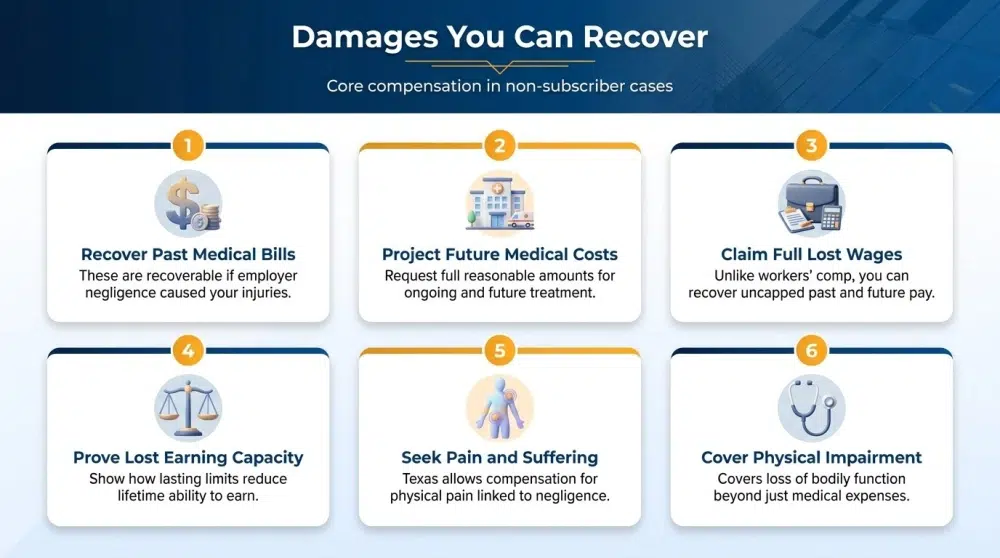
| Category | Workers’ Comp | Non-Subscriber Lawsuit |
|---|---|---|
| Past medical expenses | Yes (no-fault) | Yes (if negligence proven) |
| Future medical expenses | Limited by DWC process | Full reasonable amount |
| Lost wages | ~70% of average weekly wage, capped | Full past and future lost wages |
| Loss of earning capacity | Limited Supplemental Income Benefits | Full lifetime earning capacity loss |
| Physical pain and suffering | Not available | Available |
| Mental anguish | Not available | Available |
| Physical impairment | Impairment income benefits (limited) | Full physical impairment damages |
| Disfigurement | Not available | Available |
| Exemplary/punitive damages | Not available | Available for gross negligence |
| Wrongful death recovery | Limited death benefits | Full Chapter 71 wrongful death action |
If a workplace injury proves fatal, surviving family members may bring a wrongful death action under Texas Civil Practice and Remedies Code Chapter 71 against a non-subscribing employer. That action can include loss of companionship, mental anguish of surviving family members, and full pecuniary losses damages unavailable under the workers’ compensation death benefit structure. Our Dallas wrongful death lawyers handle these cases and coordinate the wrongful death claim alongside any survival action on behalf of the deceased worker’s estate.
Retaliation Protections After a Non-Subscriber Injury Claim
Texas Labor Code Section 451.001 prohibits an employer from discharging or otherwise discriminating against an employee because the employee filed a workers’ compensation claim in good faith or hired a lawyer to represent them. [8] This protection applies to workers at subscribing employers.
For non-subscriber employees who pursue a negligence lawsuit rather than a workers’ compensation claim, the same statute’s protections are narrower in their literal scope they refer to “workers’ compensation” proceedings specifically. Whether a non-subscriber employee who is fired for consulting a lawyer or filing a civil claim has a retaliation cause of action is a question that may depend on specific facts and how courts interpret the statute in context. If you believe you were terminated or demoted in response to reporting a workplace injury or pursuing any legal claim, document every communication and timeline carefully and speak with a personal injury lawyers team before drawing conclusions.
What Defendants Should Know
This article is designed to serve both plaintiffs and defendants. From the perspective of a non-subscribing employer facing a work injury lawsuit in Texas:
- Contributory negligence, assumption of risk, and the fellow servant rule are unavailable. Those are your three most common defences in a general negligence case, and Section 406.033 strips them away entirely.
- Comparative fault from third parties can still apply. If an independent contractor, a product manufacturer, or another company contributed to the injury, Texas Civil Practice and Remedies Code Chapter 33 allows allocation of proportionate responsibility to non-parties through a responsible third-party designation. [4]
- Independent contractor classification matters. A properly structured independent contractor relationship can affect whether an employer-employee duty exists in the first place. Courts look at the degree of control exercised by the hiring company, not just the label used in a contract.
- Occupational injury plan compliance is critical. A plan that fails to meet ERISA procedural requirements, or whose arbitration clause was not adequately disclosed to employees, may not be enforceable. Defence reliance on a defective plan can result in exposure to a full civil trial.
- Early evidence preservation is essential on both sides. OSHA inspection records, safety meeting logs, equipment maintenance histories, and supervisory communications all become contested in non-subscriber litigation. A litigation hold should issue immediately when injury is reported.
How Long Do You Have to Act?
The general personal injury statute of limitations in Texas is two years from the date of injury under Texas Civil Practice and Remedies Code Section 16.003. [7] Missing that deadline typically bars the claim entirely regardless of how serious the injury is.
Two other deadlines also matter and can arrive sooner:
- Occupational injury plan claim deadlines. If your employer has a non-subscriber benefit plan, the plan’s internal deadline for reporting and claiming benefits may be 30, 60, or 90 days. Accepting or declining plan benefits may also affect your civil claim strategy in ways that require legal guidance.
- Evidence preservation windows. Surveillance video from a Dallas worksite is typically overwritten in 30 to 90 days. Electronic data from heavy equipment black boxes, GPS tracking systems, and workplace management software can disappear quickly. A litigation hold letter sent promptly to the employer can create legal liability for destruction of that evidence.
What Should I Do Next?
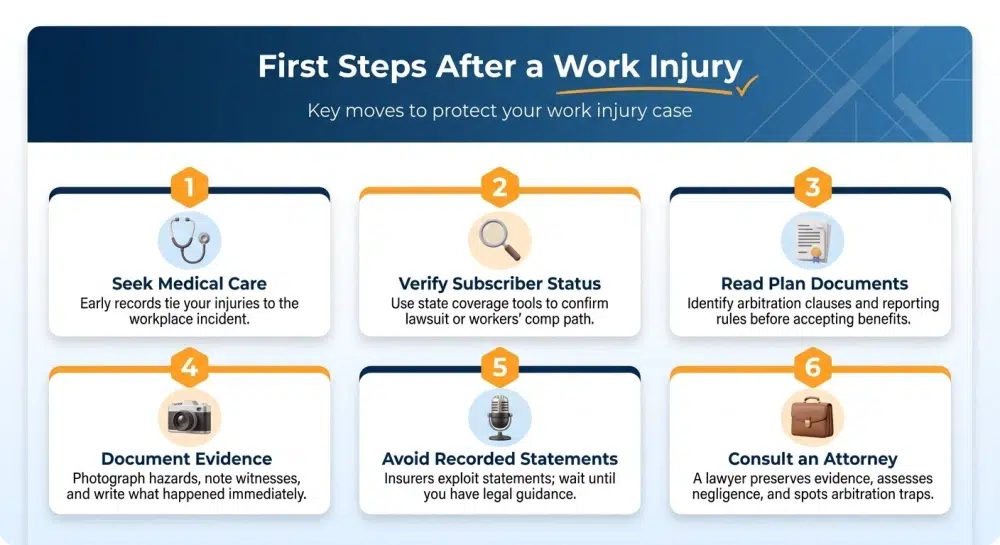
- Seek medical attention immediately and tell your treating provider the injury happened at work.
- Verify your employer’s subscriber status using the DWC coverage verification tool at tdi.texas.gov/wc/employer/coverage.html. [2]
- Read any benefit plan documents your employer provides, and note every deadline stated in them before you accept or decline coverage.
- Document the scene and your injuries. Photographs, names of witnesses, and written notes about what happened create a record when memory fades.
- Do not give a recorded statement to the employer’s insurance carrier or plan administrator until you have spoken with a lawyer.
- Consult a personal injury attorney. A Dallas work injury attorney can review the employer’s subscriber status, analyze any plan documents for arbitration traps, identify third-party defendants, and evaluate the strength of the negligence case all before you make any commitments that could limit your recovery.
For a deeper procedural walkthrough of the steps that follow an on-the-job injury, our knowledge base article on steps to take after a workplace injury: a legal overview covers the practical roadmap in detail.
Related Texas Personal Injury Resources
- Dallas Personal Injury and Accident Lawyers
- Work Injury Lawyers Dallas
- Dallas Wrongful Death Lawyers
- Texas Personal Injury Lawyers
- Steps to Take After a Workplace Injury: A Legal Overview

Talk With a GoSuits Attorney
GoSuits serves injured workers in Dallas, Plano, Carrollton, Garland, McKinney, and throughout the Dallas-Fort Worth metroplex. Our personal injury attorneys handle work injury cases on a contingency basis, meaning no fees unless we recover for you. If your Dallas employer is a non-subscriber and you have been hurt on the job, a GoSuits personal injury lawyers team can review the facts of your case, identify every source of potential recovery, and help you understand what the law actually allows without pressure to hire. Review our prior cases, learn about our attorneys, read the firm’s story on our about us page, and explore the full range of cases we handle in our practice areas section.
References
- Texas Division of Workers’ Compensation – Texas Department of Insurance
- Workers’ Compensation Insurance Coverage Verification – Texas Department of Insurance
- Texas Labor Code Chapter 406 – Texas Constitution and Statutes (statutes.capitol.texas.gov)
- Texas Civil Practice and Remedies Code Chapter 33 – Proportionate Responsibility – Texas Constitution and Statutes
- Employee Retirement Income Security Act (ERISA) – U.S. Department of Labor
- Texas Rules and Standards – Texas Judicial Branch
- Texas Civil Practice and Remedies Code Chapter 16 – Limitations – Texas Constitution and Statutes
- Texas Labor Code Chapter 451 – Discrimination Against Employees – Texas Constitution and Statutes
- Texas Civil Practice and Remedies Code Chapter 71 – Wrongful Death and Survival – Texas Constitution and Statutes
- Texas Labor Code Chapter 409 – Notice of Injury and Claims – Texas Constitution and Statutes