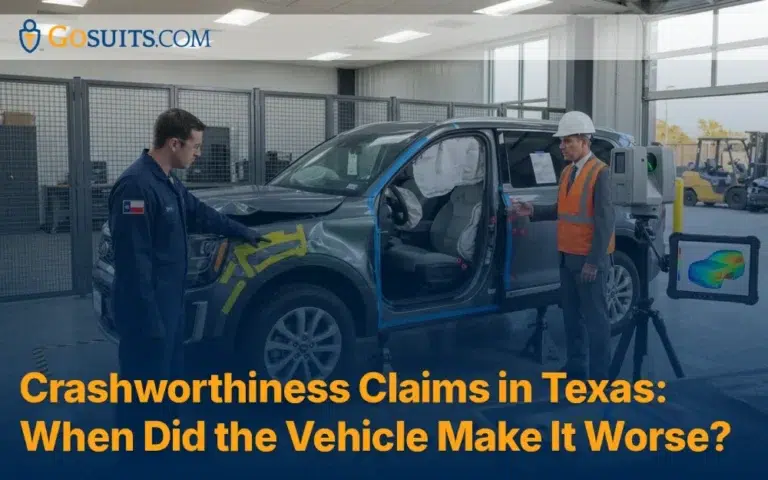
A collision on I-35E near downtown Dallas may begin with another driver’s negligence, but the injuries a person suffers do not always end with that driver’s conduct. If a seat back collapses, a roof folds inward during a rollover, an airbag fires at the wrong moment, or a fuel system ruptures and ignites, the vehicle itself becomes a second source of harm. Texas law provides a separate legal pathway for these situations, known as a crashworthiness claim, which holds the manufacturer accountable for the additional injuries caused by a defective design or construction rather than by the collision forces alone.
Legal Snapshot
- Legal Topic: Crashworthiness / Enhanced Injury Doctrine – Vehicle Product Liability
- Case Stage: Pre-litigation through trial
- Primary Legal Issue: Whether a vehicle defect enhanced injuries beyond what the collision alone would have caused
- Primary Authority: Texas Civil Practice & Remedies Code Chapter 82 (Product Liability) [AUTHORITY TO VERIFY specific provisions]; Texas comparative fault framework, Tex. Civ. Prac. & Rem. Code Ch. 33 [AUTHORITY TO VERIFY]; Nabors Well Services, Ltd. v. Romero, 456 S.W.3d 553 (Tex. 2015) (crashworthiness and seat belt admissibility); Kugle v. DaimlerChrysler Corp., 88 S.W.3d 355 (Tex. App. San Antonio 2002); Glyn-Jones v. Bridgestone/Firestone, Inc., 857 S.W.2d 640 (Tex. App. Dallas 1993)
- Date Legal Authority Last Reviewed: July 2025
What Is the Crashworthiness Doctrine?
Crashworthiness describes a vehicle’s ability to protect its occupants during a foreseeable crash, not to avoid crashes entirely. A vehicle that functions perfectly as a transportation device can still be unreasonably dangerous if its structure or safety systems fail to provide protection when a collision occurs. Courts have long recognized that manufacturers owe occupants a duty to design vehicles that do not unreasonably aggravate the physical consequences of accidents that engineers know will happen.
The doctrine is sometimes called the second-collision doctrine or the enhanced injury doctrine. The idea is straightforward: there are two collisions in many vehicle accidents. The first collision is the car striking another object. The second collision is the occupant’s body striking interior vehicle surfaces, the restraint system, or the vehicle structure itself as it deforms. A defective design can make that second collision far more severe than it should be.
Texas courts have applied this framework in cases involving roof crush, seat back failures, airbag malfunctions, fuel system fires, and restraint system defects. Product liability claims in Texas can proceed on theories of design defect, manufacturing defect, or marketing defect (failure to warn), and a crashworthiness case most commonly involves a design or manufacturing defect theory. Personal injury lawyers serving the Dallas area frequently encounter these claims in cases arising from rollover crashes on I-635 (the LBJ Freeway), rear-end collisions on US-75 (Central Expressway), and highway fire incidents along I-30.
What Texas Law Applies?
Texas product liability law is codified in Chapter 82 of the Texas Civil Practice and Remedies Code. [1] That chapter governs civil actions against product manufacturers and sellers for harm caused by a defective product and sets out standards for both design defect and manufacturing defect claims. Compliance with mandatory federal safety standards can affect, but does not automatically bar, a claim. [2]
Texas also applies a modified comparative fault framework under Chapter 33 of the Civil Practice and Remedies Code. [3] Under this framework, a plaintiff who is found more than 50 percent at fault for the underlying collision may be barred from recovery. However, fault for causing the crash and fault for a vehicle defect are separate inquiries. A driver who caused a rollover because of inattentive driving on the Dallas North Tollway may still have a valid crashworthiness claim against the manufacturer for a roof that failed to protect occupants during that rollover.
Two cases are particularly significant to understanding how Texas courts approach these claims. In Nabors Well Services, Ltd. v. Romero, 456 S.W.3d 553 (Tex. 2015), the Texas Supreme Court addressed the long-standing rule barring evidence of seat belt non-use in vehicle accident cases. [4] The Court’s reasoning illuminates the policy tensions in crashworthiness litigation. The Dallas Court of Appeals addressed product liability and enhanced injury principles in Glyn-Jones v. Bridgestone/Firestone, Inc., 857 S.W.2d 640 (Tex. App. Dallas 1993). [5] The San Antonio Court of Appeals examined crashworthiness claims involving seat back failure in Kugle v. DaimlerChrysler Corp., 88 S.W.3d 355 (Tex. App. San Antonio 2002). [6]
Federal motor vehicle safety standards set minimum performance benchmarks for vehicle systems including roofs, seats, fuel systems, and restraints. However, meeting federal minimums is not necessarily a complete defense to a Texas crashworthiness claim where engineers argue that a safer alternative design existed and was practicable. [7]
Common Crashworthiness Defect Theories
Several recurring vehicle system failures form the basis of most crashworthiness claims in Texas courts. Each involves a different part of the vehicle and a distinct engineering analysis.
Roof Crush in Rollover Crashes
When a vehicle rolls, the roof structure bears the weight of the vehicle and the forces generated by contact with the ground. A roof that lacks sufficient structural integrity can crush downward into the occupant space, causing head, neck, and spinal injuries that would not have occurred in a vehicle with a stronger roof design. Engineers evaluate roof performance by analyzing post-crash roof deformation, comparing it to pre-collision roof geometry, and assessing whether alternative structural materials or designs would have maintained the survival space while remaining cost-effective. Rollover incidents are not uncommon on elevated highway interchanges in the Dallas area, where vehicles traveling at highway speeds can lose control and roll down embankments.
Seat Back Failure During Rear Impacts
A seat back that collapses rearward during a rear-end collision launches the front-seat occupant into the back seat area or into rear-seat passengers with significant force. The seatbelt, designed to restrain the occupant in the seat, provides no protection once the seat back fails because the occupant is no longer in position relative to the restraint system. Engineers in these cases examine the seat structure, the recliner mechanism, and the seat back’s response during testing that mimics the actual crash parameters.
A driver is stopped at a light on a surface street in Deep Ellum when a vehicle traveling at 35 miles per hour strikes the rear of her car. She is wearing her seatbelt. The rear impact causes the seat back to collapse suddenly, propelling her body rearward and causing severe cervical spine injuries. Engineering analysis later reveals that the recliner mechanism failed at forces well below what vehicle safety engineers would characterize as severe, and that a reinforced alternative design was available at a modest per-unit cost. This scenario illustrates a potential seat back crashworthiness claim distinct from the claim against the rear driver. This is a hypothetical example and does not represent any actual GoSuits case result.
Airbag Timing and Deployment Failures
Airbags are calibrated to deploy within a very narrow time window during a collision. An airbag that deploys too late, too early, or not at all may fail to prevent head contact with the steering column, dashboard, or side window. Conversely, an airbag that deploys unexpectedly, or deploys with excessive force, can cause facial fractures, eye injuries, or neck injuries in occupants who were not in the ideal position the system assumed. Restraint system engineers examine event data recorder information, crash sensor calibration, and airbag module construction to evaluate whether a system functioned as designed and whether the design was reasonable.
Fuel System Fires
Here’s a scenario that keeps engineers up at night. Someone survives the initial hit. And then the fuel system fails, fuel meets a spark or a hot component, and the fire finishes what the crash couldn’t. Fuel tanks that rupture, lines that separate, missing rollover valves, fittings that weren’t up to the job. Any of those can turn into a claim. What lawyers and their experts end up looking at is basically the whole fuel system architecture, kind of piece by piece, and then how it all held together (or didn’t) under the exact deformation pattern that specific crash produced.
Restraint System Defects Beyond Airbags
Belts are more complicated than people think. You’ve got pretensioners, load-limiters, and the buckle assembly, and any one of them can be the reason someone got hurt worse than they should have. A belt that doesn’t hold the occupant in position properly during a crash can let them slide right under the lap portion, which engineers call submarining, or route the shoulder belt across the neck instead of the chest. So when experts look at a case like this, they pull the black box data, run it against the crash reconstruction, and then a biomechanics person basically works the injuries backward to figure out what the belt was actually doing at each moment.
How Is Enhanced Injury Separated from Crash-Caused Injury?
The central legal and evidentiary challenge in every crashworthiness claim is apportionment: distinguishing the injuries caused by the collision itself from the additional injuries caused by the vehicle defect. Texas law requires the plaintiff to present evidence that allows the fact-finder to make this distinction.
This is expert witness territory. Engineers, biomechanics people, and doctors, mostly. The analysis usually breaks into three chunks. First the crash gets reconstructed, so you know the real forces, speeds, and how the deceleration actually played out. Then the defective system gets its own analysis, basically asking how it performed during those specific crash conditions. Third piece is the counterfactual, which is where engineers work out what a properly designed system would’ve done, and then the biomechanics expert takes the injuries and sorts them into two buckets, the ones caused by the defect and the ones the crash was going to cause regardless.
For example, in a roof crush case, an engineer may calculate that the occupant’s head would not have contacted the roof if the roof had maintained a specified minimum survival space. A biomechanical expert may then testify that the cervical spine injuries are consistent with the head-to-roof contact that resulted from the crush, rather than with the rotational forces of the rollover itself.
Texas courts have held that the plaintiff need not establish the precise extent of enhanced injury with mathematical certainty, but the evidence must provide a reasonable basis for the jury to apportion damages between the original crash injuries and the enhanced injuries. [AUTHORITY TO VERIFY specific apportionment standard in Texas]
Say a pickup rolls on the LBJ Freeway near the High Five in a merging crash. Driver ends up with a T6 complete spinal cord injury, which is about as bad as it gets. Engineers pull the vehicle apart and find the roof crushed roughly 8 inches into the survival space, with markings showing the occupant’s head contacted the roof during the roll. Biomechanics expert then testifies at trial and lays it out for the jury, saying the rollover forces on their own probably wouldn’t produce a T6 complete injury, but axial loading from head-to-roof contact is exactly the mechanism you’d expect for this specific injury. And that’s how the enhanced injury piece gets framed. Just a hypothetical, not a real GoSuits case.
Why the Vehicle Must Not Be Released to Salvage or the Insurer
Preserving the crashed vehicle is the single most important immediate step in a crashworthiness case. The vehicle is physical evidence that cannot be recreated once it is destroyed or altered. Engineers need to examine the actual deformation of the roof, the failed seat back mechanism, the buckled fuel tank, the airbag module, and dozens of other components in their post-crash condition.
When a vehicle is declared a total loss, the at-fault driver’s insurer or the injured person’s own insurer typically acquires salvage rights and arranges for the vehicle to be sold to a salvage yard or crushed. Salvage yards routinely dismantle and crush vehicles quickly. Once this happens, the critical physical evidence is gone.
Several practical steps help preserve this evidence.
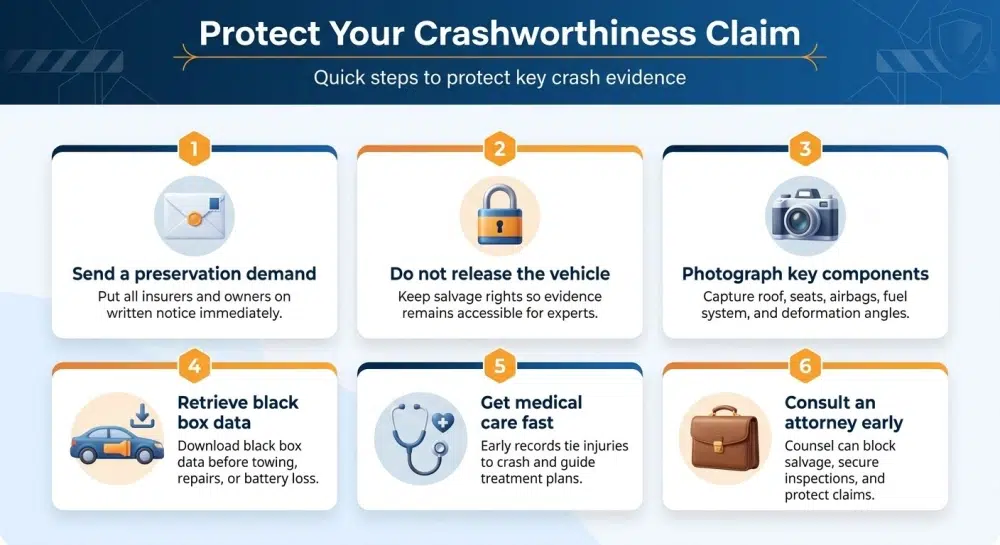
- Send a written preservation demand immediately. A formal letter should be directed to all insurers involved, the at-fault driver, and any party that may have salvage rights, specifically demanding that the vehicle not be moved, altered, sold, or destroyed. This letter creates a record and provides the legal basis for a spoliation argument if the vehicle is destroyed after notice was given.
- Photograph and document the vehicle before any movement. If the vehicle is accessible at the scene or at a tow yard before salvage transfer, thorough photographic documentation of all damaged areas, particularly the roof, seat systems, airbag status, and fuel system, is essential.
- Retrieve the event data recorder data. Most modern vehicles record pre-crash speed, brake application, steering input, and other parameters in an onboard event data recorder (EDR). This data can be downloaded using specialized equipment, but it must be retrieved before the vehicle is processed or the module is damaged.
- Retain an attorney promptly. An attorney can issue a preservation demand with legal authority, arrange for expert inspection of the vehicle, and seek a court order if necessary to prevent destruction.
What Evidence Can Matter in a Crashworthiness Claim?
Crashworthiness cases are evidence-intensive. The categories below represent potential sources of information, not a guarantee that any particular piece of evidence will be decisive in a given case.
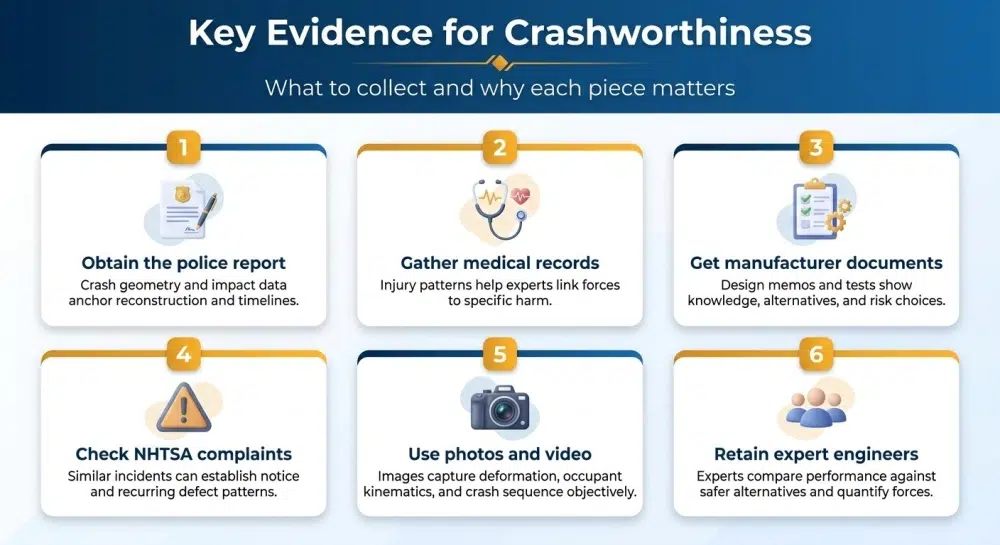
| Evidence Category | Why It May Matter |
|---|---|
| The crashed vehicle itself | Physical deformation patterns, failed components, and component markings allow engineers to analyze what happened and why |
| Event data recorder (EDR/black box) | Records pre-crash speed, braking, steering, and airbag deployment decisions in the seconds before impact |
| Police accident report and reconstruction | Documents crash geometry, speed estimates, point of impact, and officer observations of vehicle condition |
| Medical records and imaging | Injury patterns documented by emergency physicians, radiologists, and surgeons support biomechanical analysis |
| Internal manufacturer documents | Design memos, test data, prior complaints, and regulatory correspondence can reveal what the manufacturer knew about a defect |
| NHTSA complaints and recall records | Other owners’ complaints and federal recall records may establish that a defect was known or suspected |
| Photographs and video | Post-crash photographs of vehicle deformation and dashcam or surveillance footage of the collision itself |
| Expert engineering analysis | Engineers compare actual vehicle performance with the performance of a safer alternative design |

What Damages May Be Available?
If a crashworthiness claim is proven, the injured person may be entitled to recover damages specifically for the enhanced injuries caused by the vehicle defect. The recoverability of any particular category of damages depends on the facts of the individual case, the applicable law, and decisions made by a judge or jury. No outcome is guaranteed.
Categories that may be available in a Texas personal injury case arising from vehicle defects include:
- Past and future medical expenses – Costs of emergency treatment, surgery, rehabilitation, assistive devices, and ongoing medical care attributable to the enhanced injuries
- Past and future lost income – Wages and earning capacity lost because of the enhanced injuries
- Physical pain and suffering – Recognized in Texas as compensable non-economic harm
- Mental anguish – Psychological distress resulting from the injuries
- Physical impairment and disfigurement – Recognized as separate categories of non-economic damages in Texas
- Wrongful death damages – If a defect-related injury proves fatal, surviving family members may have separate wrongful death claims under Texas law. Victims may also face wrongful death claims if injuries prove fatal, making the wrongful death lawyers available through our Dallas personal injury team relevant to these cases.
- Exemplary (punitive) damages – Available in Texas when a manufacturer’s conduct was grossly negligent or malicious, subject to the caps and standards set by Texas law [AUTHORITY TO VERIFY current exemplary damage caps under Tex. Civ. Prac. & Rem. Code Ch. 41]
Damages in a crashworthiness case are typically apportioned between the enhanced injuries caused by the defect and the injuries that would have occurred regardless of the defect. Only the enhanced injuries are attributable to the manufacturer.
What If the Manufacturer Disputes the Defect?
Manufacturers of major vehicles have litigation teams experienced in defending crashworthiness claims. Common defense arguments include: the vehicle met applicable federal safety standards; the plaintiff cannot apportion enhanced injuries from original crash injuries with sufficient specificity; the plaintiff’s position, pre-existing conditions, or own conduct contributed to the injuries; and the alleged alternative design was not practicable or created different safety risks.
These defenses make the quality of expert testimony, the preservation of the vehicle, and the thoroughness of pre-litigation investigation critically important. Manufacturers also engage in extensive discovery of the plaintiff’s medical history, driving history, and other factors that may support apportionment or comparative fault arguments.
Texas courts have addressed the admissibility of seat belt non-use evidence in this context. The Texas Supreme Court’s analysis in Nabors Well Services reflects the difficulty of separating occupant behavior from vehicle performance in the factual record. [4]
How Long Do I Have to File a Crashworthiness Claim in Texas?
Texas generally imposes a two-year statute of limitations on personal injury claims, which would apply to crashworthiness and product liability claims arising from vehicle collisions. [1] [DEADLINE REQUIRES LEGAL VERIFICATION, the specific deadline applicable to any individual case depends on the precise facts, including the date of the injury, whether the plaintiff is a minor, whether a government entity is involved, and other factors that can extend or shorten the limitations period.]
Wrongful death claims in Texas are also subject to a two-year limitations period running from the date of death. [DEADLINE REQUIRES LEGAL VERIFICATION for specific wrongful death circumstances.]
Filing deadlines in complex product liability cases are among the most time-sensitive issues because expert retention, vehicle preservation, and preservation demands all need to occur long before any lawsuit is filed. Waiting until close to the limitations deadline substantially limits the options available.
If you were injured in a Dallas-area crash involving a vehicle component failure, whether on a stretch of I-30 through Oak Cliff, on the Dallas North Tollway, or on any other roadway in the Dallas County District Court’s jurisdiction, speaking with an attorney promptly is the most important step you can take to preserve your legal options.
What Should I Do Next?
If you believe a vehicle defect contributed to your injuries or a family member’s injuries in a crash, several steps can make a meaningful difference in whether a crashworthiness claim is viable.
- Do not release the vehicle. Notify every insurer involved, in writing, that you are preserving the vehicle as evidence and that they must not process, transfer, sell, or destroy it.
- Seek prompt medical evaluation. Complete and contemporaneous medical records are essential to establishing both what injuries occurred and when they were diagnosed.
- Document everything you can access. Photograph the vehicle at the earliest opportunity, preserve all correspondence with insurers, and note the names of any witnesses to the crash or to the vehicle’s condition.
- Consult an attorney before signing any insurer documents. Total-loss settlement paperwork and salvage rights transfers can affect your ability to bring a manufacturer claim.
- Request your medical records promptly. The injury patterns documented in emergency department records and imaging reports are foundational to the expert analysis required in a crashworthiness case.
For guidance on how to navigate the product liability claims process in Texas more broadly, that resource covers additional context on how defective product cases are evaluated.
Does Texas recognize the enhanced injury doctrine?
Yes. Texas courts recognize the enhanced injury doctrine, also called the second-collision doctrine. It allows an injured person to pursue a separate claim against a vehicle manufacturer for the additional harm caused by a product defect during a crash, distinct from injuries caused by the initial collision itself.
How is enhanced injury separated from the original crash injury?
Expert witnesses typically engineers and biomechanical analysts compare what injuries would have occurred in a properly designed vehicle with the injuries that actually occurred. The plaintiff bears the burden of proving which specific injuries are attributable to the product defect rather than to the crash forces themselves. For context on how Dallas fatal crash claims are documented, see what families should do after a fatal crash in Dallas.
Why must the vehicle be preserved after a crash?
The vehicle is the primary physical evidence in a crashworthiness case. Deformation patterns, failed components, and electronic data stored in the event data recorder can all be analyzed by engineers. Once a vehicle is salvaged, crushed, or repaired, that evidence is gone permanently.
What types of vehicle defects can support a crashworthiness claim in Texas?
Common defect theories include roof crush in rollovers, seat back collapse during rear impacts, airbag timing failures or non-deployments, fuel system fires after impact, and restraint system failures that allow occupant contact with interior structures.
Can I bring a crashworthiness claim even if I caused the accident?
Potentially yes. Texas law applies a modified comparative fault rule. If you were at fault for causing the underlying crash, that fault may affect your recovery, but it does not necessarily eliminate a separate claim against the manufacturer for enhanced injuries caused by a vehicle defect. Texas law bars recovery only if the plaintiff’s percentage of fault exceeds 50 percent. See this Dallas-Fort Worth crash guide for context on how fault is evaluated in Texas crashes.
What is the statute of limitations for a product liability claim in Texas?
In Texas, most personal injury claims, including product liability claims, are generally subject to a two-year statute of limitations. The precise deadline in any specific case requires legal verification because certain circumstances can affect when the limitations period begins to run. If you have questions about timing, consulting an attorney promptly is important.

Related Texas Personal Injury Resources
- Navigating Product Liability Claims: What You Need to Know
- Accident Reconstruction in Disputed Fault Cases – Dallas
- How Attorneys Preserve Vehicle Black Box Evidence
- Types of Damages Available in Texas Personal Injury Cases
- Statute of Limitations for Personal Injury in Texas
Talk With a GoSuits Attorney About Your Dallas Crashworthiness Case
Crashworthiness claims are among the most complex personal injury cases in Texas. They require engineering analysis, vehicle preservation, and a thorough understanding of product liability law. If you or a family member suffered serious injuries in a Dallas crash involving a suspected vehicle defect, a GoSuits personal injury attorney can review the circumstances and explain your options.
The Dallas County District Court at the George L. Allen Sr. Courts Building handles civil cases where vehicle manufacturers may be named defendants, and understanding local court procedures is part of building an effective case strategy.
Schedule a free consultation with our Dallas personal injury team today. There is no fee unless we recover for you.
Our Dallas personal injury team is part of GoSuits, a personal injury law firm serving Texas, California, and Illinois. You can learn more about personal injury and accident representation in Dallas, our Dallas product liability lawyers, and how we approach complex vehicle defect cases. If your crash involved a commercial truck, our Dallas team also handles product liability claims involving commercial vehicles.
References and Legal Authority
- Texas Civil Practice and Remedies Code Chapter 82 – Product Liability – Texas Legislature
- 49 U.S.C. § 30101 et seq. – National Traffic and Motor Vehicle Safety Act – Cornell Law School LII
- Texas Civil Practice and Remedies Code Chapter 33 – Proportionate Responsibility – Texas Legislature
- Nabors Well Services, Ltd. v. Romero, 456 S.W.3d 553 (Tex. 2015) – CourtListener
- Glyn-Jones v. Bridgestone/Firestone, Inc., 857 S.W.2d 640 (Tex. App. Dallas 1993) – CourtListener
- Kugle v. DaimlerChrysler Corp., 88 S.W.3d 355 (Tex. App. San Antonio 2002) – CourtListener
- Federal Motor Vehicle Safety Standards (FMVSS) – National Highway Traffic Safety Administration
- Texas Civil Practice and Remedies Code § 16.003 – Two-Year Limitations Period – Texas Legislature
- Texas Rules of Civil Procedure and Standards – Texas Courts
- Texas Court Rules Research Guide – Texas State Law Library