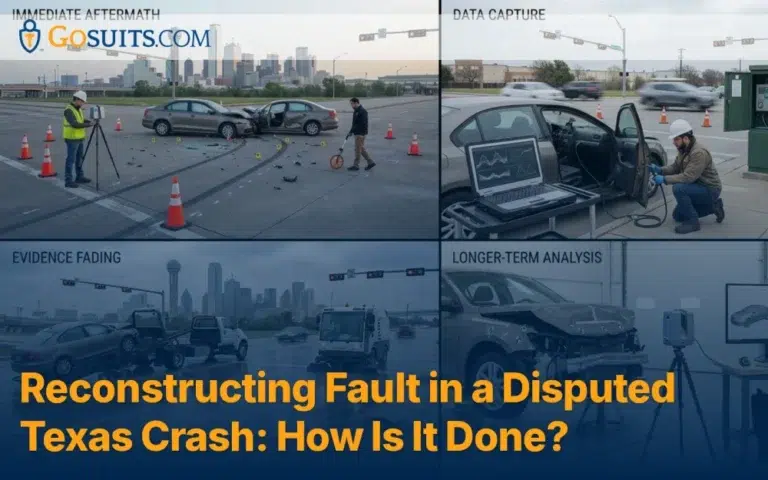
When both drivers dispute who caused a collision, physical science fills the gap that conflicting witness accounts cannot. Accident reconstruction is the discipline that translates crash evidence, vehicle damage, tire marks, road surface conditions, electronic data, and geometry into a factual narrative about what happened. In a disputed Dallas crash, where the other driver’s insurer is pushing back hard, a qualified reconstructionist working alongside personal injury lawyers can make the difference between proving liability and being denied compensation. This article explains exactly what a reconstructionist analyzes, why each evidence source matters, and how quickly that evidence disappears.
Legal Snapshot
- Legal Topic: Accident Reconstruction in Disputed Liability Cases, Texas
- Case Stage: Investigation / Pre-litigation through trial
- Primary Legal Issue: Establishing fault through physical and electronic evidence
- Primary Authority: Texas Rules of Evidence, Rules 702–705 (expert witness testimony); Texas Civil Practice & Remedies Code Chapter 41 (damages); 49 C.F.R. Part 563 (EDR federal regulations)
- Date Legal Authority Last Reviewed: June 2025
What Is Accident Reconstruction?
Accident reconstruction is a scientific process in which a trained analyst applies principles of physics, engineering, and biomechanics to determine the sequence of events in a crash, including pre-impact speeds, directions of travel, points of impact, and post-impact trajectories. In Texas civil litigation, reconstructionists typically testify as expert witnesses under Texas Rules of Evidence 702–705, which require that the expert’s opinion rest on sufficient facts or data and be the product of reliable principles and methods applied reliably to the facts of the case. [1]
Reconstruction is not guesswork. Each conclusion is grounded in measurements taken from the scene, data extracted from the vehicles themselves, and established engineering formulas. When the evidence is preserved properly, a competent reconstructionist can often determine pre-impact speeds within a few miles per hour and establish with confidence which vehicle entered the intersection first, whether a lane change was completed before or during impact, or which vehicle was moving when it appeared stationary.
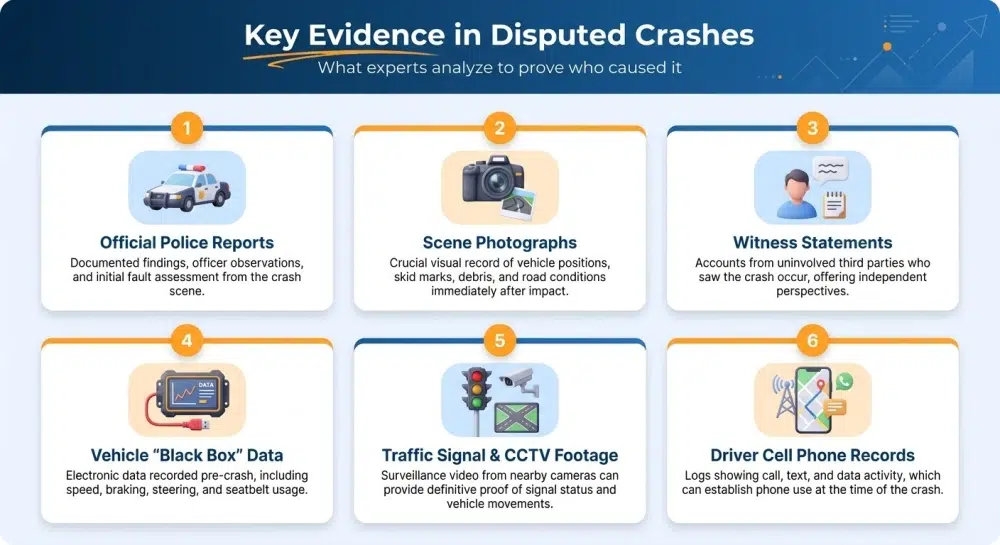
Source 1: The Event Data Recorder (EDR) Download
Most passenger vehicles manufactured in the United States since the mid-2000s contain an event data recorder – commonly called a vehicle “black box.” Federal regulations at 49 C.F.R. Part 563 [2] require that EDRs meeting specific criteria record a defined set of data elements, which typically include pre-crash vehicle speed, engine throttle, brake application, seat belt status, airbag deployment times, and the vehicle’s heading change during the event.
A reconstructionist downloads EDR data using manufacturer-specific or commercially available imaging tools. The download produces a report showing the vehicle’s behavior in the five seconds before impact and through the end of the crash event. On a stretch of I-35E with stop-and-go traffic in the Dallas metro area, for example, EDR data can reveal whether a rear-ending driver maintained highway speed right up to impact – undercutting any claim that the plaintiff stopped suddenly or whether the data shows hard braking that is inconsistent with the driver’s account.
What the EDR Records
- Vehicle speed at one-second intervals leading up to impact
- Whether the driver applied the brakes, and when
- Throttle position (accelerating, coasting, or decelerating)
- Steering angle (in newer systems)
- Seat belt status for each recorded occupant
- Airbag deployment timing and deployment commands
- Change in velocity (delta-v) during the crash
Retention Timeline for EDR Data
Most EDRs store only a fixed number of event records, commonly between one and five, and overwrite earlier records when storage is full. A subsequent minor collision, a hard-brake event, or a crash caused during a repair or tow can trigger a new write cycle that overwrites the record from the original crash. Act within days, not weeks. Once the vehicle is repaired, sold, or destroyed, the data is gone. An attorney can seek a court-ordered preservation hold or a temporary restraining order if the vehicle is at risk of being moved before the data is downloaded. [3]
Source 2: Crush Profile and Delta-V Analysis
When two vehicles collide, the force of impact deforms metal in a pattern that encodes information about the crash. A reconstructionist measures the depth, width, and direction of crush deformation on each vehicle and applies engineering models, including the widely used CRASH and RICSAC databases, to calculate the change in velocity each vehicle experienced during the collision. [4]
Delta-v is the key output. It represents how abruptly the vehicle’s velocity changed during the crash. Because the relationship between delta-v and injury severity is well-documented in biomechanical literature, crush analysis allows a reconstructionist to:
- Estimate the pre-impact speed of each vehicle
- Determine which vehicle was moving at the time of impact
- Evaluate whether an injury claim is consistent with the magnitude of the crash forces
- Identify whether the damage pattern matches the parties’ descriptions of how the crash occurred
Retention Timeline for Vehicle Damage
Once a vehicle is repaired, crush measurements are lost permanently. Insurance companies frequently push to have vehicles repaired quickly after a claim is filed, sometimes within weeks of the crash. A vehicle that is totaled and sent to a salvage yard may be crushed or parted out before photographs and measurements can be taken. Preserved vehicles should be photographed thoroughly within days of the crash. In any case where liability is disputed, an attorney should seek a hold on vehicle disposition through a preservation letter to the insurer.
Source 3: Skid Marks, Scuff Marks, and Tire Evidence
Pre-impact skid marks – produced by locked wheels scrubbing against asphalt – allow a reconstructionist to calculate the minimum speed of a vehicle before braking began, using the drag factor of the road surface and standard kinematic equations. Scuff marks, which are sideway-scrubbing patterns left by tires during a yaw or slide, help identify the path of each vehicle through the collision sequence and can pinpoint the point of impact.
In Dallas County, the George L. Allen Sr. Courts Building handles civil docket filings, and expert witnesses regularly testify about physical roadway evidence recovered from crash sites along U.S. 75 (Central Expressway), I-30, and the Dallas North Tollway – corridors where merge-related and rear-end collisions are common in heavy commute traffic.
Additional Physical Evidence
- Gouge marks: Deep cuts in pavement caused by metal-to-metal contact mark the point of maximum engagement – often the exact point of impact.
- Fluid stains: Coolant, oil, or transmission fluid drops identify where the vehicles came to rest and the sequence of post-impact movement.
- Tire marks from a yaw: Curved scuff patterns indicate a vehicle traveling sideways, which can reveal evasive maneuver direction and timing.
- Vehicle component scatter: Broken glass, plastic trim, and headlight lens fragments mark the point of impact and post-impact direction of travel.
Retention Timeline for Roadway Evidence
Skid and scuff marks on dry asphalt can persist for weeks in low-traffic areas but may be worn away within days on high-volume corridors. Rain, road-sweeping equipment, and resurfacing work will erase them entirely. The police investigation unit photographs the scene, but those photographs may not capture all relevant evidence in sufficient detail. An independent scene investigation should be conducted within the first 48 to 72 hours when possible. If a significant period has passed, the reconstructionist can still work from the police report photographs, aerial imagery, and measurements if they exist.
Source 4: Debris Field Position and Scene Mapping
The location of post-crash debris – vehicle components, cargo, personal belongings – tells the reconstructionist where the vehicles were at the moment of impact and which direction they traveled afterward. By mapping the debris field against fixed reference points (lane markings, curb edges, signal poles), the analyst can reconstruct the geometry of the crash with high accuracy.
Modern reconstructionists frequently use total-station surveying equipment, drone photogrammetry, or 3D laser scanning to capture the scene. Photogrammetry from drone imagery can produce a millimeter-accurate three-dimensional model of the roadway and surrounding environment within hours of the crash. When attorneys preserve vehicle black box evidence and initiate scene documentation quickly, these mapping tools provide a far more precise foundation for expert testimony than police photographs alone.
Retention Timeline for Debris Evidence
Debris is typically cleared by police or highway maintenance crews within hours of the crash – often before a civil attorney is even retained. The police scene photographs and diagrams are therefore critical substitutes. Police reports in Dallas County are maintained by the Dallas Police Department and can be obtained through formal request. [5] Scene photographs taken by responding officers, witnesses, or the parties themselves are the next-best source. Any photographs taken at the scene should be preserved in their original digital form, including metadata, to establish when and where they were captured.
Source 5: Traffic Signal Phase Data
Intersection crashes frequently turn on a single question: which light was green? Many signalized intersections in the Dallas metro area – including busy intersections along US-75 and at the High Five interchange – are controlled by signal controllers that log phase timing and fault events. When a crash occurs at a signalized intersection, the traffic signal controller may retain a record of which phases were active at the precise time of the collision.
Signal phase data is typically stored by the controller unit at the intersection or transmitted to a central traffic management system operated by the Texas Department of Transportation (TxDOT) or the local municipality. [6]

Retention Timeline for Signal Phase Data
This is one of the most time-sensitive evidence categories. Controller logs at many intersections are overwritten on cycles as short as 30 days, and some older systems retain only a few days of data. A formal open-records request to TxDOT or the local municipality should be submitted immediately after a disputed intersection crash. An attorney can send a preservation letter to the relevant government agency to trigger a duty to retain the data before it is overwritten in the ordinary course. This should be treated as a 24-to-72-hour priority.
Source 6: Nearby Surveillance and Dashcam Footage
Commercial properties along Dallas roadways – gas stations, retail centers, fast-food restaurants, bank branches, parking garages – frequently operate video surveillance systems aimed at parking lots, drive-throughs, and adjacent streets. These cameras sometimes capture crash events or the pre-crash behavior of the vehicles involved. In addition, dashboard cameras mounted in other vehicles, doorbell cameras from adjacent residences, and body-worn cameras on responding officers can capture footage directly relevant to fault.
Locating this footage requires a systematic canvass of properties with camera views of the crash location. Car accident lawyers in Dallas use investigators who walk the area, identify cameras, and send preservation letters to business owners and property managers. Dashcam footage from other vehicles at the scene can also be identified from witness statements gathered at the scene.
How Surveillance Footage Is Located
- Reconstruct the crash location from the police report and scene photographs
- Identify all properties within camera range of the crash point (typically a 300- to 500-foot radius)
- Send written preservation notices to each property owner or manager, citing the specific crash date, time, and location
- Follow up with subpoenas or court orders where owners fail to voluntarily produce the footage
- Request footage from TxDOT’s Traffic Management Center if the crash occurred on a monitored freeway corridor
Retention Timeline for Surveillance Footage
Commercial surveillance systems typically overwrite on automatic loops ranging from 72 hours to 30 days, depending on storage capacity and system settings. Gas stations and convenience stores frequently overwrite in three to seven days. Larger commercial properties with higher-capacity systems may retain footage for 30 to 90 days. Dashcam footage on a private vehicle may be overwritten on a loop as short as one hour if the card is full and the camera is still recording.
Evidence Retention: Realistic Windows for Disputed Dallas Crashes
| Evidence Source | Typical Retention Window | Priority Level |
|---|---|---|
| Dashcam footage (other vehicles) | Hours to 1 day (loop overwrite) | Immediate |
| Traffic signal controller logs | 30 days or less (some systems: 72 hours) | 24–72 hours |
| Gas-station / convenience-store cameras | 3 to 7 days | 24–72 hours |
| Commercial surveillance (retail, bank) | 7 to 30 days | First week |
| EDR / vehicle black box | Until next qualifying event overwrites | First week; before vehicle is repaired |
| Skid and scuff marks (high-traffic road) | 48 hours to a few days | First 48 hours |
| Vehicle crush profile | Until vehicle is repaired or destroyed | Before repair authorization |
| Debris field | Hours (cleared by maintenance crews) | Police photos become the record |
| Police report / diagrams | Permanently retained by agency | Request within first week |
| TxDOT freeway camera footage | Varies; often 14–30 days | First week |
What Legal Rules Govern This Evidence in Texas?
Texas courts apply the Texas Rules of Evidence to reconstruction testimony. Rule 702 permits expert testimony when the expert’s scientific, technical, or other specialized knowledge will help the trier of fact understand the evidence or determine a fact in issue. [7] Texas adopted the reliability framework from E.I. du Pont de Nemours & Co. v. Robinson, 923 S.W.2d 549 (Tex. 1995), which adapted the federal Daubert standard and requires that expert opinions rest on a reliable scientific methodology applied reliably to the facts. [8]
Texas Rule of Evidence 703 allows an expert to base an opinion on facts or data made known before or during trial, including data not independently admissible if experts in the field reasonably rely on such data. This provision is significant for EDR testimony, because the downloaded data report is typically admitted through the reconstructionist who performed the download and interpreted the results, not as a standalone exhibit. [1]
The Texas Civil Practice and Remedies Code governs damages in personal injury cases and establishes the framework for exemplary (punitive) damages where conduct is found to be grossly negligent. [9] Reconstruction evidence that establishes the exact speed of a defendant who was texting or intoxicated while driving can be directly relevant to a gross-negligence finding and a request for exemplary damages.
Preservation obligations arise once litigation is reasonably anticipated. Texas courts have applied spoliation sanctions – including adverse-inference instructions – when parties destroy evidence with a culpable mental state after that duty attached. An early preservation letter from a personal injury attorney’s team puts the at-fault driver and their insurer on formal notice that the evidence must be retained.
What Damages May Be Available in a Disputed Liability Crash?
Under Texas law, an injured person who prevails on liability may recover damages in several categories. Recoverability depends on the facts of the case and applicable law, and no outcome is guaranteed. Common categories recognized by Texas courts include:
- Past and future medical expenses: The reasonable value of medical care made necessary by the crash
- Lost wages and loss of earning capacity: Income lost due to the injury and, where applicable, a reduction in the ability to earn in the future
- Physical pain and mental anguish: Past and future suffering
- Physical impairment: Functional limitations that persist beyond the pain-and-suffering period
- Disfigurement: Permanent scarring or deformity
- Property damage: Vehicle repair or replacement and associated costs
- Wrongful death damages: Where a crash proves fatal, surviving family members may pursue claims under the Texas Wrongful Death Act, Texas Civil Practice and Remedies Code Chapter 71. Fatal crash attorneys in Dallas handle these claims separately from standard injury recovery.
- Exemplary damages: Available where the defendant’s conduct constitutes gross negligence under Texas Civil Practice and Remedies Code § 41.003 [9]
Texas follows a modified comparative fault rule: an injured person who is more than 50% responsible for the crash cannot recover damages. Below that threshold, recovery is reduced proportionally by the claimant’s percentage of fault. [10] Reconstruction evidence directly affects where the jury places each party on the fault spectrum.
What If the Other Driver Disputes Liability?
Disputed liability is the norm in crash litigation, not the exception. The at-fault driver’s insurer will conduct its own investigation, retain its own expert, and challenge the physical evidence where possible. A reconstructionist retained by the injured party serves several functions: building an independent scientific record of what happened, identifying weaknesses in the opposing expert’s methodology, and providing testimony that allows the jury to evaluate the crash based on evidence rather than competing stories.
When liability is genuinely contested, the strength of the reconstruction case often determines whether the matter settles favorably or must proceed to trial in Dallas County District Court. The Dallas County District Court system hears civil personal injury cases, and experienced trial courts there are familiar with reconstruction testimony, but the quality of the underlying evidence and the expert’s methodology will be scrutinized carefully.
How Long Do I Have to Act in Texas?
The general statute of limitations for personal injury claims in Texas is two years from the date of the injury, under Texas Civil Practice and Remedies Code § 16.003. [11] Claims against government entities, including TxDOT or a municipality, carry a shorter notice period of six months under the Texas Tort Claims Act, Texas Civil Practice and Remedies Code Chapter 101, and failure to comply may bar the claim entirely. [12]
The two-year limitation period does not, however, protect the physical evidence. The table above illustrates that critical evidence disappears within hours to weeks. Waiting even a few weeks to retain an attorney can result in the permanent loss of signal data, surveillance footage, skid marks, and EDR records that might have proven the case. The deadline for the lawsuit and the deadline for the evidence are very different clocks, and the evidence clock runs faster.
[DEADLINE REQUIRES LEGAL VERIFICATION – Specific deadlines depend on the identity of all potentially liable parties, including any government entity. Confirm applicable deadlines with a licensed Texas attorney.]
What Should I Do Next?
If you were injured in a disputed Dallas crash, or anywhere in the DFW metro area, the following steps protect both your health and your legal options:
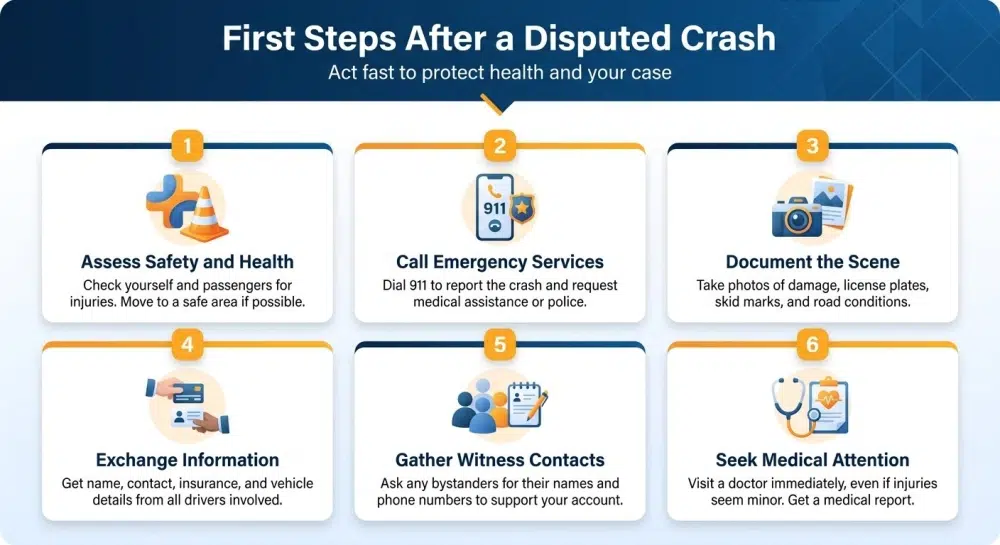
- Seek medical attention immediately – even if you do not believe you are seriously injured. Delayed symptoms are common in collision trauma, and medical records establish the connection between the crash and the injury.
- Preserve all scene photographs – including any taken on your phone, by witnesses, or by responders. Do not delete or share unedited originals.
- Do not authorize vehicle repair – until a legal hold on the vehicle’s condition has been evaluated by an attorney.
- Write down the names and contact information of all witnesses – before leaving the scene.
- Do not provide a recorded statement to the other driver’s insurer – without first consulting an attorney.
- Contact a personal injury attorney promptly – the evidence window is short, and preservation letters must be sent quickly to have legal effect.
Our Dallas car accident lawyers review the circumstances of disputed crashes and explain your legal options at no charge. The consultation is confidential and carries no obligation.

Related Texas Personal Injury Resources
Talk With a GoSuits Dallas Personal Injury Attorney
A disputed crash claim involves complex physical evidence that begins disappearing within hours. If you or someone in your family was injured in a Dallas crash where the other driver is contesting fault, a GoSuits personal injury attorney can review the circumstances, explain your options, and help coordinate evidence preservation before the window closes.
The consultation is free, confidential, and carries no obligation.
References
- Texas Rules of Evidence, Rules 702–705 – Texas Office of Court Administration
- 49 C.F.R. Part 563 – Event Data Recorders – Cornell Law School / LII
- How Attorneys Preserve Vehicle Black Box Evidence – GoSuits Knowledge Base
- Federal Rule of Evidence 702 (Daubert Standard) – Cornell Law School / LII
- Dallas Police Department – Official Website (crash report requests)
- Texas Department of Transportation – Traffic Engineering Publications
- Texas Rules of Evidence – State Law Library of Texas Guide to Texas Court Rules
- E.I. du Pont de Nemours & Co. v. Robinson, 923 S.W.2d 549 (Tex. 1995) – CourtListener
- Texas Civil Practice & Remedies Code Chapter 41 – Exemplary Damages – Texas Legislature Online
- Texas Civil Practice & Remedies Code Chapter 33 – Proportionate Responsibility – Texas Legislature Online
- Texas Civil Practice & Remedies Code § 16.003 – Two-Year Limitations Period – Texas Legislature Online
- Texas Tort Claims Act, Texas Civil Practice & Remedies Code Chapter 101 – Texas Legislature Online