Which insurance coverage applies when a rideshare driver is injured on the job in Texas depends almost entirely on what the app showed at the exact moment of the crash. Texas Occupations Code Chapter 2402 divides every rideshare trip into three distinct periods, and each period carries its own coverage rules. A driver who is logged off receives no rideshare coverage. A driver who has accepted a ride and has a passenger in the vehicle is protected by the company’s $1 million primary liability policy. The critical danger zone sits in between: a driver who is logged in, waiting for a request, and injured in a crash may face a significant coverage gap because personal auto insurers can and routinely do deny claims for vehicles used for rideshare activity without an endorsement. Understanding these three periods, and gathering the app data that proves which one applied, is the first practical step after any rideshare collision in Dallas or anywhere in Texas.
Legal Snapshot
- Legal Topic: Rideshare Driver Injury Coverage Texas
- Case Stage: Pre-litigation / Insurance claim
- Primary Legal Issue: Which insurance period applies at the time of injury
- Primary Authority: Texas Occupations Code, Chapter 2402 (Transportation Network Companies)
- Secondary Authority: Texas Labor Code (workers’ compensation exclusion for independent contractors); Texas Insurance Code
- Date Legal Authority Last Reviewed: July 2025
What Is a Transportation Network Company Under Texas Law?
Texas Occupations Code Chapter 2402 governs transportation network companies (TNCs), the formal legal term for platforms like Uber and Lyft. The chapter defines a TNC as an entity that uses a digital network to connect riders with drivers who use their personal vehicles to provide prearranged trips for compensation.[1] Under this framework, the drivers are classified as independent contractors, not employees, of the TNC.
That independent contractor classification has enormous practical consequences for personal injury claims. Because rideshare platforms do not treat drivers as employees, Texas workers’ compensation coverage does not automatically extend to drivers the way it would in a traditional employer-employee relationship.[2] A driver injured during a trip generally cannot file a workers’ compensation claim against the platform. The question of who pays therefore falls to the auto insurance layer that corresponds to the driver’s app status at the time of the collision.
For a driver working near the LBJ Freeway or commuting through downtown Dallas when the crash occurs, the same legal framework applies regardless of city. What changes the coverage analysis is not geography it is the three-period system that Chapter 2402 imposes on every TNC operating in Texas.
The Three Coverage Periods Under Chapter 2402
Texas Occupations Code Section 2402.114 sets the insurance requirements for TNCs by reference to three distinct periods of driver activity.[1] Each period triggers different minimum coverage obligations, and the company’s insurer not the driver’s personal insurer becomes the primary source of coverage once the app is active.
Period Zero: App Is Off
When a driver has not logged into the TNC app, no rideshare activity is taking place. During this period the driver is simply operating a personal vehicle, and standard personal auto insurance applies. The TNC has no coverage obligation because the driver is not performing any platform function.
Period One: App Is On, No Trip Accepted
Period One begins the moment a driver logs into the app and becomes available to accept trips. It ends when the driver accepts a specific ride request. During Period One, Texas law requires the TNC to maintain contingent liability coverage of at least $50,000 per person / $100,000 per accident for bodily injury and $25,000 for property damage.[1] That coverage is contingent, meaning it applies only if the driver’s own personal auto policy does not cover the claim first.
Period One is where the coverage gap most often appears in practice. Most standard personal auto policies contain an exclusion for vehicles used as livery or for hire. When a driver with the app active is involved in a crash, the personal insurer may deny the claim entirely on the grounds that the vehicle was being used for commercial activity. If the personal policy denies coverage, the TNC’s contingent $50,000/$100,000/$25,000 layer should activate but collecting that coverage requires proving the denial, which takes time and documentation. A driver who relies entirely on personal auto coverage and has not added a rideshare endorsement may face an extended gap before any coverage responds.
Period Two: Trip Accepted, Passenger Not Yet Picked Up
Once a driver accepts a trip request and is driving to pick up the rider, Period Two begins. At this point Chapter 2402 requires the TNC to provide liability coverage of at least $1 million per occurrence.[1] This $1 million limit also applies to uninsured and underinsured motorist coverage unless the driver has signed a written rejection of that coverage. Period Two coverage is primary, meaning it applies regardless of what the driver’s personal policy says.
Period Three: Passenger in the Vehicle
Period Three runs from the moment the passenger enters the vehicle until the trip ends and the passenger exits. The $1 million primary coverage that begins in Period Two continues through Period Three. For an injured driver, the same $1 million primary layer provides the coverage floor during this period.
The table below summarizes the three periods.
| Period | App Status | Minimum TNC Coverage Required | Coverage Type |
|---|---|---|---|
| Zero | App off | None (personal auto only) | Personal auto primary |
| One | App on, no trip accepted | $50,000/$100,000 bodily injury; $25,000 property damage | Contingent (after personal auto) |
| Two | Trip accepted, en route to rider | $1,000,000 per occurrence | Primary |
| Three | Passenger in vehicle | $1,000,000 per occurrence | Primary |
The Coverage Gap in Period One: Why It Matters
The most financially dangerous situation for an injured rideshare driver is a crash that occurs during Period One. Consider a driver who is logged into the app, waiting for a ping while sitting in traffic near the George L. Allen Sr. Courts Building in Dallas, when another vehicle rear-ends their car and causes significant injuries.
The driver has a standard personal auto policy. That policy likely contains a for-hire exclusion. The driver files a claim with their personal insurer. The insurer discovers the driver was logged into a rideshare app, a fact they can verify through a subpoena of app records or simply by asking and issues a denial letter citing the commercial use exclusion.
Now the TNC’s contingent layer applies. But “contingent” means the TNC coverage only steps in after the personal policy has been exhausted or denied. Documenting that denial and presenting the TNC’s claim can add weeks or months to the process. Meanwhile, medical bills are accumulating.
The solution available to drivers before an accident occurs is a rideshare endorsement on their personal auto policy. Many Texas insurers offer this addition, which eliminates the for-hire exclusion for periods when the driver is logged into the app but has not yet accepted a trip. Drivers who carry a rideshare endorsement have their personal policy respond during Period One, with the TNC’s contingent coverage sitting behind it as a backup.
Drivers who were injured during Period One without a rideshare endorsement have not necessarily lost all coverage. They may still have access to the TNC’s contingent layer once the personal denial is documented, and they may have uninsured/underinsured motorist claims if the other driver caused the crash. An attorney familiar with Texas rideshare injury cases can help identify all available coverage stacks and pursue them in the correct order.
How This Applies to a Real Situation
Hypothetical Example:
A Dallas rideshare driver is traveling northbound on US-75 (Central Expressway) with a passenger confirmed in the back seat. Another driver runs a red light at an interchange and strikes the rideshare vehicle. The rideshare driver sustains a broken wrist and a cervical spine injury requiring surgery.
Because the crash occurred during Period Three, the TNC’s $1 million primary coverage applies. The at-fault driver’s liability policy would be the first layer of recovery against the driver who ran the light. The TNC’s underinsured motorist coverage provides additional protection if the at-fault driver’s policy limits are insufficient to compensate all of the injured driver’s losses. The driver’s app data, preserved from the TNC platform, confirms trip status at the time of the collision.
This is a hypothetical illustration only. It does not describe any specific GoSuits case or guarantee a particular outcome for any claim.
Hypothetical Example:
A driver in the Dallas area has just finished dropping off a passenger and has not yet accepted a new request. The app is still active in Period One. Stopped at an intersection on I-35E, a distracted driver rear-ends the vehicle and causes neck and back injuries. The injured driver’s personal auto insurer denies coverage, citing a for-hire exclusion. The TNC’s contingent Period One coverage then becomes the applicable layer, capped at $50,000 per person for bodily injury. If the injuries exceed that amount, the at-fault driver’s own liability policy and the driver’s uninsured/underinsured motorist coverage become critical.
Hypothetical illustration only. No specific case results implied.
Independent Contractor Status and Workers’ Compensation in Texas
Texas is the only state in the country that does not require most private employers to carry workers’ compensation insurance.[3] Even those Texas employers who do subscribe to the workers’ compensation system do not cover independent contractors under those policies.
Rideshare platforms classify their drivers as independent contractors under Texas Occupations Code Chapter 2402. That classification means drivers are typically excluded from the workers’ compensation system altogether not just because the platform is a non-subscriber, but because the independent contractor relationship removes drivers from the definition of “employee” under the Texas Labor Code.[4]
A driver who is injured while transporting a passenger cannot file a workers’ compensation claim against the rideshare platform. Instead, the available paths to recovery run through:
- The at-fault driver’s liability insurance
- The TNC’s commercial automobile liability policy
- Uninsured or underinsured motorist coverage available under the TNC’s policy or the driver’s personal policy
- The driver’s own personal injury protection (PIP) or medical payments coverage, if purchased
- Occupational accident insurance, which some platforms make available to drivers as a voluntary benefit separate from workers’ compensation
Occupational accident insurance provided by a rideshare platform typically covers disability payments and medical expenses up to policy limits, but it is not the same as workers’ compensation and may carry different claim requirements and exclusions. Drivers should review any occupational accident policy carefully and consult with an attorney before signing any releases in connection with those claims.
If you were injured driving for a rideshare platform, understanding these distinctions is central to pursuing any personal injury claim. Our Dallas personal injury lawyers work with clients to identify every available coverage source and pursue claims through the appropriate channels.
App Data: The Evidence That Proves Your Period Status
In a rideshare injury claim, the most important factual question is almost always: what did the app show at the moment of impact? The answer determines the applicable coverage period, the insurance layer that must respond, and the potential value of the claim.
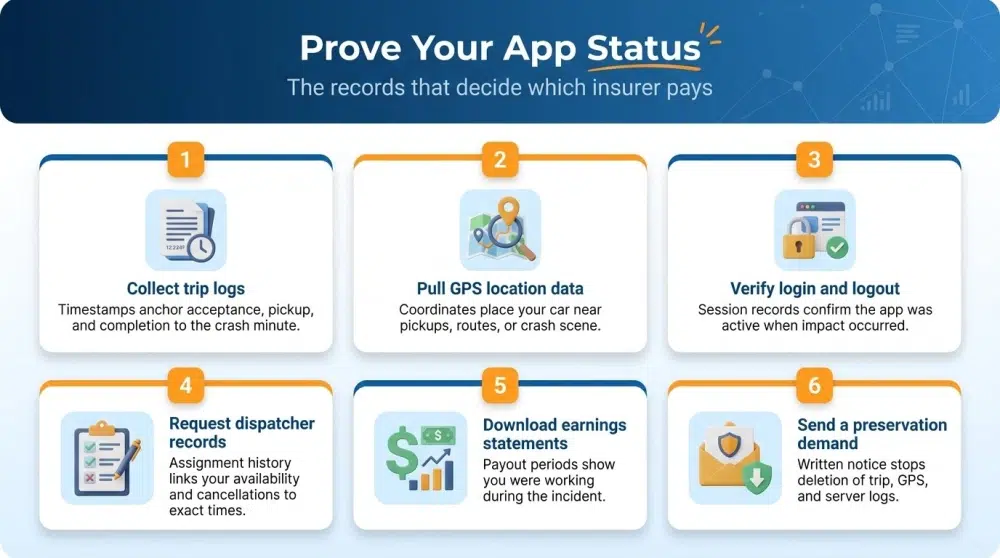
App data that may be relevant to establishing driver status includes:
- Trip logs: Timestamps showing when a trip request was accepted, when the driver arrived at the pickup location, when the passenger entered the vehicle, and when the trip was completed or cancelled
- GPS location data: Tracking the vehicle’s position at the time of the crash relative to the pickup location and destination
- Login and logout records: Confirming when the driver activated and deactivated the app
- Earnings statements: Documenting that the driver was in active service during the billing period
- Dispatcher records: Internal platform records of trip assignments, cancellations, and driver availability
This data is held by the rideshare platform, not the driver. Obtaining it in a legal proceeding typically requires a formal discovery request, subpoena, or a formal preservation demand sent before litigation begins. Platforms may not retain all data indefinitely, which means prompt action is important. The sooner a written preservation demand is sent to the platform, the less likely it is that relevant records are lost or overwritten.
Screenshots taken immediately after the crash can also capture the app’s status display if the driver is physically able to do so. However, a platform’s own internal records are generally more authoritative and harder to dispute than a screenshot.
Police reports prepared at the scene of a crash on I-30 or any other Dallas thoroughfare may note that the driver was engaged in rideshare activity, but law enforcement officers do not always capture this information. App data provides the independent, time-stamped record that the insurance coverage analysis requires.
You can find detailed guidance on rideshare accident insurance in Texas in our knowledge base, including how to preserve critical evidence after a crash.

What Evidence Can Matter in a Rideshare Driver Injury Claim?
Beyond app data, the following categories of evidence can be important to a Texas rideshare driver’s injury claim.
- Police report: Identifies the at-fault driver, the crash location, witness information, and any citations issued. Filing a report promptly preserves this information.
- Photographs and video: Images of vehicle damage, road conditions, traffic signals, skid marks, and injuries taken at the scene document conditions that cannot be replicated later. Dashcam footage, if the driver carries one, can show exactly what happened in the moments before impact.
- Witness statements: Bystanders who observed the crash, particularly on high-volume roads like the Dallas North Tollway where traffic moves quickly, may have seen the sequence of events that a camera did not capture.
- Medical records and bills: Documentation of every diagnosis, treatment, referral, and related expense supports the economic damages portion of the claim. Gaps in treatment can be used to argue that injuries were less severe than claimed.
- Employment and earnings records: A rideshare driver who cannot work while recovering has lost income. Platform earnings statements, bank records, and tax filings help establish the baseline against which lost income is measured.
- Black box and event data recorder: Modern vehicles contain electronic control modules that record speed, braking, acceleration, and seatbelt status in the moments before a crash. This data can corroborate or contradict other evidence.
- Insurance declarations pages: Both the at-fault driver’s personal policy and the TNC’s commercial policy must be identified and examined for applicable limits, exclusions, and endorsements.
- Communications: Text messages, call logs, and in-app messages can establish timeline and context. A distracted driver who was texting at the time of the crash may have discoverable phone records.
What Damages or Remedies May Be Available?
A rideshare driver injured in a Texas collision may be able to pursue compensation for a range of losses, subject to the facts of the case, the applicable coverage layers, and governing Texas law. Recoverability depends on the specific circumstances of each claim.
Economic Damages
- Past medical expenses: Hospital stays, emergency care, surgery, physical therapy, prescriptions, and related treatment costs incurred before the claim resolves
- Future medical expenses: Projected costs of ongoing treatment, follow-up surgery, long-term rehabilitation, or assistive devices where supported by medical evidence
- Lost income: Rideshare platform earnings lost during the recovery period, documented through app earnings statements and, where applicable, tax records
- Loss of earning capacity: Where an injury impairs the driver’s ability to work in any capacity, not just as a rideshare driver, the reduction in future earning ability may be compensable
Non-Economic Damages
- Physical pain and suffering: Compensation for the physical pain caused by the injuries and their treatment
- Mental anguish: Recognized under Texas law as a separate element of damages when the injury causes psychological distress
- Physical impairment: Damages for the loss of the ability to participate in activities the injured person engaged in before the crash
- Disfigurement: Compensation for permanent scarring or visible physical changes caused by the injury
Property Damage
Repair or replacement of the vehicle used for rideshare activity is a recoverable economic loss. In Texas, a diminished value claim for the reduced market value of a repaired vehicle may also be available.
Wrongful Death
If a rideshare crash results in a driver’s death, the driver’s surviving family members may have claims under the Texas Wrongful Death Act and the Texas Survival Statute.[5] The applicable insurance layers and coverage limits are the same as in a personal injury claim, though the damages elements and eligible claimants differ. Fatal crash attorneys in Dallas who handle these cases understand how the TNC’s policy responds to wrongful death claims.
Texas law imposes a modified comparative fault rule under which a claimant’s recovery is reduced proportionally by their percentage of fault, and a claimant who is more than 50 percent at fault may not recover at all.[6] How fault is allocated between the rideshare driver, the at-fault driver, and any other parties involved is a factual question that the evidence helps answer.
What If Insurance Is Disputed or Denied?
Insurance disputes in rideshare injury cases often arise in three scenarios: the personal auto insurer denies coverage citing the for-hire exclusion during Period One; the TNC’s insurer disputes which coverage period applied based on its own app records; or the at-fault driver carries inadequate coverage.
When a personal insurer denies a Period One claim, the denial letter itself becomes evidence needed to trigger the TNC’s contingent layer. The denial should be preserved in writing. The insurer’s stated reason for denial matters because it defines the scope of any bad faith claim if the denial was wrongful.
When the TNC’s insurer disputes the applicable period, the dispute usually turns on app data. The platform’s records and the driver’s own account of events must be reconciled. Timestamps, GPS coordinates, and trip logs all become central to resolving that dispute.
Texas insurance law imposes obligations on insurers to acknowledge, investigate, and accept or deny claims within specific timeframes under the Texas Prompt Payment of Claims Act.[7] Unreasonable delays or denials may give rise to additional remedies beyond the original claim amount.
If you are facing a coverage denial or dispute after a rideshare injury in Dallas, a personal injury claim can involve medical evidence, insurance issues, liability disputes, and legal deadlines that shift quickly. A GoSuits car accident lawyers in Dallas review can help you understand which coverage layers apply and whether a denial is justified.
How Long Do You Have to Act in Texas?
Texas imposes a two-year statute of limitations on personal injury claims, including those arising from vehicle collisions.[8] For a rideshare driver injured in a crash, the two-year clock generally begins running on the date of the accident. If the claim is not filed in court within that period, the right to pursue compensation may be permanently lost, regardless of the severity of the injuries.
Several considerations can affect the timing of a rideshare injury claim:
- Wrongful death claims: The statute of limitations also runs from the date of death, which may or may not be the same as the date of the crash.
- Insurance notice requirements: Many auto insurance policies require prompt notice of a loss. Delayed notice can provide an insurer with a basis to deny the claim. Notice requirements are contractual and may be shorter than the legal statute of limitations.
- Evidence preservation: While the statute of limitations sets the ultimate deadline for filing suit, the practical deadline for preserving app data, black box data, and surveillance footage is far earlier. Electronic records may be overwritten within weeks.
- Minor claimants: Where an injured person is a minor at the time of the crash, the statute of limitations may be tolled until the minor reaches the age of majority.
Deadlines in personal injury cases require legal verification for each specific set of facts. This article provides general information about Texas law and does not constitute legal advice regarding any particular claim.
What Should You Do After a Rideshare Injury in Texas?
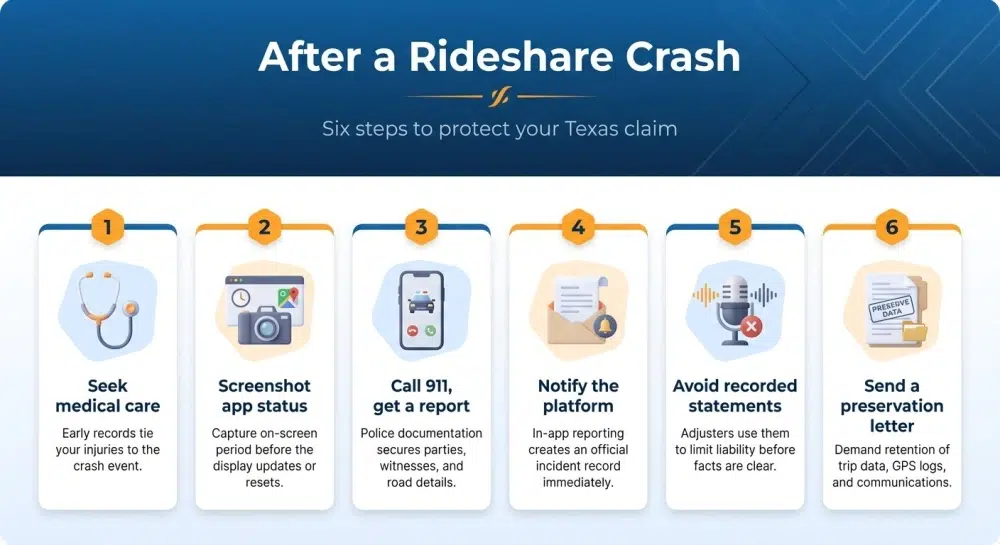
- Seek medical care immediately. Injuries that are not documented promptly are harder to connect to the crash. Emergency or urgent care records create a medical baseline.
- Capture your app status. If you are physically able, screenshot the app screen showing your status (Period One, Two, or Three) immediately after the collision before the display changes.
- Call 911 and request a police report. A Dallas police report documents the crash, identifies the parties, and preserves witness information. Even if injuries seem minor, a report creates an official record.
- Preserve all communications. Keep any messages from the rideshare platform, insurance adjusters, or the other driver. Do not delete texts or emails.
- Notify the rideshare platform. Most platforms have in-app accident reporting. Report the crash through the official channel to create a platform record.
- Do not give a recorded statement to any insurer without legal guidance. Statements made to adjusters can be used to limit or deny your claim.
- Send a written preservation demand. An attorney can send a formal letter to the rideshare platform asking that all trip data, app records, and GPS logs from the date of the crash be preserved pending legal proceedings.
- Consult an attorney before accepting any settlement offer. Early settlement offers may not account for future medical expenses, long-term disability, or the full coverage available under the TNC’s policy.

Related Texas Personal Injury Resources
- Texas Occupations Code Chapter 2402 Transportation Network Companies (statutes.capitol.texas.gov)
- Texas Labor Code Workers’ Compensation (statutes.capitol.texas.gov)
- Texas Civil Practice & Remedies Code, Chapter 33 Modified Comparative Fault
- Texas Prompt Payment of Claims Act (Texas Insurance Code Chapter 542)
- Texas Department of Insurance Consumer Protection Resources (tdi.texas.gov)
Talk With a GoSuits Attorney
A rideshare injury case isn’t just one thing. There’s medical evidence to pull together, insurance adjusters to deal with, arguments over which coverage period applied, and a handful of legal deadlines all ticking at the same time. If you got hurt driving for a rideshare platform in Dallas, or really anywhere in Texas, a GoSuits personal injury attorney can walk through the facts with you, figure out every coverage layer that might apply, and lay out your options. No obligation, no pressure.
As car accident lawyers in Dallas and across Texas, our team works on a contingency fee basis: there is no attorney fee unless a recovery is made on your behalf. You can schedule a free consultation to discuss your situation and learn what steps make sense for your claim.
References and Legal Authorities
- Texas Occupations Code Chapter 2402 – Transportation Network Companies – Texas Legislature Online
- Texas Labor Code Chapter 406 – Workers’ Compensation Coverage – Texas Legislature Online
- Texas Workers’ Compensation for Employers – Texas Department of Insurance
- Texas Labor Code Chapter 401 – Definitions – Texas Legislature Online
- Texas Civil Practice & Remedies Code Chapter 71 – Wrongful Death; Survival – Texas Legislature Online
- Texas Civil Practice & Remedies Code Chapter 33 – Proportionate Responsibility – Texas Legislature Online
- Texas Insurance Code Chapter 542 – Processing and Settlement of Claims – Texas Legislature Online
- Texas Civil Practice & Remedies Code Chapter 16 – Limitations – Texas Legislature Online
- Independent Contractor – Wex Legal Dictionary, Cornell Law School Legal Information Institute
- Rideshare Insurance Information for Texas Consumers – Texas Department of Insurance