






























California strict liability and what it means for your case
Most injury claims require proving someone was careless. Product liability in California works differently, and that difference matters enormously if you’ve been hurt.
The California Supreme Court established strict liability for defective products in Greenman v. Yuba Power Products, Inc., 59 Cal. 2d 57 (1963). Under that rule, a manufacturer is liable when a product it places on the market has a defect that causes injury during reasonably foreseeable use. You do not have to prove the manufacturer was negligent. You prove the defect, you prove it existed when the product left the manufacturer’s control, and you prove it caused the harm. That’s the standard.
California recognizes three routes to liability. A design defect claim says the product’s design was unreasonably dangerous even when built exactly as intended. California courts apply the consumer-expectations test and the risk-benefit test from Barker v. Lull Engineering Co., 20 Cal. 3d 413 (1978), and on a risk-benefit case the burden of justifying the design shifts to the manufacturer once you show the defect caused the injury. A manufacturing defect claim says the specific unit that hurt you departed from the manufacturer’s own specifications, the product was a bad copy of what it was supposed to be. A failure-to-warn claim says the manufacturer knew or should have known about a risk and failed to communicate it clearly, whether on the label, in the instructions, or through the retailer.
You can plead all three in the alternative, and you often should, because the strongest theory may not be clear until discovery produces the manufacturer’s internal documents.
California Civil Code section 1714 codifies the underlying negligence duty, and plaintiffs commonly add a negligence count alongside strict liability. The filing deadline for most product injury claims is two years from the date of injury under California Code of Civil Procedure section 335.1, with a discovery rule available when the defect or its connection to the injury was not immediately apparent. Do not assume the clock has not started. Call first and get that question answered.
Who can actually be held responsible?
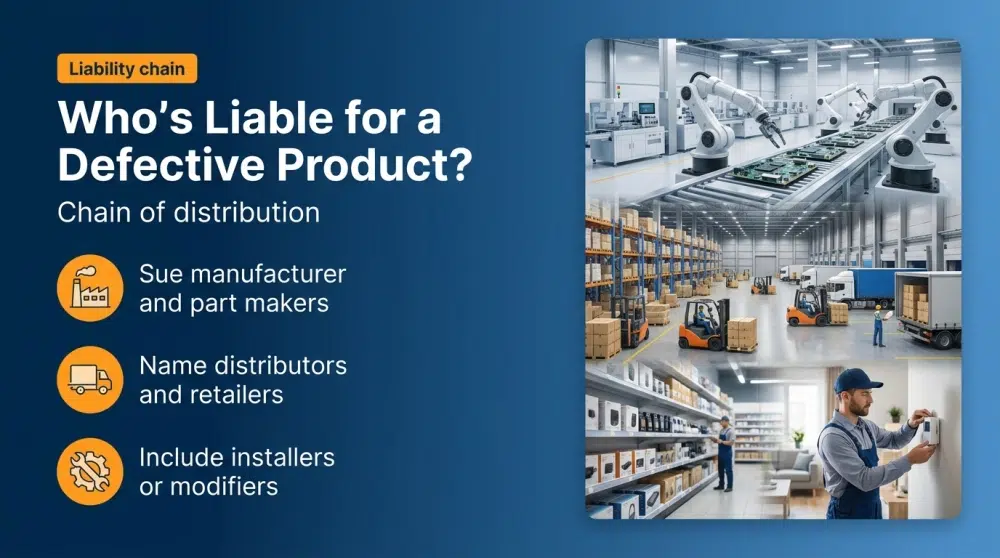
One of the most important things California law does in this area is extend strict liability through the entire chain of distribution. You are not limited to suing whoever made the product.
The manufacturer, the company that designed and built it, is the obvious defendant. But if a defective component caused the failure, the component-part maker can be sued separately. If a distributor or wholesaler moved the product from factory to retailer, that party can be liable too. The retailer that sold it to you, whether that’s a big-box store, a dealership, or an online seller, can be held strictly liable even without any role in designing or making the product. And if a third party installed, repaired, or modified the product before it reached you, that party may share responsibility as well.
Why cast a wide net? Because some defendants settle early while others fight. Some have policy limits that won’t fully cover serious injuries. A few may be judgment-proof or in bankruptcy. The defendants worth pursuing are not always the obvious ones at the start. We investigate the full chain before deciding who stays in the case and who doesn’t.
On the consumer side, California’s pure comparative negligence rule from Li v. Yellow Cab Co., 13 Cal. 3d 804 (1975), and extended to product liability cases by Daly v. General Motors Corp., 20 Cal. 3d 725 (1978), means your own partial fault reduces your recovery proportionally but does not eliminate it. A jury that finds you 25% at fault for ignoring a warning still awards you 75% of the total damages.
The evidence you need to keep, starting right now
The product is the most valuable piece of evidence in this kind of case. Do not throw it away. Do not clean it or repair it. Do not hand it back to the retailer. Do not let the manufacturer’s adjuster take it for inspection without your attorney present. California’s spoliation-of-evidence doctrine allows courts to penalize the party responsible for losing or destroying evidence, and that cuts both ways: manufacturers have an obligation to preserve their own records once litigation is foreseeable, and we send preservation demands immediately after you call to put them on notice.
Beyond the product itself, gather the original packaging, the instruction manual, any warning labels, receipts, and the model and serial numbers. Photograph the product before and after the failure. Collect your medical records. Pull any recall notices from the CPSC, NHTSA, or FDA databases. If the product was purchased online, save the order confirmation and product listing page before it disappears.
We also pull prior incident reports through SaferProducts.gov and NHTSA’s vehicle complaint portal, which often show the manufacturer had notice of the same failure pattern long before your injury. In discovery, we go after internal design documents, test records, safety meeting minutes, and the emails manufacturers send each other when a product keeps failing. That kind of internal paper trail is frequently what separates a case that settles well from one that has to fight to trial.
What can you actually recover?
California product liability law allows recovery of both economic and noneconomic damages. Economic damages include past and future medical bills, lost wages, reduced earning capacity going forward, property damage, and out-of-pocket costs you paid because of the injury. Noneconomic damages cover pain and suffering, emotional distress, disfigurement, loss of enjoyment of life, and a spouse’s loss of consortium.
In cases where a manufacturer acted with malice, oppression, or fraud, California Civil Code section 3294 allows punitive damages on top of that. Hiding a known defect from regulators, suppressing test data that showed failures, continuing to sell a product after internal reports flagged the hazard: those kinds of corporate decisions create punitive exposure. Constitutional limits under State Farm v. Campbell generally cap the ratio of punitive to compensatory damages, but the number can still be significant.
When a product defect kills someone, surviving family members can bring a wrongful death claim under California Code of Civil Procedure section 377.60 and a separate survival action under section 377.30. The wrongful death claim recovers the family’s losses, including lost financial support and loss of love, companionship, and society. The survival action captures what the decedent would have been owed had they lived to see the case resolve.
One thing that affects what you actually take home: medical liens. When treatment is provided on a lien, the medical provider has a claim against your recovery. We negotiate those liens down at the end of the case, often by meaningful amounts, so the number on the settlement check translates into real money in your pocket rather than going straight back to pay off bills at full rate. That lien negotiation step is part of the job, not an afterthought.
What to do in the first 48 hours
Get medical care. That comes first. If the injury is serious, go to the emergency department at Hoag Hospital in Newport Beach or Kaiser Permanente Irvine, or call 911. Medical records created close in time to the injury are harder to attack than records generated weeks later, and your health is what matters most.
Then preserve the product. Put it somewhere safe and leave it exactly as it is. Take photographs from multiple angles, including close-ups of the area that failed. If the product is a vehicle, do not let it be towed to a storage facility without knowing where it is going and who controls access.
Do not speak to the manufacturer’s insurance company without counsel. Their adjusters are trained to gather statements early, while injuries are not fully understood and emotions are high. An early recorded statement that downplays symptoms or accepts blame for how the product was used can follow the case for years. The safest thing is to say you are represented and give them your attorney’s contact information.
Call us. We work on contingency and handle the preservation demands, the investigation, and the legal strategy while you handle recovering. Our attorneys are part of our Irvine personal injury practice, which means your product case draws on the same trial infrastructure, the same engineering professionals, and the same medical network as every serious injury case we handle in Orange County. You can read more about our fee structure and what contingency representation actually means in our no win, no fee overview. And when you’re ready to talk, you can schedule a free consultation at any time, day or night.
How these cases are valued and what moves the number
The value of a product liability claim depends on four things: the severity of the injury, the strength of the liability evidence, the number and financial resources of the defendants, and the jurisdiction where the case will be tried.
Severity drives the medical damages component. A burn requiring multiple grafts, a brain injury with lasting cognitive effects, or a spinal cord injury requiring lifetime care will anchor a much larger recovery than a fracture that healed cleanly. Future medical costs, calculated with the help of life-care planners and reduced to present value by economists, often dwarf the past bills by a wide margin in catastrophic cases.
Liability strength determines whether the case settles or fights. A manufacturer with internal emails showing it knew about the failure mode before your injury is in a very different position than one facing a theory that requires building the defect case from scratch through engineering analysis. Discovery is where that difference is revealed.
The number of defendants expands the available insurance. A case against a manufacturer alone is capped by their policy limits. A case against the manufacturer, the component-part maker, and the retailer draws from multiple policies and potentially corporate assets as well.
And the jury pool matters. Orange County Superior Court juries have seen these cases before and tend to respond with fairness when the evidence is clear and the injury is real. We prepare every case as if it will go to trial, which is also what produces the settlements that actually reflect the case’s value.
