













































Which county does a Carrollton injury case belong in?
Carrollton sits in three counties at once, Dallas, Denton and Collin. The county lines run through the city, so it is not always obvious from an address which county a crash or a fall belongs to, and two people in the same crash can live in different counties.
That matters because a civil injury suit in Texas is filed in a district court. Venue generally follows where the events took place or where a defendant lives. A rear-end crash on Josey Lane, a fall at a Belt Line Road shopping center and a collision with a driver who lives in Plano can each point to a different courthouse. We decide that before filing, not after, because the right county affects how fast a docket moves and which jury pool hears the case.
Many cases never get that far. Most settle with the insurer once the medical picture is clear. But the insurer prices the claim knowing whether your lawyer is willing to file in whichever county is correct.
What injuries and incidents bring people in from Carrollton?
Vehicle crashes are the largest group. I-35E carries heavy commuter and freight traffic through the city, the President George Bush Turnpike crosses the city, the Sam Rayburn Tollway touches its far north end, and Old Denton Road meets the turnpike in the area known as Koreatown Carrollton.
Not everything is a crash. People slip on wet floors in stores along Belt Line Road and Trinity Mills Road, get bitten by dogs in parks and neighborhood streets, and are hurt by products that failed. Some are injured while working, and some are hurt as pedestrians near DART stops, where the Green Line runs through Trinity Mills and Downtown Carrollton and ends at North Carrollton/Frankford.
Rideshare and delivery vehicles are now part of ordinary traffic here. A driver on an app can carry several layers of insurance depending on whether the app was off, waiting for a request or carrying a passenger, and sorting that out takes records the injured person does not have.
The most serious cases involve brain and spinal cord injuries, burns, and deaths. A death caused by someone else’s negligence belongs to a different kind of claim, with different people allowed to bring it, and it deserves its own conversation with an attorney.
Who ends up paying?
Usually an insurance company, and often more than one.
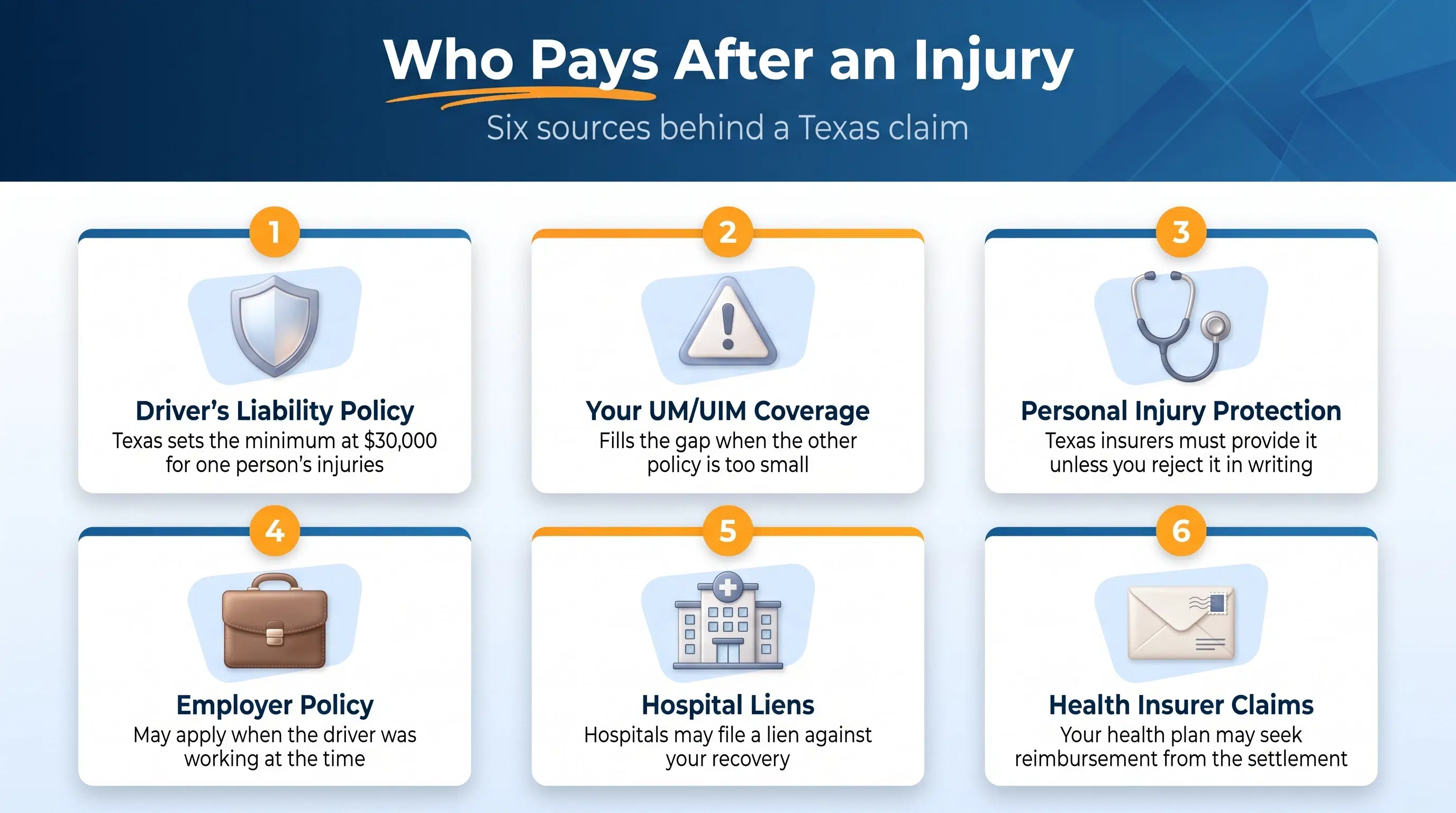
Texas requires drivers to carry at least $30,000 for one person’s bodily injury, $60,000 for all injured people in one collision, and $25,000 for property damage. Those are the minimums under Transportation Code section 601.072, and they run out fast when someone has surgery. This is why we look past the at-fault driver’s policy to your own uninsured and underinsured motorist coverage, any employer policy if the driver was working, and personal injury protection, which Texas insurers must provide unless the named insured rejects it in writing.
Medical providers add their own claims. A hospital may file a lien against your recovery, health insurers may seek reimbursement, and the bills on the table at settlement are rarely the numbers that matter. Texas law also limits recovery of medical expenses to the amount actually paid or incurred, which is a reason the billing records get read closely. At settlement we negotiate with hospitals, ER groups and other lien holders to reduce what comes out of the award, so more of the money reaches you.
Is the driver the only one who can be blamed?
Rarely. A crash on I-35E at rush hour might involve the driver who hit you, an employer who sent that driver out on a deadline, a company that did not maintain the vehicle, and a city or contractor responsible for a lane closure or a broken signal. Each is a separate target with separate insurance, and Texas assigns responsibility among all of them.
The same thinking applies away from the road. A fall in an apartment complex can involve the owner, the management company and a repair contractor. A dog bite may be covered by a homeowner’s or renter’s policy the owner forgot they had. A defective product can reach back to the maker, the distributor and the store. Finding the full list early matters because every extra defendant is another policy that can pay.
What should you do in the first week?
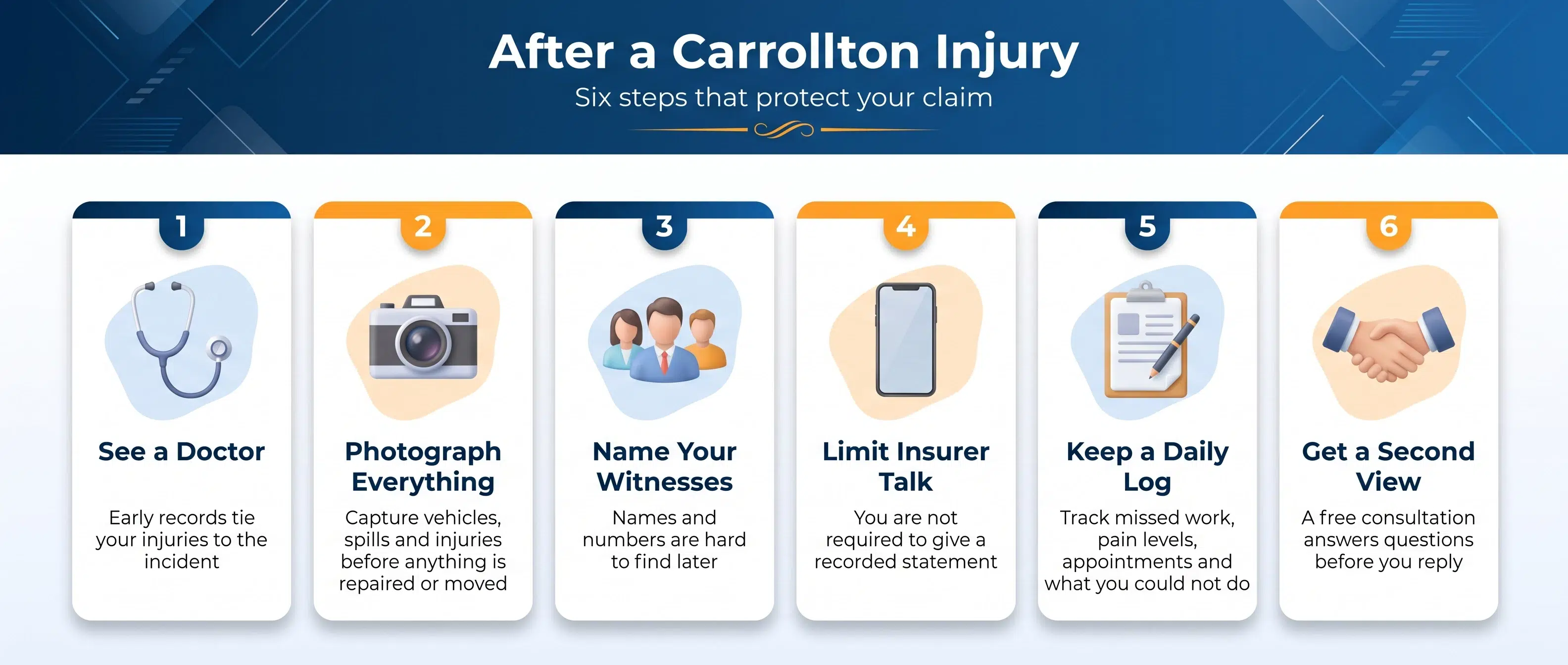
See a doctor, even if you feel mostly fine. Adrenaline hides injuries, and a gap between the incident and the first medical record is something an adjuster will point to later.
Take photographs before anything is moved or repaired: vehicles, the road, the spill, the torn carpet, your injuries as they change. Write down names of witnesses. If you were in a crash, you can buy the official Texas Peace Officer’s Crash Report from TxDOT’s online system, and people involved in a crash can request it.
Say little to the other side’s insurer. You are not required to give a recorded statement, and a casual remark about feeling okay can follow your claim for months. If you want a second view before replying to anyone, schedule a free consultation with our team.
Keep a simple log of missed work, pain levels, appointments and what you could not do. Courts and insurers respond to dates and specifics.
How do insurers handle an injury claim?
They start fast and friendly. A call arrives within a day or two, the adjuster asks how you are feeling, and a recorded statement is requested. Soon after comes an offer, often modest, and a form to release medical records that reaches back years.
None of this is illegal, and some adjusters are straightforward. But the file they are building is about reducing what the company pays: a gap in treatment becomes proof you recovered, a prior back complaint becomes the cause of your pain, a photo of you carrying groceries becomes proof you are fine. We handle the calls so you do not have to decide, mid-recovery, how much to say.
If the insurer acts unreasonably, Texas has an insurance code that applies to unfair claim practices, and that is another point we weigh when the offers do not match the records.
How long do you have, and what disappears sooner?
Most Texas injury suits must be filed within two years of the injury under Civil Practice and Remedies Code section 16.003. If someone died, the two years run from the date of death. A person younger than 18 when hurt generally has the clock paused until they turn 18.
Claims against a city, county or transit agency are different. The Texas Tort Claims Act requires notice within six months of the incident, and some city charters set shorter periods. A fall on a city sidewalk or a crash with a city vehicle can be lost to that notice rule long before the two years are up.
Evidence runs out faster than either. Parking lot and doorbell cameras overwrite in days. A vehicle with event data is repaired, sold or salvaged. We send preservation letters early for that reason.
What if you were partly at fault?
Texas uses proportionate responsibility. A jury assigns each person a percentage of fault. If you are found more than 50 percent responsible you recover nothing, and if you are 50 percent or less your damages are reduced by your share (Civil Practice and Remedies Code sections 33.001 and 33.012).
So a claim is often decided by a fight over small percentages. Did you brake late, or was the other driver following too close? Was the floor sign out, or wasn’t it? Insurers know a few points of fault shave real money off a claim, which is why they ask pointed questions early.
What is a claim worth?
There is no formula, and anyone quoting a number before your treatment is finished is guessing. Value comes from medical bills and records, how long you were out of work and what you earn, future care, and the effect on how you live. Permanent changes count for more than a good recovery.
Pain and the loss of ordinary life are real parts of the number, even though they have no receipt. A jury is asked what the injury has cost you in comfort, activity and peace of mind, and it helps to have a doctor, a spouse or a coworker who can describe the before and after. Lost earning ability is handled the same way: records first, then an honest projection.
Insurers often offer early, before the full extent of an injury is known. A disc injury that looks like a sprain in week two can mean an injection series or surgery by month six, and a release signed in between closes the claim. Our guide to how injury claims move through Texas courts walks through what happens if talks fail and suit is filed.
Which Carrollton cases do we take?
Our Dallas office is here in Carrollton, on Commander Drive, and most of the Carrollton cases we see start on the road. Crashes on I-35E, the President George Bush Turnpike, Josey Lane and Belt Line Road are handled by our Dallas-area car accident lawyers. Freight and delivery trucks run the same corridors, and a crash with one brings in a carrier, its insurer and federal safety rules, which our Dallas-area truck accident team works from the first week.
When someone is killed, Texas allows the surviving spouse, children and parents to bring a wrongful death claim, and the estate may bring a separate survival claim. Our Dallas-area wrongful death lawyers handle those cases. We also take fall, dog bite, premises and product injury cases from Carrollton, including cases that reach well beyond the city, through our Dallas personal injury office.