- What Is the Texas Modified Comparative Fault Rule?
- How Does the 51% Bar Rule Work in Texas Auto Accidents?
- How Is Fault Percentage Calculated in a Texas Car Accident?
- What Does Shared Fault Mean for Injured Drivers in Texas?
- How Does Proportionate Responsibility Affect Defendants in Texas?
- How Does Texas Fault Law Affect Your Insurance Claim?
- What Happens When Multiple Defendants Share Fault in a Dallas Crash?
- Can Proportionate Responsibility Apply in Texas Wrongful Death Claims?
- How GoSuits Dallas Personal Injury Attorneys Can Help
- References and Resources
What Is the Texas Modified Comparative Fault Rule?
If you have been in a car accident in Texas and someone tells you that you were partially at fault, you may be wondering whether you can still recover compensation. The answer depends on a specific legal doctrine known as the Texas modified comparative fault rule, formally called the proportionate responsibility doctrine.
Texas Civil Practice and Remedies Code Chapter 33 governs proportionate responsibility in personal injury claims in the state. [1] Under this framework, Texas courts and juries assign a percentage of fault to each party involved in an accident, including the plaintiff, the defendant, and any responsible third parties. The damages you can receive are then reduced in proportion to your assigned share of fault.
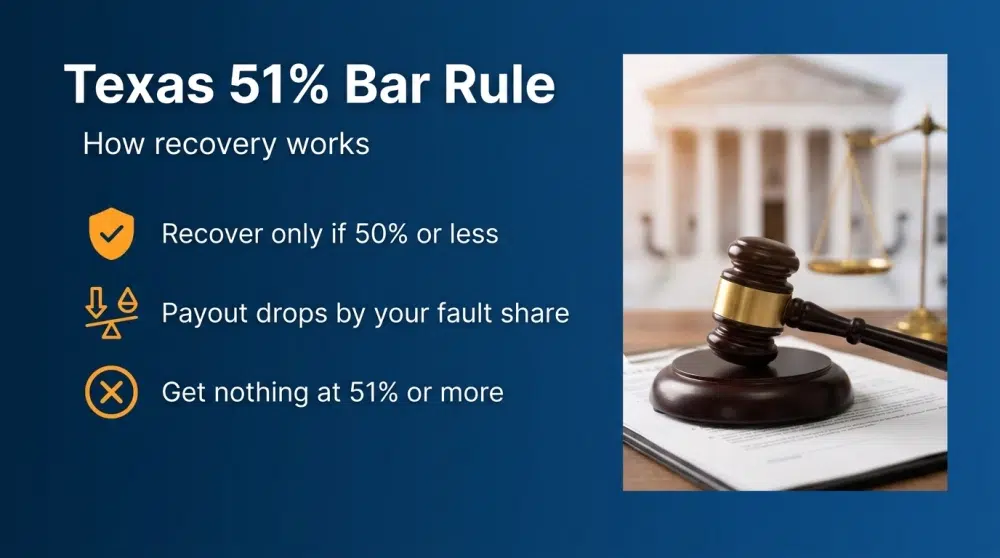
Texas follows the 51% bar rule, one of two forms of modified comparative negligence recognized across the United States. [2] What that means in plain terms is this: if you are found to be 51% or more responsible for causing the accident, you are completely barred from recovering any damages. If your share of fault is 50% or less, you can still recover, but your award is reduced by your percentage of responsibility.
This rule differs meaningfully from the pure comparative fault standard used in states like California, where a plaintiff can collect damages even if they were 99% at fault. It also differs from the old contributory negligence rule, still used in a handful of states, where any fault on the plaintiff’s part eliminated the right to recover entirely. Texas sits between those two extremes. The proportionate responsibility framework acknowledges that accidents are frequently the product of more than one person’s conduct while still placing a meaningful limit on recovery for plaintiffs who bear more than half the blame.
If you have been injured in a Dallas area collision and someone is contesting your right to compensation, speaking with personal injury lawyers who understand how Texas courts apply Chapter 33 is an important step. Do not try to handle these determinations alone.
How Does the 51% Bar Rule Work in Texas Auto Accidents?
The 51% bar operates as an absolute cutoff. Texas courts do not adjust or average around it. Once a trier of fact, whether a jury or a judge, finds that a plaintiff’s percentage of responsibility exceeds 50%, that plaintiff receives nothing. The math does not soften the result.
Consider a straightforward example. Suppose a driver runs a red light and strikes another vehicle that was traveling slightly over the speed limit. The jury determines that the red-light runner is 80% responsible and the speeding driver is 20% responsible. The 20% driver may recover, but their damages are reduced by 20%. They cannot recover the full value of their losses because they contributed to the collision.
Now reverse the scenario. Suppose the speeding driver was clocked well above the limit in a school zone, and the jury finds them 55% responsible and the other driver 45% responsible. In that case, the 55% driver is barred from any recovery under the 51% rule, even if they suffered severe injuries.
The Texas Supreme Court and courts of appeals have consistently applied this threshold in auto accident litigation. [3] The language in Tex. Civ. Prac. & Rem. Code § 33.001 states that a claimant may not recover damages if their percentage of responsibility is greater than 50 percent. [1]
In Dallas and throughout the Dallas-Fort Worth metroplex, juries in auto accident cases receive detailed jury instructions on how to assign percentages. The verdict form asks jurors to distribute fault among all responsible parties, including the claimant. Each percentage point matters. A swing of two or three points can determine whether an injured person receives any compensation at all.
Because the stakes are so high around the 50% threshold, defense attorneys in Texas actively work to push a plaintiff’s fault percentage above 51%. This makes accurate fault investigation and strong evidence presentation critical on the plaintiff’s side. Skilled car accident lawyers in Dallas know how insurers and defense teams frame fault narratives, and they work to counter those arguments with evidence.
How Is Fault Percentage Calculated in a Texas Car Accident?
What types of evidence do courts use to determine fault percentages in Texas?
Fault percentages are not assigned by a formula. They emerge from a weighing of all available evidence about how the accident happened and what each party could have done differently. Courts and juries consider a wide range of materials.
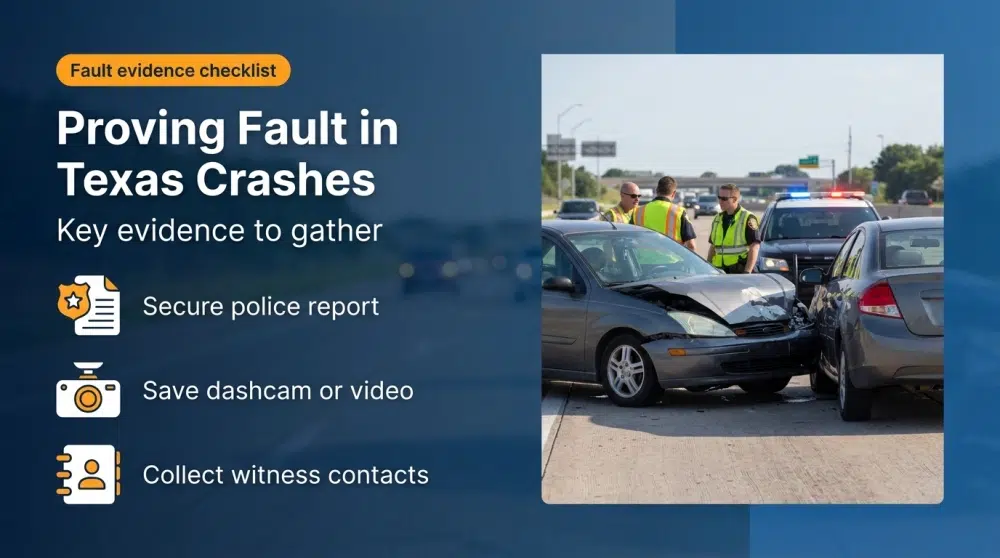
- Police reports — Texas Transportation Code requires law enforcement to investigate crashes resulting in injury or death. The reporting officer’s observations, citations issued, and initial fault assessments carry significant weight, though they are not legally binding. [4]
- Traffic camera and surveillance footage — Video evidence from intersection cameras, dashcams, or nearby business surveillance can show exactly how a collision unfolded.
- Vehicle data recorders (black boxes) — Many modern vehicles store speed, braking, and steering data in the moments before impact. Attorneys can subpoena this information.
- Witness testimony — Statements from bystanders, passengers, or other drivers who observed the events can corroborate or challenge each party’s account.
- Accident reconstruction analysis — In complex crashes, forensic investigators analyze physical evidence including skid marks, vehicle damage patterns, and final resting positions to reconstruct the sequence of events.
- Medical records — The nature and location of injuries can sometimes reveal the mechanics of impact.
- Traffic and road conditions — Whether a road was poorly lit, whether signs were obscured, or whether a traffic control device was malfunctioning can affect how fault is distributed.
According to the Texas Department of Transportation, there were 15,352 serious injury crashes and 4,283 fatal crashes on Texas roadways in a recent reporting year. [5] Dallas County consistently ranks among the highest counties in the state for crash frequency, making proportionate responsibility determinations a common feature of local civil litigation.
Understanding how Texas negligence law applies across different types of incidents is foundational to building a sound proportionate responsibility argument in court.
Are there categories of driver conduct that commonly raise a plaintiff’s fault percentage?
Yes. Certain behaviors reliably increase the percentage of fault a jury will assign to any driver involved in a crash. In Texas auto accident cases, the following conduct is frequently cited:
- Speeding — Exceeding posted speed limits or driving too fast for conditions.
- Distracted driving — Cell phone use, eating, or any activity that diverts attention from the road.
- Failure to yield — Ignoring right-of-way rules at intersections, merges, or highway on-ramps.
- Following too closely — Tailgating reduces stopping distance and is treated as negligent driving.
- Failure to use turn signals — Sudden lane changes without signaling can shift fault to the changing driver.
- Driving under the influence — DWI is a serious criminal offense in Texas and dramatically increases fault exposure in civil claims. [6]
- Seatbelt non-use — Although Texas courts limit how much seatbelt evidence can affect fault, it can still be raised in certain circumstances.
Defendants and their insurers will look for any of these factors in a plaintiff’s conduct. The defense strategy often centers on inflating the injured party’s share of responsibility to push it past the 51% threshold. This is one reason why gathering evidence quickly after a crash is so important to protecting your ability to recover.
What Does Shared Fault Mean for Injured Drivers in Texas?
Can I recover damages if I was partly at fault for my own accident in Texas?
Yes, provided that your share of fault does not exceed 50%. Texas law under Chapter 33 explicitly allows recovery when the claimant’s percentage of responsibility is 50% or less. [1] However, the amount you recover is reduced proportionately.
Here is a practical illustration. Suppose a jury determines your total compensable damages are $200,000 and assigns you 30% of the fault for failing to signal a lane change before the at-fault driver struck you. Your recovery is reduced by 30%, leaving you with $140,000. That is still a significant recovery, even with the reduction.
The key considerations for injured plaintiffs under the Texas modified comparative fault rule are:
- Document everything at the scene — Photographs, witness contact information, and your own written recollection of events help preserve the factual record in your favor.
- Do not admit fault at the scene — Statements made immediately after an accident can be used against you. Avoid speculating about what you could have done differently.
- Seek medical attention promptly — A gap in treatment can be used to argue that your injuries are less serious or were caused by something other than the accident.
- Preserve vehicle evidence — Do not have your car repaired before it has been inspected and documented. Physical damage is evidence.
- Engage legal counsel early — The sooner personal injury lawyers begin gathering and preserving evidence, the stronger your proportionate fault defense becomes.
Texas also applies the proportionate responsibility rule to passengers. A passenger who contributed to causing an accident, for instance by grabbing the steering wheel, can have their own damages reduced. In most passenger injury cases, however, the passenger bears little or no fault and can typically pursue the full value of their damages.
How Does Proportionate Responsibility Affect Defendants in Texas?

What are a defendant’s obligations under Texas proportionate responsibility law?
From the defendant’s perspective, the proportionate responsibility framework has several important implications in Texas auto accident claims.
First, Texas uses what is called a proportionate several liability rule for most defendants. [1] Under Chapter 33, a defendant is generally liable only for the portion of the damages that matches their own percentage of fault. If a defendant is found 40% responsible and total damages are $500,000, that defendant pays $200,000 — not the full amount.
There is an important exception. Under Section 33.013 of the Texas Civil Practice and Remedies Code, a defendant who is more than 50% responsible for the harm, or who acted with fraud, malice, or specific intentional conduct, can be held jointly and severally liable for the full damages. [1] This is sometimes called the “greater than 50% rule” for joint and several liability. In a severe accident where one driver was clearly the dominant cause, that driver faces exposure for the entire damages award even if other parties were also partially at fault.
Second, defendants can designate responsible third parties to the lawsuit. Texas courts allow a defendant to point to entities or individuals who were not named in the lawsuit but who also contributed to causing the accident. The jury then assigns fault to those parties as well. If a negligent road construction company, a defective vehicle manufacturer, or another driver contributed to the crash, the defendant may seek to have that fault distributed among all responsible parties rather than borne entirely by the named defendant.
Third, insurance companies defending Texas auto accident claims are well aware of how the 51% bar operates and often use it aggressively. Insurers frequently investigate plaintiff conduct from the outset, looking for any evidence that shifts the fault balance toward or past 51%. This is why defendants represented by experienced trial counsel, and plaintiffs equally represented by seasoned car accident lawyers, tend to reach more factually grounded outcomes than cases handled without skilled advocacy on both sides.
How Does Texas Fault Law Affect Your Insurance Claim?
Does Texas follow a no-fault or at-fault insurance system?
Texas is an at-fault state for auto accidents. [7] This means the driver who caused the crash is financially responsible for the resulting damages, and injured parties typically pursue compensation through the at-fault driver’s liability insurance rather than through their own coverage.
Texas law requires minimum liability insurance of $30,000 per injured person, $60,000 per accident, and $25,000 for property damage, commonly written as 30/60/25 coverage. [8] However, these minimums are often insufficient to fully compensate victims of serious crashes.
The way fault percentages interact with insurance claims in Texas can be complicated. When you file a claim against another driver’s insurer, that insurer will conduct its own investigation to determine how much fault, if any, to assign to you. Their interests are not aligned with yours. Insurance adjusters may:
- Record your statements and use offhand remarks about your driving to increase your assigned fault percentage.
- Offer quick settlements before the full extent of your injuries is understood, which can prevent you from recovering the full value of your claim.
- Dispute causation, arguing that some of your injuries existed before the accident or were caused by subsequent events.
- Characterize your actions as contributing to the accident based on incomplete information.
Under the Texas proportionate responsibility framework, a determination by an insurer that you were, say, 52% at fault means they will pay you nothing. That determination is not final or binding in a court proceeding, but many injured people accept it without understanding that they have the right to dispute it. Talking to Dallas car accident lawyers before accepting or rejecting an insurance settlement is consistently the more protective approach.
Personal injury lawyers can evaluate whether the insurer’s fault assessment is defensible, gather independent evidence, and either negotiate a more accurate settlement or pursue litigation to have a jury make the fault determination instead.
What Happens When Multiple Defendants Share Fault in a Dallas Crash?
How does Texas law handle proportionate responsibility when several parties caused the accident?
Multi-party crashes are common in urban driving environments, and Dallas is no exception. When more than two parties share responsibility for an accident, Chapter 33 of the Texas Civil Practice and Remedies Code applies to each of them individually.
The jury is asked to assign a specific percentage of responsibility to each party, including the plaintiff, each defendant, and any designated responsible third parties. Those percentages must add up to 100%. Each defendant is then generally liable only for their proportionate share of damages, unless they exceed the 50% threshold that triggers joint and several liability.
For example, consider a three-car chain-reaction collision on I-35 in Dallas. The jury assigns 60% fault to the first driver who rear-ended the second car, 25% fault to the second driver who had a broken taillight, and 15% fault to the plaintiff who was following slightly too closely. Because the plaintiff is 15% at fault, they can still recover. Their damages are reduced by 15%. The 60% driver is individually liable for 60% of the damages but, because their fault exceeds 50%, they also carry joint and several liability for the whole. The 25% driver is liable only for 25%.
These calculations become especially important when one defendant is judgment-proof, meaning they lack the assets or insurance to pay their share. In that case, the plaintiff must look to the remaining defendants, and the extent of each defendant’s joint and several liability determines what can actually be collected.
In situations involving commercial trucks, rideshare vehicles, or multiple drivers, the liability web becomes more intricate. Our Dallas truck accident lawyers handle these layered cases routinely, identifying all potentially responsible parties and building a complete record of fault allocation from the outset.
Can Proportionate Responsibility Apply in Texas Wrongful Death Claims?
Does the 51% bar rule apply when a family has lost someone in a Texas car accident?
Yes. The proportionate responsibility doctrine applies in Texas wrongful death and survival actions just as it does in personal injury claims. Chapter 33 of the Texas Civil Practice and Remedies Code governs both categories of claims. [1]
When a person is killed in a Texas auto accident, eligible family members may bring a wrongful death claim under Texas Civil Practice and Remedies Code Chapter 71. [9] These claimants include the surviving spouse, children, and parents of the deceased. The same proportionate responsibility framework applies: if the deceased driver was found to be more than 50% responsible for the crash that caused their own death, the family’s wrongful death claim may be barred entirely.
This result can feel deeply unjust to surviving families, and it underscores why accurate fault investigation is so critical in fatal crash cases. When a loved one dies in an accident, insurers and defendants may aggressively argue that the deceased bore primary responsibility as a way to defeat the surviving family’s claim. Wrongful death lawyers in Dallas who handle these matters work to preserve evidence of the other driver’s conduct, challenge one-sided fault narratives, and pursue justice for families who have suffered an irreplaceable loss.
Victims may also face wrongful death claims if injuries prove fatal after the initial crash and they are brought by the family. In those situations, the injury case can convert into a wrongful death action, and the same proportionate responsibility analysis applies. Having counsel who understands both dimensions of this law is essential.
Texas applies a two-year statute of limitations to wrongful death claims from the date of death. [10] Waiting too long to pursue a claim is one of the most common and costly mistakes families make in the aftermath of a fatal accident.

How GoSuits Dallas Personal Injury Attorneys Can Help
If you or someone you love has been injured in a Texas auto accident and you are facing questions about shared fault or the 51% bar rule, the way your case is built from the very first day matters enormously. Fault percentages are determined by evidence, and the quality of that evidence often determines how the law applies to your specific facts.
GoSuits is a technology-forward personal injury firm serving clients throughout Texas, California, and Illinois, with a strong Dallas presence handling cases across the Dallas-Fort Worth metroplex, including communities like Plano, McKinney, Irving, and Carrollton. We practice in car and truck accident injury claims, motorcycle accidents, construction site injuries, product liability, workplace injury, and wrongful death cases. Our team brings more than 30 years of combined legal experience and a demonstrated record of going to trial when that is what our clients’ cases require.
What separates GoSuits from traditional firms is our proprietary case management technology. We built our own software platform that accelerates every stage of a case, from evidence collection and medical record analysis to demand letter preparation and settlement tracking. This technology gives our clients faster, more organized, and more informed representation at every phase. But technology does not replace human connection. Every GoSuits client has a dedicated attorney assigned to their case, not a case manager or intake coordinator. You have direct, unfettered access to your lawyer throughout the process.
In personal injury claims involving proportionate responsibility disputes, we work from day one to document the accident scene, preserve vehicle data, identify witnesses, and retain reconstruction analysis where needed. We know how Texas insurers use the 51% bar as a negotiating weapon, and we know how to counter it. Our prior cases reflect results across a wide range of personal injury scenarios, and our attorneys bring courtroom experience that is rare among firms that primarily settle claims.
Our practice areas span personal injury, including auto accidents, commercial truck collisions, motorcycle crashes, wrongful death claims, construction accidents, product liability, and work injuries. You can read more about who we are and how we work on our about us page, and you can review the full scope of our practice areas to understand how we may be able to help with your specific situation.
We handle cases on a contingency basis, meaning you pay nothing unless we recover for you. If you have been involved in a Dallas area collision and want to understand how the Texas modified comparative fault rule may affect your claim, we welcome you to schedule a free consultation with our team today. Speaking with one of our attorneys costs you nothing and gives you a clearer picture of your rights and options under Texas law.
References and Resources
- Texas Civil Practice and Remedies Code, Chapter 33 — Proportionate Responsibility – Texas Legislature Online
- Comparative Negligence – Legal Information Institute, Cornell Law School
- Texas Court Rules and Standards – Texas Judicial Branch
- Texas Transportation Code, Chapter 550 — Accidents and Accident Reports – Texas Legislature Online
- Texas Motor Vehicle Crash Data and Statistics – Texas Department of Transportation
- Texas Penal Code, Chapter 49 — Intoxication and Alcoholic Beverage Offenses – Texas Legislature Online
- Auto Insurance Guide – Texas Department of Insurance
- Buying Auto Insurance in Texas – Texas Department of Insurance
- Texas Civil Practice and Remedies Code, Chapter 71 — Wrongful Death; Survival; Injuries Occurring Out of State – Texas Legislature Online
- Texas Civil Practice and Remedies Code, Chapter 16 — Limitations – Texas Legislature Online
- Texas Court Rules – Texas State Law Library
- Texas Statutes Research Guide – Texas State Law Library