- What is the Illinois 50% comparative fault rule for car accidents?
- What does 735 ILCS 5/2-1116 actually say about shared fault?
- How does Illinois modified comparative negligence differ from California and Texas?
- How is fault percentage calculated in an Illinois car accident case?
- What types of evidence affect fault allocation under Illinois comparative fault?
- How does shared fault affect your compensation in a Chicago car accident claim?
- What are common Illinois car accident scenarios where comparative negligence applies?
- Can wrongful death claims in Illinois be affected by comparative fault?
- What are the deadlines for filing a car accident claim in Illinois?
- How do insurance companies use comparative fault arguments against injured drivers?
- What should you do immediately after a car accident in Illinois to protect your claim?
- How GoSuits Chicago Helps Car Accident Injury Victims
- References
What is the Illinois 50% Comparative Fault Rule for Car Accidents?
If you have been hurt in a car crash in Chicago, Naperville, Joliet, Elgin, or anywhere else across Illinois, one of the first questions you will face is: who was at fault, and by how much? Illinois answers that question through its modified comparative negligence statute, which caps your right to recover based on how much of the fault is yours.
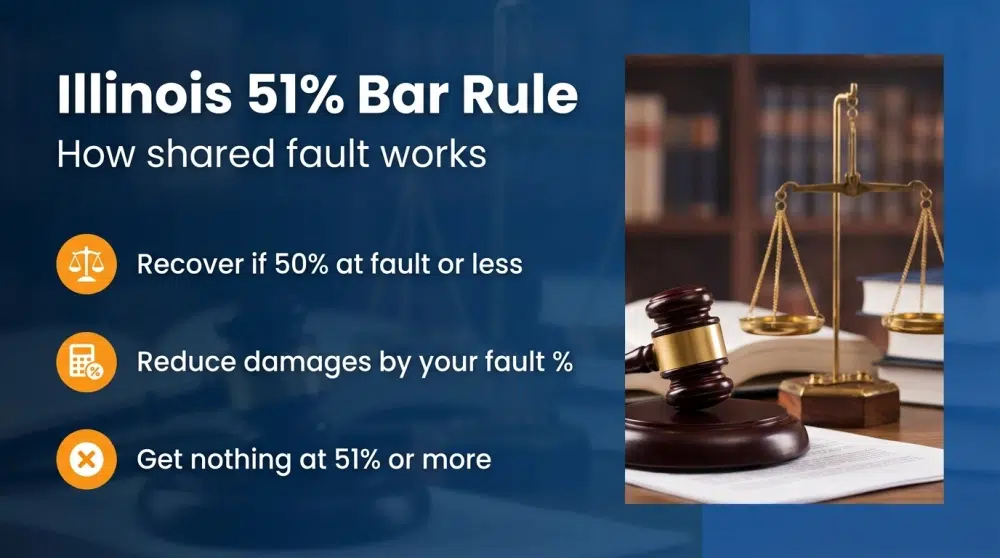
Under Illinois law, the rule works like this: if you are found to be 50 percent or less at fault for the crash, you may still recover damages from the other at-fault party. However, your compensation is reduced by your own percentage of fault. If you are found to be 51 percent or more at fault, you are completely barred from recovering anything. [1]
This is called the “51 percent bar rule” and it is codified in 735 ILCS 5/2-1116, Illinois’s governing personal injury statute. Understanding this rule is critical for anyone who has been injured in an Illinois car accident and is considering filing a civil claim. It directly shapes every settlement negotiation and every trial outcome in the state.
Because personal injury lawyers help injured people navigate these rules, connecting with a qualified attorney early gives you the best chance of protecting your right to recover. The stakes of comparative fault determinations are real: a single percentage point can mean the difference between a full recovery and none at all.
What Does 735 ILCS 5/2-1116 Actually Say About Shared Fault?
The Illinois modified comparative negligence rule is found in the Code of Civil Procedure at 735 ILCS 5/2-1116. The statute states that in all actions on account of bodily injury, death, or property damage, the contributory fault of the plaintiff shall not bar a recovery if that fault was not greater than 50 percent of the total proximate cause of the injury. [2]
In practical terms, the statute directs the fact finder, whether judge or jury, to assign a percentage of fault to each party. The plaintiff’s damages are then reduced by the percentage attributable to their own conduct. If a jury determines that both the plaintiff and the defendant contributed to causing a crash, the court applies the apportionment formula before entering a final judgment.
The statute also addresses situations with multiple defendants. Each defendant’s liability for compensatory damages is generally limited to their proportionate share of the plaintiff’s damages, subject to specific rules about joint and several liability as modified by prior legislative amendments. The interplay of these provisions makes Illinois comparative fault law meaningful to analyze with thorough legal guidance rather than on your own.
Working with car accident lawyers who know the procedural requirements of the Illinois Code of Civil Procedure can mean the difference between a fair recovery and being left with nothing after a genuine crash caused largely by someone else.
How Does Illinois Modified Comparative Negligence Differ from California and Texas?
Three states where GoSuits actively handles serious personal injury cases are Illinois, California, and Texas. Each state takes a different approach to comparative fault, and those differences are important for anyone whose case may have multistate connections. [3]
What rule does Illinois follow?
Illinois follows modified comparative negligence with the 51 percent bar, codified in 735 ILCS 5/2-1116. A plaintiff who is 50 percent or less at fault recovers, with damages reduced by their share. A plaintiff who is 51 percent or more at fault recovers nothing.
What rule does Texas follow?
Texas also follows modified comparative negligence with a 51 percent bar under Texas Civil Practice and Remedies Code Chapter 33. The structure closely mirrors Illinois: plaintiffs can recover only if their percentage of responsibility does not exceed 50 percent, and their damages are reduced proportionally. [4]
What rule does California follow?
California uses pure comparative negligence, meaning a plaintiff can recover even if they are 99 percent at fault. Their damages are simply reduced by their share of fault, but there is no percentage bar that cuts off recovery entirely. This is a more plaintiff-friendly standard than either Illinois or Texas. [5]
The distinction matters in crash scenarios involving out-of-state drivers or vehicles that traveled across state lines. The applicable law depends on where the tort occurred and other choice-of-law considerations. If your accident happened on an Illinois highway such as I-90, I-55, or I-290 in the Chicago metro area, Illinois law will almost certainly govern the negligence standards applied to your case.
For a deeper look at how the last clear chance rule intersects with Illinois comparative negligence in car accidents, our knowledge base provides an authoritative breakdown of how these doctrines interact.
How is Fault Percentage Calculated in an Illinois Car Accident Case?
Fault allocation is not a mechanical formula. It is a fact-intensive inquiry that considers the conduct of every party involved in a crash. Under Illinois law, the jury or judge weighs the actions of each driver against the standard of what a reasonably careful person would have done under the same circumstances.
Key factors that commonly influence fault percentages in Illinois car accident claims include:
- Traffic law violations such as running a red light, speeding, or failing to yield right-of-way
- Distracted driving including cell phone use at the time of impact
- Following distance and whether a trailing driver maintained a safe gap
- Road and visibility conditions such as fog on the Illinois Tollway or ice on city streets in Chicago winters
- Vehicle condition including defective brake lights, bald tires, or malfunctioning signals
- Driver impairment from alcohol, drugs, or medication
- Evasive action taken by each driver in the moments before impact
Expert witnesses often play a significant role in contested cases. Accident reconstructionists use physical evidence, vehicle event data recorders (EDR/black box data), dashcam footage, and roadway geometry to reconstruct what happened in the seconds before a collision. Human factors analysts assess perception-reaction times. Medical and biomechanical consultants connect the injury pattern to the crash mechanism.
These are the same types of resources that skilled Illinois personal injury lawyers deploy when building a case. Gathering this evidence early, before cameras are overwritten and vehicles are repaired, is one of the most critical steps you can take after a crash.
What Types of Evidence Affect Fault Allocation Under Illinois Comparative Fault?
Evidence that shifts or stabilizes comparative fault percentages falls into several categories. Each type carries distinct value in both negotiation and litigation:
Electronic and Digital Evidence
- Event data recorders (EDR) capture pre-impact speed, throttle position, braking data, and seat belt use in the seconds before a crash. Illinois courts allow this data in civil proceedings when properly authenticated. Requesting preservation of EDR data immediately after a crash is essential, because repair or totaling of a vehicle can erase the record.
- Dashcam footage from the vehicles involved or from nearby commercial properties can show whether a driver had a clear view, whether brake lights were functioning, and the precise sequence of events.
- Cell phone records obtained through proper discovery can confirm or deny whether a driver was texting or on a call at the moment of impact.
Physical and Scene Evidence
- Skid marks and gouge marks help reconstructionists determine pre-impact speeds and the angle of collision.
- Final resting positions of vehicles combined with damage profiles indicate the force and direction of impact.
- Traffic signal and camera data from Chicago and suburban Cook County intersections can confirm signal phase at the time of the crash.
Witness and Documentary Evidence
- Independent witness statements gathered at the scene, before memories fade, often provide the clearest third-party accounts.
- Police crash reports document officer observations, citations issued, and preliminary fault determinations, though these are not binding on civil juries.
- Weather and road condition records from the National Weather Service and IDOT can contextualize slick pavement, reduced visibility, or signal outages at the time of a crash.
The Illinois Department of Transportation compiles annual crash statistics across the state, documenting hundreds of thousands of police-reported collisions each year in Cook County, DuPage County, Lake County, Will County, and Kane County. Nationally, the National Highway Traffic Safety Administration tracks fatal and serious injury crashes through its Fatality Analysis Reporting System. [6]
How Does Shared Fault Affect Your Compensation in a Chicago Car Accident Claim?
The mathematical mechanics of Illinois comparative fault are straightforward, but the real-world stakes are significant. Here is a concrete example of how the numbers work:
Suppose you were rear-ended at an intersection in Chicago’s Loop and suffered $100,000 in verified damages including medical bills, lost wages, and pain and suffering. A jury finds that the driver who struck you was 80 percent at fault for following too closely and running a yellow light, while you were 20 percent at fault for braking more abruptly than the situation required.
Under 735 ILCS 5/2-1116, your $100,000 in damages would be reduced by 20 percent, leaving you with a $80,000 recovery. That 20 percent reduction matters. Now imagine if the insurer’s attorney argued you were 55 percent at fault instead of 20 percent. At 55 percent, you would receive nothing.
This is why insurance adjusters frequently attempt to inflate a plaintiff’s share of fault in their initial investigation. They may argue that you had time to see the hazard, that your reaction was delayed, or that your vehicle had maintenance issues. Countering those arguments with solid evidence is the core work of Chicago car accident lawyers handling comparative fault disputes.
Victims of serious crashes who are injured should connect with our Chicago personal injury team to discuss the specific fault dynamics of their case before speaking with any insurance representative.
What Are Common Illinois Car Accident Scenarios Where Comparative Negligence Applies?
Comparative fault disputes arise most frequently in specific crash types. Understanding how fault is typically analyzed in each scenario helps you anticipate the arguments that may be made against you:
Rear-End Collisions
In Illinois, the following driver generally has a duty to maintain a safe following distance and keep a proper lookout. However, the lead driver can share fault if they changed lanes without warning, had nonfunctioning brake lights, or braked without cause. A rear-end crash on the Kennedy Expressway or the Eisenhower Expressway might involve a lead driver who abruptly decelerated while simultaneously merging, creating shared fault. Percentage allocation depends on the precise conduct of each driver in those final moments. [7]
Left-Turn Collisions at Intersections
Turning drivers in Illinois are required to yield to oncoming traffic. But oncoming drivers who were exceeding the speed limit or were distracted can see their share of fault increased. In a busy intersection like Milwaukee Avenue and North Avenue in Chicago, or Route 59 in Naperville, both drivers’ speeds, sightlines, and signal compliance become critical factors.
Lane Change and Merge Crashes
Drivers who change lanes without checking mirrors or signaling bear primary fault, but the driver in the adjacent lane may share fault if they were in a known blind spot and failed to yield. On multi-lane Illinois highways like I-294 or the Illinois Tollway, these fact patterns are common.
T-Bone Crashes at Uncontrolled and Controlled Intersections
Right-of-way disputes at intersections in cities like Joliet, Aurora, Waukegan, and Rockford generate significant comparative fault litigation. Red light and stop sign violations are evaluated alongside factors like vehicle speed and driver distraction.

Distracted and Impaired Driving Crashes
When one driver was texting or impaired, their share of fault is typically high. However, the other driver may still share some fault if their own actions, such as speeding or failing to maintain lane, contributed to the severity of the impact.
In cases where injuries are fatal, the Illinois Wrongful Death Act provides a separate claim structure that allows surviving family members to pursue recovery for loss of financial support, loss of society and companionship, and grief. The same comparative fault principles apply: if the decedent’s share of fault exceeds 50 percent, recovery is barred. If it is 50 percent or less, damages are reduced proportionally. Families navigating fatal crash claims should also explore wrongful death lawyers who understand both the procedural and emotional dimensions of these cases.
Can Wrongful Death Claims in Illinois Be Affected by Comparative Fault?
Yes. The Illinois Wrongful Death Act, 740 ILCS 180/0.01 et seq., provides a cause of action when a person’s death is caused by a wrongful act, neglect, or default. [8] The same comparative negligence framework that applies to personal injury cases under 735 ILCS 5/2-1116 extends to wrongful death claims.
If the deceased driver was partially at fault for the crash, the family’s wrongful death recovery is reduced proportionally. If the deceased is found to be more than 50 percent at fault, the wrongful death claim is barred in its entirety.
Wrongful death claims are typically brought by the personal representative of the decedent’s estate on behalf of the surviving next of kin, which may include a spouse, children, or parents. A survival action, a separate but related claim, allows the estate to pursue damages the decedent personally suffered before death, including pre-death pain and suffering, medical expenses incurred after the crash, and lost wages.
The two-year statute of limitations that generally applies to personal injury claims in Illinois also applies to wrongful death actions, running from the date of death rather than the date of the underlying crash. For families in Chicago or across Illinois who have lost a loved one in a car accident, time is a critical factor, and preservation of crash scene evidence must begin as soon as possible after the event.
What Are the Deadlines for Filing a Car Accident Claim in Illinois?
Illinois imposes strict time limits on personal injury and car accident claims. The general statute of limitations for personal injury actions in Illinois is two years from the date of injury, as set out in 735 ILCS 5/13-202. [9]
There are important exceptions and variations:
- Wrongful death: Two years from the date of death, under the Wrongful Death Act.
- Minors: For injured plaintiffs who were minors at the time of the crash, the limitations period may be tolled until the minor reaches age 18, though evidence preservation must still begin immediately.
- Claims against government entities: Claims against the City of Chicago, Cook County, the Illinois Department of Transportation, or other public entities may have shorter notice requirements and different limitations periods. The Local Governmental and Governmental Employees Tort Immunity Act imposes procedural obligations that can cut off claims if missed.
- Property damage: A five-year limitations period applies to property damage claims under 735 ILCS 5/13-205.
Missing a deadline is almost always fatal to a claim. Illinois courts have very limited discretion to extend limitations periods once they have run. Do not delay in consulting with legal counsel after an Illinois car accident. Evidence disappears, memories fade, and the clock is always running.
How Do Insurance Companies Use Comparative Fault Arguments Against Injured Drivers?
Insurance adjusters are trained to identify and develop comparative fault arguments that reduce or eliminate the insurer’s payout. Common tactics include:
Seeking Early Recorded Statements
Adjusters often contact injured claimants within days of a crash, before medical treatment is complete and before the victim fully understands their injuries. These early statements can be used to extract admissions of fault or minimize injury descriptions. You are generally not required to give a recorded statement to the other driver’s insurer, and doing so without legal guidance is a common mistake.
Inflating Plaintiff Fault Percentages
Adjusters may argue that you had time to see the hazard and react, that you were speeding by even a small margin, or that your vehicle’s condition contributed to the severity of the crash. Each of these arguments, if accepted by a jury, increases your share of fault and reduces the defendant’s exposure.
Disputing Causation and Injury Severity
Insurers frequently argue that your injuries were pre-existing or that the crash mechanism was insufficient to cause the claimed injuries. Medical records, imaging studies, and expert testimony are used to counter these arguments.
Using Delay as a Tool
Some insurers delay claim investigation in hopes that key evidence, such as intersection camera footage or EDR data, will be overwritten or lost before it can be preserved. Acting quickly to send preservation letters and obtain legal representation is critical to protecting the integrity of your evidence base.
For injured people in Chicago, Elgin, Cicero, Naperville, Joliet, or Waukegan, working with car accident lawyers in Chicago who understand these tactics gives you a meaningful counterbalance to the insurer’s resources and strategies.
What Should You Do Immediately After a Car Accident in Illinois to Protect Your Claim?
The steps you take in the first hours and days after an Illinois car crash have a direct impact on comparative fault determinations and on the overall strength of your personal injury claim. Illinois personal injury law does not reward delay.
Immediate Steps at the Scene
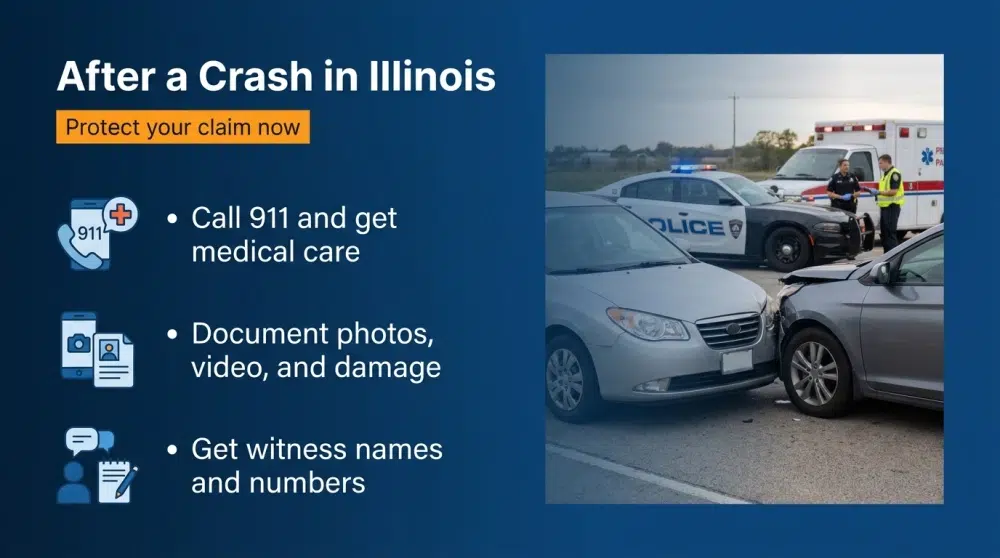
- Ensure safety and call for emergency services. Report the crash to law enforcement and seek medical attention even if you feel uninjured. Some serious injuries, including concussions and soft tissue damage, do not produce immediate symptoms.
- Document everything you can safely capture. Photograph vehicle positions, skid marks, traffic controls, road conditions, weather, lighting, and any visible injuries.
- Identify and speak with witnesses. Collect names and contact information before people leave the scene.
- Preserve your dashcam footage. If you have a dashcam, do not overwrite the footage from the day of the crash.
Steps in the Days Following the Crash
- Seek and follow through with medical treatment. Gaps in medical care are used by insurers to argue that your injuries are not serious or were not caused by the crash.
- Request nearby surveillance footage early. Businesses, residences, and public cameras in Chicago and suburban Illinois often overwrite footage within 48 to 72 hours. An attorney can send a preservation letter immediately.
- Preserve all records. Keep copies of the police report, medical bills, pay stubs reflecting lost work, and any correspondence from insurers.
- Avoid social media posts about the crash, your injuries, or your activities. These are routinely used by defense attorneys and insurers to challenge injury severity.
- Consult with an Illinois personal injury lawyer before giving any recorded statement to any insurer, including your own.
The sooner legal counsel is involved, the sooner preservation letters, investigation steps, and formal demand timelines can be put in place. Waiting weeks or months costs you evidence that cannot be recovered.
How GoSuits Chicago Helps Car Accident Injury Victims
At GoSuits, we handle serious personal injury and car accident cases across Illinois, with particular depth in Chicago and the surrounding Chicagoland area including Cook County, DuPage County, Lake County, and Will County. We also represent clients in Texas and California, giving us a perspective on multistate negligence standards that most single-state practices simply do not have.
Why does technology matter in comparative fault cases?
GoSuits built its own proprietary case management software that integrates every stage of the litigation process: investigation, records gathering, damages modeling, demand letter preparation, negotiation tracking, and discovery management. This technology-driven approach means we can move faster, maintain tighter accuracy, and counter insurer tactics more effectively than traditional paper-heavy practices.
When a Chicago intersection camera is set to overwrite in 48 hours, speed matters. Our systems allow us to generate and serve preservation letters within hours of intake, not days. When an insurer’s adjuster sends a lowball offer with a thin comparative fault argument, our software helps us respond with a documented counter-demand supported by the full evidence record.
What makes GoSuits different from high-volume law firms?
We do not use case managers as a buffer between you and your attorney. Every GoSuits client has direct, unfettered access to their designated attorney. You can reach your lawyer by phone, email, or text. You will not be handed off to a paralegal when you have a question about your case status or a negotiation development. This direct access model is a deliberate choice that reflects our belief that personal injury clients deserve genuine counsel, not just case processing.
Our team brings 30 years of combined experience across car accident claims, wrongful death litigation, truck collision cases, and catastrophic injury matters. We have tried cases to verdict in Illinois and Texas courts, which means our settlement demands carry the credibility of a team that is genuinely prepared to take a case to trial if a fair resolution is not reached. Insurers know this, and it changes the negotiation dynamic.

What do GoSuits’ prior results show?
Our prior cases page documents outcomes including verdicts and settlements across our practice areas. We have been recognized with Top 100 Settlement distinctions in Texas, named among the Top 40 Under 40 by the National Trial Lawyers, recognized by Best Lawyers in 2022, 2023, 2024, and 2025, and by Super Lawyers since 2021.
Those results are not promises about your specific outcome. Every case turns on its own facts, its own fault dynamics, and its own evidence record. What they do reflect is a consistent track record of preparation, advocacy, and results for injured people across the state.
What practice areas does GoSuits handle in Illinois?
Our Illinois practice covers the full range of serious personal injury and wrongful death matters. Detailed information about each practice area is available on our practice areas page. Our our attorneys page provides background on each member of our legal team, and our about us page describes how we approach client relationships and case strategy.
How can a free consultation help you right now?
If you or a family member were injured in a car accident in Illinois, a free consultation gives you immediate, direct access to a personal injury lawyer who can evaluate your situation, answer your questions about comparative fault, and outline what evidence needs to be secured before it disappears. We take cases on a contingency fee basis, meaning there are no attorney fees unless we recover for you.
The 51 percent bar under 735 ILCS 5/2-1116 means that fault allocation can determine everything. We help you build the strongest possible case for keeping your percentage of fault as low as the evidence supports, and for demonstrating the full extent of the other party’s responsibility. Schedule a free consultation with our team today.
References & Resources
- 735 ILCS 5/2-1116 – Contributory Fault – Illinois General Assembly
- Illinois Code of Civil Procedure, Article II – General Provisions, 735 ILCS 5/2-1116 – Illinois General Assembly
- Comparative Negligence – Legal Information Institute, Cornell Law School
- Texas Civil Practice and Remedies Code Chapter 33 – Proportionate Responsibility – Texas Legislature
- Contributory Negligence – Legal Information Institute, Cornell Law School
- Fatality Analysis Reporting System (FARS) – National Highway Traffic Safety Administration
- Negligence – Legal Information Institute, Cornell Law School
- 740 ILCS 180 – Illinois Wrongful Death Act – Illinois General Assembly
- 735 ILCS 5/13-202 – Statute of Limitations for Personal Injury – Illinois General Assembly
- Tort – Legal Information Institute, Cornell Law School