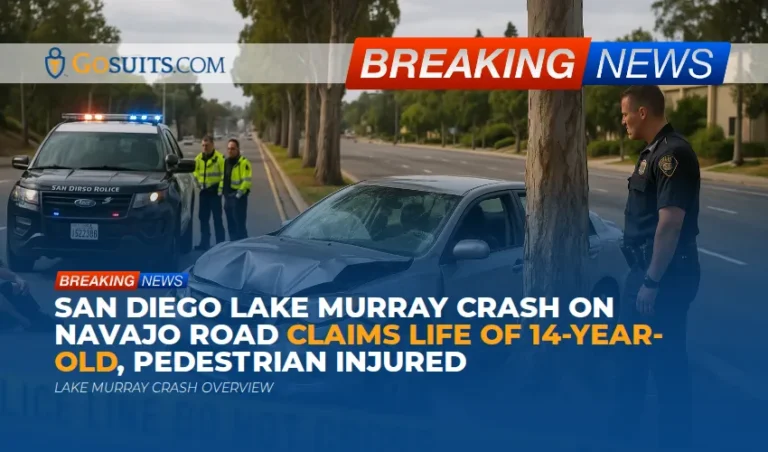
- Lake Murray crash overview
- What SDPD has reported so far
- Where it happened and why that matters locally
- Injuries and local trauma care pathways
- What investigators typically examine in crashes like this
- Civil liability lens: pedestrians, passengers, and families
- Records to request and evidence to secure
- Insurance coverage layers that may apply
- Who to call in San Diego for help and documents
- Immediate next steps that protect claims
- Why acting quickly matters
- California legal context relevant to this crash
- Commentary from Gosuits Irvine Personal Injury Attorney
- References
Lake Murray crash overview
Late Sunday morning around 11:30 a.m., a serious single-vehicle crash near the 7500 block of Navajo Road in the Lake Murray area left a 14-year-old girl dead at the scene. According to the San Diego Police Department, the westbound vehicle first struck an 18-year-old pedestrian who was walking on the sidewalk north of the street, then continued on until it hit a tree in the center median. Inside the car were four people: a 35-year-old driver, a 1-year-old passenger, an 8-year-old passenger, and the 14-year-old girl who tragically died on scene. The pedestrian suffered a concussion and a severe arm injury. The driver sustained a fractured right ankle. SDPD asks anyone with information to call Crime Stoppers at 888-580-8477.
When a crash like this happens on a well-traveled corridor, neighbors in San Carlos, Allied Gardens, and folks heading to Lake Murray Community Park feel it deeply. Families here walk these sidewalks and drive these routes every day. If you witnessed anything, even a small detail, your information may help piece together what happened.
What SDPD has reported so far
From SDPD’s initial report, several key facts stand out:
- Time and place: About 11:30 a.m., 7500 block of Navajo Road, Lake Murray area.
- Sequence: The vehicle struck an 18-year-old pedestrian on the sidewalk, did not stop, and then collided with a tree in the center median.
- Occupants: 35-year-old driver; three juvenile passengers ages 1, 8, and 14.
- Outcomes: The 14-year-old died at the scene; the pedestrian sustained a concussion and significant arm trauma; the driver suffered a fractured ankle; the 1 and 8-year-old passengers were reported uninjured.
As investigations develop, SDPD’s Traffic Division typically documents roadway evidence, vehicle damage, statements, and any available video. That documentation later supports civil claims, crash reconstructions, and insurance determinations.
People often ask who to speak with about rights after a serious incident. Many turn to personal injury lawyers, and they also search for car accident lawyers and wrongful death lawyers to understand the civil options available to injured pedestrians and grieving families. These are common, natural first steps to get oriented.
Where it happened and why that matters locally
Navajo Road connects key parts of San Carlos and the Lake Murray area. On weekends, the corridor draws walkers, runners, and cyclists heading toward Lake Murray and Mission Trails Regional Park. Sidewalks along this stretch can see heavy foot traffic, especially late mornings when families are out. That context matters because pedestrian impacts on sidewalks usually raise questions about lane position, speed, evasive actions, and sight lines.
Neighbors also know that the center median trees on Navajo Road provide shade and visual cues, but when a car leaves its lane, those fixed objects become unforgiving. Investigators will study why the car continued after the first impact and what contributed to the median collision.

Injuries and local trauma care pathways
San Diego County’s regional trauma system includes multiple designated trauma centers, including adult and pediatric facilities like UC San Diego Medical Center in Hillcrest, Scripps Memorial La Jolla, Sharp Memorial, and Rady Children’s Hospital. These centers coordinate with EMS for rapid treatment of life-threatening injuries [1]. Severe head trauma, complex fractures, and internal injuries often require advanced imaging and specialist care that these hospitals provide.
Following a pedestrian concussion and severe arm injury, standard medical protocols often include neurological evaluation, imaging for brain injury, and orthopedic assessment. Even when someone seems okay early on, delayed symptoms can appear. It is common for people to feel fine at the scene but develop headaches, dizziness, or limb pain later that day. This is one reason families in the area seek medical attention right away and keep detailed notes about evolving symptoms.
What investigators typically examine in crashes like this
In a vehicle-on-pedestrian crash followed by a collision with a fixed object, typical lines of inquiry include:
- Driver conduct: Speed, distraction, fatigue, or impairment. California law imposes duties on motorists toward pedestrians in crosswalks and, more broadly, in roadway environments where pedestrians are present [2].
- Duty to stop after a collision: California Vehicle Code requires drivers involved in a collision causing injury or death to immediately stop at or near the scene and provide aid and information. A failure to stop can have civil implications, including negligence per se arguments in later claims [3].
- Roadway and environment: Lane design, signage, sight distance, and the presence of trees or median features that might affect vehicle path or visibility.
- Vehicle condition: Mechanical issues like brake failure or steering problems, along with tire condition and airbag deployment data.
- Data and video: Event data recorder downloads, dashcam or nearby security camera footage, and any city traffic camera archives.
Witness accounts are vital. If you saw the approach, the point of pedestrian impact, or vehicle movement toward the median, SDPD encourages you to share that information. In many San Diego neighborhoods, doorbell and storefront cameras capture helpful angles of roadways and sidewalks. Families sometimes pursue video promptly, working with counsel to send preservation notices and to collect footage before standard retention cycles overwrite it.
Civil liability lens: pedestrians, passengers, and families
Victims and families often want a plain-English outline of who may bring civil claims after a tragedy like this. While every case turns on its facts, a few general principles apply in California:
- Injured pedestrian’s claim: The 18-year-old pedestrian may pursue a bodily injury claim against any at-fault driver and potentially other responsible parties, seeking damages for medical care, lost income, and pain and suffering.
- Passengers’ claims: Injured passengers may assert claims even if they rode with the at-fault driver. California permits passenger claims against a negligent driver regardless of relationship, subject to available defenses and coverage.
- Wrongful death: Close family members of the 14-year-old may bring a wrongful death action under California law for losses like financial support, companionship, and funeral expenses, subject to statutory rules about who can file and how proceeds are distributed [4].
Those looking for guidance frequently consult car accident lawyers about roadway fault and evidence, and they also reach out to wrongful death lawyers to understand who may file, what damages may be available, and how probate issues intersect with litigation. Because rules surrounding minors and estates can be complex, many also speak with personal injury lawyers to coordinate a consistent strategy for all affected family members.
When a crash involves a pedestrian on a sidewalk, counsel often assesses stopping distance, driver attentiveness, and whether any evasive maneuvers were attempted. Video and data downloads can be decisive in clarifying vehicle path and speed.
Families sometimes ask how attorney help differs by location. Local familiarity with San Diego’s corridors, crosswalk norms, and pedestrian patterns can help frame a case narrative for claims adjusters and, if needed, a jury. For a sense of how a team approaches multi-party crash investigations, you can review our Irvine personal injury team overview.
Records to request and evidence to secure
Evidence can vanish quickly. Here are core items people in San Diego often request after a serious crash, along with where those materials typically come from:
- SDPD collision report: The official crash report, diagrams, and any supplemental narratives are requested through the Police Records unit [5]. Ask for all supplements and attachments.
- Medical Examiner records: In a fatality, the San Diego County Medical Examiner may produce autopsy findings or cause-of-death documentation pursuant to county policies and state law [6]. These records are often central to a wrongful death claim.
- Traffic or surveillance video: Seek footage from nearby residences and businesses. For strategies and timing considerations, see request cctv footage after a california car accident.
- Event Data Recorder and vehicle downloads: Modern vehicles store pre-crash speed, braking, and other data. Learn how counsel secures and preserves this evidence in attorneys preserve vehicle black box evidence.
- DMV collision reporting: If a crash results in injury or death, California requires an SR-1 collision report to DMV within 10 days in many situations, typically filed by a driver or their insurer [7].
Two quick reminders about communications and timing. First, when insurance carriers call, recorded statements can include questions that seem routine but later complicate fault arguments. Second, many video systems overwrite within days. Preservation now beats regret later.
Insurance coverage layers that may apply
Crashes with both a pedestrian injury and a passenger fatality can involve multiple overlapping coverages. Common layers include:
- Auto liability coverage: The at-fault vehicle’s liability policy is typically primary for injuries to third parties, including pedestrians and non-negligent passengers.
- Uninsured/Underinsured Motorist (UM/UIM): If the at-fault driver lacks enough coverage, injured people may turn to their own UM/UIM policies for additional benefits, subject to policy terms and California law [8].
- Medical payments coverage: Some policies include med-pay that can help with immediate medical costs regardless of fault, with subrogation issues to be managed later.
- Wrongful death claims: Families may pursue claims for wrongful death damages through available liability limits. Issues like policy-limits disclosure and stacked coverages often arise during negotiations.
Because multiple claimants can be competing for limited policy limits, it can be critical to determine coverage early, verify all potentially applicable policies, and evaluate whether any additional responsible parties exist. Many people first consult personal injury lawyers to map this out, then retain counsel as needed to coordinate communications with insurers and preserve leverage.
In similar crashes, families also ask how case strategy differs for pedestrians versus passengers. From a coverage standpoint, both claims typically proceed against the negligent driver’s insurer, but pedestrian claims sometimes add roadway-design or premises angles if facts support them. That assessment depends on detailed scene analysis and is highly fact specific.
Who to call in San Diego for help and documents
- San Diego Police Department Records: Request the collision report, 911 audio, and any supplements through SDPD Records. Confirm any required IDs, incident numbers, or fees when you submit [5].
- SDPD Traffic Division: If you witnessed the crash or have camera footage, notify the Traffic Division or share a tip via Crime Stoppers at 888-580-8477.
- San Diego County Medical Examiner: Families can consult the Medical Examiner’s office about autopsy findings, cause of death, and release procedures [6].
- California DMV: Drivers and insurers handle SR-1 crash reporting obligations in injury or fatal crashes [7].
- California Victim Compensation Board (CalVCB): For qualifying victims and families, CalVCB can assist with funeral, medical, and counseling costs not covered elsewhere [9].
If you’re unsure which agency holds a particular record, start with SDPD Records. For hospital records, contact the hospital’s Health Information Management or Medical Records Department directly and ask for instructions on releasing records for an injury claim or a decedent’s estate.
Immediate next steps that protect claims
Here is a practical, time-sensitive checklist many in San Diego follow after a serious roadway incident:
- Secure legal guidance before calling insurers: Speak with counsel first. What gets said in an insurer’s recorded statement can be used later to minimize liability or damages. Avoid signing medical or blanket authorizations until you understand the scope and impact.
- Preserve video and scene evidence: Ask nearby businesses and residents to retain footage; send preservation letters where appropriate. Document vehicle positions, debris fields, and any roadway hazards with date-stamped photos.
- Track medical care: Keep every bill, doctor’s note, and discharge summary. A contemporaneous symptom journal can help establish the course of injuries.
- Request official records: Initiate SDPD collision report and Medical Examiner requests soon, since processing times can vary.
- Confirm insurance coverage: Identify every policy that might apply and track adjuster contact details in writing.
To understand rights and options before engaging with insurance carriers, many people choose to schedule a free consultation with a seasoned injury team.
People often speak with Irvine personal injury lawyers when a crash occurs elsewhere in Southern California and they need an initial roadmap. Others ask car accident lawyers in Irvine for a second opinion on strategy or policy limits. Families facing a fatality sometimes reach out to wrongful death lawyers in Irvine to understand who can file and how civil claims move forward in California courts.
Why acting quickly matters
Several clocks start to run right away. Video systems overwrite. Witness memories fade. Vehicles may be repaired, destroying black-box data opportunities. If a government entity is potentially involved, California’s Government Claims Act has short claim deadlines measured in months, not years [10]. Prompt action now preserves choices later.
Taking timely steps can help with three outcomes: identifying all sources of coverage, anchoring fault with reliable evidence, and protecting the family’s ability to bring the right claims against the right parties within legal deadlines. Waiting can foreclose options, especially with limited policy limits and multiple claimants.
California legal context relevant to this crash
Two state code sections are commonly discussed in pedestrian and fatal-crash cases:
- Duty of care to pedestrians: California Vehicle Code section 21950 sets forth the driver’s duty in crosswalk contexts, but even outside painted crosswalks, drivers must exercise due care to avoid collisions with pedestrians on or adjacent to roadways [2].
- Stop-and-render-aid obligations: California Vehicle Code section 20001 requires a driver involved in an injury or fatality crash to stop and fulfill statutory duties. Civil practitioners sometimes frame violations of safety statutes as negligence per se in appropriate cases [3].
For families, wrongful death is governed by California Code of Civil Procedure section 377.60, which identifies the relatives who may bring claims and the categories of recoverable damages [4]. When a potential public-entity claim exists, California Government Code section 911.2 sets short administrative claim deadlines before any lawsuit can be filed [10].
Because statutes interact with facts in detailed ways, many people first speak with personal injury lawyers to get oriented and then weigh whether to retain counsel for active representation. If the collision happened in Southern California and you are comparing options, some folks consult Irvine personal injury lawyers for a jurisdictionally aligned perspective on California law and procedure.
People also look to car accident lawyers for guidance in coordinating medical care and documenting wage loss, and they lean on wrongful death lawyers for compassionate, organized handling of estate and dependency questions while the investigation continues.

Commentary from Gosuits Irvine Personal Injury Attorney
Our hearts go out to everyone affected by the Lake Murray crash. A 14-year-old’s death is devastating, and the ripple effects are felt across San Carlos, Allied Gardens, and the broader East County community. This article is for educational purposes and general information only. It cannot account for every fact or provide instructions for any specific case.
Based on SDPD’s initial account, key questions will focus on why the car veered onto a sidewalk where an 18-year-old was walking, why it did not stop immediately after that impact, and what led to the subsequent collision with the median tree. In sidewalk-impact cases, we look closely at attentiveness, speed, and whether evasive measures occurred. Where a driver does not stop after an injury crash, California’s stop-and-render-aid duties are likely to be part of the civil conversation as well.
Insurance companies and large entities know that shocked families are vulnerable. Adjusters may push for recorded statements, ask for broad medical authorizations, or float quick, low-dollar offers when evidence is still developing. Those tactics can reduce claim value and limit leverage later. Before speaking with any insurer, it is wise to consult a lawyer who can explain rights, protect the record, and help prioritize evidence collection. What someone says to an insurance company can be used against them later on.
A free consultation is important because it gives people a no-cost way to understand immediate action items, deadlines, and likely coverage paths. Even if you ultimately handle parts of the process yourself, an early conversation can clarify how to obtain SDPD reports, secure video, preserve vehicle data, and coordinate with the Medical Examiner’s office. In fatal crashes that involve both a pedestrian injury and a young passenger’s death, there are often multiple moving pieces. A thoughtful plan helps families regain a sense of direction during a difficult time.
References
- San Diego County Trauma System Overview – San Diego County EMS
- California Vehicle Code § 21950, Pedestrians’ right-of-way – California Legislative Information
- California Vehicle Code § 20001, Duty to stop at scene of accident – California Legislative Information
- Code of Civil Procedure § 377.60, Wrongful death actions – California Legislative Information
- Police Records and Reports – City of San Diego
- San Diego County Medical Examiner – County of San Diego
- SR-1 Report of Traffic Accident Occurring in California – California DMV
- Financial Responsibility Requirements and Insurance – California DMV
- California Victim Compensation Board – CalVCB
- Government Code § 911.2, Claim presentation deadline – California Legislative Information