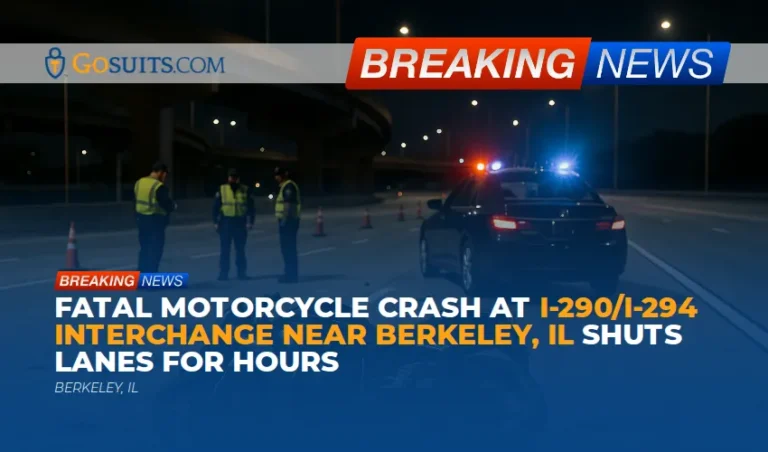
- What we know about the I-290 and I-294 fatal motorcycle crash near Berkeley
- Local context around the Eisenhower Expressway and Tri-State Tollway interchange
- How to get official records and who to call for information
- First steps families often take after a fatal motorcycle crash
- Illinois legal insight on liability, fault, and rights after a motorcycle and car collision
- Insurance layers and common issues families encounter
- Evidence to preserve around an expressway crash and why timing matters
- Time sensitive actions and statutes that may apply
- Community grounded resources around Berkeley and west suburban corridors
- Commentary from Gosuits Chicago Personal Injury Attorney
- References
What we know about the I-290 and I-294 fatal motorcycle crash near Berkeley
Illinois State Police reported a deadly crash involving a motorcycle and a black Honda at the I-290 eastbound to I-294 interchange near Berkeley just before 1 a.m. on Sunday. Troopers diverted traffic to southbound I-294 while all lanes were shut down for several hours, reopening around 6:30 a.m., according to the initial public updates. The motorcyclist was taken to a nearby hospital and pronounced deceased. Authorities had not released the rider’s identity at the time of the early report, and the investigation remains active.
If you were driving through this corridor overnight, the closure and detour likely affected traffic moving from the Eisenhower Expressway toward the Tri-State Tollway, backing up lanes east of Hillside and Westchester. These multi-lane expressway interchanges can become complex at night, especially when visibility is low and traffic is still moving at highway speeds.
Local context around the Eisenhower Expressway and Tri-State Tollway interchange
Locals know the I-290 and I-294 junction well. It sits along a heavily traveled west suburban corridor that serves communities like Berkeley, Hillside, Elmhurst, Northlake, and Maywood. The Eisenhower Expressway, often called “the Ike,” has a mix of straight segments and short weaving zones near ramps. The Tri-State Tollway carries a high volume of regional traffic, including commercial vehicles heading toward logistics hubs around Franklin Park and O’Hare. Add predawn timing and it becomes even more challenging for all road users.
Motorcyclists are particularly exposed in these environments. Lane changes near ramp splits, quick merges, and night visibility can all increase risk. Even a small misjudgment by any driver can have outsized consequences when one of the vehicles offers limited protection to its rider.

How to get official records and who to call for information
When a fatal crash occurs on a state highway in Cook County, families usually need several records to understand what happened and to handle necessary paperwork. Here are the most common sources and why they matter. Where available, we have added references to official pages you can review at the end of this article.
- Illinois State Police crash report. ISP troopers typically investigate serious and fatal expressway crashes in the Chicago region. You can learn how to request a crash report or desk report and view the agency’s process on the official ISP site [2]. For Chicagoland freeway fender benders, ISP Troop 3 sometimes takes desk reports at partner police departments; for serious injury or fatal crashes, an ISP trooper report is typically created at the scene.
- Cook County Medical Examiner. For deaths in Cook County, the Medical Examiner determines cause and manner of death. Families can find information about reports, case status, and record requests through the county’s official portal [6].
- Death certificates. Certified copies are obtained through the Cook County Clerk’s office. Their vital records section outlines eligibility and how to request copies [7].
- FOIA requests for public records. If additional agency records are relevant, Illinois FOIA provides a path to request certain documents from public bodies. The Illinois Attorney General’s FOIA page explains the process [8]. Response times and exemptions can apply.
If there is uncertainty about what to request first or how records fit together, it is common to ask questions before taking action. In situations like this, if guidance would help, you can also schedule a free consultation to understand which records typically matter most and how they are used in civil claims.
First steps families often take after a fatal motorcycle crash
Every family’s path looks a little different, but the following actions often help during the first few days after a serious crash on the Ike or the Tri-State.
- Confirm which agency is the primary investigator. On I-290 and I-294, Illinois State Police are usually the lead. Write down any report number or incident number you receive at the scene or from hospital staff.
- Preserve personal evidence. Gather helmet, riding gear, phone, and any dash cam data. Save texts or calls from potential witnesses. Store these items in a safe, dry place and avoid cleaning or altering them until you have guidance.
- Identify possible witnesses. Note names and contact details of anyone who stopped to help, as well as tow operators. Expressway incidents often have independent witnesses who are vital later.
- Keep medical and funeral records. Hospital records, transport records, and any funeral or memorial documentation become important for claims that may follow.
- Use caution before speaking with insurers. Insurance adjusters sometimes call quickly. What is said early can be recorded and used to limit or dispute liability later. Before calling back, many families first speak with counsel to understand their rights and how to avoid common pitfalls.
Illinois legal insight on liability, fault, and rights after a motorcycle and car collision
At its core, a civil claim after a motorcycle and passenger vehicle collision asks who had the right of way, whether anyone failed to keep a proper lookout, and whether any driver made unsafe changes of lane or speed near the interchange. Complexities arise in low light, when multiple drivers are merging, or where there is conflicting testimony about the sequence of movements. In those situations, reconstruction evidence and witness statements often carry significant weight.
Families often ask where to even begin. A starting point is understanding how Illinois handles shared responsibility. Illinois follows a modified comparative negligence rule. If an injured party is 50 percent or less at fault, recovery is reduced by that percentage. If more than 50 percent at fault, recovery is barred. That framework is set out in statute [3]. A wrongful death claim is a separate cause of action established by Illinois law that allows certain close family members to pursue damages tied to the loss [4].
Motorcyclists sometimes worry that the absence of certain gear will be blamed for the crash itself. Helmet or gear discussions more typically affect injury severity arguments, not who caused the collision. Fault still focuses on driver behavior like unsafe lane changes, failure to yield, or speeding near ramps. Skilled investigation can uncover details the initial scene report might not capture, such as on-vehicle data, unusual headlight or taillight patterns, and timestamped location records from phones or apps.
If you are comparing resources or looking for a focused page on two-wheel crashes in this region, you can review the Chicago motorcycle page here: Chicago motorcycle crash legal team.
Many people find it helpful to talk with motorcycle accident lawyers before engaging with any insurer. Separate from any criminal investigation, the civil side often moves on a different track and timeline. That early conversation can map what facts matter, which records to lock down, and how insurance layers interact when a car and a motorcycle are involved. It is also common to speak with motorcycle accident lawyers in Chicago for a clearer sense of local procedures and venue considerations.
Insurance layers and common issues families encounter
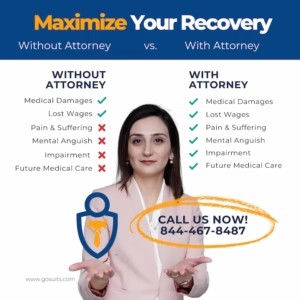
After a fatal motorcycle and car collision, multiple policies can come into play. The at fault driver’s liability policy is usually front and center. In Illinois, drivers must carry at least the statutory minimum liability coverage, explained by the Secretary of State’s office [5]. In a deadly crash, minimum limits are often insufficient. That is where other layers may matter, including the decedent’s own uninsured or underinsured motorist coverage and any umbrella coverage that might exist in the household.
When the crash involves a private passenger vehicle, the owner’s policy might differ from the driver’s, and exclusions or household member clauses can complicate matters. Immediate offers from an at fault insurer may not reflect the long list of losses recoverable under Illinois law. Wrongful death damages can include loss of financial support, services, and other harms recognized by statute [4]. Talking with counsel before giving statements can help families spot lowball approaches that omit major categories of harm.
Insurers sometimes try to obtain recorded statements quickly. That can lock in partial narratives before full evidence is gathered. If there is any uncertainty, consider pausing outreach to insurers until you have guidance about what to say and what to avoid. The same caution applies to social media comments about the crash. A short discussion with personal injury lawyers can prevent simple mistakes from becoming case wide problems. When questions arise specific to regional practice, Chicago personal injury lawyers are familiar with local norms for claim handling and venue.
Evidence to preserve around an expressway crash and why timing matters
Critical evidence can disappear fast on high speed corridors like I-290 and I-294. Tire marks fade, debris gets swept, and vehicle data modules can be lost when a car or bike is salvaged. Even a hospital’s trauma documentation can rotate to archive quickly. That is why evidence preservation should begin early, and why families often have a representative send preservation letters while they focus on grieving.
For a quick checklist tailored to this jurisdiction, see chicago motorcycle crash evidence checklist. It covers documents and data points that tend to matter most in local motorcycle claims.
Investigators often seek the following in serious collisions:
- Scene documentation. Photographs, debris field measurements, and any available mapping from the investigating agency.
- Vehicle inspections. Motorcycle and car inspections can reveal lamp filament status, brake condition, or prior damage unrelated to this event.
- Electronic data. On newer vehicles, event data recorders can log speed, throttle, and braking in the final seconds. Some bikes have aftermarket data devices. Many riders also use GPS or apps that track routes.
- Third party video. Private dash cams, ride cams, and nearby business cameras often capture segments of the approach or the crash itself. Retention windows can be very short.
- Phone records and app location data. Narrow time windows and tower pings can clarify vehicle positions and movement.
Families sometimes ask how long the civil process takes when a fatality is involved. Each case is different, but a good overview is here: how long does it take to settle a wrongful death lawsuit. It outlines the stages that commonly affect timeline.
Time sensitive actions and statutes that may apply
Illinois imposes deadlines for filing civil claims. Wrongful death cases generally have a two year limitation period, with some exceptions depending on the circumstances and potential defendants [4]. Personal injury claims also have a two year default limitations period, subject to tolling or special rules in certain settings. Illinois’ comparative negligence statute also shapes how fault arguments affect recovery [3].
Why act early even if two years sounds like a long time? First, evidence fades. Second, insurers often engage in early positioning that can influence the rest of the claim. Third, some defendants are governmental or quasi governmental entities, which can trigger different notice requirements. Preserving the ability to bring a strong wrongful death claim in Chicago often depends on steps taken in the first weeks, not the last days of a two year window.
In practical terms, this means promptly locking down medical and coroner records, preserving vehicle data, gathering witnesses, and understanding policy layers. A focused early plan reduces the risk of missing something that later becomes central to liability or damages.
Community grounded resources around Berkeley and west suburban corridors
Crashes at the I-290 and I-294 interchange can involve motorists from many west suburban communities. People traveling from Berkeley, Hillside, Elmhurst, Maywood, and Westchester use this connector daily. When tragedies happen, knowing who to contact locally can relieve some stress.
- Illinois State Police. The ISP crash report portal and desk report information explain where and how crash reporting works for Chicagoland freeways [2].
- Cook County Medical Examiner. For questions about cause and manner of death, case status, and report availability, the office’s public portal is a starting point [6].
- Cook County Clerk vital records. For certified death certificates, the Clerk provides instructions and eligibility requirements [7].
- Illinois FOIA. If additional public records might exist with an agency, the Attorney General’s FOIA guidance explains how to submit a request and what timelines apply [8].
When uncertainty persists about sequence of events, liability, or what insurers are obligated to cover, people often seek clarity before giving recorded statements. A short conversation with personal injury lawyers can help map next steps. If you want a local frame of reference and context on venue or jury pools, talking with motorcycle accident lawyers in Chicago may also be useful.
Commentary from Gosuits Chicago Personal Injury Attorney
Our hearts are with the rider’s loved ones and everyone affected by this heartbreaking crash near the I-290 and I-294 interchange. This summary is intended for general information so community members can better understand the process and available resources.
From what is publicly known, this involved a motorcycle and a passenger vehicle in a complex interchange setting during the early morning hours. In our experience with serious highway cases, careful reconstruction and witness follow up are critical. The first days matter. Digital evidence can vanish quickly, and multiple insurance layers may be in play.
Insurance carriers and large corporate entities regularly use early statements and partial document requests to limit claims. People dealing with shock and grief may not realize that what they say in a first phone call can be cited back months later to dispute liability or minimize damages. Adjusters are trained for that environment. Community members should not feel rushed into recorded statements without understanding their rights and the scope of coverage available.
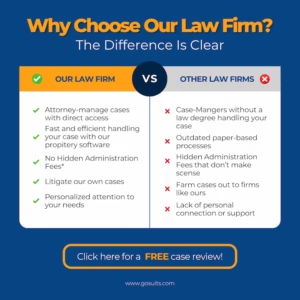
It is important to obtain a free consultation before engaging with any insurer. Even a brief conversation can clarify who to contact, which records to request, and how to avoid missteps that make later recovery more difficult. Families across Cook County deserve space to grieve and a clear plan for preserving their claims while the investigation proceeds.
References
- Crash Facts – Illinois Department of Transportation
- Crash Reports – Illinois State Police
- 735 ILCS 5/2-1116 Comparative Fault – Illinois General Assembly
- Wrongful Death Act, 740 ILCS 180 – Illinois General Assembly
- Mandatory Insurance – Illinois Secretary of State
- Medical Examiner – Cook County Government
- Death Certificates – Cook County Clerk
- Freedom of Information Act – Illinois Attorney General