- What we know about the Lake Forest e-motorcycle crash near El Toro High School
- Local context for Lake Forest and South Orange County
- Safety and legal implications of e-motorcycles on public roads in California
- Potential civil liability and insurance issues after a fatal pedestrian collision with an e-motorcycle
- Which records to request and where to call in Orange County
- How to preserve evidence and protect a potential claim
- Key California timelines and who may bring a wrongful death case
- Next practical steps and why timing matters
- References
- Commentary from Gosuits Irvine Personal Injury Attorney
What we know about the Lake Forest e-motorcycle crash near El Toro High School
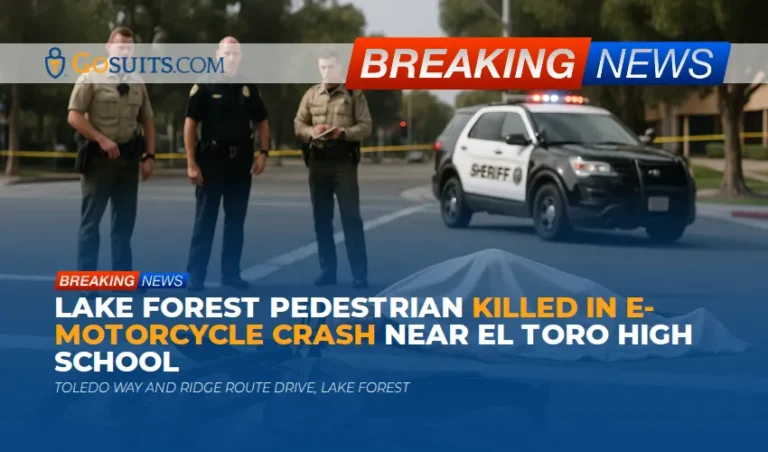
Neighbors around Toledo Way and Ridge Route Drive in Lake Forest know that late-afternoon foot traffic around El Toro High School can be steady. On April 16, according to prosecutors and the Orange County Sheriff’s Department, a 14-year-old riding an e-motorcycle was performing wheelies in the roadway when he allegedly struck 81-year-old substitute teacher and Vietnam veteran Ed Ashman as Ashman walked home. Authorities say the teen fled the scene but was identified with help from witnesses and later taken into custody. Weeks later, Ashman succumbed to his injuries, and prosecutors announced upgraded charges against the teen’s mother, including involuntary manslaughter, based on allegations that she had been warned about illegal and dangerous riding behavior before the collision.
Law enforcement reports indicate the crash location at Toledo Way and Ridge Route Drive, a few blocks from Lake Forest City Hall and a short drive from the neighborhood corridor that includes El Toro Road and the Veterans Park area. These are streets many families use daily, so the shock in the Saddleback Valley community is understandable.
Prosecutors stated that the 2025 Surron Ultra Bee at issue can reach highway-adjacent speeds and would require proper licensing, registration, and insurance to operate on public roads. They also alleged the boy’s mother attempted to conceal the crash. Although state law prevents prosecutors from publicly discussing juvenile charges, OCDA reported that this is the third recent Orange County case involving parents accused of allowing illegal e-motorcycle riding.
What authorities have publicly said
Based on official statements summarized in local reporting, the Orange County District Attorney alleged that: the 14-year-old was performing stunts in the roadway; he struck the pedestrian; he fled but was later identified; the e-motorcycle required licensing and insurance to be lawfully used on a public street; and the teen’s mother had previously been warned. The amended complaint now includes involuntary manslaughter and other counts. We do not speculate on potential criminal outcomes. Our focus here is on safety and civil rights, because families often do not know where to begin with records, insurance, and the civil claims process after a fatal incident.
Local context for Lake Forest and South Orange County
Lake Forest families know the routes near El Toro High School, Serrano Road, and the Ridge Route corridor. On school days, you will see students walking or biking, parents in pickup lines, and neighbors on foot crossing between neighborhoods like the streets south of Bake Parkway and toward Heritage Hill Historic Park. It is a walkable area with many residential driveways and parked cars. Stunt riding or high-speed operation of any motorized two-wheel vehicle in that environment can be devastating, even at what seems like moderate speeds.
South Orange County has also seen a rise in powered micromobility devices, from e-bikes to off-road capable e-motorcycles. The local conversation is rarely about banning technology. It is about lawful operation, rider training, age and license rules, and keeping pedestrians safe near schools, parks, and shopping centers such as The Orchard and the El Toro Road retail corridors.
Safety and legal implications of e-motorcycles on public roads in California
Many folks ask a simple question after a crash like this: is that fast electric bike a bicycle or a motorcycle under California law? The answer matters for who can ride it, where it can go, and what paperwork and insurance are required.
How California law classifies e-bikes, mopeds, and e-motorcycles
California distinguishes among electric bicycles, motorized bicycles or mopeds, motor-driven cycles, and motorcycles. Electric bicycles are addressed by state law and safety agencies, but high-powered off-road electric motorcycles like some Surron models are typically not e-bikes under California law. When devices exceed e-bike power and speed limits or lack required equipment, they may be treated as mopeds, motor-driven cycles, or full motorcycles, which triggers license and registration requirements. For example, California’s vehicle code defines motorized bicycles or mopeds and sets conditions for their lawful operation [3]. The California DMV provides licensing guidance for motorcycles, including the M1 and M2 classes [1] [2].
Off-highway vehicles, including many dirt bikes and some e-motorcycles, are restricted from public street operation unless they meet specific equipment, registration, and licensing rules. California State Parks and the Vehicle Code address where OHVs may be used, and the Vehicle Code prohibits operating off-highway vehicles on public roads subject to narrow exceptions [4] [5].
Licensing, registration, and insurance
If a powered two-wheel device is classified as a motorcycle or motor-driven cycle and is used on a public street, California law requires an appropriate motorcycle license, registration, and insurance. The DMV’s motorcyclist handbook explains the licensing path and safety expectations for riders who lawfully use public roads [1]. The legal status of the specific vehicle at issue in a given crash is a fact question, but prosecutors in this incident alleged that the machine required a motorcycle license, insurance, and a license plate to be lawfully ridden on Toledo Way and Ridge Route Drive.
Hit-and-run rules are strict when someone is hurt
When a collision results in injury or death, California’s Vehicle Code imposes a duty to stop, exchange information, and render reasonable assistance. Fleeing the scene of an injury collision can trigger serious criminal exposure under the hit-and-run statute [6]. From a civil standpoint, leaving the scene also complicates insurance claims and evidence preservation.
Why speed and rider behavior matter so much
NHTSA’s motorcycle safety research consistently shows the heightened risk motorcycles pose to riders and pedestrians when speed or stunt behavior is involved, even more so in mixed-use corridors near schools or parks. National data reflect that the consequences of unsafe operation can be catastrophic for vulnerable road users [7]. California’s Office of Traffic Safety has highlighted the safety challenges of high-powered micromobility as communities adapt to new devices on local roads [8].
Potential civil liability and insurance issues after a fatal pedestrian collision with an e-motorcycle
This article is educational and not case-specific advice. Each collision is unique, and liability turns on facts, vehicle classification, and insurance contract language. Still, certain civil law themes commonly arise after a fatal pedestrian collision with a powered two-wheel vehicle.
Potential negligence of the rider
California negligence law weighs whether the rider operated with reasonable care under the circumstances. Performing wheelies in a traffic lane where pedestrians are present is the kind of fact pattern courts often consider dangerous. Evidence from witnesses, nearby cameras, vehicle data, and street design can all matter. Early steps to document skid marks, debris fields, and sightlines are often critical. Riders and families reviewing their options sometimes speak with motorcycle accident lawyers to understand fault analysis and insurance avenues. In South Orange County, many also look up Irvine motorcycle accident lawyers to discuss local procedures and venue issues.
Parental liability theories may be implicated
When an underage rider operates an unlawful or improperly equipped vehicle on a public street, civil claims can explore negligent supervision, negligent entrustment, or statutory liability tied to minors’ driving. Those theories are fact dependent and can intersect with criminal allegations. Even if prosecutors bring charges, a civil wrongful death claim remains independent and has a different burden of proof. Because these theories turn on sensitive family facts and insurance contracts, families often consult with our Irvine personal injury team for a confidential review of potential civil claims and coverages.
Insurance coverage questions that commonly arise
Insurance can be complicated when a powered two-wheel vehicle is not properly insured or registered:
- Motorcycle liability insurance may apply if a valid policy exists and the vehicle qualifies as a motorcycle or motor-driven cycle per policy terms and law.
- Homeowner’s insurance often excludes motor vehicle incidents arising from operation of motorized vehicles away from the insured premises, but policy wording varies.
- Auto policies for the injured pedestrian may provide uninsured or underinsured motorist benefits if the pedestrian carries UM or UIM coverage and the device qualifies as a motor vehicle under that policy. California families sometimes explore these benefits when the at-fault rider is uninsured or unknown.
Because a misstatement to any insurer can be used later to dispute fault or damages, it is generally wise to talk with a lawyer before providing recorded statements. People who start claims sometimes search for personal injury lawyers or look up personal injury lawyers in Irvine to understand what coverages may be in play and which statements are required by contract.
Which records to request and where to call in Orange County
Accurate records help families understand what happened and protect a potential civil claim. In South Orange County, Lake Forest contracts with the Orange County Sheriff’s Department for law enforcement services. That centralizes record requests.
- Traffic collision report. The Orange County Sheriff’s Department Records and Information unit processes report requests. Eligible parties can ask for the traffic collision report, supplemental narratives, and diagrams when available. OCSD explains report-request procedures on its public website and provides instructions for in-person and mail requests [9].
- 911 audio and CAD logs. In some cases, families request 911 recordings, dispatch logs, and unit histories. These may be obtainable through a Public Records Act request, with redactions as required by law. The California Attorney General outlines how the Public Records Act works and what to expect in a request process [12].
- Orange County Sheriff Coroner records. For fatal incidents, the OCSD Coroner Division maintains case files. Families may request certain records, including autopsy and toxicology when authorized, following the Coroner’s posted procedures [10].
- Death certificate. Certified copies are available through the California Department of Public Health Vital Records or the Orange County Clerk-Recorder. CDPH lists statewide options for ordering certified copies and outlines eligibility and ID requirements [11].
- Victim services. The California Victim Compensation Board provides financial assistance for certain expenses and can guide next steps, eligibility, and documentation [13].
When submitting requests, keep a consistent file naming system and note the OCSD report number, incident date, and location. If you are unsure how to phrase a records request, many families review the California PRA overview first or ask a legal professional to draft a targeted request that protects privacy and avoids disclosing unnecessary information.
How to preserve evidence and protect a potential claim
Small details matter. Where a device first struck a pedestrian, debris location, and even shoe scuffing can be critical. Surveillance video from homes along Ridge Route Drive, dashcams from vehicles queued for pickups near El Toro High School, and school security footage may exist for only a short time. Intersection-facing cameras from nearby businesses sometimes overwrite within days.
Consider documenting the scene from multiple angles at the same time of day to capture lighting conditions. If the involved e-motorcycle is accessible, photographs of the controls, tire wear, and any performance modifications should be taken promptly. When in doubt, review irvine pedestrian accidents your rights if you were hit by a car for a plain-language checklist of immediate steps tailored to local roads and agencies in this area.
For families navigating a fatal incident, preserving phone records, text messages, and social media posts related to the ride, including timestamps of alleged stunt videos, can be as important as vehicle photos. A concise, date-stamped log of medical events, hospice notes, and funeral arrangements also helps future damages documentation. A practical guide many find useful is irvine what evidence to save after a fatal accident, which walks through time-sensitive preservation.
If any insurer or claims representative reaches out quickly, remember that what you say can be used later to minimize or deny payment. Before giving any recorded statement, many people decide to schedule a free consultation using this link: schedule a free consultation. An initial conversation can help clarify which statements are required by policy versus which can wait until records are gathered.
Key California timelines and who may bring a wrongful death case
California law sets deadlines for civil cases and defines who may bring a wrongful death action. The statute of limitations for most wrongful death claims is two years from the date of death [15]. Eligible claimants in a wrongful death case are generally listed in Code of Civil Procedure section 377.60, which includes a decedent’s surviving spouse, domestic partner, and certain heirs, among others [14]. There can also be a related survival action that allows recovery for certain claims the decedent could have brought had they lived. Those civil procedures are separate from any criminal process and have different burdens of proof and evidentiary rules.
Because a fatal incident can involve multiple insurance contracts, potential comparative fault arguments, and sensitive family status questions, families often benefit from a careful review of coverage letters, policy limits, and the order in which to present claims. Some people begin by reading about a wrongful death claim, while others look up wrongful death claim in Irvine to understand local venue considerations in Orange County Superior Court.
Next practical steps and why timing matters
Every serious crash leaves people juggling grief and logistics. A measured plan helps.
- Secure critical records quickly. Ask OCSD for the traffic collision report and any supplemental materials. Confirm Coroner case numbers and next-of-kin authorization for records. Track report numbers in a single folder.
- Preserve video and photos now. Send time-limited preservation requests to nearby homeowners and businesses on Ridge Route Drive, Toledo Way, and feeder streets. Ask for unedited original files with metadata.
- Collect insurance documents. Gather auto and UM/UIM policies for household members, any motorcycle policies involved, and homeowner policies. Note policy numbers and claim phone numbers.
- Be careful with early statements. Insurers may seek quick interviews or broad medical authorizations. Statements made in the first days can be used later. Speak to an attorney first so you understand your rights and obligations before you contact an insurance company.
- Document expenses and impacts. Keep receipts for funeral and memorial costs, travel, lost income for time spent on arrangements, and counseling invoices.
Why now and not later? Video overwrites. Witness recollections fade. Vehicle modifications can be reversed. Early preservation tightens the factual record and reduces room for later disputes about speed, stunting, or right-of-way. Acting within the two-year civil limitations window is essential, and some evidence demands need to go out within days or weeks to be effective.

References
- Licensing Information – California Motorcyclist Handbook – California DMV
- California Vehicle Code §12804.9 License Classes – California Legislature
- California Vehicle Code §406 Motorized Bicycle or Moped – California Legislature
- California Vehicle Code §38025 Operation of Off-Highway Vehicles on Highways – California Legislature
- Where to Ride OHVs and Basic Requirements – California State Parks OHMVR
- California Vehicle Code §20001 Duty to Stop at Scene of Accident – California Legislature
- Motorcycle Safety Overview – National Highway Traffic Safety Administration
- E-Bike Safety Campaign – California Office of Traffic Safety
- Request a Copy of a Report – Orange County Sheriff’s Department
- Coroner Division Information – Orange County Sheriff’s Department
- Vital Records: Birth, Death, and Marriage – California Department of Public Health
- Public Records Act Requests in California – Office of the Attorney General
- California Victim Compensation Board – Official Site
- California Code of Civil Procedure §377.60 Wrongful Death – California Legislature
- California Code of Civil Procedure §335.1 Statute of Limitations for Injury or Death – California Legislature
Commentary from Gosuits Irvine Personal Injury Attorney
Our hearts go out to Mr. Ashman’s loved ones and to the Lake Forest community. Losing a neighbor and teacher under these circumstances is heartbreaking. This article is shared for education and general information. It is not a substitute for tailored guidance about any specific case.
From a civil-injury perspective, a few points stand out. First, the location matters. This collision reportedly occurred in a neighborhood corridor used by students and pedestrians, which heightens the duty to operate any motorized two-wheel device with care. Second, prosecutors’ statements about licensing and equipment requirements for the e-motorcycle highlight a growing safety issue in Orange County. High-powered devices that ride like motorcycles but are treated casually can create confusion and tragic outcomes. Finally, prompt evidence preservation near school zones can make or break a liability analysis, especially when initial reports mention stunts or speed.
Insurance companies and large corporations sometimes capitalize on confusion after a fatal incident. Early recorded statements can be parsed to argue comparative fault or to narrow damages. Adjusters may ask for overly broad medical authorizations or push families to accept quick, low payments before full costs are known. Without a full set of records, including the collision report, any available video, and Coroner documentation, families are at a disadvantage during those first calls.
That is why a free consultation can be so important. It gives families a chance to understand the types of coverage that may apply, the order in which to pursue claims, and how to avoid unhelpful statements to insurers. Speaking with a seasoned local injury attorney before engaging with insurance carriers helps protect the claim’s integrity while the evidence is gathered and reviewed.