- What Is the Illinois Car Accident Statute of Limitations?
- How Long Do You Have to File a Car Accident Lawsuit in Illinois?
- What Is the Deadline for a Wrongful Death Claim After a Car Crash in Illinois?
- What Happens If a Government Vehicle Was Involved?
- Are There Exceptions That Can Pause the Illinois Filing Deadline?
- How Does the Discovery Rule Apply to Illinois Car Accident Claims?
- What Does the Statute of Limitations Mean If You Are the Defendant?
- Where Are Illinois Car Accident Lawsuits Filed?
- Why Should You Act Well Before the Deadline?
- Frequently Asked Questions
- How GoSuits Chicago Helps Illinois Injury Victims
- References and Resources
What Is the Illinois Car Accident Statute of Limitations?
If you were injured in a car crash anywhere in Illinois whether on the Kennedy Expressway in Chicago, on I-90 heading through the South Side, or on a surface street in Naperville, the clock starts running the moment the collision happens. A statute of limitations is a law that sets a hard deadline for filing a civil lawsuit. [1] Once that window closes, a court will almost always dismiss your case, no matter how strong your claim might otherwise be. Understanding these deadlines is one of the most practically important pieces of information any injured person or family member can have.
Illinois law governs personal injury claims through the Illinois Compiled Statutes (ILCS). For most car accident personal injury claims, the controlling provision is found at 735 ILCS 5/13-202. [2] Separate statutes govern wrongful death claims, claims against government entities, and situations involving minors or people under legal disability. This article walks through each of those deadlines, identifies common exceptions, and explains what both plaintiffs and defendants need to know before taking legal action.
Illinois courts that hear civil injury claims at the trial level are the Circuit Courts in Cook County, that is the Circuit Court of Cook County, which handles the majority of Chicago-area car accident lawsuits. Civil filings in Cook County are made at the Richard J. Daley Center in the Loop, the main civil courthouse for Cook County. [3] If you are injured and you are a personal injury claim filer in Illinois, that courthouse or the circuit court in your own county is where your case would ultimately be filed if a negotiated resolution cannot be reached.
How Long Do You Have to File a Car Accident Lawsuit in Illinois?
Under 735 ILCS 5/13-202, a plaintiff injured in a car accident generally has two years from the date of injury to file a civil lawsuit against the at-fault party. [2] This two-year period is the standard Illinois personal injury deadline for motor vehicle crashes, slip and falls, and most other negligence-based tort claims.
The two-year period begins on the date the injury occurs meaning the date of the crash itself, in most vehicle collision cases. If the statute runs out and you have not filed a lawsuit, the defendant can raise the limitations period as a complete defense, and the court will dismiss the case.
What Does “Filing” Mean Under the Illinois Statute?
Filing means submitting your complaint the formal legal document that initiates a civil lawsuit to the clerk of the appropriate circuit court. Merely sending a demand letter to the opposing driver or their insurance carrier does not satisfy the limitations period. The complaint must be filed with the court before the deadline expires. If you are filing in Cook County, that means presenting the complaint and paying the filing fee at the Richard J. Daley Center, or using Illinois’ statewide e-filing system (eFileIL). [3]
Illinois also requires that the defendant be served with process the summons and complaint but service does not have to be completed before the deadline, as long as the complaint is filed on time and service follows within the period required by the court’s rules.
Does a Property Damage Claim Have the Same Deadline?
Property damage claims arising from car accidents in Illinois are governed by a different statute. Under 735 ILCS 5/13-205, a claim for damage to personal property such as damage to your vehicle carries a five-year statute of limitations. [4] This is longer than the personal injury deadline and reflects the difference in how Illinois law treats bodily injury versus damage to tangible property. If your claim involves both personal injuries and vehicle damage, the shorter two-year window controls the personal injury portion.
If you were injured in a crash on the Dan Ryan Expressway or in stop-and-go traffic on I-290 heading toward the West Side, both your injury claim and your property damage claim arise from the same event but they run on different clocks. Working with car accident lawyers before either deadline expires protects both aspects of your claim.
What Is the Deadline for a Wrongful Death Claim After a Car Crash in Illinois?
When a car accident results in a fatality, the surviving family has a separate legal claim under the Illinois Wrongful Death Act, 740 ILCS 180/. [5] Under that statute, the representative of the decedent’s estate has two years from the date of death to file a wrongful death lawsuit. This is a distinct deadline from the personal injury statute; it runs from the date the person died, not necessarily the date of the crash (though in most accident cases the two dates are the same or very close).
If a crash victim survives for several months before passing away from their injuries, the wrongful death clock starts on the date of death. Families dealing with a loss after a serious crash on Lake Shore Drive or I-55 near the South Side need to be aware that the injury claim and the wrongful death claim may have slightly different deadlines. A wrongful death claim requires the filing party to be the legal representative of the estate, which may require opening a probate estate if one has not already been established.
It is also worth noting that Illinois imposes a cap on the limitations period under the Wrongful Death Act: if the deceased person’s personal injury claim would have been time-barred at the time of death, then no wrongful death claim can be brought. [5] This interplay between the personal injury and wrongful death deadlines is one reason families should not delay speaking with wrongful death claim lawyers after a fatal crash.
What Happens If a Government Vehicle Was Involved?
Crashes involving vehicles owned or operated by government entities. Chicago city buses, Cook County vehicles, state highway trucks on I-94, or vehicles operated by municipal agencies involve an additional and much shorter procedural requirement. Under the Local Governmental and Governmental Employees Tort Immunity Act (745 ILCS 10/), [6] a person who intends to sue a local public entity must file a written notice of intent within one year of the injury date. This notice requirement is separate from the actual two-year deadline to file suit. Failing to provide timely notice can bar the claim entirely, even if the two-year period has not yet expired.
Claims against the State of Illinois itself are handled differently, through the Illinois Court of Claims rather than the circuit courts, and carry their own notice and filing requirements. If the crash involved a State of Illinois highway crew, a IDOT vehicle, or an Illinois State Police car, the Court of Claims Act procedures apply instead. [7]
The practical takeaway: if any government vehicle or government employee was involved in your crash, you need to identify and act on the applicable notice deadline immediately do not wait until year two of the two-year period. The one-year notice window moves much faster.
Are There Exceptions That Can Pause the Illinois Filing Deadline?
Illinois law recognizes several circumstances that can “toll”, meaning pause or extend the running of the statute of limitations. These are sometimes called tolling provisions, and they exist because the law recognizes that rigid deadlines can sometimes produce unjust results in specific situations.
How Does the Minor Tolling Rule Work in Illinois?
Under 735 ILCS 5/13-211, [8] when the person injured in a car accident is a minor at the time of the crash, the two-year statute of limitations does not begin to run until the minor turns 18 years old. At that point, the minor has two years from their eighteenth birthday to file suit. In practical terms, a child injured in a car crash has until their twentieth birthday to file. Parents or guardians may still file on the child’s behalf during minority, but the law does not require them to do so within two years of the crash.
What If the Injured Person Was Under Legal Disability?
735 ILCS 5/13-211 also addresses situations where the injured person was under a legal disability at the time of the crash, for example, a person who lacked legal capacity due to a serious mental impairment. In such cases, the statute is tolled during the period of disability. Once the disability ends, the person has two years to file. The rules governing disability tolling are fact-specific, and the courts analyze them on a case-by-case basis.

What If the Defendant Left Illinois?
Under 735 ILCS 5/13-208, [9] if the defendant is absent from Illinois for periods after the cause of action accrues, that time of absence is not counted against the plaintiff. In other words, if the at-fault driver left the state after the crash, the time they spent outside Illinois may toll the statute, though Illinois courts apply this provision with some nuance, particularly when the defendant remained amenable to service of process through long-arm jurisdiction.
Can Fraud or Concealment Extend the Deadline?
Illinois recognizes that fraudulent concealment of facts by the defendant can toll the limitations period. Under 735 ILCS 5/13-215, [9] if the defendant fraudulently conceals a cause of action, the two-year clock is tolled until the plaintiff discovered or should have discovered the fraud. This provision most commonly arises in product defect or defective road design cases rather than straightforward crash-and-fault scenarios, but it can apply if, for example, a commercial trucking company actively concealed inspection records after a crash on I-94.
How Does the Discovery Rule Apply to Illinois Car Accident Claims?
In Illinois, the discovery rule provides that a cause of action “accrues”, meaning the limitations period begins, not necessarily on the date of the event itself, but on the date the plaintiff knew or reasonably should have known that they were injured and that the injury was wrongfully caused. [10]
For most car accident cases, the discovery rule changes little: the injured person typically knows they were hurt at the scene or shortly after. However, the discovery rule becomes important in cases where:
- Latent injuries do not become apparent until days or weeks after the crash (for example, a slow-onset herniated disc or traumatic brain injury that was not initially diagnosed)
- The cause of the injury was not obvious, for example, a vehicle defect that contributed to the crash but was not identified until a later investigation
- The identity of the at-fault party was unknown immediately after the crash
In these situations, the Illinois Supreme Court has recognized that strict application of the date-of-injury rule would be unfair. The discovery rule is applied on a case-by-case basis, and courts look at both subjective knowledge (what the plaintiff actually knew) and objective knowledge (what a reasonable person in that situation should have known). It is not a license to indefinitely postpone filing; rather, it prevents the clock from running before a plaintiff could reasonably have known they had a claim. [10]
Even when the discovery rule applies, injured people should not delay. The longer you wait, the more difficult it becomes to gather evidence, locate witnesses, and build a strong case. Surveillance footage from crashes on Wacker Drive or rush-hour collisions on the Eisenhower Expressway is often overwritten within days. Medical records decay in clarity of recollection. Acting promptly is always the practical choice, regardless of how the discovery rule applies to your specific situation.
What Does the Statute of Limitations Mean If You Are the Defendant?
The statute of limitations is not only relevant to plaintiffs. If you were a driver involved in a crash in Illinois and you believe you may be at fault or if someone has signaled they intend to make a claim against you, understanding the deadline is equally important from a defense perspective.
Illinois operates under a modified comparative fault system governed by 735 ILCS 5/2-1116. [11] Under this system, a plaintiff who is more than 50 percent at fault for their own injuries is barred from recovery. If the plaintiff is 50 percent or less at fault, their damages are reduced proportionally. This means that in many two-car collisions, both parties may have claims against each other, and both parties face the same two-year window.
As a defendant, you have a right to raise the expiration of the statute of limitations as an affirmative defense in any lawsuit filed against you. If the plaintiff files suit after the two-year deadline without a valid basis for tolling, your attorney can move to dismiss the case based on that defense. At the same time, if you have a counterclaim, for example, if you believe the other driver was actually at fault, you must be careful that your own claim is also filed within the applicable limitations period.
For defendants who are businesses, employers, or commercial vehicle operators, the time immediately after a crash is critical for preserving your own evidence: securing vehicle black box data, driver logs, dispatch records, and witness information. Evidence preservation benefits both plaintiffs and defendants, and courts have sanctioned parties for destroying or failing to preserve relevant records.
Where Are Illinois Car Accident Lawsuits Filed?
Illinois personal injury lawsuits arising from car accidents are filed in the circuit court of the county where the crash occurred or where any defendant resides. For crashes in Chicago and Cook County, that is the Circuit Court of Cook County. Civil cases are filed at the Richard J. Daley Center at 50 W. Washington Street in the Loop. [3] The Circuit Court of Cook County is one of the largest unified court systems in the United States, handling an enormous volume of civil personal injury litigation each year.
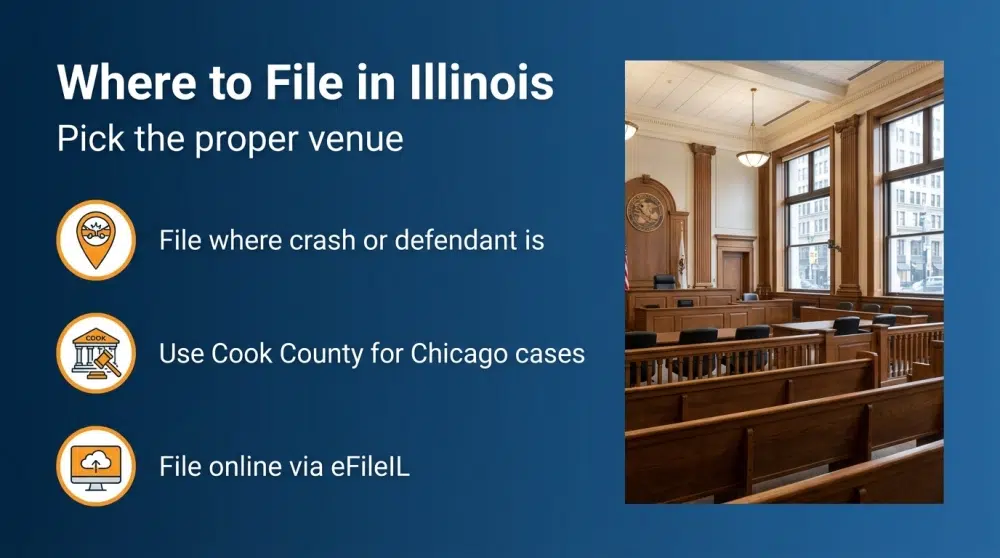
For crashes in the collar counties around Chicago including DuPage, Lake, Kane, Will, or McHenry cases are filed in the circuit court of the relevant county. A crash on I-88 near Naperville would typically be filed in DuPage County Circuit Court if both parties are from that area. Proper venue is an important procedural consideration that can affect how efficiently a case moves through the system.
Illinois also has an optional arbitration program for civil cases that meet certain criteria. Under the circuit court’s mandatory arbitration rules, personal injury cases within the court’s arbitration jurisdictional threshold may be routed through arbitration before proceeding to trial. This is handled through the Circuit Court of Cook County’s civil division and can be a faster path to resolution for cases that qualify. Our knowledge base article on Illinois personal injury arbitration: what it is and how it works covers this process in more detail.
Why Should You Act Well Before the Deadline?
The two-year deadline is the outer limit, not the optimal time to start. Acting early matters for several practical reasons that have nothing to do with the legal technicality of the limitations period itself.
What Evidence Is at Risk of Disappearing After a Chicago-Area Crash?
Physical and digital evidence from car accidents deteriorates or disappears rapidly. Consider what is at stake after a crash on the Kennedy Expressway in rush-hour traffic or a rear-end collision at a congested interchange on I-94:
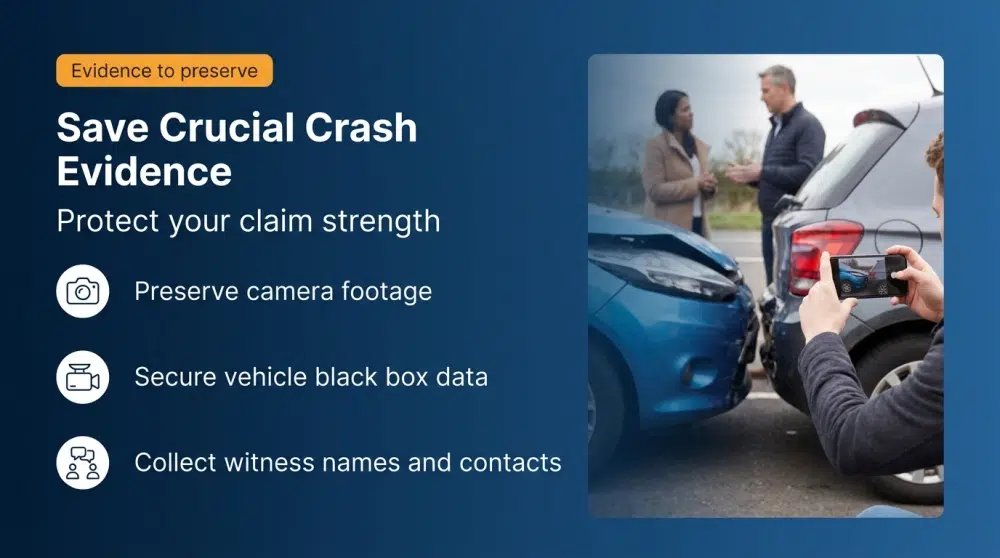
- Traffic and surveillance camera footage – Cameras operated by IDOT, the Chicago Department of Transportation, and private businesses typically overwrite footage within 30 to 90 days unless formally preserved through a litigation hold or subpoena.
- Vehicle event data recorders (black boxes) – Data from onboard computers capturing speed, braking, and steering inputs can be overwritten or lost if the vehicle is repaired or totaled quickly.
- Physical road evidence – Skid marks, debris patterns, and road hazards at the scene fade or are cleared within days.
- Witness memories – People who saw the crash remember details more clearly in the days after it occurs. Delay makes witness testimony less reliable and harder to corroborate.
- Medical causation – A continuous chain of medical treatment beginning right after the crash strengthens the causal link between the collision and your injuries. Gaps in treatment can be used by insurance adjusters to argue that your injuries were pre-existing or unrelated.
Illinois sees a significant number of serious traffic crashes each year. According to the Illinois Department of Transportation, there are tens of thousands of injury crashes annually on Illinois roads, with Cook County including the Chicago metro area consistently accounting for the highest share. [12] Heavy traffic volumes on routes like I-55 through the South Side, I-290 on the West Side, and Lake Shore Drive through Lincoln Park mean that crashes happen in conditions where evidence can be quickly disrupted by subsequent traffic or road clearing operations.
What Are the Risks of Waiting Too Long to Consult an Attorney?
Waiting significantly reduces your options. Insurance companies on the defense side begin investigating crashes immediately. Adjusters may contact you early, hoping to obtain recorded statements or quick settlements before you understand the full extent of your injuries or your legal rights. If you accept a settlement before consulting with personal injury lawyers, you likely sign a release that ends your ability to pursue further compensation even if your injuries turn out to be more serious than initially apparent.
The injured need the full benefit of their legal rights. Acting promptly after a car accident in Illinois gives you the opportunity to gather and preserve evidence, receive a full assessment of your injuries and their long-term consequences, and negotiate from a position of knowledge rather than urgency.
How GoSuits Chicago Helps Illinois Injury Victims
If you were hurt in a car accident anywhere in Illinois whether on the Dan Ryan, the Eisenhower, or a neighborhood street in Waukegan or Elgin, the filing deadline is real, and the window closes without warning. A free consultation with our Chicago personal injury attorneys can help you understand exactly where you stand, what evidence needs to be preserved, and what your claim may be worth before you make any decisions about dealing with insurance adjusters on your own.
GoSuits is a technology-forward personal injury law firm with 30 years of combined legal experience across our attorneys. We serve clients throughout Illinois, California, and Texas. Our Chicago personal injury team handles car accident injury claims, fatal crash wrongful death cases, and the full range of injury litigation that arises from traffic crashes across Cook County and the surrounding collar counties.
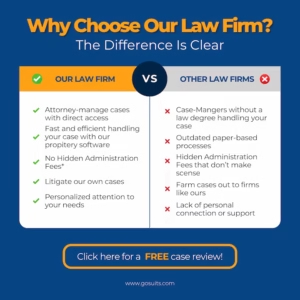
What sets our approach apart is proprietary case management software built specifically for personal injury litigation. Our technology accelerates the documentation, investigation, and demand phases of a case without sacrificing the personal attention that every injured client deserves. Unlike firms that route clients through case managers, every GoSuits client has a designated attorney with direct, unfettered access to that attorney throughout the case. You will always know who is handling your matter and how to reach them directly.
Our attorneys bring genuine trial experience to every case we take. Insurance companies evaluate claims based on whether the opposing counsel will actually take a case to trial. Our trial background gives us meaningful leverage at the settlement table, and when a fair resolution cannot be reached, we are prepared to litigate. You can review our prior cases to see the results we have achieved for real clients, or learn more about our attorneys and their backgrounds.
Our practice areas for Illinois clients include car accident claims, truck crash litigation involving commercial vehicles on I-94 and I-290, wrongful death claims following fatal crashes, motorcycle accident cases, and a range of other personal injury matters. You can view our full list of practice areas or learn more on our about us page.
Time matters after a crash. If the two-year deadline is approaching, or if you simply want to understand your rights before making any decisions, we encourage you to reach out. Schedule a free consultation with our Chicago team today and let us review your situation at no cost and no obligation to you.
References and Resources
- Statute of Limitations – Legal Information Institute, Cornell Law School
- 735 ILCS 5/13-202 – Actions for Damages (Two-Year Personal Injury Limitation) – Illinois General Assembly
- Circuit Court of Illinois – Illinois Courts
- 735 ILCS 5/13-205 – Five-Year Limitation (Property Damage) – Illinois General Assembly
- 740 ILCS 180/ – Illinois Wrongful Death Act – Illinois General Assembly
- 745 ILCS 10/ – Local Governmental and Governmental Employees Tort Immunity Act – Illinois General Assembly
- 705 ILCS 505/ – Court of Claims Act – Illinois General Assembly
- 735 ILCS 5/13-211 – Minors and Persons Under Legal Disability – Illinois General Assembly
- 735 ILCS 5/13-208 and 5/13-215 – Absence from State; Fraudulent Concealment – Illinois General Assembly
- Discovery Rule – Legal Information Institute, Cornell Law School
- 735 ILCS 5/2-1116 – Modified Comparative Fault – Illinois General Assembly
- Illinois Highway Safety Crash Data and Statistics – Illinois Department of Transportation