- What Is a Facilitation Hearing in an Auto Accident Case?
- How Does Facilitation Differ from Mediation and Arbitration?
- What Happens Step by Step During a Facilitation Hearing?
- What Should Plaintiffs Know Before Entering Facilitation?
- What Should Defendants and Insurers Know About Facilitation?
- How Does California Approach Auto Accident Dispute Resolution?
- How Does Texas Handle Facilitation in Car Accident Cases?
- What Are the ADR Options in Illinois for Injury Disputes?
- How Do Insurance Disputes Affect the Facilitation Process?
- What Role Does Personal Injury Settlement Negotiation Play?
- What Happens If Facilitation Fails to Produce a Settlement?
- Why Does Legal Representation Matter in Facilitation Hearings?
- How GoSuits Can Help with Your Auto Accident Dispute
- References & Resources
What Is a Facilitation Hearing in an Auto Accident Case?
If you have been injured in a car crash and your claim is disputed, the words “facilitation hearing” may come up early in the process. Put simply, a facilitation hearing is a structured, non-binding meeting where a trained neutral third party, called a facilitator, guides the injured party, the at-fault party, and their respective insurers toward a resolution without going to trial. [1]
Think of facilitation as one branch on the bigger ADR tree. ADR being alternative dispute resolution, in case the acronym hasn’t sunk in yet. California’s Judicial Branch officially treats it as a kind of settlement conference, where both sides meet with a neutral officer who helps them honestly look at what’s strong and what isn’t, then nudges them toward an agreement. [2] And the federal courts, more or less, group it the same way. [3]
Unlike a courtroom hearing, facilitation takes place in a private setting. You are not under oath in the same formal sense as at trial, no judge issues a ruling, and nothing you say in the session can typically be used against you later in litigation if talks break down. That confidentiality is one reason personal injury lawyers value it as a first step before filing a lawsuit or advancing deep into civil discovery.
In Irvine and throughout Orange County, facilitation hearings in auto accident cases frequently take place before a case is formally set for trial at the Orange County Superior Court. Whether your collision happened on the I-405 near the Irvine Spectrum, on SR-55, or on SR-73 heading toward Newport Beach, the claim will likely move through this phase if the at-fault driver’s insurer contests the extent of your injuries or the dollar value of your losses.
How Does Facilitation Differ from Mediation and Arbitration?
Many people use the terms “facilitation,” “mediation,” and “arbitration” interchangeably, but they are distinct processes with important legal differences.
What is mediation in car accident cases?
In mediation, both parties use an impartial mediator who actively tries to craft a settlement they can both accept. [2] The mediator does not decide the case; the mediator helps communication flow and tests each side’s positions. In facilitation, the facilitator plays a similar role but often has a narrower mandate: keeping the conversation productive and structured rather than deeply evaluating legal merit. In practice, many personal injury practitioners use the terms interchangeably for pre-trial settlement sessions, and the distinction can blur depending on the rules of the court or program involved.
What is arbitration, and how binding is it?
Arbitration is more formal. A neutral arbitrator hears arguments and evidence, then issues a decision. Binding arbitration means you cannot appeal the outcome, even if you disagree. Non-binding arbitration allows either party to reject the decision and proceed to trial. [2] Unlike facilitation, arbitration produces a decision; facilitation only produces a settlement if both parties voluntarily agree.
Our knowledge base article on mediation vs. arbitration in personal injury cases explores those differences in greater depth if you want to understand how each process might apply to your situation.
Where do settlement conferences fit in?
Settlement conferences, especially mandatory ones, are often ordered by a judge as a case approaches trial. [2] They resemble facilitation but carry more court oversight. In some California superior courts, including those handling Orange County civil cases at the Central Justice Center in Santa Ana, a judge or settlement officer runs the conference directly. The goal is the same: reach an agreement that avoids the cost and uncertainty of a jury trial.
What Happens Step by Step During a Facilitation Hearing?
Understanding the flow of a facilitation hearing removes much of the anxiety surrounding it. Here is what you can generally expect from start to finish in a civil auto accident dispute.
Who arranges the hearing and when?
Facilitation is usually initiated in one of three ways: voluntarily by both parties before a lawsuit is filed, by agreement of counsel after a lawsuit is filed but before trial, or by court order as part of mandatory ADR programs. California law actively encourages ADR at every stage of civil litigation to reduce the burden on trial courts. [4] In Texas, the Civil Practice and Remedies Code contains provisions for alternative dispute resolution proceedings, including facilitation-style processes, that judges may order or parties may elect. [5]
What documents do you need to bring?
Before the session, both sides typically exchange pre-facilitation briefs summarizing their legal positions, supporting evidence, and damages calculations. For the injured party, this usually includes:
- Police and accident reports documenting the crash scene
- Medical records and billing statements showing treatment history and cost
- Wage loss documentation if the injury kept you out of work
- Photos and video evidence from the scene and aftermath
- Expert opinions on fault, causation, or future care needs
For the defense side, the insurer or at-fault driver typically submits a demand package response, often questioning liability, the severity of injuries, or the reasonableness of claimed medical expenses.
How does the facilitation session itself unfold?
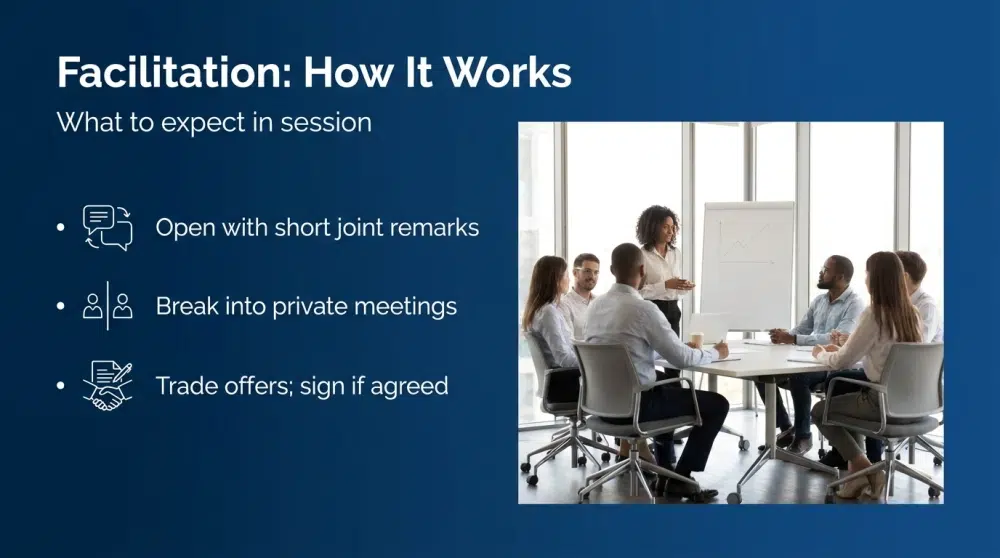
The facilitator typically opens with a joint session where both sides make brief presentations. Then the facilitator meets separately with each party in private caucuses. During caucuses, the facilitator probes the strength of each position, encourages realistic thinking about risk, and ferries settlement offers back and forth. This shuttle-diplomacy structure lets people say things privately that they would not say face to face.
The personal injury settlement negotiation phase accelerates during caucuses, because the facilitator can share candid feedback that a party’s demand is above market, or that the insurer’s opening offer fails to account for the severity of documented injuries. If both sides reach a figure each can accept, a written settlement agreement is signed on the day, and the case typically concludes short of trial.
What Should Plaintiffs Know Before Entering Facilitation?
If you were injured in a rear-end collision on the I-405 in heavy afternoon traffic near Costa Mesa, or in a side-impact crash on Culver Drive in Irvine, the facilitation hearing is a pivotal moment for your claim. Coming prepared is not optional.
Is the opening demand set in stone?
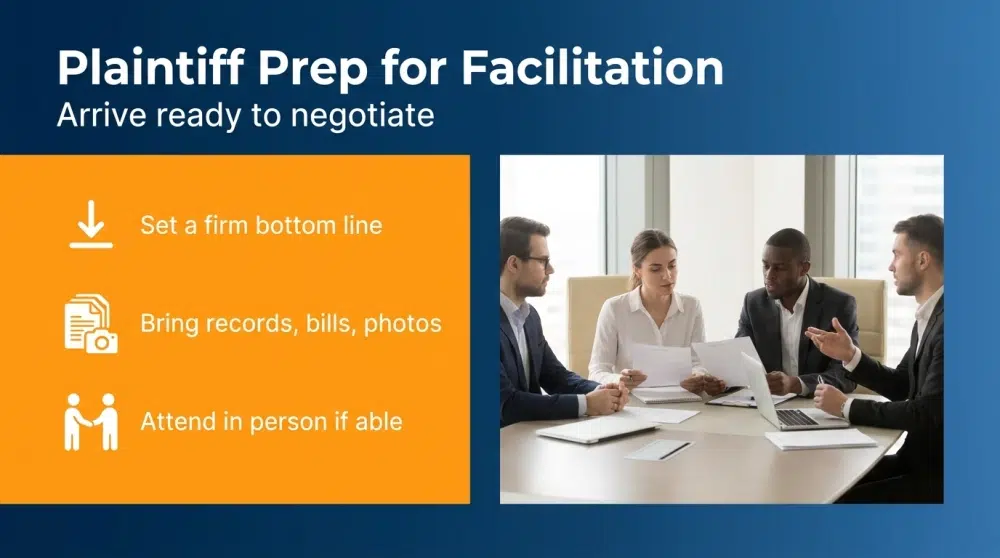
No. A facilitation hearing involves movement. If your attorney opens with a demand and the facilitator is skilled, expect that number to be challenged and questioned. The facilitator’s role is not to validate your position; it is to pressure-test it. Your attorney should help you set a realistic but firm reservation number, which is the minimum you are genuinely willing to accept, before the session begins. You should not walk into facilitation without knowing that number.
What damages can be discussed at facilitation?
In California, plaintiffs may pursue economic damages such as medical bills, future care costs, and lost earning capacity, as well as non-economic damages for pain and suffering and loss of enjoyment of life. [6] Texas similarly allows recovery for both economic and non-economic losses in personal injury claims. [7] Illinois law follows the same general framework. [8] All of these categories are on the table during facilitation, and the facilitator will want both sides to address them clearly.
Should you attend in person?
In most auto accident cases, it is strongly encouraged for the injured party to attend rather than leaving it entirely to counsel. The human element matters: a facilitator who sees the plaintiff is more likely to convey to the insurer the genuine impact of the injury. Your presence also allows your attorney to consult you in real time as numbers evolve during the session.
What Should Defendants and Insurers Know About Facilitation?
Not every article on facilitation focuses equally on the defense perspective, but civil cases involve two sides, and understanding how insurers and at-fault defendants approach these hearings is important for anyone navigating a disputed car accident claim.
What authority must the insurer representative have?
One of the most common facilitation failures occurs when the insurance adjuster present does not have authority to settle above a certain dollar amount. Courts and parties expect that the representative who attends has meaningful settlement authority, not a nominal cap designed to prevent any real negotiation. Where a court orders facilitation, the order will usually require that a person with full settlement authority be present. [4]
Can defendants raise contributory fault defenses in facilitation?
Yes. One of the core defense strategies in facilitation is asserting comparative fault. In California, pure comparative negligence means that even a mostly at-fault plaintiff can still recover, but the recovery is reduced by their percentage of fault. [9] In Texas, the modified comparative fault system bars recovery if the plaintiff is more than 50 percent responsible. [10] Illinois applies a similar 51 percent bar. [11] These jurisdictional rules shape how aggressively each side litigates comparative fault as a lever in settlement talks.
What role do disputed injury claims play?
Disputed injury claims are among the most common reasons an insurer refuses an early settlement. An insurer may contend that the injuries predated the accident, that the treatment was excessive, or that the claimed pain and suffering is unsupported by objective findings. These arguments surface in facilitation. The plaintiff’s lawyer will typically have medical records, imaging reports, and sometimes expert letters ready to counter them. Knowing the insurer’s likely arguments in advance allows a prepared claimant to address them head-on during the session.
How Does California Approach Auto Accident Dispute Resolution?
California has one of the most developed ADR frameworks of any state. The Judicial Branch actively promotes ADR in civil cases through court programs, mediation panels, and judicial education. [2] The California Rules of Court, specifically Rule 3.891 and related provisions, establish mandatory settlement conferences for civil cases approaching trial in superior courts. [4]
In Orange County, cases filed in the Superior Court are frequently directed toward the court’s ADR program, which includes panel mediators who handle everything from fender-bender cases to serious accident injury disputes. If your case is pending at the Central Justice Center in Santa Ana, you should expect the court to inquire about ADR status at early case management conferences.
For cases with serious injuries caused by a collision in Los Angeles, such as a crash on the 405 freeway or on surface streets in downtown LA, the Los Angeles County Superior Court at the Stanley Mosk Courthouse has its own active ADR programs, and the court frequently orders mandatory settlement conferences. Cases across Southern California follow similar pathways through these programs before reaching trial.
If you are injured and working with car accident lawyers in Irvine, understanding the court’s ADR pathway allows your attorney to plan the timing of facilitation strategically. Initiating it before significant discovery costs accumulate can save both sides time and money.
How Does Texas Handle Facilitation in Car Accident Cases?
Texas has a statute devoted to alternative dispute resolution: Chapter 154 of the Civil Practice and Remedies Code. [5] It authorizes courts to refer cases to ADR proceedings, including mediation, mini-trial, moderated settlement conference, summary jury trial, and arbitration. What Texas calls a “moderated settlement conference” is functionally close to what other jurisdictions call a facilitation hearing.
Here’s the Dallas reality. Most car accident cases that go to the Dallas County District Court at the George L. Allen Sr. Courts Building pass through mediation or a settlement conference before trial. The metro sees a ton of collision litigation, particularly from crashes on I-635, I-35E, and US-75, the kind of corridors where stop-and-go traffic kind of cooks up rear-end and lane-change wrecks on a daily basis. Plano, Frisco, Carrollton, the rest of North Texas. Same court system, same playbook.
Texas also recognizes the importance of qualified mediators. The Texas Judicial Branch has adopted Ethical Guidelines for Mediators that apply to ADR proceedings in civil cases. [12] The facilitator’s neutrality and professional standards are meant to give both parties confidence that the process is fair.
Injured Texans looking for personal injury lawyers who know their way through the Dallas court system will want counsel that understands both the substantive law governing their claims and the procedural norms of local ADR programs.
What Are the ADR Options in Illinois for Injury Disputes?
Illinois courts also actively promote alternative dispute resolution. The Illinois Supreme Court has authorized and encouraged the use of ADR, including arbitration and mediation, in civil cases. [3] Cook County, where Chicago-area injury cases are typically filed, operates mandatory arbitration programs for many civil disputes under a certain dollar threshold, along with voluntary mediation for higher-value cases.
Cook County doesn’t really let you skip ADR. File at the Richard J. Daley Center and you’ll bump into the arbitration program pretty quickly. A lot of civil cases have to clear an arbitration hearing before they’re eligible for a jury trial, which kind of works as an early neutral evaluation. Sometimes the case ends right there. Sometimes it just sharpens what’s actually still being fought over before trial prep gets serious.
Voluntary mediation tends to show up when the dollar figures get scary. Think serious injury cases out of the Dan Ryan, the Kennedy, or a wreck on Lake Shore Drive, where there’s just too much at stake to leave it to the mandatory arbitration track. Chicago-area personal injury lawyers reach for seasoned mediators on these regularly, especially for high-value auto disputes, wrongful death claims, and truck accident files that nobody wants to take all the way to a jury.
Some injuries don’t heal. Illinois law gets that, and when a collision leaves someone permanently disabled or worse, a case can involve both personal injury and wrongful death lawyers at the same time. Both claim types can still be worked through facilitation or mediation, which honestly matters a lot for surviving family members. It lets them take part in a process that respects what they’ve lost without dragging them through the whole length of a jury trial.
How Do Insurance Disputes Affect the Facilitation Process?
In nearly every disputed auto accident case, the real dispute is between the injured party and the at-fault driver’s insurance company. The insurance dispute resolution process shapes the entire facilitation dynamic in important ways.
What if the insurer denies coverage altogether?
If an insurer has issued a denial of coverage to its own policyholder, the facilitation dynamic becomes more complex. The at-fault driver may have limited personal assets, and the path to recovery narrows. In those situations, your own uninsured or underinsured motorist coverage may be central to the claim. That means your own insurer becomes a party to the negotiation, which changes the facilitation structure entirely.
What if the insurer acts in bad faith?
California has robust bad faith insurance law that imposes duties on insurers to promptly investigate and fairly evaluate claims. [13] An insurer that stonewalls legitimate claims or makes unreasonably low offers without conducting a proper investigation may face liability beyond the policy limits. That exposure often changes an insurer’s calculus in facilitation. When claimants are working with experienced personal injury lawyers who have a track record of taking cases to trial, the insurer is more likely to engage meaningfully in facilitation rather than offering nominal sums.
What about disputed liability claims?
When fault is genuinely uncertain, for example, in a multi-vehicle crash with conflicting witness accounts, facilitation can be particularly valuable. Rather than spending years litigating comparative fault in depositions and at trial, the parties can explore a compromise allocation that reflects the uncertainty. This is not weakness; it is a practical recognition that every lawsuit carries risk for both sides, and resolution through facilitation often produces a faster, more certain outcome than gambling on a verdict.
What Role Does Personal Injury Settlement Negotiation Play?
Personal injury settlement negotiation is both an art and a science. The facilitation hearing is where that negotiation crystallizes under the guidance of a neutral third party. Before a case reaches that point, however, the negotiation groundwork must already be laid.
What is the demand letter, and why does it matter?
Most auto accident claims begin with a demand letter sent by the injured party’s attorney to the at-fault driver’s insurer. The letter summarizes the facts, establishes liability, documents the damages, and requests a settlement figure. The insurer’s response, either a counter-offer or a denial, sets the stage for whether informal resolution is possible or whether facilitation is needed. [14]
How does preparing for facilitation improve the settlement outcome?
When your attorney has fully documented your damages, obtained supporting expert opinions, and communicated clearly what you would need from a jury to win, the insurer understands that proceeding to trial carries genuine risk. That risk is what motivates meaningful participation in facilitation. Underprepared claimants, especially those without legal representation, often accept inadequate offers simply because they do not know what their case is actually worth or how to present it effectively.
Statistics compiled by the National Center for State Courts indicate that the vast majority of civil cases filed do not reach trial, with settlement resolving most disputes. [15] The facilitation hearing is one of the most important stages at which that settlement occurs. Going into it without skilled advocacy is one of the most costly decisions an injured person can make.
What Happens If Facilitation Fails to Produce a Settlement?
Not every facilitation hearing ends with a signed agreement, and that is acceptable. The process has value even when it does not immediately resolve the claim.
Does a failed facilitation affect the lawsuit timeline?
If facilitation was court-ordered, the court is usually notified that the session took place but not told what was said or offered. The case then continues on its normal litigation track. Discovery proceeds, depositions are taken, and the case may be set for trial. In some jurisdictions, a second facilitation session is ordered closer to the trial date once more information has been developed through discovery.
Does anything said in facilitation become part of the court record?
California Evidence Code Section 1119 provides broad protection for statements made during mediation and settlement conferences. [6] Texas and Illinois have similar protections under their respective ADR statutes. [5] The general principle is that candid, good-faith participation in facilitation should not be penalized by having statements used as admissions later. This protection is one of the key reasons both sides can speak more freely during facilitation than they could in a deposition.
Can partial agreements be reached?
Yes. Facilitation does not have to be all or nothing. Parties sometimes reach agreement on certain issues, such as stipulating to liability while leaving damages for later resolution, or agreeing on a figure for economic damages while medical treatment is still ongoing. Partial agreements can streamline subsequent proceedings and reduce the overall cost of the dispute even when full resolution is not immediate.
Why Does Legal Representation Matter in Facilitation Hearings?
It can be tempting to think that facilitation is informal enough to handle without a lawyer, especially if the insurance company seems cooperative. That impression can be costly.
Insurers employ experienced adjusters and defense counsel whose professional focus is minimizing payouts. They understand comparative fault doctrine, the range of verdicts in similar cases, and the leverage created by litigation costs. Facing that structure alone, without counsel who has navigated the same process repeatedly, places you at a significant disadvantage before the first offer is even made.
Moreover, signing a settlement agreement in facilitation is binding. Once signed, it typically releases the at-fault party and the insurer from all future claims related to the accident, even if your injuries later prove more serious than they appeared at the time of the session. Understanding what you are releasing, and ensuring the agreement contains appropriate protections, requires careful review by an attorney before you sign anything.
If you are injured and trying to understand what the facilitation process holds for you, connecting with personal injury lawyers is a critical first step. For anyone working with Irvine car accident lawyers or handling claims across Orange County, having knowledgeable counsel throughout the facilitation process can materially affect the outcome. Victims who face wrongful death claims following fatal collisions similarly benefit from representation by wrongful death lawyers who can bring both the personal injury and wrongful death dimensions of the case into a cohesive strategy for facilitation.
Across Texas, from Dallas county courtrooms to cases filed in the DFW metro area, the same principle applies. Facilitation without legal counsel is a risk that experienced attorneys consistently counsel against. The same holds in Chicago, where the circuit court ADR process rewards preparation and penalizes those who are not ready to present their claims effectively.
How GoSuits Irvine Helps With Auto Accident Dispute Resolution
If you are dealing with a disputed injury claim after a car accident, the facilitation hearing is not just a procedural step; it is an opportunity to resolve your case without enduring the full length and expense of a jury trial. But arriving at that opportunity without preparation, without experienced counsel, and without a clear strategy can turn a promising case into an inadequate outcome.
GoSuits is a technology-driven personal injury law firm serving clients across California, Texas, and Illinois. Our approach is different from traditional injury firms in an important way: we built proprietary software to manage and accelerate every stage of your case, from evidence collection and demand drafting through facilitation preparation and trial readiness. Our tools track claim details, deadline calendars, and document management with a precision that allows our attorneys to spend more time on strategy and advocacy rather than administrative overhead.
But technology is only part of what we offer. Every client at GoSuits works directly with a designated attorney throughout the entire case. You will not be handed off to a case manager or lost in a rotation of staff who do not know your file. You have direct access to your attorney, not filtered through layers of administrative staff. That relationship matters enormously when the facilitation session is approaching and the decisions you make carry real financial consequences.
Our attorneys bring over 30 years of combined experience representing injured clients across California, Texas, and Illinois. We have handled car accident cases, truck crash claims, rideshare accident disputes, and wrongful death matters at every stage, from pre-litigation demand letters through jury verdicts. That trial experience is not just a credential; it is a negotiating tool. Insurance companies and defense counsel know when they are across the table from attorneys who are prepared to try a case, and that preparation changes how they engage in facilitation.
Our prior cases reflect the depth of work we bring to each client’s matter. Our attorneys are trial-tested, strategically focused, and committed to protecting your rights through every step of the process. You can learn more about us and explore our full range of services under our practice areas.
Whether your case is rooted in Irvine, across Orange County, in the Dallas area, or in the Chicago metropolitan area, we are here to help you navigate the auto accident dispute resolution process with the preparation and advocacy your case deserves. If you are ready to talk through your situation, schedule a free consultation with our team today. There are no fees unless we recover for you.
References & Resources
- Alternative Dispute Resolution – Legal Information Institute, Cornell Law School
- ADR Types – Judicial Branch of California
- Alternative Dispute Resolution – United States Courts
- Alternative Dispute Resolution (ADR) – Judicial Branch of California
- Texas Civil Practice and Remedies Code Chapter 154 – Alternative Dispute Resolution Procedures
- California Evidence Code Section 1119 – Mediation Confidentiality
- Texas Civil Practice and Remedies Code Chapter 41 – Damages
- Illinois Compiled Statutes – Code of Civil Procedure
- Comparative Negligence – Legal Information Institute, Cornell Law School
- Texas Civil Practice and Remedies Code Chapter 33 – Proportionate Responsibility
- Illinois Code of Civil Procedure Section 2-1116 – Modified Comparative Fault
- Texas Rules and Standards – Texas Judicial Branch
- California Insurance Code Section 790.03 – Unfair Claims Settlement Practices
- Personal Injury Demand Letter FAQ – GoSuits Knowledge Base
- Civil Case Reform Research – National Center for State Courts