- What happened near El Toro High School in Lake Forest
- Who was involved, when it happened, and where
- Local agencies and records families can request in Orange County
- California law on e-motorcycles, licensing, registration, and street use
- Potential civil liability and wrongful death considerations
- Insurance realities after an e-motorcycle fatality
- Evidence to preserve and time sensitivity
- Community safety takeaways for South County neighborhoods
- Commentary from Gosuits Irvine Personal Injury Attorney
- References
What happened near El Toro High School in Lake Forest
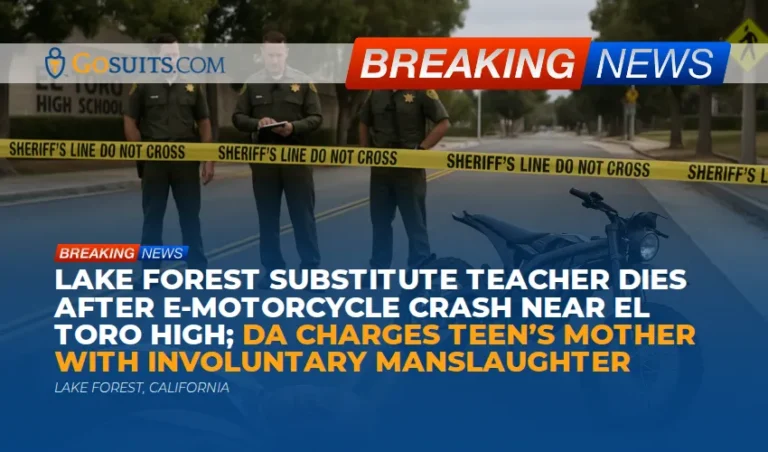
Deputies responded to a report of a pedestrian struck by an e-motorcycle around 4 p.m. on April 16 near El Toro High School in Lake Forest. According to witness accounts cited by prosecutors, a 14-year-old was riding an e-motorcycle and performing wheelies when the collision occurred. The rider allegedly fled the scene, and the pedestrian, an 81-year-old substitute teacher and Vietnam veteran, suffered life-threatening injuries and was hospitalized. After weeks in critical condition, the victim, identified publicly as Mr. Ed Ashman, died on Thursday. The Orange County District Attorney announced on Friday that charges against the boy’s mother were upgraded to include involuntary manslaughter, along with prior counts that included child endangerment and accessory after the fact.
Law enforcement located the teen rider soon after the incident at a nearby Lake Forest residence. Prosecutors stated the rider’s e-motorcycle was a 2025 Surron Ultra Bee. Based on a law enforcement inspection and the DA’s filing, it was categorized under California law as either a motor-driven cycle or a motorcycle for licensing and equipment purposes. These categories require a valid motorcycle license for street operation, registration, a license plate, insurance, and proper motorcycle safety equipment. Riders must be 16 or older and properly licensed for public road use in California [1] [2] [3] [4] [5].
Who was involved, when it happened, and where
Involved individuals
The pedestrian, 81-year-old substitute teacher Mr. Ed Ashman, had been walking home from his job at El Toro High School when he was struck. The rider was a 14-year-old from Lake Forest. The Orange County District Attorney also charged the rider’s parent, a 50-year-old Aliso Viejo resident, with multiple offenses.
Timeline
Authorities say the pedestrian was struck at about 4 p.m. on April 16. The victim died on Thursday several weeks later. On Friday, the DA filed an amended complaint adding an involuntary manslaughter count.
Location
The collision happened near El Toro High School in Lake Forest, a spot many South County residents know well, close to the afternoon school rush and neighborhood foot traffic typical around the campus. The teen rider was found at a nearby residence in Lake Forest. The arraignment for the parent is scheduled at the Harbor Justice Center in Newport Beach.
Local agencies and records families can request in Orange County
In the aftermath of a serious crash or wrongful death, families often need official records to understand what happened and to navigate funeral arrangements, benefits, or potential civil claims. Here are the main public records and support pathways available locally in Orange County. We list them here with plain-language descriptions; the formal source links are in the References section at the bottom.
Police report from the Orange County Sheriff’s Department
Lake Forest is served by the Orange County Sheriff’s Department. Families or legal representatives can request the traffic collision report and any supplemental reports from OCSD Records. These documents typically identify involved parties, list known witnesses, capture scene diagrams or photos when available, and note any citations or arrests. OCSD provides guidance and request procedures through its Records unit [12].
Autopsy and coroner documents
For deaths occurring under sudden or traumatic circumstances, the Orange County Sheriff’s Department Coroner Division manages examination and documentation. Next of kin can request copies of the autopsy report, coroner’s investigation narrative, and death certificate information. These documents can be important for insurance claims and any resulting civil filings. The OCSD Coroner Division publishes instructions on eligibility, timing, and fees for record requests [11].

Victim compensation and support services
Eligible family members may seek help with certain expenses through the California Victim Compensation Board, commonly called CalVCB. Depending on eligibility, CalVCB may help with funeral and burial costs, counseling, and other covered losses not paid by another source. The application process and coverage categories are published by CalVCB [13].
Why these records matter
– Document what happened: Official reports fix details in time and help protect against later disputes over key facts.
– Support insurance or benefits claims: Insurers often require certified records, including death certificates or coroner determinations.
– Preserve legal options: Timely requests help ensure evidence is not lost and that filing deadlines can be evaluated against the known facts.
California law on e-motorcycles, licensing, registration, and street use
Many South Orange County residents have noticed a rise in e-bikes and e-motorcycles around Lake Forest, Aliso Viejo, Laguna Hills, and Mission Viejo. It can be confusing to tell what is legal to ride on public streets and what requires a license. California law makes important distinctions.
E-bikes versus motor-driven cycles and motorcycles
– Low-speed electric bicycles: California Vehicle Code section 312.5 defines three classes of low-speed e-bikes. These are treated differently from motor vehicles if they meet the statutory power, speed, and equipment limitations. Licensing and registration are not required for those e-bikes that fit the statutory definitions [7].
– Motor-driven cycle: Vehicle Code section 405 defines a motor-driven cycle as a motorcycle with an engine smaller than a specified displacement. Though smaller, it remains a motor vehicle with licensing, registration, insurance, and equipment requirements for street use [3].
– Motorcycle: Vehicle Code section 400 defines motorcycle. Where a powered two-wheeler exceeds e-bike thresholds, it may be classified as a motorcycle and must comply with all motorcycle requirements [2].
Minimum age and licensing
For public roads, riders of motor-driven cycles or motorcycles must be properly licensed. In California, an M1 or M2 motorcycle license requires riders to be at least 16 years old, meet testing or training requirements, and follow provisional restrictions for minors [1].
Registration, insurance, and equipment
Street operation of motorcycles and motor-driven cycles requires DMV registration, a visible license plate, compliant equipment, and valid financial responsibility through insurance. The DMV publishes motorcycle registration process steps and California’s required insurance minimums [4] [5].
Duties after a collision
Any driver involved in a crash resulting in injury or death has legal duties to stop, render aid, and exchange information under Vehicle Code section 20001. Leaving the scene can lead to serious criminal exposure, and it also becomes a key fact in related civil claims about fault and damages [6].
Pedestrian right of way basics
California law requires drivers to exercise due care for pedestrian safety. Vehicle Code section 21950 governs right of way in crosswalks and highlights a broader responsibility to reduce speed or take other action to safeguard pedestrians, regardless of who technically has the right of way at a given moment [8].

Potential civil liability and wrongful death considerations
When a fatal injury occurs, families often ask what civil remedies may exist. In California, a wrongful death claim allows eligible survivors to pursue civil responsibility against those whose negligence or wrongful conduct caused the death. Code of Civil Procedure section 377.60 identifies who may bring an action and section 377.61 addresses the measure of damages, which can include economic and non-economic components tied to the loss suffered by the family [9] [10].
Because this incident involved a 14-year-old rider allegedly operating a motor-driven cycle or motorcycle illegally on public streets, multiple civil theories could be examined.
Potential claims paths
– Negligence against the rider: The core question is whether the rider breached a duty of care to a pedestrian and thereby caused fatal injuries. Evidence such as witness statements, video, and physical scene data often guides that assessment.
– Negligent entrustment: A parent or adult who knowingly allows an unlicensed minor to operate a motor-driven cycle or motorcycle on public roads can face claims for negligent entrustment if that decision foreseeably leads to harm.
– Parental liability statutes: California law can impose civil liability on parents or guardians in certain scenarios. Vehicle Code section 17707 can impose liability on a person who signs a minor’s license application for the minor’s negligent driving. Even when no signed application exists, plaintiffs may still assert negligent supervision or negligent entrustment under common law, and Civil Code section 1714.1 addresses parental liability for a minor’s willful misconduct up to certain statutory limits [14] [15].
Wrongful death damages overview
Wrongful death damages are intended to compensate survivors for losses they suffer due to the decedent’s death. These may include the loss of financial support, household services, companionship, guidance, and more, as defined by statute and case law. California’s wrongful death framework is codified in the Code of Civil Procedure [9] [10]. Because this is a fatal pedestrian incident, families sometimes consult wrongful death lawyers to understand eligibility, damages categories, and procedural steps, and may also review options with wrongful death lawyers in Irvine to learn how local courts and juries have historically treated similar claims.
Insurance realities after an e-motorcycle fatality
Insurance coverage can become a complex puzzle when a powered two-wheeler is involved, especially for newer electric platforms like the Surron Ultra Bee. The street classification of the vehicle drives which policy may apply. If the device qualifies as a motor-driven cycle or motorcycle, coverage generally flows through a motorcycle policy rather than a homeowner’s or renter’s policy.
Common coverage questions
– Does the rider have a motorcycle policy? If yes, its bodily injury limits and exclusions matter. If no, the lack of required financial responsibility can complicate recovery. California publishes minimum financial responsibility requirements for motor vehicles; higher limits are common and can be important in catastrophic cases [5].
– Homeowner’s or renter’s insurance: These policies usually exclude motor vehicle operation away from an insured location. Some policies may contain narrow exceptions, but it is uncommon for them to cover street motorcycle use.
– Umbrella or excess coverage: Some families carry umbrella liability policies that can provide an extra layer of protection above underlying auto or motorcycle limits, subject to strict conditions and triggering rules.
– Uninsured or underinsured motorist benefits for the pedestrian’s household: If the victim’s household carried UM/UIM on an auto policy, those benefits sometimes apply to pedestrian injuries caused by a motor vehicle. Policy language governs, so it is important to read the declarations and endorsements closely.
Dealing with insurers
Insurance adjusters will move quickly to gather statements, lock in facts, and evaluate liability. Families often consult personal injury lawyers before giving recorded statements. What someone says to an insurer can be used later in ways that affect fault apportionment or damages. Locally, people also look to personal injury lawyers in Irvine when they want a South County perspective on insurer practices and courthouse norms around Newport Beach, Santa Ana, and surrounding venues.
Evidence to preserve and time sensitivity
Some of the most valuable proof in a fatal collision can disappear in days. Think about how many vehicles move through the area near El Toro High School each afternoon, how often businesses overwrite their camera footage, and how quickly social media posts get deleted. Documenting early matters. Our quick resources can help: see Irvine What Evidence To Save After a Fatal Accident for a focused checklist tailored to our local courts and claims practices.
High-impact evidence to look for
– Witness information: Names, phone numbers, and any photos or videos they captured.
– Nearby surveillance or school cameras: Cameras around campus perimeters, nearby intersections, or storefronts can clarify speed, evasive actions, and the rider’s conduct right before and after impact.
– Vehicle data and equipment: If the powered bike or motorcycle is recovered, preserve its state. Power settings, aftermarket modifications, and any device logs could be material.
– Medical and coroner records: Hospital charts, imaging, and the coroner’s findings tie injuries to mechanisms of trauma and timing. Requesting these promptly from the OCSD Coroner and providers can prevent delays [11].
Before contacting any insurance company
It is wise to speak with an attorney first to understand rights and obligations. Statements to an adverse insurer can be used against a claimant later. People sometimes consult motorcycle accident lawyers to evaluate whether to give a recorded statement, how to route medical authorizations, and how to manage contact from multiple insurers. For local context, families also look for motorcycle accident lawyers in Irvine to navigate South County practices and timelines.
Time-sensitive steps
– Request key records fast: OCSD collision reports and coroner documents can take time to process, and they drive next steps like insurance notifications and benefits applications [11] [12].
– Preserve digital evidence: Send preservation notices to nearby businesses and, if applicable, the school district for any external-facing cameras that might have captured the incident envelope.
– Organize benefits and support: Review eligibility for state victim compensation through CalVCB while civil decisions are still being evaluated [13].
When action cannot wait
– What to do: Gather the decedent’s full name, date of birth, dates of hospitalization, and incident details; request the OCSD collision report; initiate coroner records requests; and collect copies of any health records and funeral invoices. Keep a list of witnesses and leads for camera footage. If any insurer has already reached out, note the claim number and adjuster contact, but do not provide recorded statements until legal counsel has advised on strategy.
– Why act now: Some video retention cycles last only days. Witness recollection fades quickly. Agencies may need weeks to process requests, so the earlier you begin, the sooner you will have the documentation needed for benefits, insurance, and potential civil filings.
– Where this matters most: High-traffic corridors around El Toro High School, Trabuco Road, and Bake Parkway see constant turnover in vehicles and potential witnesses. Afternoon bell schedules and sports practices create a tight window for canvassing. Start with the businesses and community facilities that face the likely approach paths used by students and staff walking home.
If you want a step-by-step hit-and-run guide tailored to Orange County practice, see Irvine Hit and Run Steps That Protect Your Claim. If an insurer is already pressing for statements or medical authorizations, consider schedule a free consultation to understand options before responding.
Community safety takeaways for South County neighborhoods
Lake Forest and Aliso Viejo families know these streets well. After school, the sidewalks fill near El Toro High School, local parks, and neighborhood centers. Powered bikes and e-motorcycles bring new risks when used on public roads without proper licensing, registration, or safety equipment. Here are grounded takeaways that match what we see in South County neighborhoods.
For families
– Confirm your device’s legal status: Not all e-two-wheelers are e-bikes under California law. Some are actually motor-driven cycles or motorcycles, which trigger licensing, registration, plate, insurance, and full equipment requirements [2] [3] [4] [5].
– Set firm rules for street use: Riders under 16 cannot lawfully operate a motorcycle or motor-driven cycle on public roads. Keep powered rides off the street unless age, licensing, and equipment requirements are fully met [1].
– Helmet and visibility: Even when riding legally, high-visibility gear and compliant helmets reduce severe-injury risk.

For riders
– Slow near schools and parks: Afternoon foot traffic is heavy around campus perimeters, Lake Forest Sports Park, and nearby shopping centers. Approach intersections and driveways at safe speeds.
– Know your duties if a crash happens: Stop, render aid, and exchange information. Leaving the scene escalates legal exposure dramatically and can affect related civil outcomes [6].
For pedestrians
– Use predictable routes and crosswalks whenever possible: While the law protects pedestrians, visibility, timing, and route choice can still reduce risk. California’s right-of-way rules require drivers to exercise due care, but everyone wins with defensive awareness at the curb [8].
Commentary from Gosuits Irvine Personal Injury Attorney
Our hearts are with Mr. Ashman’s loved ones and the El Toro High School community. This piece is offered for general information, not as a directive about any individual case. Every set of facts is different, and the legal path depends on details only the official records and a thorough review can reveal.
From a civil injury perspective, the facts reported publicly raise classic questions about negligent operation, negligent entrustment, and parental responsibility in the context of powered two-wheelers that require licensing and insurance. When a death follows weeks after the initial impact, documentation from hospitals and the coroner helps connect the medical narrative to the incident timeline in a way that insurers and courts can fairly evaluate.
Insurance carriers and corporate defendants often move quickly after an incident to shape the record. That can include early outreach for recorded statements, sweeping medical authorizations, or attempts to steer conversations toward low liability and modest damages. When grieving families are still gathering the basics, that dynamic can put them at a disadvantage.
A free consultation helps people understand the sequence of steps, potential filing deadlines, and how to approach insurers without harming their position. It also provides a safe space to ask hard questions about damages, coverage layers, and the practical next moves for gathering proof, including scene video and witness statements.
References
- Motorcycle License – California DMV
- California Vehicle Code § 400 Motorcycle – California Legislature
- California Vehicle Code § 405 Motor-driven cycle – California Legislature
- Register your motorcycle – California DMV
- Insurance Requirements – California DMV
- California Vehicle Code § 20001 Duty to stop at accident – California Legislature
- California Vehicle Code § 312.5 Low-speed electric bicycles – California Legislature
- California Vehicle Code § 21950 Pedestrians’ rights and duties – California Legislature
- California Code of Civil Procedure § 377.60 Wrongful death – California Legislature
- California Code of Civil Procedure § 377.61 Damages in wrongful death – California Legislature
- Coroner Division – Orange County Sheriff’s Department
- Records Unit and Public Records – Orange County Sheriff’s Department
- California Victim Compensation Board – CalVCB
- California Vehicle Code § 17707 Liability of signer for minor’s negligence – California Legislature
- California Civil Code § 1714.1 Parental liability for minor’s willful misconduct – California Legislature