Legal Snapshot
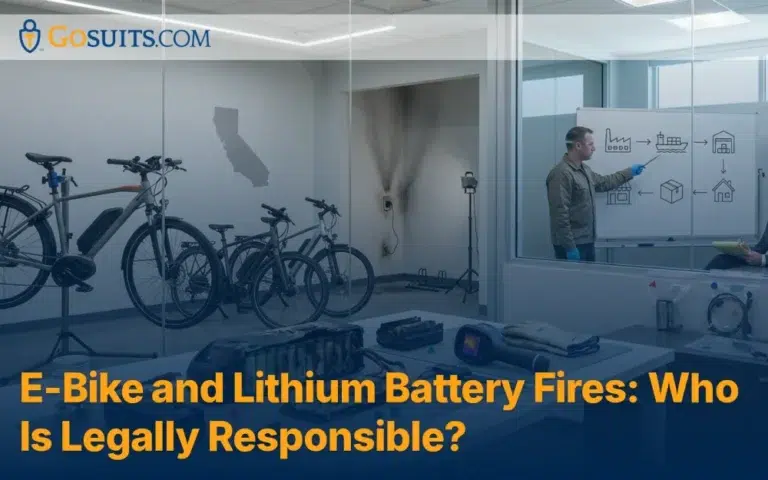
E-Bike and Lithium Battery Fires: Who Is Legally Responsible?
When an e-bike battery or charger ignites and causes an injury or property loss, California law allows an injured person to pursue a product liability claim against every commercial seller in the supply chain, including the manufacturer, importer, domestic distributor, and retailer, regardless of which party was directly at fault. The legal theory is strict liability, meaning you do not have to prove carelessness; you must prove the product was defective when it left the seller’s control and that the defect caused your harm. The classification of the e-bike under California Vehicle Code § 312.5 matters because it shapes where and how the bike may be used, which bears on foreseeable risk and the seller’s duty to provide a safe product and compliant charger.
How California Classifies Electric Bicycles Under Vehicle Code § 312.5
California Vehicle Code § 312.5, as amended effective January 1, 2025 by Stats. 2024, Ch. 791, Sec. 2 (SB 1271), divides electric bicycles into three classes. [3] Each class carries specific operating rules, and every manufacturer and distributor selling into California must permanently affix a label that states the classification number, top assisted speed, and motor wattage.
| Class | Common Name | Motor Assistance Rule | Top Assisted Speed |
|---|---|---|---|
| Class 1 | Low-speed pedal-assisted | Motor assists only while pedaling; cannot propel the bike exclusively (except start-assist or walk mode up to 3.7 mph) | 20 mph |
| Class 2 | Low-speed throttle-assisted | Motor may propel the bike exclusively without pedaling | 20 mph |
| Class 3 | Speed pedal-assisted | Motor assists only while pedaling; equipped with a speedometer; cannot propel the bike exclusively (except start-assist or walk mode up to 3.7 mph) | 28 mph |
A vehicle with a motor exceeding 750 watts, or one modified to exceed 20 mph on motor power alone, does not qualify as an electric bicycle under the code and may not be sold or labeled as one. [3] This matters in a fire case because a seller who markets a non-compliant device as a Class 2 e-bike may face liability both for the misclassification and for any defect in the battery or power system that caused the fire.
Classification also affects venue. Class 3 e-bikes are prohibited on certain bike paths and trails in California, and a rider who is injured while charging a Class 3 bike at a commercial rental location in the Irvine Spectrum or Newport Beach may face arguments about foreseeable use environments. Where the bike was charged and stored when the fire occurred is a relevant factual issue in every battery-fire case.
Why Lithium-Ion Batteries Catch Fire: The Physics Behind Thermal Runaway
Lithium-ion cells store large amounts of energy in a chemically reactive format. When a cell is damaged, overcharged, exposed to heat, or manufactured with an internal defect, the internal chemistry can enter an uncontrolled self-heating cycle known as thermal runaway. Thermal runaway can release combustible gases, cause cell rupture, and ignite surrounding materials. In an enclosed space, a garage, an apartment hallway, a storage room, the resulting fire can spread rapidly. [4]
Several conditions commonly trigger thermal runaway in e-bike batteries:
- Internal cell manufacturing defects: Microscopic impurities or thin separators introduced during cell production can cause internal short circuits. This is a manufacturing defect.
- Damaged or punctured battery packs: A crash, a drop, or repeated compression of the pack can deform cells and create the conditions for a short.
- Incompatible or counterfeit chargers: Using a charger that delivers voltage or current outside the battery management system’s rated range can overcharge cells. Counterfeit chargers, widely sold online, frequently lack the circuit protection required to stop charging when the pack is full.
- Absent or inadequate battery management systems (BMS): A properly designed BMS monitors cell temperature and voltage and interrupts charging before dangerous conditions develop. A battery pack without a functioning BMS, or with a BMS that fails to perform, removes the last line of defense against overcharge.
- Design defects in the pack architecture: Packing cells too tightly without adequate thermal management, or selecting cell chemistry poorly suited to the bike’s power demands, are design-level failures that affect every unit in the product line.
The distinction between a manufacturing defect (one bad batch of cells) and a design defect (every unit of that model is vulnerable) is important because a design defect claim can encompass an entire product line, whereas a manufacturing defect is typically tied to specific production units identifiable by serial number or date code.
Certification Standards That Apply to Compliant E-Bike Batteries and Chargers
Industry certification programs set minimum safety thresholds for lithium-ion batteries and charging systems sold in the United States. While California does not currently require by statute that every e-bike battery carry a specific certification mark, these standards are widely recognized benchmarks of reasonably safe design and are relevant to product liability analysis. [5]
- UL 2849 (Standard for Electrical Systems for E-Bikes): Published by Underwriters Laboratories, this standard addresses the complete electrical system of an electric bicycle, including the battery pack, motor, wiring, and charger interaction. A battery or charger that deviates from UL 2849 requirements without adequate justification may support a design defect or failure-to-warn claim.
- UL 2271 (Standard for Batteries for Use in Light Electric Vehicle Applications): Addresses cell-level and pack-level performance, including thermal runaway propagation and charging limits.
- UL 2594 (Standard for Electric Vehicle Supply Equipment): Relevant to charging systems used with e-bikes.
When a product is sold with a certification mark it has not actually earned, a practice sometimes called “false certification” or “counterfeit labeling” that misrepresentation can independently support a consumer protection or fraud theory in addition to a product defect claim. Both the Orange County Superior Court (Central Justice Center in Santa Ana) and the Los Angeles County Superior Court regularly see these issues in product liability filings. [AUTHORITY TO VERIFY: Specific reported decisions on e-bike false certification in California courts]
Our Irvine product liability lawyers and the broader team handling personal injury claims handle defective product cases in Orange County and throughout California. If a fire investigation reveals a non-certified battery pack or charger, that evidence is central to the legal theory.
Who in the Supply Chain Can Be Strictly Liable Under California Law?
California follows the strict liability framework established in Greenman v. Yuba Power Products, Inc., 59 Cal.2d 57 (1963), and later refined by the California Supreme Court. [1] Under that framework, every commercial seller in the distribution chain who placed the defective product into the stream of commerce may be held strictly liable to the injured person. Personal injury lawyers who handle these cases look at every identifiable entity in the chain. [6]
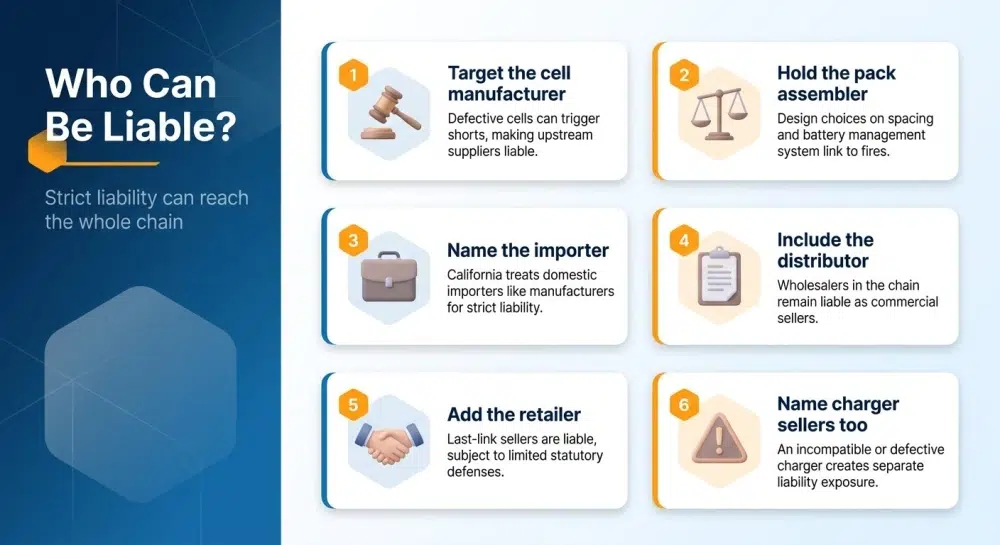
The parties who may face liability in an e-bike battery fire case typically include:
- The battery cell manufacturer: If individual lithium-ion cells are defectively manufactured, the company that produced the cells is potentially liable even though the cells were assembled by someone else into a larger pack.
- The battery pack assembler or e-bike manufacturer: The company that integrates the cells, BMS, and casing into a complete battery pack and installs it in the e-bike is responsible for design choices about cell spacing, thermal management, and BMS specification.
- The importer: When the manufacturer is overseas, as is common with many budget-priced e-bikes sold in the United States, the domestic importer who first places the product in commerce in this country steps into a role that California courts have recognized as equivalent to manufacturer for purposes of strict liability. [AUTHORITY TO VERIFY: Specific California appellate decision confirming importer strict liability in the e-bike context]
- The domestic distributor: A wholesaler who moves the product from importer to retailer is also within the chain.
- The retailer: The bicycle shop, sporting goods store, or online storefront that sells to the consumer is the last link and is generally strictly liable alongside the others. However, California Civil Code § 1714.45 provides retailers who are not also manufacturers with a conditional defense if the manufacturer is identified and amenable to jurisdiction. [7]
- The charger manufacturer and distributor: If the fire was caused by an incompatible or defective charger rather than the battery itself, the charger’s manufacturer and every seller in that product’s chain are independently subject to a strict liability claim.
The Practical Challenge When the Manufacturer Is Overseas
Many e-bike batteries and low-cost e-bikes are manufactured in countries where obtaining jurisdiction in a California court is difficult. Serving a Chinese manufacturer through the Hague Convention is time-consuming, and collecting a judgment against a foreign company can be practically impossible. When that is the case, the domestic importer and retailer often become the primary targets of the claim. If the importer cannot be identified or is also beyond reach, the retailer may bear sole or primary liability in practice, even though the defect originated upstream.
This underscores the importance of identifying every entity in the supply chain as early as possible and issuing litigation hold notices and evidence preservation demands before records are lost. This is one reason why promptly contacting a personal injury lawyer after a fire loss is important: supply chain records, import documentation, and product testing records can disappear quickly.
Online Marketplace Seller Liability: The Evolving Legal Question
A growing number of e-bikes and replacement batteries are purchased through large online marketplaces where the marketplace platform itself does not manufacture or take title to the goods. California courts have addressed whether a marketplace operator that facilitates the sale of a defective product can be held strictly liable as a seller.
In Bolger v. Amazon.com, LLC, 53 Cal.App.5th 431 (2020), the California Court of Appeal held that Amazon could be strictly liable as a seller in the distribution chain for a defective product sold by a third-party seller through its Fulfilled by Amazon program. [8] The court reasoned that Amazon’s role in the transaction, storing the product, processing the payment, and handling fulfillment was functionally equivalent to that of a traditional retailer, even though it did not hold title to the goods. The California Supreme Court declined to review that decision.
The practical implication for an e-bike battery fire victim who purchased the product online: the marketplace through which the sale occurred may be a defendant alongside the overseas manufacturer, even if the marketplace argues it is merely a conduit. This area of law continues to develop, and whether a given marketplace transaction triggers liability under Bolger depends on the specific terms of the seller’s agreement with the platform and the nature of the platform’s involvement in storage, fulfillment, and payment.
[AUTHORITY TO VERIFY: Post-Bolger California decisions addressing marketplace liability specifically for e-bike or battery products]
What Evidence Can Matter in an E-Bike Battery Fire Claim?
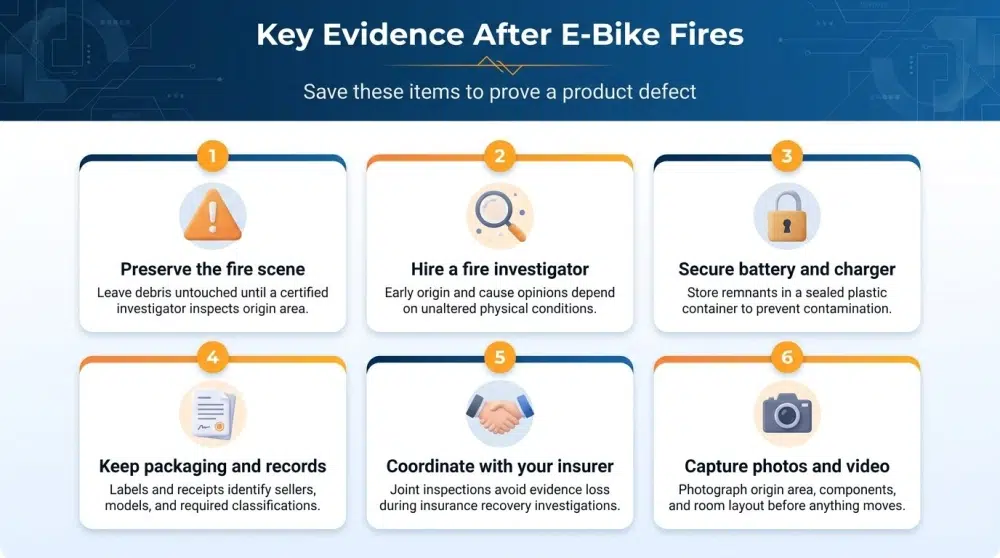
The physical evidence in a battery fire case is uniquely perishable. Fire investigation and legal teams must act quickly. [9] The categories that routinely matter include:
Preserve the Fire Scene
Before any debris is cleared, contact counsel who can retain a certified fire investigator with electrical or battery-fire expertise. The investigator must determine the fire’s origin and cause specifically, whether the burn pattern and physical evidence are consistent with an e-bike battery or charger as the ignition source. The investigator’s ability to render an opinion depends entirely on the condition of the scene.
Retain the Battery and Charger
The battery pack and the charger are the two most critical items of physical evidence. Even a severely fire-damaged battery can yield metallurgical evidence, cell remnants, BMS components, and wiring patterns that allow an expert to determine whether an internal cell defect, an overcharge condition, or a mechanical damage event initiated the thermal runaway. The charger may show evidence of counterfeit components or missing protection circuits. Both items should be placed in a sealed, non-metallic container and stored where they will not be further oxidized or contaminated. Do not discard them.
Retain the Packaging, Manual, and Purchase Records
The original product box, any labeling showing the required California Vehicle Code § 312.5 classification, the owner’s manual, and the charger’s specifications sheet all matter. They establish what the seller represented about the product’s safety rating and charging compatibility. Purchase records from the retailer or online platform establish who sold the product and when.
Coordinate With Your Property Insurer’s Subrogation Investigation
If a property insurer pays a claim for fire damage, the insurer will typically pursue its own subrogation investigation meaning it will seek to recover what it paid from the responsible manufacturer or seller. A property insurer’s fire investigator may be on scene before any other party. Injured persons and their counsel should coordinate immediately with the property insurer’s adjuster and investigator to ensure the physical evidence is jointly preserved, documented, and not released prematurely to any defendant.
If the property insurer’s investigator and the personal injury claimant’s investigator work at cross-purposes, or if the insurer releases the scene before adequate documentation is complete critical evidence may be lost. This coordination issue is one reason that injured parties benefit from retaining legal counsel promptly after a fire involving a suspected defective product.
Other Categories of Evidence
- Photographs and video: Document the fire origin area, the battery remains, the charger, and the layout of the room before anything is moved.
- Medical records: Burns, smoke inhalation, and trauma injuries from a fire are documented in emergency and follow-up records and form the evidentiary basis for injury damages.
- Fire department report: The fire department’s incident report and any supplemental investigation documents are public records that may provide early origin-and-cause information.
- Product registration and warranty records: These documents may identify the exact manufacturing lot, batch number, or serial number range associated with known defects.
- Recall and safety alert records: The Consumer Product Safety Commission (CPSC) maintains a recall database. A product recall involving the specific model or battery pack at issue can significantly strengthen a defect claim. [10]
- Manufacturer testing and quality-control records: In litigation, these records are obtained through discovery. They may reveal prior knowledge of thermal runaway risks or failed internal testing.
- Social media and online reviews: Other consumers’ reports of the same fire or overheating problem with the same product can support notice and design defect claims.
The evidence collected does not automatically prove liability; it provides the foundation for expert analysis. An origin-and-cause fire investigator and a battery engineer working together can connect the physical evidence to a specific defect theory. This work is necessary before any claim can be properly evaluated.
For a closer look at how to document physical evidence in a product defect case in Orange County, see our related knowledge-base article on exploding battery lawsuits involving e-bikes and scooters.
The Three Defect Theories and How They Apply to Battery Fires
California product liability law recognizes three categories of product defect. Each applies differently to battery fire claims:
Manufacturing Defect
A manufacturing defect exists when a specific unit departs from the product’s intended design. If a cell separator was too thin in a particular production run, or if contaminants entered the electrolyte during assembly, those units are defective even if the design itself was safe. A manufacturing defect claim is supported by evidence that other units from the same product line did not catch fire under similar conditions, and that the specific battery pack involved deviated from the manufacturer’s own specifications.
Design Defect
A design defect is present when the product is manufactured exactly as intended, but the design itself poses unreasonable risks. California courts apply two tests: the consumer expectations test (would a reasonable consumer expect the product to be safe under normal use?) and the risk-utility test (do the product’s benefits outweigh the risk of harm imposed by the design?). [11] If every unit of a particular e-bike model uses a battery pack architecture that lacks sufficient cell-level thermal protection, the entire product line may share the defect regardless of the individual manufacturing lot.
Failure to Warn
A seller who knows or should know of a latent danger that is not obvious to the user must provide adequate warnings and instructions. If the product’s manual does not warn against using third-party chargers, does not identify the specific charger models that are compatible, or does not explain the risk of leaving the battery on charge unattended, a failure-to-warn claim may arise independently of any defect in the battery itself. This theory is particularly relevant when the fire is traced to a charger problem rather than a cell defect.
How This Applies in a Real Case
Picture this one. Not a real GoSuits case, just a hypothetical. A condo resident near the Irvine Spectrum orders a Class 2 e-bike from some online marketplace, and it arrives with a charger. The owner’s manual? Pretty vague. It doesn’t really spell out that you should only use the included charger. So when the original one gets lost, the owner buys a replacement, listed as compatible on the same site. Seemed fine. Months later, that replacement charger overcharges the battery while the owner’s sleeping. Thermal runaway. The fire spreads, two units get damaged, and both the owner and a neighbor end up hurt.
In this scenario, potential defendants include: (1) the overseas e-bike manufacturer (if reachable); (2) the domestic importer; (3) the marketplace platform, potentially under Bolger v. Amazon.com, LLC; (4) the replacement charger’s manufacturer and importer; and (5) the retailer that listed the charger as compatible. Defect theories potentially include: design defect in the battery pack (inadequate BMS), failure to warn about charger compatibility, and manufacturing defect in the replacement charger itself. The property insurer for both condominium units would likely pursue subrogation. An origin-and-cause investigator would need to examine both the battery and the charger remnants before any debris is cleared.
What Damages or Remedies May Be Available?
The recoverability of any category of damages depends on the specific facts, the extent of injury, and applicable California law. A product liability claim arising from a battery fire may support claims for:
- Medical expenses: Emergency treatment for burns, smoke inhalation, and trauma; surgery; hospitalization; rehabilitation.
- Future medical expenses: Burns can require repeated surgeries, skin grafting, and long-term pain management. Future care needs must be documented through medical expert testimony.
- Lost income and loss of earning capacity: If injuries prevent the injured person from working, lost wages and, in severe cases, reduced future earning capacity are recognized elements of damages under California law.
- Physical pain: California allows recovery for subjective physical suffering.
- Mental anguish and emotional distress: Survivors of fires frequently experience post-traumatic stress disorder and other psychological injuries.
- Physical impairment and disfigurement: Significant burn scarring and impaired mobility are separately compensable under California law.
- Property damage: The destroyed bicycle, damaged structure, and destroyed personal property are recoverable. Property damage claims may be subrogated by the property insurer.
- Wrongful death damages: If a fire fatality occurs, California wrongful death attorneys may pursue claims by surviving family members under California Code of Civil Procedure § 377.60 et seq. for loss of financial support, loss of companionship, and related items. [12]
- Punitive or exemplary damages: Under California Civil Code § 3294, punitive damages may be available if the defendant acted with malice, fraud, or oppression. Evidence that a manufacturer knew of thermal runaway risks and concealed them, or continued selling a product after receiving consumer complaints of fires, could support a punitive damages claim. These are not available in every case and depend on a showing of conscious disregard for safety.
Whether injuries are fatal or non-fatal, victims of a defective e-bike battery fire in Orange County or anywhere in the Irvine area should consult a personal injury attorney who handles wrongful death claims, as both injury and death arising from the same event may need to be addressed in coordinated litigation.
What If Insurance Is Involved?
Multiple insurance policies may intersect in an e-bike battery fire case:
- Homeowner’s or renter’s insurance: May cover the property damage from the fire. The insurer that pays the claim typically acquires subrogation rights against the responsible manufacturer and sellers, meaning it can pursue its own lawsuit to recover what it paid.
- Health insurance or Medi-Cal: Medical insurers who pay treatment costs may assert liens against any personal injury recovery under California’s Hospital Lien Act and related statutes. These liens must be managed as part of the overall case resolution.
- Product liability insurance carried by the retailer or importer: These policies are the primary source of recovery when the foreign manufacturer cannot be served. Identifying and accessing the right policy layer is one of the early steps in resolving a product defect claim.
- Manufacturer’s recall or consumer product liability fund: If the CPSC has issued a recall, the manufacturer may have established a claims process. Accepting compensation through a recall program does not automatically waive a civil personal injury claim, but the interaction between recall settlement offers and civil litigation should be reviewed carefully.
How Long Do I Have to Act?
Here’s the deadline most people miss. California gives you two years from the date of injury to file a personal injury claim on a defective product, per Code of Civil Procedure § 335.1. [13] Property damage alone can stretch to three years under § 338, which is a kind of useful distinction when a fire wrecks the condo but nobody gets hurt. The clock usually kicks off on the date of the fire, or when the injury got discovered, or honestly when a reasonable person would have figured it out.
Several deadlines shorter than two years can apply in specific situations:
- Government entity claims: If the fire occurred at a government-owned facility or involved a government-managed product program, a government claim must typically be filed within six months of the incident under the Government Claims Act. Filing deadlines for government claims are shorter and can be missed if a claimant waits to consult an attorney.
- Wrongful death: The two-year limitations period also applies to wrongful death claims, generally running from the date of death.
- Insurance notice requirements: Property insurance policies typically require prompt notice of loss. Failure to notify promptly can give the insurer grounds to reduce or deny the claim.
Because evidence preservation is most effective in the days and weeks immediately after a fire, and because the statute of limitations can bar an otherwise valid claim if missed, early consultation with counsel is important. [DEADLINE REQUIRES LEGAL VERIFICATION for any government entity involvement or other tolling circumstances specific to a given case.]
What Should I Do Next?
If you were injured or suffered property loss in an e-bike battery or charger fire, the steps that most protect your legal position are:
- Seek immediate medical attention. Document every injury and follow up consistently with treating physicians.
- Do not disturb the fire scene. Contact legal counsel before the scene is cleaned, remediated, or repaired. Fire investigators need access to the origin area.
- Secure the battery and charger. Even heavily damaged, these items are the most important physical evidence in your case.
- Retain all purchase records, packaging, and documentation. Screenshot or print online purchase confirmations, marketplace listings, and any product specification pages.
- Notify your property insurer promptly. But before you speak with any insurer’s adjuster about the cause of the fire, understand that those statements can be used in litigation.
- Identify and preserve the product’s labeling. The California Vehicle Code § 312.5 classification label and any certification marks on the battery or charger are important.
- Consult a personal injury attorney. The supply chain complexity in battery fire cases, the involvement of multiple insurance carriers, and the evidence-preservation demands of an origin-and-cause investigation make early legal involvement important.
These cases are messy. An e-bike battery fire claim pulls in medical records, a full fire investigation, supply chain digging, insurance back-and-forth, and some pretty strict deadlines you can’t miss. If you got hurt in a fire somewhere in Irvine, elsewhere in Orange County, or anywhere around Southern California, a GoSuits personal injury attorney can walk through what happened and lay out what options you’ve actually got. Schedule a free consultation.
Talk With a GoSuits Attorney
An e-bike battery fire can result in severe burns, property destruction, and long-term medical needs. The legal issues involve multiple defendants across an international supply chain, specialized fire and battery engineering evidence, property insurer coordination, and strict deadlines under California law. If you or someone close to you was injured in Irvine, anywhere in Orange County, or in surrounding communities such as Costa Mesa, Newport Beach, or Santa Ana, a GoSuits personal injury attorney can review what happened and explain your legal options. There is no obligation and no fee unless your case is recovered upon.
References and Legal Authorities
- Greenman v. Yuba Power Products, Inc., 59 Cal.2d 57 (1963) – Justia
- Products Liability – Legal Information Institute, Cornell Law School
- California Vehicle Code § 312.5 (Amended by Stats. 2024, Ch. 791) – California Legislative Information
- Lithium-Ion Battery Fire Safety – National Fire Protection Association (NFPA)
- UL 2849 Standard for Electrical Systems for E-Bikes – Underwriters Laboratories
- Strict Liability – Legal Information Institute, Cornell Law School
- California Civil Code § 1714.45 (Seller’s Liability) – California Legislative Information
- Bolger v. Amazon.com, LLC, 53 Cal.App.5th 431 (2020) – Justia
- Fire Statistics – National Fire Protection Association
- Consumer Product Safety Commission Recall Database
- California Civil Code § 1714 (General Negligence and Products Liability) – California Legislative Information
- California Code of Civil Procedure § 377.60 (Wrongful Death) – California Legislative Information
- California Code of Civil Procedure § 335.1 (Two-Year Personal Injury Limitation) – California Legislative Information